.svg)
.svg)
.svg)


%201.svg)
April 2, 2026
The Link Building Playbook That Still Works in 2026: Earn Authority Without Paying for It
Link building has a reputation problem it does not entirely deserve. When most Australian marketing teams hear the term, they picture one of two things: the paid link schemes that Google has been penalising for years and that still circulate in the shadier corners of the SEO industry, or the outreach programmes that require significant labour that produce a handful of marginal links per month at a cost that makes the return on investment look questionable at best. Both of these pictures miss the methods that actually work in 2026, which share a common characteristic: they earn links as a byproduct of producing something valuable rather than acquiring them as a standalone purchase or extraction exercise. The distinction matters commercially because earned links are structurally different from purchased links. They tend to come from more relevant and more authoritative sources. They are more stable because they are not contingent on a payment being maintained. They are more likely to produce lasting ranking improvements because they represent genuine signals of editorial endorsement. And they are not a liability that sits waiting for the next Google spam update to detonate. This article covers the link earning methods that Australian businesses and their marketing teams can execute in 2026 to build domain authority through genuine editorial signals rather than purchases or schemes.


Email Template Design: Branded Newsletters That Work Across Email Clients
Designing a branded email newsletter is a fundamentally different challenge from designing a web page or a social media post, and the businesses that underestimate this difference pay for it every time a subscriber opens their email in Microsoft Outlook and sees a broken layout, missing images, or a design that looks nothing like the polished template it appeared to be in the design preview. The email rendering environment is genuinely fragmented in a way that no other digital channel is: a single email must render acceptably across dozens of email clients and applications that each interpret HTML and CSS differently, with Outlook in particular using a rendering engine based on Microsoft Word rather than a web browser, producing predictable failures in layout, font rendering, and background image support for any designer who approaches email HTML as if it were a web page. A email template that is well designed accounts for these differences from the first line of code, using a set of proven structural and styling patterns that produce consistent results across Gmail, Apple Mail, Outlook, Yahoo, and the mobile clients that account for a large and growing proportion of Australian email opens. This article explains the design and development principles that produce branded email newsletters that work reliably across every major email client, and identifies the specific failure modes that most commonly affect Australian business email programmes.

Call-Only Campaigns for Services: Phone Lead Generation Strategy
For many Australian service businesses, a phone call is more commercially valuable than a form submission. A caller has already committed to immediate, direct communication with the business, has typically made the decision to engage a provider rather than continuing to research options, and converts to a booked job or signed agreement at a significantly higher rate than a website visitor who fills out a contact form and waits for a response. Google Ads call-only campaigns are designed specifically for this conversion pathway. They are mobile search ads that display a phone number and a call button instead of a website link, so that when a searcher taps the ad they are connected immediately to the business rather than being directed to a landing page. For Australian trade services, professional services, healthcare providers, legal firms, real estate agents, and any service category where the sales process begins with a conversation, call-only campaigns deserve dedicated budget and careful management alongside or instead of standard text campaigns directed at website leads. This article covers the full setup, targeting, bidding, and tracking strategy for call-only campaigns in the Australian market in 2026.
PPC Landing Page Requirements: What We Need from Clients for Conversion Success
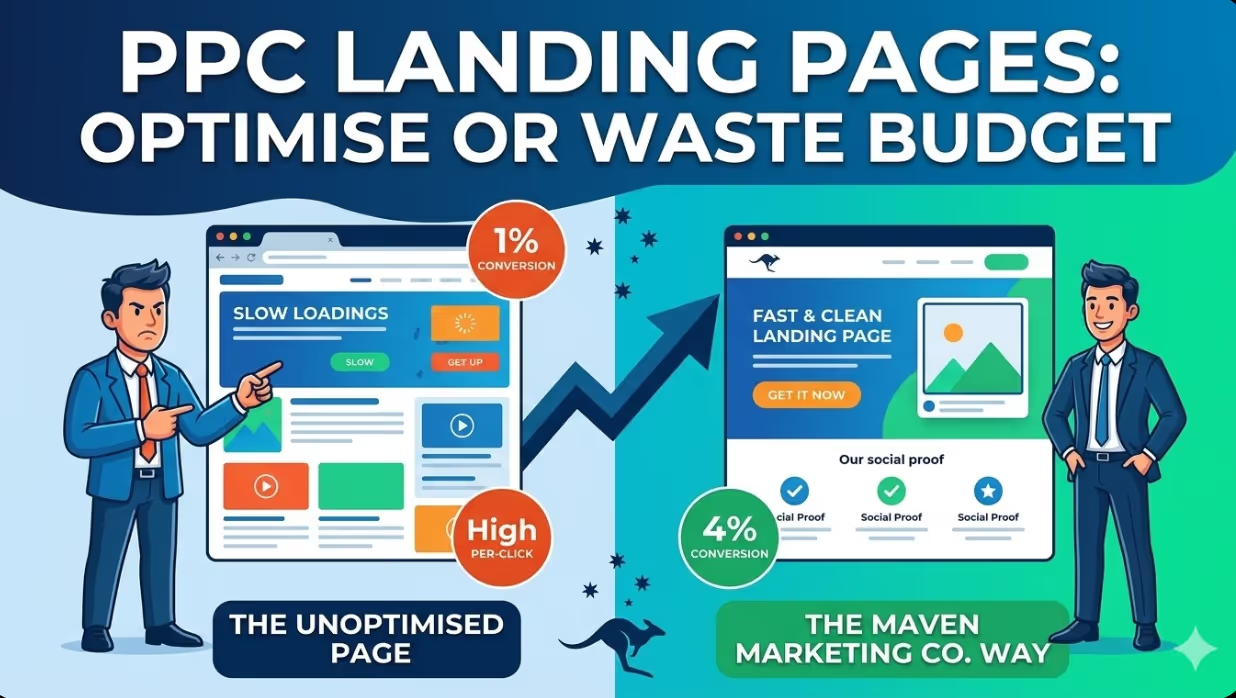
The most common preventable source of wasted PPC budget in Australian Google Ads accounts is not poor keyword selection, incorrect bidding, or insufficient negative keyword management. It is sending paid traffic to landing pages that are structurally incapable of converting it. A Google Ads campaign managed with precision and expertise cannot overcome a landing page that loads in eight seconds, presents a generic homepage rather than a page specific to the ad's promise, has no visible phone number, requires visitors to navigate through three pages to find a contact form, or places its only call to action below the fold of content that most visitors will not scroll through. When Maven Marketing Co takes on a new PPC client, we conduct a landing page assessment before the first dollar of paid traffic is directed anywhere. The assessment identifies pages that are ready to receive paid traffic, pages that need targeted improvements before activation, and pages that require a landing page built specifically for the campaign to be created before the campaign can be expected to perform at the standard the client requires. This article explains what we look for in that assessment, why each element matters for conversion performance, and what Australian businesses should prepare before briefing a PPC agency on a new paid search campaign.

Website Lead Generation Optimisation: Form Placement and CTA Strategy
Most Australian business websites have a contact form somewhere on a contact page and a button in the navigation that says "Contact Us." This is not a lead generation strategy. It is a passive facility for visitors who have already made the decision to reach out, and it produces enquiries at a rate that reflects how few visitors choose to make contact without prompting without any encouragement or direction from the site itself. A website that is genuinely optimised for lead generation treats every page as a conversion opportunity, makes the act of enquiring as frictionless as possible regardless of where a visitor is in the site, and designs its calls to action to match the intent and knowledge level of the visitor at each stage of their journey through the content. The gap in enquiry volume between a passively constructed website and one built with deliberate lead generation infrastructure is consistently significant for Australian service businesses, and the optimisation required to close that gap is primarily a matter of structure, placement, and message rather than design budget or platform. This article covers the principles and specific tactics that produce the most meaningful improvements in website lead generation performance for Australian businesses in 2026.

Mobile Responsive Testing: 12 Devices We Check Before Site Launch
Responsive design tools that run in the browser, including Chrome DevTools device emulation and every online viewport preview service, are useful for catching obvious layout problems during development but they are not a substitute for testing on actual hardware. The visual rendering, touch event handling, font smoothing, scroll behaviour, video playback, form input behaviour, and performance characteristics of a real device running a real operating system with real browser software produce a different result from what even the most accurate emulator can replicate. Australian websites that skip device testing before launch discover the discrepancies after they go live, usually through user complaints, analytics data showing high bounce rates on specific device and browser combinations, or accessibility reports identifying interaction failures that emulation did not surface. The twelve devices in Maven Marketing Co's testing set used before launch are selected to represent the range of operating systems, screen densities, browser engines, and input methods that Australian website visitors are most likely to be using in 2026. Each device tests something different, and a site that passes on all twelve has been validated against a realistic cross section of the Australian audience it will serve. This article explains which devices are in the set, what each one is specifically testing for, and what the most common failures are at each device category.

Google Analytics 4 Measurement Protocol: Server-Side Event Tracking
The JavaScript tag that powers standard Google Analytics 4 tracking has a weakness that is well documented: it runs in the browser, and anything that prevents the browser from executing it, whether that is an adblocker, a content security policy, tracking prevention built into the browser, or the simple absence of a browser in transactions between servers, creates a gap in the data. For Australian businesses whose revenue depends on accurate conversion tracking, that gap has real commercial consequences. Orders processed in the back end without a corresponding browser session, offline conversions that happen after the digital journey ends, events from mobile applications where web tags do not apply, and transactions that occur in audience segments with heavy adblocker use all represent data that the standard JavaScript implementation cannot capture. GA4's Measurement Protocol is the solution to this problem. It is an HTTP API that allows any system with the ability to make an HTTP request to send events directly to Google Analytics, bypassing the browser layer entirely. Tracking via the Measurement Protocol from the server restores the data completeness that browser constraints erode and enables event types that the JavaScript SDK cannot physically capture. This article covers the implementation of GA4 Measurement Protocol tracking for Australian development teams, from the authentication requirements and request structure through to the event parameters and debugging tools needed to validate the implementation.

BigQuery for Marketing: SQL Queries for Google Analytics 4 Data
The standard Google Analytics 4 interface is a capable reporting tool for the majority of marketing analysis tasks, and for most Australian businesses it covers the dimensions, metrics, and exploration tools needed for ongoing performance monitoring. But there is a category of marketing analysis that the interface cannot perform: analysis that requires joining GA4 data to external data sources, constructing custom attribution models across the raw event stream, building cohort analyses at the user level, or querying at the granularity of individual events and sessions rather than the aggregated summaries the interface presents. This is where BigQuery becomes essential. Google Analytics 4's native BigQuery export, available to all GA4 properties at no additional cost beyond BigQuery storage and query fees, sends the raw event data from every session to a BigQuery dataset where it can be queried with SQL, joined to CRM data, revenue data, and advertising data, and used to build analyses that the standard interface cannot construct. For Australian marketing teams with access to a SQL-capable analyst, the BigQuery export transforms GA4 from a reporting tool into a full analytical data warehouse. This article covers the foundational query patterns for marketing analysis on GA4 BigQuery data, with practical SQL that Australian teams can adapt for their own datasets.

SQL Query Optimisation: Database Performance for High-Traffic Sites
Database performance is the hidden variable in most Australian website performance problems. When a page loads slowly, the investigation tends to start with assets on the front end, server configuration, and caching layers, and these are legitimate places to look. But for sites generating substantial query loads through activity generated by users, ecommerce catalogues, content management systems, or dynamic search functionality, the database layer is frequently where the most severe and most persistent performance bottlenecks live. A page that makes twelve database queries to render, each taking 200 milliseconds because they lack appropriate indexes or contain inefficient join structures, will be slow regardless of how well the assets on the front end are optimised, how aggressively the CDN is configured, or how much RAM the server has. The good news is that SQL query optimisation consistently delivers some of the largest page load time improvements available in web performance work, because the gains from a single poorly optimised query can be dramatic: a query that takes 800 milliseconds without an index can often be reduced to under five milliseconds with one. This article covers the core SQL query optimisation techniques that produce the most significant performance improvements for Australian websites with high traffic, in the sequence a database performance investigation should follow.

Google Ads Bid Strategy Selection: Matching Automation to Business Goals
The selection of a bid strategy in Google Ads is one of the most consequential decisions in paid search management, and one of the least systematically made by Australian PPC practitioners. Most accounts arrive at their current bid strategy through a combination of platform recommendations, historical precedent, and the path of least resistance rather than through a deliberate assessment of what the campaign's commercial goal requires and whether the available conversion data can support the level of automation being applied. The result is a common and costly mismatch: accounts running target ROAS strategies with insufficient conversion volume for the algorithm to model accurately, campaigns on maximise clicks strategies that have long since accumulated enough data to benefit from conversion optimisation, and Performance Max campaigns set to target CPA objectives when the actual commercial goal is to maximise profitable revenue rather than minimise cost per lead. Each of these mismatches costs money in a way that is difficult to see in the standard metrics because the campaign appears to be optimising, just not toward the right objective. This article provides the framework for matching bid strategy to commercial goal, conversion data availability, and campaign maturity across the full range of Google Ads bid strategies available to Australian advertisers in 2026.
Shopping Campaign Restructuring: Fixing Underperforming Product Ads
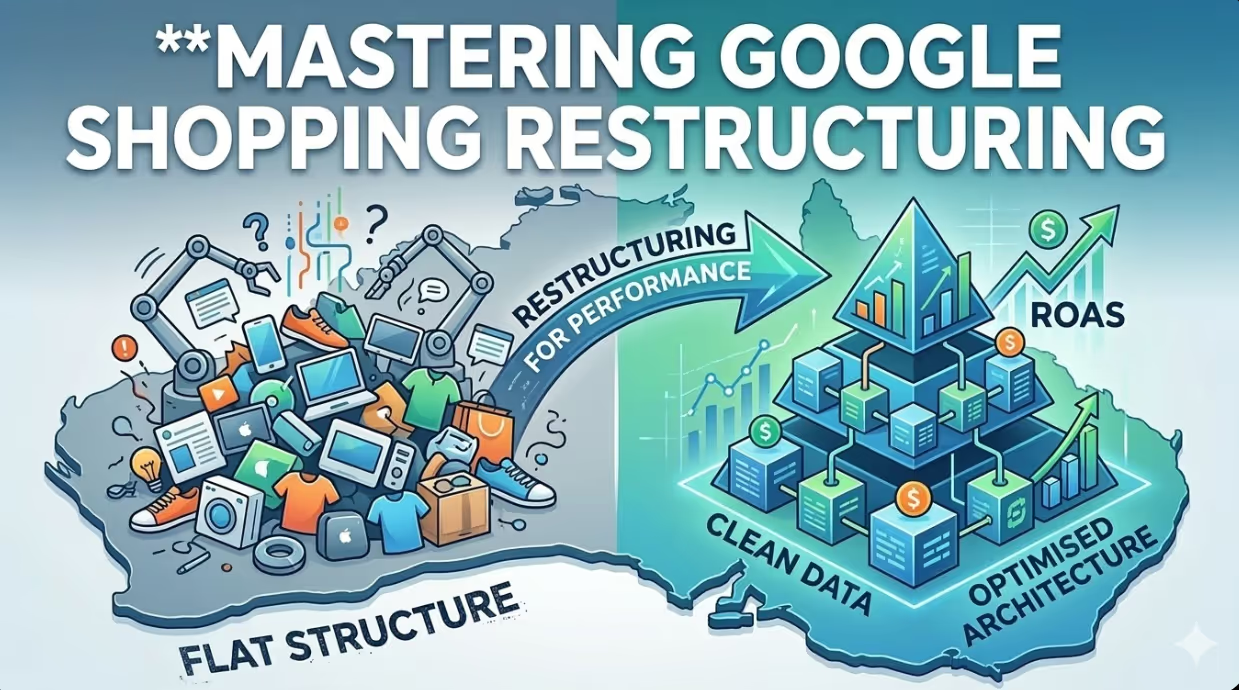
A Google Shopping campaign that is generating spend but not producing the revenue its budget should support is one of the most frustrating problems in ecommerce PPC management, because the surface metrics often look acceptable while the underlying structure is working against the account's commercial objectives. Impressions are steady, rates of clicks through look reasonable, and conversions are occurring, but the cost per sale is too high, the ROAS is below target, and the categories or products that should be driving revenue are being outbid by the ones that should not be receiving the budget at all. In most cases, the problem is not the campaign settings. It is the structure beneath them: a product feed that has not been optimised to give Google the product attribute quality it needs to match against the right queries, a campaign organisation that allocates budget uniformly across products with fundamentally different margins and conversion rates, and a bidding strategy that has been given either too little data or the wrong objective to produce results the business actually needs. Restructuring a Shopping campaign is not primarily a settings exercise. It is a systematic diagnostic process that identifies the specific structural, feed, and bidding problems preventing the campaign from performing and addresses them in the sequence that produces the fastest and most durable improvement. This article covers that process in the detail required for Australian ecommerce businesses to execute it effectively.

Google Ads Account Structure: Campaign Architecture for Different Business Models
The architecture of a Google Ads account determines the quality of the data it produces, the precision with which the bidding algorithm can optimise, and the ease with which a manager can identify performance problems and act on them. An account where campaigns have been added incrementally without a governing structural logic, where ad groups contain mixed intent keywords, where budgets are shared in ways that allow poorly performing campaigns to absorb spend from stronger ones, and where conversion tracking is configured too broadly to produce clean attribution data is not just inefficient. It is actively misleading, generating performance metrics that look adequate in aggregate but obscure the specific sources of value and waste that a thoroughly structured account makes immediately visible. Google Ads account structure is not a discipline that suits all situations. The right architecture for an Australian ecommerce business selling hundreds of products across multiple categories is fundamentally different from the right architecture for a local service business generating enquiries across two or three service lines. Understanding the structural principles that apply to each major business model type, and applying them before adding campaigns rather than trying to restructure an account after the fact, is among the activities with the greatest leverage in PPC management. This article covers the campaign architecture principles and recommended structures for four distinct Australian business model types.
Google Ads Negative Keyword Mining: Advanced Techniques Beyond Search Terms Report
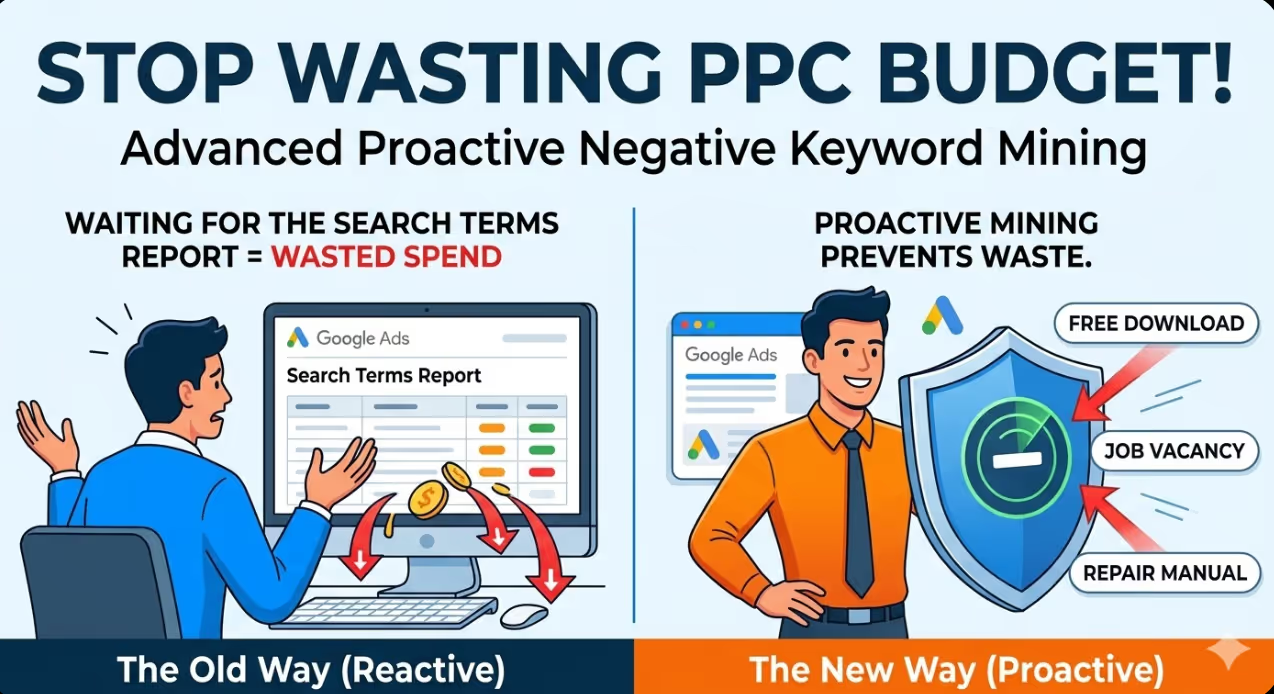
Most Australian PPC managers who actively manage negative keywords do so reactively: they open the Search Terms Report after spend has already been committed, identify queries that generated clicks without converting, and add them as negatives to prevent future waste. This reactive approach captures obvious problems after the damage is done, but it leaves the most significant sources of wasted spend untouched, because many of the queries that will drain budget from a campaign never appear prominently in the Search Terms Report until they have already accumulated meaningful spend. A proactive negative keyword strategy goes substantially further, mining for irrelevant query patterns before they enter the account through competitor analysis, industry terminology research, keyword expansion modelling, and a systematic analysis of the search intent landscape around every core keyword the account targets. The difference in wasted spend reduction between a reactive and a proactive approach to negative keyword management is significant in absolute dollar terms for most Australian PPC accounts, and the improvement in campaign efficiency that follows from eliminating irrelevant traffic compounds over time as the account's conversion signals become cleaner and the bidding algorithm is no longer optimising toward queries that were never commercially relevant. This article covers the full range of advanced negative keyword mining techniques that extend well beyond the Search Terms Report.