.svg)


%201.svg)
.avif)
Key Takeaways
- Negative keywords reduce wasted spend 25-40% by preventing ads from showing for irrelevant searches that consume budget without converting, with savings redirected toward profitable keywords
- Regular search term analysis is non-negotiable, requiring weekly review of actual search queries triggering ads to identify new negative opportunities before they drain significant budget
- Match type strategy matters critically with broad match negatives blocking variations (use cautiously), phrase match negatives preventing specific word order, and exact match negatives targeting precise queries
- Negative keyword lists organized by theme enable efficient management across campaigns, with shared lists for universal negatives (jobs, free, DIY) and campaign-specific lists for nuanced filtering
- Brand protection through negative keywords prevents competitors bidding on your brand terms whilst stopping your ads from showing for competitor names when their searches won't convert
Your Google Ads search term report reveals uncomfortable truth: 34% of your clicks came from searches completely misaligned with your business. Your premium plumbing service paid for 127 clicks from "DIY plumbing repairs" ($487 wasted on people explicitly avoiding professional services). Your commercial law firm received 89 clicks seeking "free legal advice" ($679 spent on prospects wanting exactly what you don't offer). Your Brisbane-based business funded 156 clicks from Sydney and Melbourne searchers ($812 spent on geographic mismatches impossible to serve).
These weren't marginal cases—they represented systematic budget drain from preventable targeting failures. Every wasted click funded irrelevant traffic whilst starving budget from profitable keywords actually driving qualified leads.
Melbourne digital marketing agency Rocket achieved $4,200 monthly savings through implementing comprehensive negative keyword strategy across their Google Ads account. They weren't reducing spend—they were reallocating wasted budget toward converting keywords. Lead volume increased 23% without budget increase as negative keywords filtered non-converting traffic whilst preserving qualified prospects.
Research examining Google Ads efficiency demonstrates that businesses implementing strategic negative keyword management reduce cost per acquisition 15-30% compared to accounts without systematic negative keyword hygiene, with savings directly improving campaign profitability.
.avif)
Understanding Negative Keywords: The Budget Protection Mechanism
Negative keywords prevent ads from displaying when search queries contain specified terms or phrases, filtering traffic before clicks occur and charges apply.
How negative keywords function:
When user searches Google, their query matches against both regular keywords (triggering ads) and negative keywords (preventing ads). If search contains negative keyword, ad doesn't show regardless of regular keyword match. This filtering occurs before auction, preventing wasteful bid participation. Budget preserves for searches without negative keyword triggers, concentrating spend on qualified traffic.
Sydney e-commerce retailer discovered their "running shoes" campaign triggered for searches including "free running shoes," "donate running shoes," "repair running shoes," and "running shoes drawing" despite selling new running shoes exclusively. Adding these as negative keywords immediately reduced irrelevant clicks 31% without affecting qualified purchase-intent traffic.
Common negative keyword categories:
Intent modifiers include "free," "cheap," "DIY," "how to make," "download," and similar terms indicating wrong purchase intent or stage. Brisbane software company selling $4,500 annual subscriptions added "free" as broad match negative, eliminating 340 monthly clicks from users seeking free alternatives. Job seekers terms like "jobs," "careers," "salary," "employment," "hiring" prevent recruitment searches triggering ads. Geographic mismatches filter locations outside service area through "Sydney," "Melbourne," "Perth" negatives for Brisbane-only businesses. Competitor names prevent ads showing when users search competing brands unlikely to convert. Informational queries including "what is," "definition," "meaning," "history" filter research searches without purchase intent.
Quality indicators like "review," "complaint," "scam," "lawsuit" attract reputation researchers rather than buyers. Educational content searchers using "course," "training," "tutorial," "learn" when selling finished services. Wrong product attributes such as "used," "refurbished," "replica" when selling new authentic products exclusively.
Search Term Analysis: Mining Negative Keyword Opportunities
Systematic search term review identifies actual queries triggering ads, revealing negative keyword opportunities preventing future waste.
Search term report analysis process:
Access Google Ads search term report through Campaigns → Keywords → Search Terms, showing actual queries that triggered ads. Adelaide accounting firm reviewing search terms discovered "free tax return" queries consumed 8% of monthly budget despite impossibility of converting unpaid service seekers. Filter by impressions, clicks, and cost identifying high-volume negative opportunities. Sort by cost descending reveals most expensive irrelevant terms draining budget fastest. Brisbane legal practice found single search term "free legal advice Queensland" cost $340 monthly across 23 clicks with zero conversions.
Red flag search patterns:
Zero conversion keywords receiving 20+ clicks indicate systematic mismatch requiring negative addition. High impression, low CTR combinations (under 1% CTR) suggest relevance problems where ads show but users recognize mismatch. Geographic terms outside service area appearing frequently reveal targeting gaps. Perth retailer discovered "Sydney" appeared in 12% of search terms despite Western Australia exclusive operations. Question keywords like "how to," "can I," "should I" often indicate informational rather than transactional intent.
Analysis frequency recommendations:
New campaigns require daily review first week identifying obvious negative opportunities quickly. Established campaigns with stable performance need weekly reviews catching new patterns before significant waste. Mature campaigns with comprehensive negatives can shift to bi-weekly analysis. However, seasonal businesses or those with dynamic offerings should increase frequency during high-volume periods. Melbourne travel agency reviews search terms daily during peak booking season (January-February) but weekly during slower periods.
Volume thresholds for negative addition:
Single click costing 50%+ of target CPA warrants immediate negative evaluation. Three clicks without conversion suggest systematic mismatch requiring action. Five+ clicks with zero conversions demand negative addition unless strategic reason exists. Sydney professional services firm uses "three strikes" rule—any search term generating three clicks without conversion automatically becomes negative keyword candidate for review.
.avif)
Match Types for Negative Keywords: Precision vs Protection
Negative keyword match types determine filtering breadth, with strategic selection balancing waste prevention against overly aggressive blocking that restricts reach.
Negative broad match prevents ads when search contains all negative keyword terms in any order, including variations. Most aggressive option blocking extensive queries. "Running shoes" as negative broad match blocks: "blue running shoes," "women's running shoes," "running shoes sale," "best shoes for running," but allows "running" alone or "shoes" alone. Use cautiously as variations may block legitimate traffic. Brisbane gym adding "contract" as negative broad match accidentally blocked "contract muscles" and "muscle contraction" searches relevant to fitness services.
Negative phrase match prevents ads when search contains exact phrase in specified order, allowing additional words before or after. "Free legal advice" as negative phrase match blocks: "free legal advice Brisbane," "get free legal advice," "free legal advice family law," but allows "legal advice" alone, "free consultation legal" (different word order), or "advice for free legal services" (words separated). Provides controlled filtering preventing specific problematic phrases.
Negative exact match blocks only the precise search query without variations. [running shoes] as negative exact match blocks "running shoes" exclusively, allowing "blue running shoes," "running shoe," "shoes for running." Least aggressive option requiring highest maintenance. Adelaide retailer uses exact match negatives for specific model numbers or SKUs they don't stock, blocking precise queries without affecting broader relevant traffic.
Match type selection strategy:
Broad match negatives work well for obvious universal exclusions like "free," "jobs," "porn." Phrase match serves most negative keywords, balancing protection with precision. Exact match handles specific problematic queries without risking legitimate traffic blocking. Melbourne marketing agency uses 70% phrase match, 20% broad match, and 10% exact match negatives in typical campaign structure.
Testing match type impact:
Add new negatives as phrase match initially, monitoring impression and click volume changes. If legitimate traffic declines, adjust to exact match narrowing scope. If irrelevant queries persist, consider broad match expansion. Perth legal firm added "cheap" as phrase match negative, discovered it blocked "affordable legal services" searches from budget-conscious qualified leads, and adjusted to exact match ["cheap lawyer"] specifically.
Building Comprehensive Negative Keyword Lists
Organized negative keyword lists enable efficient management across multiple campaigns through shared exclusions and campaign-specific filters.
Account-level shared negative lists apply universally across all campaigns, handling common exclusions every campaign requires. Create lists by theme for logical organization:
Universal exclusions list contains terms never relevant: "free," "gratis," "pirated," "torrent," "porn," "xxx." Job seekers list includes "jobs," "careers," "employment," "hiring," "salary," "wage," "recruitment," "job openings." Geographic exclusions lists locations outside service area: interstate cities, international locations. Competitor names list prevents ads showing for competitor brand searches unlikely to convert. Sydney agency maintains 47 competitor names as shared negative list applied to all campaigns.
DIY/self-service list filters searches indicating customers wanting to do-it-themselves: "DIY," "do it yourself," "how to," "tutorial," "instructions," "guide." Educational content list includes "course," "training," "certification," "learn," "study," "degree." Brisbane software company's educational list prevents ads showing to people seeking training about their product category rather than purchasing software.
Campaign-specific negative lists handle nuanced exclusions relevant to particular offerings. Premium product campaigns exclude "cheap," "affordable," "budget," "discount" whilst budget campaigns welcome these terms. Service area campaigns include competing suburbs or cities. Product-specific campaigns exclude incompatible attributes—"Android" negative in iOS app campaign.
List management workflow:
Start with 50-100 universal negatives from industry research and competitive analysis. Review search terms weekly adding 5-15 new negatives from actual queries. Audit negative lists quarterly removing outdated exclusions that may now be relevant. Document reasoning for non-obvious negatives preventing future confusion. Adelaide manufacturing firm documents each negative addition with note like "blocks student research queries, no purchase intent" enabling future audits.
.avif)
Advanced Negative Keyword Strategies
Sophisticated negative keyword applications extend beyond obvious exclusions to strategic filtering improving campaign efficiency.
Funnel stage filtering uses negatives maintaining campaign focus on specific buyer journey stages. Awareness campaigns exclude "buy," "purchase," "price," focusing budget on educational content promoting brand discovery. Consideration campaigns exclude "what is," "definition" (too early) and "buy now," "purchase" (too late). Conversion campaigns exclude informational terms, concentrating on high-intent purchase searches. Melbourne retailer structures campaigns by stage with negatives ensuring traffic appropriately matches campaign objectives.
Price point segregation prevents budget misallocation between premium and budget offerings. Luxury campaign includes "cheap," "affordable," "budget" as negatives whilst budget campaign excludes "premium," "luxury," "high-end." Sydney jeweler selling $500-$5,000 pieces added "under $100" as phrase match negative eliminating 23% of clicks from users seeking costume jewelry entirely different market.
Cross-campaign negatives prevent internal competition between campaigns targeting overlapping keywords. Brand campaign includes competitor names as negatives preventing brand budget from funding competitor searches. Generic campaign includes own brand terms as negatives forcing brand searches toward dedicated brand campaign with appropriate messaging. Brisbane law firm's "family law" campaign includes "employment law," "criminal law," and "property law" negatives directing those searches to dedicated service campaigns.
Seasonal and promotional negatives filter irrelevant temporal searches. During non-sale periods, include "Black Friday," "EOFY sale," "Boxing Day" as negatives preventing ads showing to deal-seekers when promotions inactive. Remove these negatives during actual promotional periods. Adelaide retailer activates "sale" negative list March-May and August-November, deactivating during major retail events.
Quality filtering through negative reviews prevents competitor damage. Add competitor brand + "review," "complaint," "scam" as phrase match negatives if competitors bid on your reviews driving negative research traffic to your ads. Conversely, add your own brand + "complaint" as negative preventing your ads from appearing when angry customers search about you (they already know you exist).
Measuring Negative Keyword Impact
Systematic measurement validates negative keyword strategy effectiveness whilst identifying optimization opportunities.
Key performance metrics:
Search impression share increase indicates negatives removed irrelevant auction participation, allowing budget concentration on qualified opportunities. Perth accounting firm increased impression share from 62% to 79% after negative implementation despite unchanged budget—savings from blocked irrelevant searches funded additional qualified auctions. Click-through rate improvement suggests better ad-search alignment as irrelevant impressions decline. Brisbane legal practice improved CTR from 3.2% to 5.7% after negative additions filtered mismatched searches where users correctly identified irrelevance.
Cost per conversion reduction directly measures efficiency gains from eliminating wasted clicks. Melbourne home services company reduced CPA from $87 to $61 through negative implementation, with savings redirected toward scaling qualified keywords. Conversion rate increase occurs when traffic quality improves through filtering non-converters. Sydney education provider improved conversion rate from 8.2% to 11.4% as negatives prevented clicks from researchers, job seekers, and wrong-geography prospects.
Wasted spend calculation quantifies budget saved. Sum cost of clicks from search terms added as negatives, project monthly savings assuming negatives prevent future occurrences. Adelaide retailer calculated $4,200 monthly savings from negative implementation by summing historical spend on queries now blocked.
Quality Score improvements emerge as click-through rate increases signal better ad relevance to Google. Brisbane tourism operator observed Quality Score increases from 6-7 to 8-9 after comprehensive negative implementation, reducing actual CPC 15-20% through improved relevance scoring.
.avif)
Negative Keyword Maintenance: Ongoing Optimization
Negative keyword strategy requires continuous maintenance as search behavior evolves and business offerings change.
Weekly search term review remains foundational discipline identifying new negative opportunities. Dedicate 30-60 minutes weekly to search term analysis, adding 5-15 new negatives. Melbourne agency schedules Friday afternoon "negative keyword sessions" where team reviews all accounts systematically. Quarterly negative list audit removes outdated negatives that may now be relevant. Business expansion into new services or locations may make previously blocked terms appropriate. Sydney consultancy quarterly reviews negatives removing exclusions as service offerings expanded.
Seasonal negative adjustments activate and deactivate lists based on calendar. EOFY-related negatives activate March-June, deactivate July-February when tax season irrelevant. Christmas negatives activate October-December. Brisbane retailer maintains "seasonal negatives" list toggled based on promotional calendar rather than deleting and recreating. New product launch negative review ensures existing negatives don't block relevant searches for new offerings. Adelaide manufacturer launching new product line audited 340 account negatives, removing 23 that would inappropriately block new product searches.
Competitor monitoring identifies new competitor names requiring negative addition. Industry changes bring new competitors whose brand terms should be excluded. Perth software company monitors industry news monthly, adding emerging competitor names to shared negative list preventing budget waste on competitor-focused searches.
Frequently Asked Questions
How many negative keywords should my Google Ads account have?
Account negative keyword volume varies dramatically by industry, campaign structure, and maturity. New accounts might start with 50-100 universal negatives from industry research and best practices. After 3-6 months of search term analysis, typical accounts maintain 300-800 total negatives across all campaigns and shared lists. Large accounts with extensive campaign structures can reach 2,000-5,000+ negatives. However, quantity matters less than quality—having appropriate negatives that actually prevent waste outweighs arbitrary volume targets. Focus on systematic search term review adding negatives that address actual wasted spend rather than pursuing specific counts. Melbourne businesses typically maintain 400-600 account-level negatives plus campaign-specific additions, though B2B services often have fewer (200-400) whilst e-commerce retailers maintain more (800-1,500+) given product variety.
Can I use too many negative keywords and hurt performance?
Yes, overly aggressive negative keywords can restrict reach to qualified prospects, particularly when using broad match negatives blocking legitimate variations. Warning signs include declining impression share without corresponding efficiency improvements, dropping qualified conversion volume, and increasing cost per conversion despite theoretically "cleaner" traffic. If negative additions correlate with conversion volume decline, audit recent negatives identifying overly broad exclusions. The solution is precise negative match type selection—use phrase and exact match for most negatives, reserving broad match for truly universal exclusions. Additionally, review negative keyword lists quarterly removing outdated exclusions as business offerings expand. Sydney agency discovered their "cheap" broad match negative blocked "affordable premium solutions" searches from qualified mid-market prospects, switching to exact match ["cheap"] prevented legitimate traffic loss.
Should I add negative keywords preemptively or reactively based on search terms?
Hybrid approach proves most effective. Start with 50-100 preemptive negatives based on industry knowledge—universal terms like "free," "jobs," and obvious geographic exclusions protect budget immediately without requiring historical data. However, the majority of negatives should come from reactive search term analysis revealing actual wasteful queries specific to your campaigns. Preemptive negatives prevent obvious waste from day one whilst reactive additions address nuanced mismatches impossible to anticipate. Brisbane businesses typically implement 60-80 preemptive negatives at campaign launch, then add 5-15 weekly from search term analysis during first 90 days, eventually stabilizing at 3-5 monthly additions as campaign matures and negative library covers most irrelevant scenarios.
Protect Your Google Ads Budget Through Strategic Negative Keywords
Negative keyword strategy separates efficient Google Ads accounts achieving healthy ROI from those hemorrhaging budget on irrelevant clicks that will never convert. The difference between profitable campaigns and money pits often isn't creative quality or landing page design—it's systematic waste prevention through negative keywords protecting budget for genuinely qualified traffic.
Yet most Australian SMEs lack the discipline and expertise for comprehensive negative keyword management, either implementing hastily during initial setup then abandoning maintenance, or avoiding negatives entirely whilst wondering why costs keep rising without corresponding results.
Maven Marketing Co specializes in Google Ads optimization for Australian businesses, providing comprehensive negative keyword strategy including initial negative research and implementation, ongoing search term analysis and negative additions, campaign structure optimization for efficient negative management, match type strategy balancing protection with reach, and performance measurement quantifying waste reduction and efficiency gains.
From building foundational negative lists through continuous optimization and quarterly audits, we eliminate wasted spend whilst preserving and expanding qualified traffic driving actual business outcomes.
Schedule your Google Ads audit with Maven Marketing Co today and discover exactly how much budget you're wasting on irrelevant clicks, which negative opportunities will deliver immediate savings, and how to structure ongoing negative keyword management that compounds efficiency improvements over time.
Stop funding irrelevant traffic. Start protecting budget for prospects who actually convert.

Table of contents
read more blogs
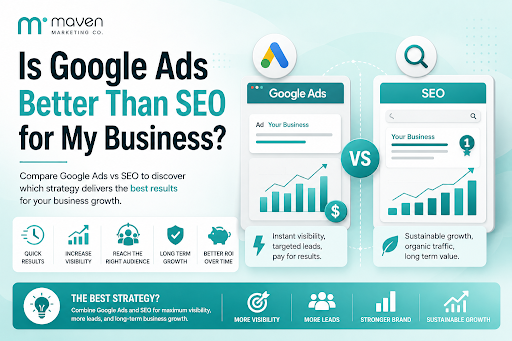
Is Google Ads Better Than SEO for My Business
One of the biggest questions business owners ask when they are planning online growth is whether they should invest in Google Ads or SEO. Both are strong marketing plays that help your company show up in Google search results, but they do things in separate lanes. Google Ads gives quicker visibility and can bring in leads fast, whereas SEO more or less focuses on slow, steady organic traffic that tends to grow the longer you keep building it. Picking the right direction depends on what you want to achieve, how much money you can spend, how crowded the market is, and how quickly you need results, like sooner rather than later. The good news is you don’t always have to choose one or the other; it’s not exactly a black-and-white situation. If you take time to understand the strongest points of both, you can put together a more sensible digital marketing plan that supports consistent expansion. In this guide, we’ll compare Google Ads vs SEO, explain the main differences, and help you figure out what option makes the most sense for your business.

When Should I Hire a Digital Marketing Agency
Growing a business today takes more than just having a website or throwing a post on social media; customers usually search around online, compare providers, skim reviews, and basically expect the brand to show up with a solid digital presence before they even think about buying. Many businesses try to run their marketing themselves, but there comes a point when “doing it all in-house” becomes clunky and hard to manage, all at once. Knowing when to hire a digital marketing agency can end up making a big, real difference for your growth. If you’re not getting enough leads, or your online visibility feels stuck, or sales are just not moving, the right agency can bring the know-how, plus a clear plan, to help you get noticeably better outcomes. In this guide, we’ll dig into what a digital marketing agency actually does, the usual signs it’s time to bring one on, and how picking the right marketing partner can help your business move forward at a faster pace.
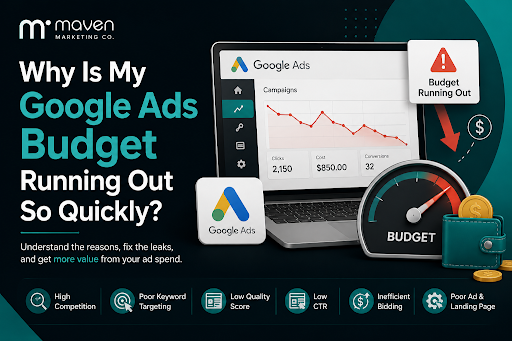
Why Is My Google Ads Budget Running Out So Quickly
Running a successful Google Ads budget isn’t only about throwing more money at it. It’s more like making every dollar, doing a bit extra. A lot of businesses start a Google Ads campaign with big hopes, then find out their daily budget is gone within a few hours, and that feels weird, right? After that, your ads stop showing effectively, new leads slip away, and your return on investment dips. So if your Google Ads budget is running out too fast, don’t stress. It’s a fairly common issue, and in most situations, it can be repaired with the right approach. There are multiple little things that can drain your advertising money quicker than you expected, from costly keywords to audience targeting that just doesn’t quite fit. In this guide, we’ll walk through why your budget disappears so quickly, how to cut wasteful spend, and the most reliable ways to boost your Google Ads ROI, even if your budget stays the same.