
.svg)
.svg)
.svg)


%201.svg)
Key Takeaways
- Brand refreshes update visual identity, messaging, and positioning while maintaining core brand recognition and equity, ideal for modernization without alienating existing customers or discarding functional brand assets
- Complete rebrands create entirely new identities when fundamental business changes, severe reputation damage, market repositioning, or complete visual obsolescence make evolution insufficient to address strategic needs
- Decision frameworks evaluate brand equity strength, business transformation scope, market position changes, customer perception gaps, and competitive landscape shifts to determine appropriate intervention level
- Implementation approaches differ dramatically, with refreshes requiring 3-6 months and moderate investment while complete rebrands demand 6-12+ months, significant budgets, comprehensive stakeholder management, and staged rollout strategies
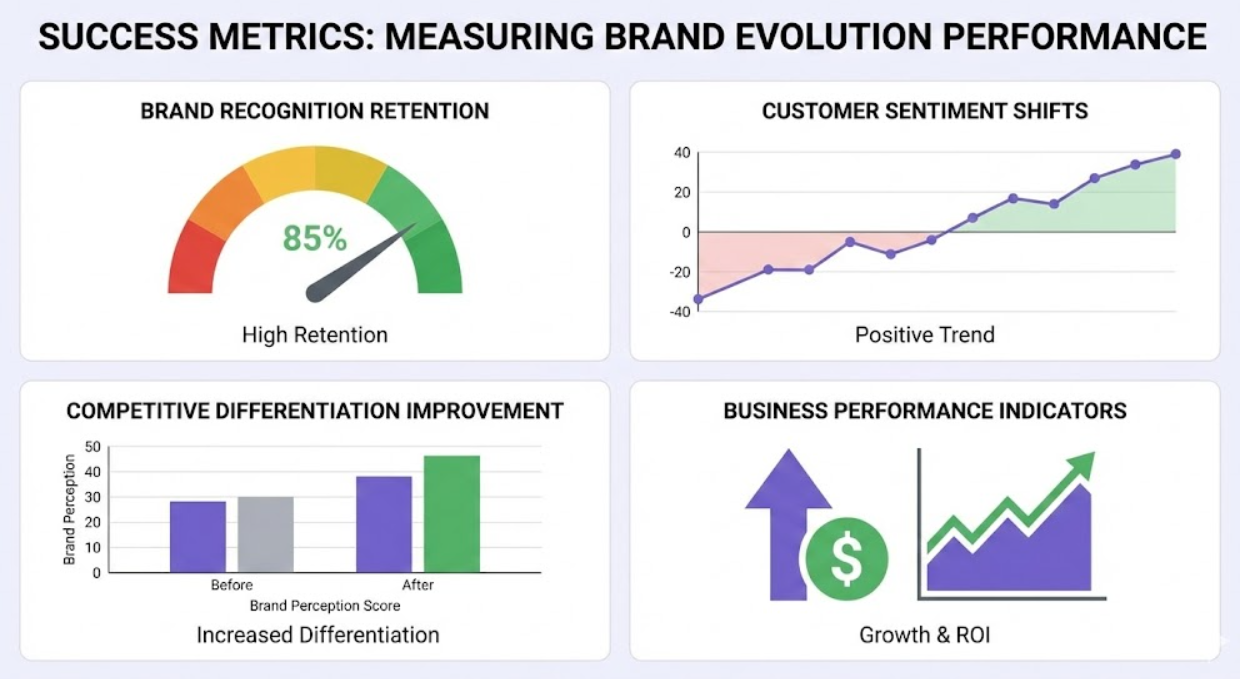
- Success metrics track brand recognition retention, customer sentiment shifts, market perception alignment, competitive differentiation improvement, and business performance indicators that validate strategic brand investment
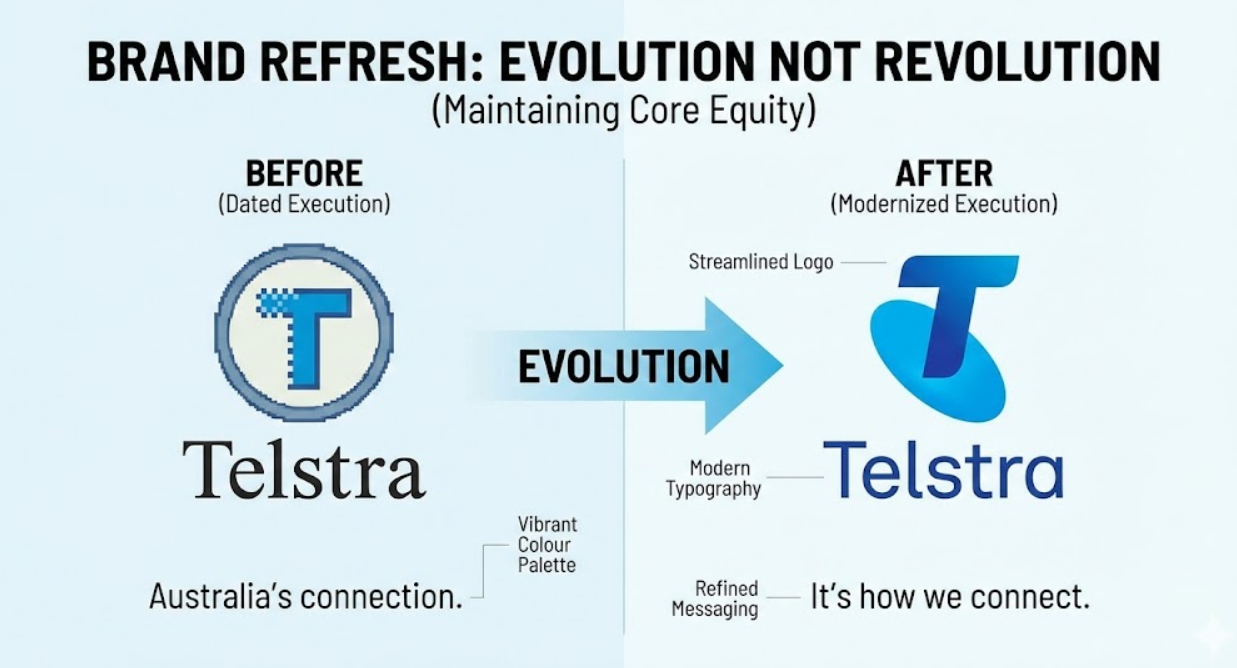
Telstra's 2011 brand refresh updated typography and simplified its "T" symbol while maintaining recognizable blue and the core brand architecture that Australians knew. Commonwealth Bank evolved its yellow and black identity multiple times over decades without losing instant recognition. Qantas modernized its kangaroo progressively while preserving the iconic symbol's equity.
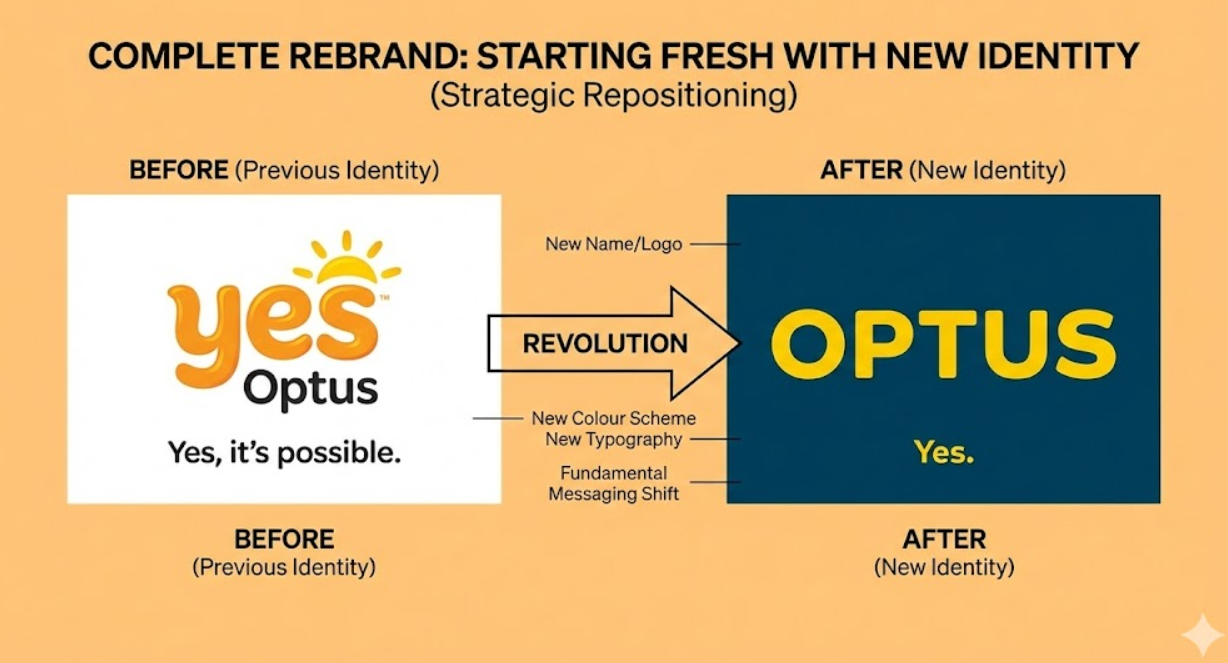
Then there's Optus, which completely rebranded from "yes" to its current identity, discarding previous brand investment. Westpac underwent significant rebranding when merging various banking brands under a unified identity. These weren't subtle updates—they were fundamental transformations.
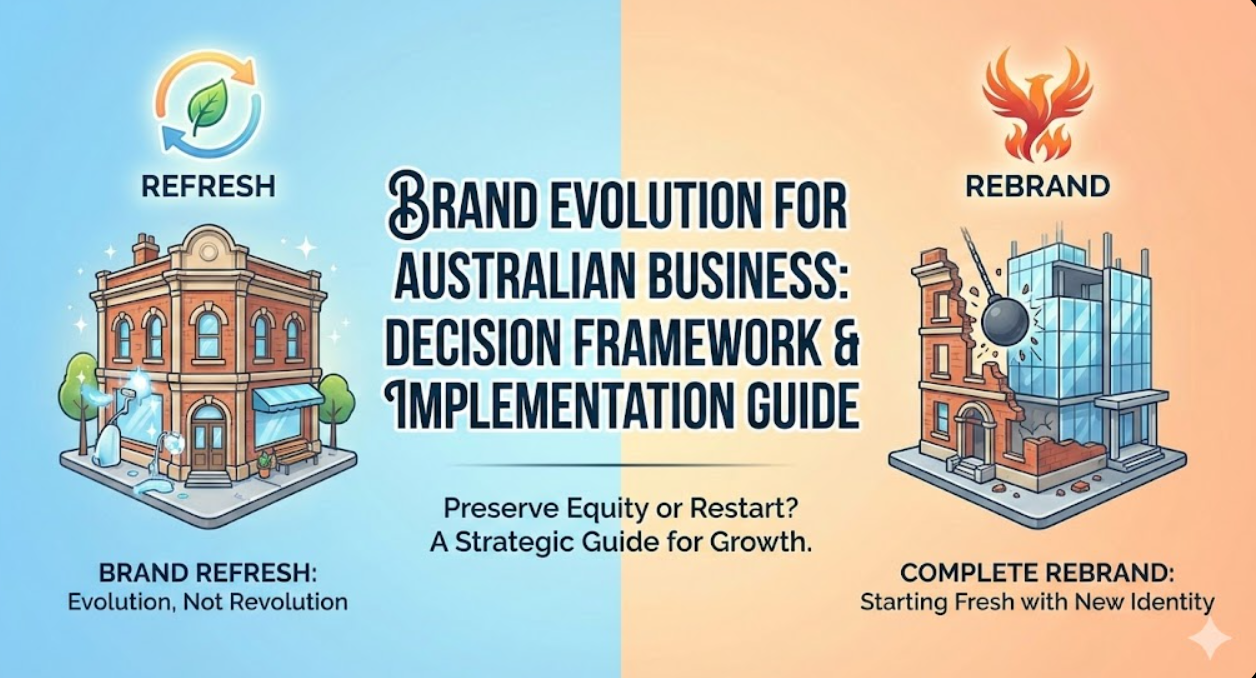
The distinction matters enormously. Brand refreshes preserve equity while modernizing. Complete rebrands restart from zero, sacrificing existing recognition for strategic repositioning. Australian businesses facing this decision often default to the familiar middle ground of refreshing when complete transformation is actually needed, or burn down valuable brand equity through unnecessary rebrands when thoughtful evolution would suffice.
Understanding Brand Refresh: Evolution Not Revolution
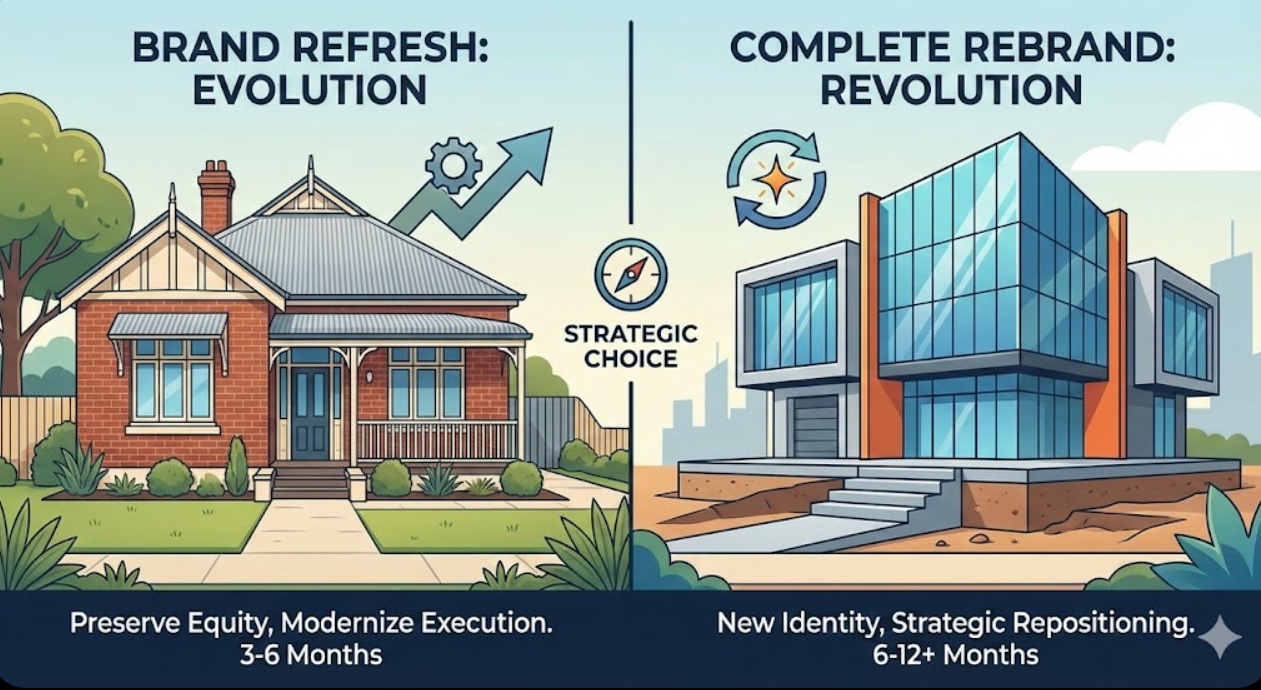
A brand refresh updates your identity's execution while preserving its essence. Think of it as renovation rather than demolition and rebuilding. The foundation remains; you're improving finishes, updating fixtures, and modernizing aesthetics.
Brand refreshes typically address visual elements that feel dated or no longer reflect your business reality. Logos get streamlined or simplified for digital applications. Colour palettes expand or shift to contemporary preferences. Typography updates from outdated fonts to modern alternatives. Photography style evolves from stiff corporate shots to authentic candid moments. Website design modernizes while maintaining familiar navigation and structure.
Messaging refreshes sharpen positioning without changing fundamental identity. Your value proposition gets articulated more clearly. Brand voice becomes more consistent across touchpoints. Taglines update to reflect current strategy while maintaining brand personality. Content approaches evolve to match contemporary consumption preferences.
According to brand strategy research from Prophet, successful brand refreshes maintain 60-80% of existing brand equity while addressing specific limitations or dated elements. The goal is evolution that existing customers barely notice consciously but subconsciously register as improvement.
Brand refreshes work when your core identity functions well but execution has fallen behind. Your logo still communicates appropriate values but looks pixelated on modern displays. Your brand colours remain distinctive but feel muted compared to vibrant contemporary palettes. Your messaging foundation is sound but language feels formal for today's conversational digital culture.
The timeframe for brand refreshes typically spans 3-6 months from strategic planning through implementation. Costs range from $15,000 to $75,000 for Australian small to medium businesses, depending on scope and complexity. The investment updates visual identity, refreshes core marketing materials, and establishes updated guidelines without comprehensive overhaul of every branded asset.
Understanding Complete Rebrand: Starting Fresh with New Identity
A complete rebrand creates an entirely new brand identity that may share little or nothing with your previous incarnation. This is demolition and reconstruction, not renovation. You're building a new brand from foundation up, which means discarding previous brand equity and starting recognition building from zero.
Complete rebrands replace logos with new symbols or wordmarks bearing no visual relationship to previous marks. Colour palettes change entirely, abandoning previous brand colours for completely different schemes. Typography adopts new font families with different personalities. Brand names sometimes change entirely, severing all connection to previous identity. Messaging and positioning shift fundamentally, targeting different audiences or communicating different value propositions.
The strategic rationale for complete rebrands involves fundamental business transformation. Companies shifting from B2B to B2C markets often need completely different brand approaches. Businesses expanding from local to national or international markets may rebrand to shed regional associations. Mergers between equals typically create new unified brands rather than subordinating one identity to another.
Reputation crises sometimes necessitate complete rebrands. When brand names become associated with scandal, failure, or negative perceptions too deeply rooted to overcome, starting fresh offers the only path forward. Australian businesses caught in significant controversies occasionally rebrand to distance themselves from damaged identities.
Complete obsolescence drives rebrands when visual identities or positioning become so outdated that evolution can't bridge the gap. If your brand looks like it belongs in 1985 and your industry has transformed completely, incremental updates won't achieve necessary modernization.
The timeframe for complete rebrands spans 6-12+ months from strategic planning through full implementation. Costs for Australian small to medium businesses range from $50,000 to $250,000+, depending on scope, market reach, and implementation complexity. This investment covers strategy development, complete identity creation, comprehensive asset production, and staged rollout across all touchpoints.
Warning Signs Your Australian Business Needs Brand Intervention
Certain symptoms indicate your brand requires attention, though they don't necessarily reveal whether refresh or rebrand is appropriate. Recognition of these warning signs triggers the strategic evaluation that determines intervention level.
Customer perception misalignment occurs when how customers see your brand diverges significantly from how you position yourself. You emphasize innovation but customers perceive you as traditional. You invest in premium quality but market perception positions you as budget option. You've evolved significantly but customers remember who you were five years ago. These gaps indicate brand communication failures requiring intervention.
Visual identity obsolescence manifests when your logo, colours, typography, or overall aesthetic feel jarringly outdated compared to contemporary standards. If your brand identity could plausibly appear in a 1990s archive, it's limiting rather than serving your business. Modern audiences make snap judgments about business credibility based on visual professionalism—dated identities suggest dated businesses.
Competitive disadvantage emerges when competitor brands appear more modern, professional, or aligned with market preferences while your identity feels stale. You're competing with one hand tied behind your back when your brand doesn't measure up visually or strategically to alternatives customers consider. Research from Siegel+Gale found that 64% of consumers base purchase decisions partly on brand perception, making competitive brand disadvantage directly revenue-impacting.
Business transformation necessitates brand evolution when your company has fundamentally changed. You've shifted business models, entered new markets, acquired companies, or pivoted strategic direction. Your brand identity was built for who you were, not who you've become. The disconnect between identity and reality confuses customers and limits growth.
Geographic expansion often requires brand consideration. Local brands expanding nationally may need to shed regional associations. Australian businesses expanding internationally sometimes discover their identities don't translate culturally or linguistically. What works perfectly in Melbourne might confuse markets in Singapore or London.
Demographic shifts in target audiences can render brands misaligned. If your customer base has aged significantly younger or older than when you established your brand, visual identity and messaging that once resonated may now miss the mark. Generational preferences differ dramatically—brands built for Baby Boomers often fail to connect with Millennials or Gen Z.
Internal confusion about brand identity suggests problems. When your own team can't consistently articulate what your brand stands for, express your value proposition coherently, or apply visual identity consistently, you lack the clear brand foundation necessary for effective marketing. Internal brand confusion inevitably manifests as external market confusion.
The Decision Framework: Refresh or Complete Rebrand?
Strategic frameworks help determine which intervention your Australian business actually needs. Evaluate multiple factors systematically rather than defaulting to preconceived preferences for evolution or transformation.
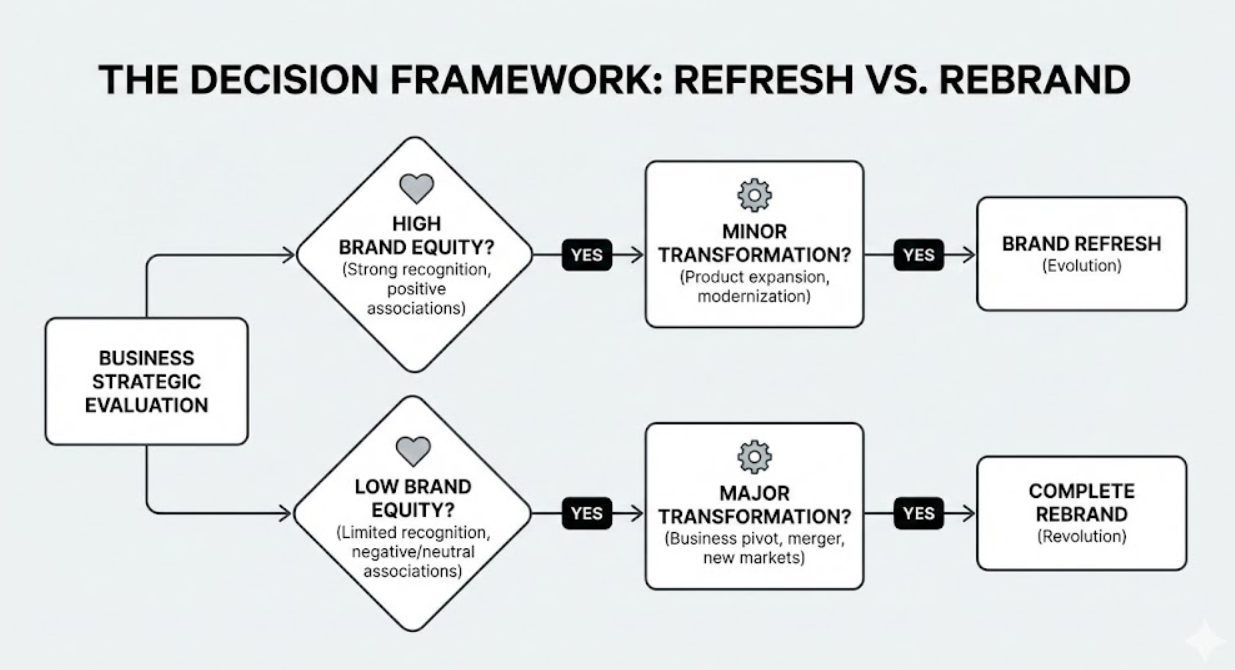
Brand equity assessment examines how much value your current brand holds. High brand equity—strong recognition, positive associations, loyal customer base, premium positioning—argues strongly for preservation through refresh rather than discarding through rebrand. Low brand equity—limited recognition, neutral or negative associations, commodity positioning—makes complete rebrand less risky since you're not sacrificing much existing value.
Measure brand equity through recognition testing (what percentage of target audience recognizes your brand), association mapping (what qualities people attribute to your brand), preference studies (how you rank against competitors), and loyalty metrics (repeat purchase rates, customer lifetime value). High scores across these dimensions indicate equity worth preserving.
Business transformation scope determines whether evolution suffices or transformation is necessary. Minor shifts—expanding product lines, targeting adjacent markets, modernizing operations—typically work with brand refreshes that update positioning messaging without identity overhaul. Major transformations—complete business model pivots, mergers creating new entities, geographic expansion to dramatically different markets—often require complete rebrands that acknowledge fundamental change.
Customer continuity importance weighs how critical existing customer retention is versus new customer acquisition. Businesses dependent on long-term customer relationships should preserve brand recognition that maintains those connections. Refreshes keep existing customers comfortable while attracting new ones. Businesses prioritizing dramatic new market expansion over existing customer retention can rebrand more aggressively since alienating some current customers matters less than capturing new audiences.
Reputation status influences intervention level. Neutral to positive reputations benefit from refreshes that build on existing goodwill. Damaged reputations may require complete rebrands that create distance from negative associations. However, reputation problems aren't automatically rebrand triggers—sometimes operational improvements and consistent positive messaging rehabilitate damaged brands more effectively than name changes that look like evasion.
Visual identity salvageability determines whether your existing visual elements can be modernized or must be replaced. Logos with strong basic shapes and clear symbolic meaning often refresh beautifully through refinement and simplification. Logos that are overly complex, poorly conceived originally, or use dated design trends may resist effective updating. Assess whether your core visual identity can evolve into contemporary form or requires complete replacement.
Competitive positioning needs reveal whether you can achieve necessary differentiation through refresh or require rebrand. If your market has evolved and your brand feels indistinguishable from competitors, ask whether refined positioning and updated visual identity create sufficient differentiation. If your entire brand approach mirrors competitor conventions you need to escape, complete rebrand may be necessary to establish unique market position.
Budget and timeline constraints impose practical limitations. Brand refreshes cost 30-50% of complete rebrands and complete in half the time. If your business situation demands visible brand improvement within 3-4 months on limited budget, refresh represents your realistic option even if rebrand would be theoretically ideal. Conversely, if you have 12+ months and substantial budget, complete rebrand becomes feasible for situations that truly demand it.
Brand Refresh Implementation: Modernizing While Maintaining Equity
Successful brand refreshes follow systematic approaches that update effectively while preserving recognition and customer relationships.
Audit current brand performance comprehensively before designing changes. Analyze which brand elements work well and should be preserved, which elements feel dated or limit effectiveness, and which elements customers recognize most strongly. Customer research reveals which brand aspects drive recognition and positive associations versus which elements can change without disrupting brand equity. This audit prevents discarding valuable equity while updating problematic elements.
Define strategic objectives for your refresh. Are you modernizing for digital applications? Expanding appeal to younger demographics? Aligning brand with business evolution? Improving competitive differentiation? Clear objectives guide design decisions and prevent aimless aesthetic updates disconnected from business strategy.
Evolve visual identity systematically. Logo refinements typically simplify shapes, remove dated effects like gradients or shadows, adjust proportions for better digital scalability, or modernize typography while maintaining recognizable form. Colour updates might expand palettes with contemporary accent colours while preserving primary brand colours that drive recognition. Typography refreshes adopt modern font families that share personality characteristics with previous fonts—if your brand used friendly rounded fonts, modern updates should maintain that warmth rather than pivoting to sharp geometric fonts.
Update brand guidelines comprehensively. Refreshes provide perfect opportunities to create or revise brand guidelines that improve consistency going forward. Document updated visual standards, refined messaging frameworks, and contemporary application examples that guide internal teams and external partners.
Implement staged rollout that prioritizes high-visibility touchpoints. Update digital properties first—website, social media, email templates—since these reach audiences frequently and updates happen instantly. Transition marketing materials as inventory depletes rather than discarding functional assets prematurely. Update signage and environmental graphics on scheduled replacement cycles. Staged implementation spreads costs while ensuring customer-facing touchpoints reflect updated brand quickly.
Communicate evolution strategically. Most brand refreshes don't require announcement—customers notice gradual improvements without needing explanation. However, significant refreshes benefit from proactive communication that frames updates positively. "We've evolved our brand to better reflect our commitment to innovation and service" demonstrates intentionality while exciting customers about improvements.
Monitor customer response during and after refresh implementation. Track sentiment through social listening, customer feedback channels, and direct surveys. Measure whether recognition remains strong and associations strengthen as intended. Quick course corrections address unexpected negative responses before they solidify into lasting perception problems.
Complete Rebrand Implementation: Managing Transformation Successfully
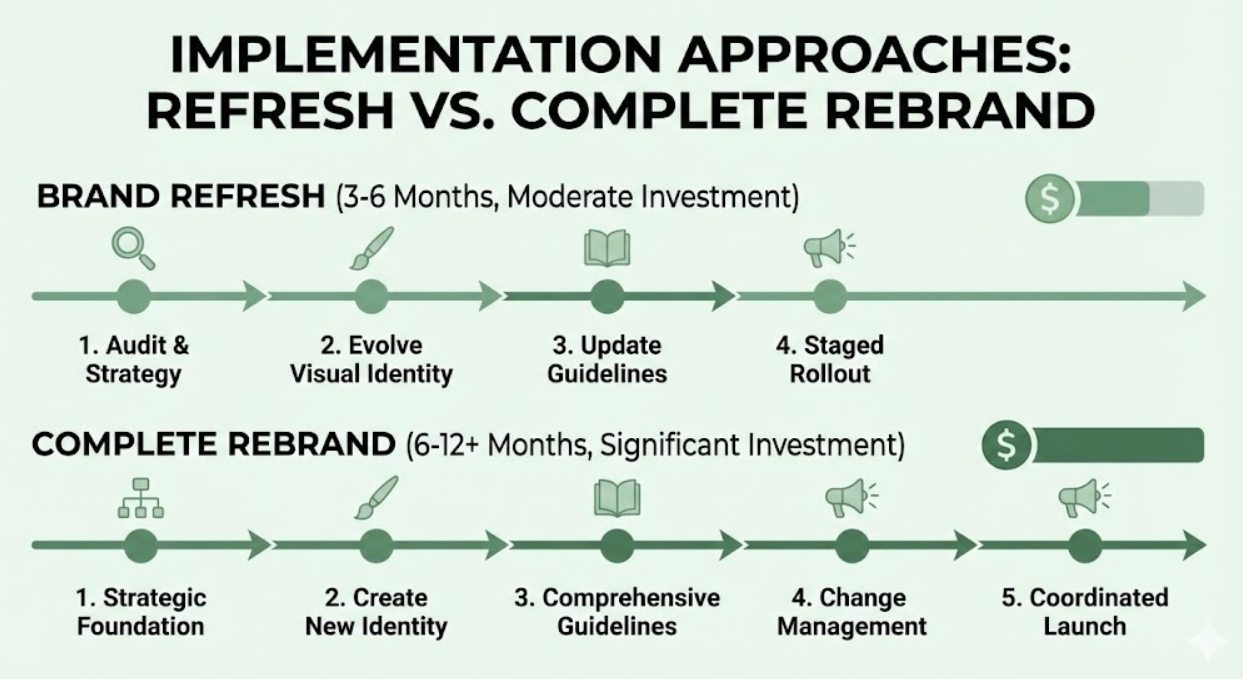
Complete rebrands demand more comprehensive planning and change management since you're asking stakeholders to adopt entirely new brand identities.
Conduct thorough strategic foundation work before creative development begins. Define your positioning, target audiences, value proposition, brand personality, and competitive strategy clearly. Complete rebrands built on shaky strategic foundations fail regardless of creative execution quality. Invest heavily in research—customer insights, competitive analysis, market trends—that informs strategic decisions.
Develop comprehensive creative identity including name (if changing), logo and visual identity system, colour palette, typography, photography and imagery style, brand voice and messaging, and all supporting brand elements. Test creative directions with target audiences before finalizing to validate that new identity communicates intended messages and differentiates effectively.
Create detailed brand guidelines that enable consistent implementation across all applications. Complete rebrands require more comprehensive guidelines than refreshes since every aspect of brand expression is new. Include strategy context explaining brand positioning and personality, detailed visual identity standards, messaging frameworks and voice guidance, and extensive application examples across touchpoints.
Plan change management and stakeholder buy-in systematically. Internal stakeholders—employees, leadership, board members—must understand rationale for rebrand, believe in new identity, and commit to consistent implementation. External stakeholders—customers, partners, investors—need communication that frames rebrand positively while acknowledging change. Research from Interbrand shows that poorly managed stakeholder communication during rebrands causes 40% of rebrand failures despite sound strategic and creative work.
Develop comprehensive implementation timeline spanning all touchpoints. Complete rebrands can't happen instantaneously across entire organizations. Prioritize customer-facing touchpoints for early transition while allowing longer timelines for infrastructure, packaging, or large-scale environmental graphics. Create cutover dates when old brand officially retires and new brand launches publicly, even if behind-the-scenes implementation continues.
Execute coordinated launch that introduces new brand with impact. Complete rebrands benefit from announcement and celebration that generates positive attention and excitement. Launch campaigns explaining rebrand rationale, showcasing new identity, and reinforcing what remains constant about your business help customers transition emotionally while building awareness.
Provide ongoing support and resources for teams implementing new brand. Training sessions, easily accessible digital asset libraries, and responsive brand guardians who answer questions prevent inconsistent implementation that undermines rebrand investment.
Measure rebrand performance against defined objectives. Track awareness and recognition of new brand identity, sentiment and association development, competitive perception shifts, and business metrics tied to rebrand goals. Rebrands represent significant investments requiring performance accountability.
Common Mistakes That Undermine Australian Brand Evolution
Avoiding predictable mistakes improves outcomes for both refreshes and complete rebrands.
Changing for change's sake without strategic rationale wastes resources and risks alienating customers. Every brand evolution should address specific business needs or market challenges. If you can't articulate clear strategic objectives for brand work, delay until you can. Aesthetic preference alone rarely justifies brand investment.
Underestimating existing brand equity leads to discarding valuable assets unnecessarily. Australian businesses sometimes pursue complete rebrands when thoughtful refreshes would achieve objectives while preserving recognition. Properly measure brand equity before assuming your current brand holds little value.
Following competitor trends blindly creates derivative brands without differentiation. If every competitor recently refreshed with minimalist sans-serif logos and pastel palettes, copying that approach ensures you blend in rather than stand out. Use competitor analysis to identify differentiation opportunities, not templates to copy.
Neglecting customer perspective produces brands that please internal stakeholders while confusing markets. Your brand exists for customer connection, not internal aesthetic satisfaction. Validate brand decisions through customer research and testing rather than assuming your preferences match market preferences.
Inadequate budget allocation compromises execution quality. Brand refreshes or rebrands implemented cheaply look cheap, undermining rather than enhancing market perception. If budget constraints prevent quality execution, delay brand work until adequate resources are available or reduce scope to what you can execute excellently.
Inconsistent implementation wastes brand investment by allowing old and new identities to coexist indefinitely. Set firm transition timelines and enforce them. Mixed brand applications confuse customers and fragment brand equity between old and new versions.
Forgetting brand is behaviour, not just visuals leads to superficial changes that don't address underlying brand challenges. Updated logos and colours won't fix poor customer service, inconsistent product quality, or unclear value propositions. Brand evolution must be supported by operational delivery that fulfills brand promises.
Frequently Asked Questions
How do Australian small businesses determine if they have enough brand equity worth preserving to justify a refresh over a complete rebrand when they have limited market research budgets?
Small businesses can assess brand equity effectively through affordable methods that provide sufficient insight for strategic decisions. Start with simple recognition testing—show your logo to 20-30 people within your target demographic (don't use family or employees) without context and ask if they recognize it and what associations come to mind. Recognition rates above 40-50% among target audiences indicate meaningful equity. Analyse your customer retention rates and repeat purchase patterns—high retention (60%+ customers returning) suggests brand loyalty worth preserving. Review your social media follower engagement and website direct traffic—audiences actively seeking your brand indicate equity. Conduct informal interviews with 10-15 recent customers asking what influenced their purchase decision and how they'd describe your brand to friends. If customers consistently reference your brand name, colours, or specific visual elements, you've built recognizable equity. Survey your team about customer feedback and questions—if customers regularly mention your brand identity positively or use your brand as shorthand for certain qualities, equity exists. Compare your pricing power to competitors—if you command premium pricing or maintain pricing during competitive discounting, brand equity contributes to that power. Research from Nielsen indicates that even small businesses with limited marketing budgets build meaningful local brand equity within 3-5 years of consistent operation. For small businesses operating more than 3-5 years with stable customer bases and community presence, default to brand refresh preserving equity unless specific strategic reasons demand complete change. For businesses under 3 years old with limited market presence or those facing fundamental business pivots, complete rebrand risks less since you're not discarding substantial equity. When uncertain, bias toward preservation through refresh—discarding brand equity unnecessarily is harder to recover from than conservative evolution.
What timeline and budget should Australian businesses expect for brand refreshes versus complete rebrands and how do costs scale for different business sizes and market reach?
Brand refresh timelines typically span 3-6 months from project initiation through implementation across core touchpoints. Month 1 involves brand audit and strategic planning. Months 2-3 cover creative development and refinement. Months 4-6 encompass production and rollout of updated brand materials. For Australian small businesses (annual revenue under $5M), brand refresh budgets typically range $15,000-$40,000 covering strategic consulting, logo refinement, updated colour palettes and typography, refreshed brand guidelines, core marketing material templates, and website visual updates. Medium businesses ($5M-$50M revenue) typically invest $40,000-$100,000 including more comprehensive market research, extensive guideline development, broader asset production, and multi-location implementation support. Complete rebrand timelines extend 6-12+ months with more extensive phases. Months 1-3 focus on strategic foundation including market research, positioning development, and naming (if changing). Months 4-6 involve comprehensive creative development across all brand elements. Months 7-12+ cover detailed implementation planning, asset production, stakeholder training, and staged rollout. Small business complete rebrand budgets range $50,000-$100,000. Medium business rebrands typically require $100,000-$250,000+. Geographic reach impacts costs significantly—businesses operating across multiple states or internationally face higher implementation costs due to diverse touchpoint management, regulatory compliance across jurisdictions, and cultural adaptation requirements. Digital-first businesses with limited physical touchpoints (signage, packaging, printed materials) generally spend 30-40% less than businesses with extensive physical brand applications. These figures represent professional execution with experienced brand consultants and designers. Cutting corners with inexperienced providers or template-based approaches reduces immediate costs but often requires expensive corrections later. Most Australian businesses underestimate implementation costs beyond creative development—producing new signage, updating packaging, printing new marketing materials, website development, and photography often equal or exceed design development costs. Build comprehensive project budgets including implementation, not just creative work, to avoid budget overruns mid-project.
How should Australian businesses manage the transition period during brand refreshes or rebrands to minimize customer confusion while rolling out new identities across physical locations, digital platforms, and existing inventory?
Successful transition management requires strategic phasing that balances speed, cost efficiency, and customer clarity. Begin by establishing a firm cutover date when your new brand officially launches publicly, even if behind-the-scenes implementation continues afterward. This cutover date creates an anchor point for planning and prevents indefinite mixed branding. Four to six weeks before cutover, implement new brand across digital touchpoints—website, social media profiles, email templates, and digital advertising. Digital transitions happen instantly without inventory concerns or physical production timelines. This digital-first approach means highest-visibility customer touchpoints reflect new brand immediately at launch. For physical locations, implement new brand during cutover using temporary solutions where necessary—vinyl decals over existing signage, printed banners covering old branding—rather than delaying launch for permanent signage production. Schedule permanent signage installation within 3-6 months post-launch once you've validated new brand performance. For existing inventory (packaging, marketing materials, merchandise), apply "use by" dates rather than wastefully discarding functional materials. Packaging with substantial remaining inventory can transition using stickers covering old logos or "As part of our evolution..." messaging acknowledging transition. Marketing materials like brochures and business cards transition as current supplies deplete—order new brand versions but finish using old inventory for non-critical applications. For customer-facing materials like proposals and presentations, transition immediately since these high-impact touchpoints significantly influence perception. Communicate transparently with customers about evolution through email announcements, social media posts, and on-site signage explaining "You might notice we've evolved our brand to better serve you." Most customers appreciate transparency and respond positively to proactive communication. Research from Landor found that businesses communicating brand transitions clearly experience 45% less customer confusion than those attempting silent transitions. For franchisees or multi-location businesses, provide transition support including subsidies for signage updates, clear timelines with grace periods, and transition kits making changeover straightforward. Enforce cutover compliance for customer-facing touchpoints while allowing flexibility for lower-priority applications. Monitor customer feedback channels during transition and address confusion quickly with clarifying communications. Most transition periods span 6-12 months from launch to complete implementation across all touchpoints. Accept this reality rather than forcing artificially compressed timelines that compromise quality or waste resources.
Strategic Brand Evolution Drives Business Growth
The decision between brand refresh and complete rebrand isn't about aesthetics or trends—it's strategic business investment that positions Australian businesses for future success. Refreshes preserve valuable equity while modernizing for contemporary markets. Rebrands create fundamental transformation when business evolution demands it.
Neither approach is inherently superior. The question is which serves your specific strategic needs, market position, and business trajectory. Businesses that systematically evaluate brand equity, transformation scope, and market requirements make informed decisions that align brand investment with business objectives.
Your brand represents one of your most valuable business assets. Evolving it thoughtfully—whether through careful refresh or bold rebrand—strengthens market position, clarifies customer communication, and enables sustainable growth across changing Australian markets.
Ready to determine whether your Australian business needs a brand refresh or complete rebrand? Maven Marketing Co. provides strategic brand consulting that evaluates your situation objectively and develops transformation roadmaps aligned with your business goals. Let's explore your brand evolution together.

Table of contents
read more blogs

Packaging Design Trends: Standing Out on Australian Retail Shelves
Australian retail shelves are battlegrounds where products have three seconds to capture attention, communicate value, and trigger purchase decisions. In supermarkets stocked with 30,000+ product variations and consumers making 95% of purchase decisions at shelf, packaging design determines whether your product gets noticed or ignored. Yet most Australian businesses approach packaging as afterthought rather than strategic asset, missing opportunities to differentiate, command premium pricing, and build lasting brand recognition. This comprehensive guide reveals the packaging design trends reshaping Australian retail, from sustainability imperatives and minimalist aesthetics to sensory design and cultural localization. Discover the psychological principles behind effective packaging, the regulatory requirements you must navigate, and the strategic frameworks that transform packaging from container into compelling sales tool that performs 24/7 on retail shelves across Australia.
Brand Refresh vs Complete Rebrand: When Australian Businesses Should Pivot
Your brand feels dated. Customer perceptions don't match your current reality. Competitors have modernized while your identity remains stuck in 2010. You know something needs to change, but should you refresh your existing brand or burn it down and rebuild from scratch? This decision carries massive implications for budget, timeline, customer relationships, and business momentum. Get it wrong and you risk alienating loyal customers while confusing prospects. Get it right and you position your Australian business for accelerated growth with renewed market relevance. This comprehensive guide reveals the strategic frameworks that determine whether your business needs a subtle refresh or complete transformation, the warning signs that demand action, the costs and risks of each approach, and the implementation roadmaps that protect brand equity while driving necessary evolution.
Social Media Asset Templates: Streamlining Content Creation Workflows
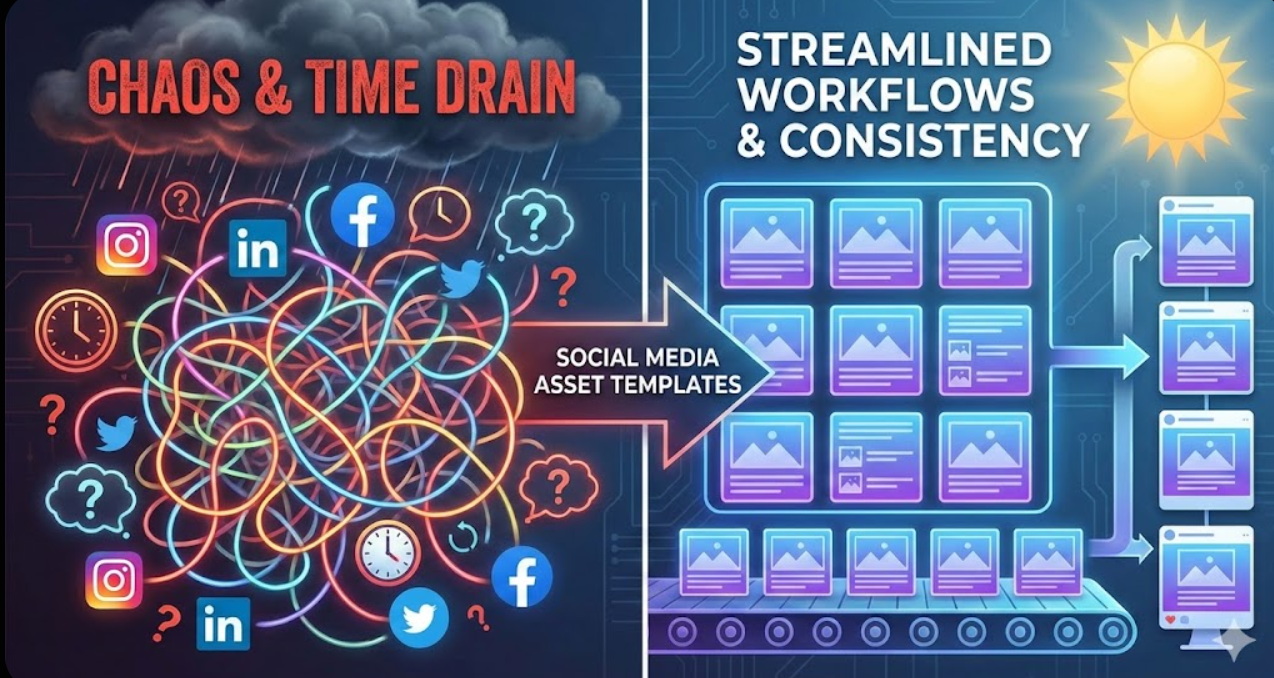
Creating fresh social media content daily drains time, energy, and creative resources from Australian businesses already stretched thin. Yet consistency and quality can't be compromised when your social presence directly impacts brand perception and customer acquisition. Social media asset templates solve this tension by transforming repetitive design work into streamlined, scalable systems that maintain brand consistency while accelerating production. This comprehensive guide reveals how to build template libraries that reduce content creation time by 70%, ensure brand consistency across platforms and team members, and free your team to focus on strategy and engagement rather than design mechanics. From establishing design systems and creating flexible template frameworks to implementing approval workflows and measuring template effectiveness, discover the blueprint for sustainable social media content production that scales with your business growth.


