.svg)


%201.svg)
.avif)
Key Takeaways
- Data Quality is Ad Quality: Your Google Shopping feed acts as the "keyword list" for your campaigns. Rich, accurate attributes (like GTINs and detailed titles) directly influence which search queries trigger your ads.
- Title Optimisation is Critical: Front-loading key product details—such as brand, product type, and specific attributes like colour or size—can significantly improve Click-Through Rate (CTR) by matching user intent more closely.
- Custom Labels Drive Strategy: Utilising Custom Labels (0-4) allows you to segment products based on business logic (e.g., "High Margin," "Clearance," "Best Sellers") rather than just product categories, enabling smarter bidding.
- Visuals Make the Sale: High-quality, compliant images are non-negotiable. Ensuring your images meet Google's specifications while standing out visually is the first step in winning the click in the crowded Shopping carousel.
Google Shopping Feed Optimisation: Maximising ROI for E-commerce Brands
If you run an e-commerce store in Australia, you know the feeling: you’re staring at your Google Ads dashboard, watching the cost-per-click (CPC) creep up while your conversion value stagnates. You’ve tweaked your bidding strategies, adjusted your budgets, and maybe even refreshed your creative. But have you looked under the hood at your product feed?
For many online retailers, the Google Merchant Center feed is a "set and forget" asset. This is a costly mistake. Your product feed is the foundation of your entire Google Shopping performance. Unlike Search campaigns where you bid on keywords, Shopping campaigns rely entirely on the data you provide to decide when and where your ads appear.
If your data is "fluffy" or incomplete, Google is guessing. And when Google guesses, you lose money.
At Maven Marketing Co., we believe that technical precision leads to marketing performance. Let’s dive into how you can optimise your Google Shopping feed to stop wasting budget and start maximising your Return on Investment (ROI).
.avif)
The Anatomy of a High-Performance Feed
A product feed is simply a file—usually a spreadsheet or XML—that contains a list of your products and their attributes. While Google requires basic data like id, title, link, and price, the magic happens in the optional and recommended attributes.
1. Product Titles: Your 150-Character Elevator Pitch
The [title] attribute is arguably the single most important factor in your feed. It carries the most weight for Google’s search matching algorithm.
Most retailers simply pull the product name from their website. For example, a website might list a pair of shoes simply as "Air Zoom Pegasus." On your site, that works because the user is already in the "Nike Running" category. On Google Shopping, however, "Air Zoom Pegasus" is vague.
The Fix: Structure your titles to match how users search. A proven formula usually looks like this:
- Brand + Product Type + Gender + Key Attribute (Colour/Size/Material)
- Poor: Men’s Running Shirt
- Optimised: Nike Men’s Running Shirt, Dri-Fit Breathable, Blue, Size L
By front-loading the most vital information, you ensure that even if the title gets truncated on a mobile screen, the user sees exactly what they are looking for.
.avif)
2. GTINs: The Trust Signal
Global Trade Item Numbers (GTINs) are the fingerprints of retail. They are unique identifiers (like UPCs or EANs) that tell Google exactly what product you are selling.
According to Google’s Product Data Specification, accurate GTINs help the algorithm classify your products and match them to search queries with higher precision. Products with valid GTINs often receive priority in the auction because Google trusts the data. If you are reselling branded goods, do not skip this field.
3. Google Product Category vs. Product Type
There is often confusion here.
- Google Product Category: This is a standardised classification from Google’s taxonomy (e.g.,
Apparel & Accessories > Clothing > Shirts & Tops). It helps Google understand what you are selling. - Product Type: This is your own internal categorisation. It’s less rigid and allows you to use your own site’s breadcrumb structure (e.g.,
Home > Living Room > Cushions > Velvet).
Pro Tip: Use the [product_type] attribute to create highly specific campaign structures. While Google uses the Category for matching, you can use the Type for your own reporting and bidding segmentation.
4. Custom Labels: Your Strategic Lever
This is where the pros separate themselves from the amateurs. Custom Labels ([custom_label_0] through [custom_label_4]) do not affect how your ads rank, but they dramatically affect how you manage them.
You can use these labels to tag products with business intelligence that Google doesn’t know about, such as:
- Margin: High vs. Low
- Seasonality: Winter, Summer, Christmas
- Performance: Best Sellers, Dead Stock
- Price Bucket: Under $50, Over $100
Imagine being able to bid aggressively on your "High Margin" items while pulling back spend on "Low Margin" stock. That is the power of Custom Labels.
Visuals That Win the Click
In the Google Shopping carousel, your image is your storefront. It is the first thing a potential customer sees. If your image is blurry, cluttered, or generic, you will be scrolled past.
Google recommends using high-quality images with a white background. However, "compliant" doesn't always mean "compelling."
- Resolution matters: Ensure your images are at least 800x800 pixels (though larger is better) to allow for the zoom function.
- Show the product clearly: The product should take up 75-90% of the frame.
- Avoid text overlays: Google will disapprove images with watermarks or promotional text (e.g., "Free Shipping" written on the image).
For categories like apparel, showing the product on a model can sometimes outperform a flat lay. Test different image angles using the [additional_image_link] attribute to give Google more options to display.
Note: For brick-and-mortar retailers, don't forget the power of Local Inventory Ads. These allow you to show local shoppers that the product they are searching for is in stock at your nearby store, driving foot traffic alongside web traffic.
Managing Feed Health and Disapprovals
A healthy feed is a profitable feed. If your products are disapproved, they aren't showing up, and your competitors are taking your market share.
Common errors include:
- Price Mismatches: If the price in your feed ($50) doesn't match the price on your landing page ($55), Google will disapprove the item to protect the user experience.
- Invalid Images: Broken URLs or images that are too small.
- Policy Violations: Selling restricted items without the proper flagging.
Regularly checking the "Diagnostics" tab in Merchant Center is essential. Tools like Optmyzr provide excellent workflows for auditing these errors and keeping your feed compliant.
Case Studies: The Impact of Feed Optimisation
Case Study 1: The "Invisible" Fashion Retailer
The Challenge: A mid-sized Australian clothing brand was struggling with low impressions. Their products were high quality, but their feed titles were generic (e.g., "Maxi Dress"). They were barely showing up for long-tail searches.
The Solution: We overhauled their product titles. Instead of just "Maxi Dress," we dynamically updated the feed to populate titles like "Womens Floral Boho Maxi Dress, Red, Size 12 - Summer Collection." We also utilised Custom Labels to segment their "New Arrivals" from their "Clearance" stock, allowing for more aggressive bidding on fresh inventory.
The Result: Within 30 days, impressions increased by 140%, and because the titles were more relevant to the search queries, the Click-Through Rate (CTR) improved by 45%, leading to a significant boost in overall ROAS.
Case Study 2: The Tech Hardware Store
The Challenge: A computer parts retailer was bleeding budget on low-margin cables and accessories while their high-ticket items (GPUs and Monitors) weren't getting enough budget share.
The Solution: By implementing Custom Labels based on "Gross Margin," we segmented the campaigns. We set a high Target ROAS (tROAS) for the low-margin cables to ensure profitability and a lower, more aggressive tROAS for the high-value items to capture market share.
The Result: The account moved from a break-even point to a 300% increase in profitability over a quarter. By telling Google exactly how to value each click based on business data, the ad spend became an investment rather than an expense.
For more technical details on feed management strategies, you can read insights from feed management platforms like Channable.
.avif)
Frequently Asked Questions (FAQ)
Q: How often should I update my Google Shopping feed?
A: Ideally, your feed should update automatically every day. If your prices or inventory levels change frequently (e.g., hourly), you should set up "Automatic Item Updates" or schedule feed fetches multiple times a day to avoid disapprovals for mismatched data.
Q: Do I need a third-party feed management tool?
A: For small stores (under 500 SKUs), the direct integration with Shopify or WooCommerce is often sufficient. However, for larger catalogues, a dedicated feed management tool is highly recommended. It allows you to create sophisticated rules (like "If title contains 'Men's', add 'Male' to Gender attribute") without altering the data on your actual website.
Q: Why are my products showing up for irrelevant search terms?
A: Since there are no keywords in Shopping, this usually means your Product Titles or Descriptions contain broad or misleading terms. Refine your titles to be more specific and use "Negative Keywords" in your Google Ads campaign settings to block unwanted traffic.
Ready to Scale Your E-commerce Growth?
Optimising a Google Shopping feed requires a blend of data science, technical know-how, and marketing savvy. It’s meticulous work, but the payoff is a campaign that runs more efficiently and scales more profitably.
You don't have to navigate the complexities of Merchant Center alone. At Maven Marketing Co., we specialise in turning complex data into clear, profitable results for ambitious Australian brands. We dig into the data so you can focus on running your business.
Get a Free Audit of Your Shopping Feed Today

Table of contents
read more blogs
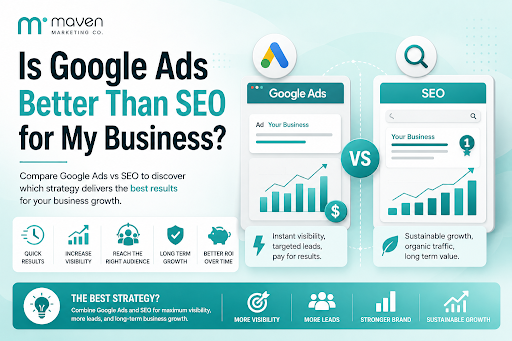
Is Google Ads Better Than SEO for My Business
One of the biggest questions business owners ask when they are planning online growth is whether they should invest in Google Ads or SEO. Both are strong marketing plays that help your company show up in Google search results, but they do things in separate lanes. Google Ads gives quicker visibility and can bring in leads fast, whereas SEO more or less focuses on slow, steady organic traffic that tends to grow the longer you keep building it. Picking the right direction depends on what you want to achieve, how much money you can spend, how crowded the market is, and how quickly you need results, like sooner rather than later. The good news is you don’t always have to choose one or the other; it’s not exactly a black-and-white situation. If you take time to understand the strongest points of both, you can put together a more sensible digital marketing plan that supports consistent expansion. In this guide, we’ll compare Google Ads vs SEO, explain the main differences, and help you figure out what option makes the most sense for your business.

When Should I Hire a Digital Marketing Agency
Growing a business today takes more than just having a website or throwing a post on social media; customers usually search around online, compare providers, skim reviews, and basically expect the brand to show up with a solid digital presence before they even think about buying. Many businesses try to run their marketing themselves, but there comes a point when “doing it all in-house” becomes clunky and hard to manage, all at once. Knowing when to hire a digital marketing agency can end up making a big, real difference for your growth. If you’re not getting enough leads, or your online visibility feels stuck, or sales are just not moving, the right agency can bring the know-how, plus a clear plan, to help you get noticeably better outcomes. In this guide, we’ll dig into what a digital marketing agency actually does, the usual signs it’s time to bring one on, and how picking the right marketing partner can help your business move forward at a faster pace.
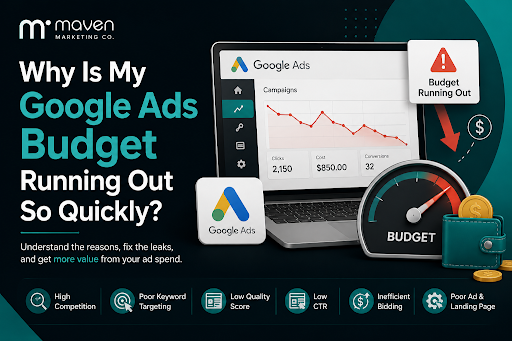
Why Is My Google Ads Budget Running Out So Quickly
Running a successful Google Ads budget isn’t only about throwing more money at it. It’s more like making every dollar, doing a bit extra. A lot of businesses start a Google Ads campaign with big hopes, then find out their daily budget is gone within a few hours, and that feels weird, right? After that, your ads stop showing effectively, new leads slip away, and your return on investment dips. So if your Google Ads budget is running out too fast, don’t stress. It’s a fairly common issue, and in most situations, it can be repaired with the right approach. There are multiple little things that can drain your advertising money quicker than you expected, from costly keywords to audience targeting that just doesn’t quite fit. In this guide, we’ll walk through why your budget disappears so quickly, how to cut wasteful spend, and the most reliable ways to boost your Google Ads ROI, even if your budget stays the same.