.svg)


%201.svg)

Key Takeaways
- 90-day planning cycles balance strategic focus with tactical adaptability, providing sufficient time for initiatives to generate results while remaining responsive to market changes and performance data
- Limiting focus to 3-5 major initiatives per quarter prevents resource dilution, with concentrated effort on priority objectives outperforming scattered attempts across 10+ simultaneous projects
- Weekly milestone tracking and bi-weekly plan reviews prevent execution drift, ensuring roadmaps drive actual implementation rather than becoming aspirational documents ignored after creation
- Clear success metrics defined upfront enable objective performance evaluation, with specific KPIs for each initiative allowing data-driven decisions about continuation, optimization, or termination
- Resource allocation must match ambition realistically, with honest assessment of team capacity, budget availability, and skillset gaps preventing the common mistake of planning more work than possible execution allows
The beginning of a new quarter always brings optimism. This will be the quarter we finally get organized, implement that content strategy, rebuild the website, launch social advertising, and fix our SEO. Three months later, nothing's finished, the team is overwhelmed, and you're planning the same initiatives for next quarter.
This cycle repeats endlessly for businesses lacking structured planning. Good intentions collide with operational reality. Urgent tasks crowd out important projects. Without clear roadmaps, digital marketing becomes random tactics rather than coordinated strategy.
Strategic planning doesn't require MBA-level complexity. Effective 90-day roadmaps answer four questions: What are we trying to achieve? What specific actions will get us there? Who's responsible? How will we measure success?
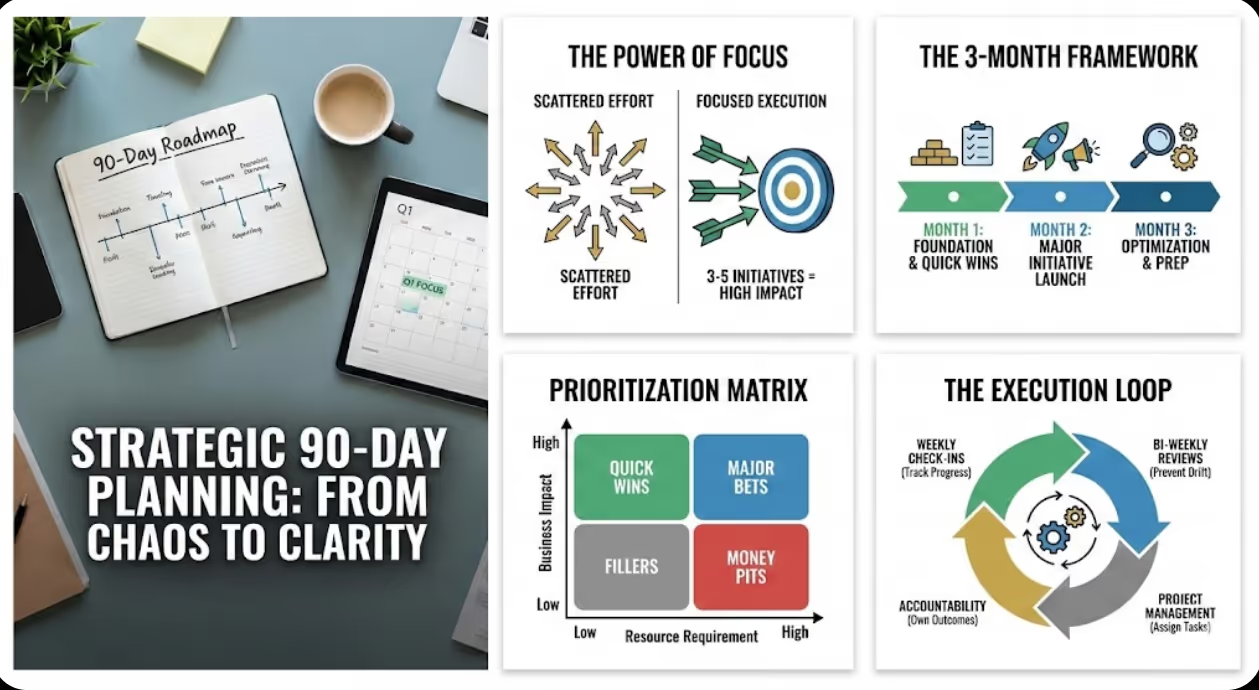
Why 90-Day Planning Works
Quarterly cycles match business reality. Annual plans are too long—market conditions shift substantially within 12 months. Monthly plans are too short—most meaningful initiatives require 6-12 weeks to implement and generate results.
Ninety days provides the sweet spot: sufficient time to complete substantial projects while remaining adaptable.
Psychological advantages multiply success probability. Humans struggle maintaining focus beyond 90 days but can sustain effort through quarterly sprints. The finish line feels achievable.
Measurable progress builds momentum. Completing quarterly roadmaps creates confidence. Each quarter's successes inform smarter planning for subsequent periods.
Agile responsiveness prevents obsolescence. Markets shift and opportunities arise. Quarterly planning allows course correction every 90 days rather than following obsolete annual plans.
Pre-Planning: Assessment and Goal Setting
Current state analysis establishes your starting point:
Audit existing digital presence: Website traffic and conversions, SEO rankings, social media engagement, email metrics, paid advertising ROAS, content performance.
Competitive landscape assessment: What are competitors doing well? Where are they vulnerable? What tactics are working in your industry?
Resource inventory:
- Team capacity: Hours available for execution
- Budget availability: Actual dollars allocable
- Skills assessment: In-house capabilities vs outsourcing needs
- Technology stack: Available platforms and tools
Business objective alignment ensures marketing serves commercial goals:
- Revenue targets
- Lead generation goals
- Brand awareness objectives
- Customer retention targets
- Operational efficiency improvements
The 90-Day Roadmap Framework
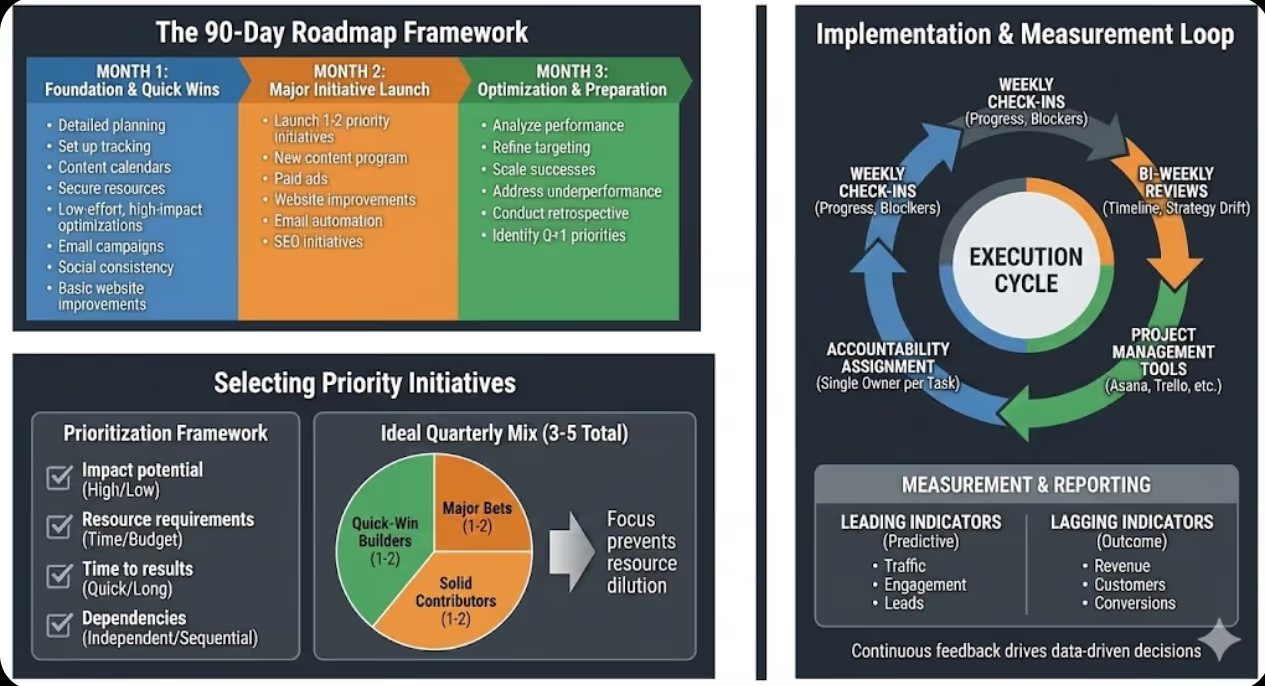
Month 1: Foundation and Quick Wins
Focus on foundational work and quick-win tactics generating early momentum.
Foundation activities:
- Complete detailed planning for larger initiatives
- Set up tracking infrastructure
- Establish content calendars and timelines
- Secure required resources and approvals
Quick wins:
- Low-effort, high-impact optimizations
- Email campaigns to existing database
- Social media posting consistency
- Basic website conversion improvements
- Existing campaign optimization
Month 2: Major Initiative Launch
Launch your 1-2 highest-priority initiatives requiring substantial effort:
- New content marketing program
- Paid advertising campaigns
- Website improvements
- Email automation sequences
- SEO initiatives
Focus prevents resource dilution. Launching one initiative well outperforms half-implementing three simultaneously.
Month 3: Optimization and Preparation
Use final month for optimization and next quarter preparation.
Optimization: Analyze performance data, refine targeting/messaging, scale successes, address underperformance, document learnings.
Preparation: Conduct retrospective, identify Q+1 priorities, begin foundational work for next projects, update documentation.
Selecting Your 3-5 Priority Initiatives
Limit yourself to 3-5 major initiatives per quarter. Forced prioritization ensures focused execution.
Prioritization framework evaluates:
Impact potential: How significantly would success affect business objectives?
Resource requirements: How much time, budget, expertise required?
Time to results: How quickly will this generate outcomes?
Dependencies: Can it proceed independently or does it require other initiatives first?
Ideal quarterly mix:
- 1-2 high-impact, high-resource initiatives (major bets)
- 1-2 medium-impact, moderate-resource initiatives (solid contributors)
- 1-2 low-resource, quick-win initiatives (momentum builders)
Common mistakes:
- Planning more work than capacity allows
- Choosing initiatives without clear success metrics
- Neglecting prerequisite work
Creating Your Roadmap Document
Essential components:
Executive summary: Quarter objectives, focus areas, expected outcomes, resource allocation, success metrics.
Initiative details:
- Initiative name and objective
- Success metrics and targets
- Key activities and milestones
- Resource requirements
- Owner/responsible party
- Timeline and deadlines
- Dependencies and risks
Calendar view: Visual timeline showing when activities occur.
Measurement dashboard: Centralized view of all KPIs, baselines, and targets.
Weekly checkpoint template: Simple format for tracking progress and flagging blockers.
Keep roadmaps concise—10-15 pages maximum. Create in accessible formats (Google Docs, shared drives, project tools) enabling easy reference.
Implementation: From Plan to Execution
Weekly team check-ins (30 minutes) reviewing:
- Progress since last check-in
- Blockers and challenges
- Priorities for coming week
- Resource needs
Bi-weekly plan reviews catch drift before it derails quarters:
- Are initiatives tracking to timeline?
- Do priorities still make strategic sense?
- Are resource allocations working?
- Should anything be adjusted?
Project management tooling transforms plans into tasks. Popular options: Asana, Trello, Monday.com, ClickUp, Notion.
Accountability assignment: Every task needs a single owner—the person responsible for ensuring it happens.
Measurement and Reporting
Leading vs lagging indicators: Track both. Leading indicators (traffic, engagement, leads) predict outcomes and respond quickly. Lagging indicators (revenue, customers, conversions) measure ultimate outcomes.
Initiative-specific KPIs (2-4 metrics per initiative):
Content marketing:
- Publish 24 blog posts (activity)
- Generate 2,500 organic sessions monthly (traffic)
- Achieve 3.5%+ conversion rate (conversion)
- Generate 60 content-attributed leads (outcome)
Monthly reporting (1-2 pages):
- Overall quarter progress
- Initiative-by-initiative status
- Key wins and achievements
- Challenges and blockers
- Data highlights
- Planned adjustments
Case Study: Sydney Professional Services Firm
A Sydney consulting firm approached digital marketing chaotically, with partners demanding random tactics. Results were poor: scattered content, inconsistent social, underperforming ads, no measurable ROI.
In Q1 2024, new leadership implemented quarterly planning with three focused initiatives: content foundation (LinkedIn articles, comprehensive guides), email revival (segmentation, monthly newsletter, automation), and LinkedIn presence (3x weekly posts, partner sharing).
Q1 Results: Generated 1,240 organic sessions (24% above target), 34 content leads. Email open rate 31%, 12 enquiries attributed. LinkedIn grew to 680 followers, 5.1% engagement. Three new clients: $127,000 project value.
Q2 built on success with podcast launch, paid LinkedIn ads, and marketing automation.
6-month impact: Marketing-attributed revenue $345,000 vs. $47,000 spend = 7.3x ROI. Marketing evolved from chaotic firefighting to strategic execution.
Case Study: Brisbane E-commerce Retailer
A Brisbane homewares store struggled with overwhelm, identifying 22 "urgent priorities" for Q1. Spreading effort across 22 priorities meant nothing received adequate attention.
Q2 planning reduced to 3 focused initiatives: email automation foundation, website conversion optimization, and customer retention program.
Q2 Results: Email revenue increased from 8% to 21% of total. Site conversion improved from 1.4% to 2.4%. Repeat purchase rate reached 31% (toward 35% target). Revenue increased 28% vs Q1 despite identical traffic. Average order value increased 12%.
Founder's insight: "Saying no to 19 'priorities' to focus intensely on 3 felt terrifying. Finishing 3 things well beats starting 22 poorly."
Frequently Asked Questions
Should small businesses with limited resources still create 90-day roadmaps?
Absolutely—smaller businesses benefit even more because limited resources make strategic allocation critical. With constrained capacity, you can't afford scattered effort. A simple roadmap might include just 2-3 initiatives with realistic timelines. Even solo marketers benefit from quarterly planning—it transforms reactive scrambling into intentional progress. Start simple: one-page roadmap listing 2-3 priorities, key milestones, success metrics.
How do you handle urgent requests that disrupt quarterly roadmaps?
Build buffer capacity (20-30% of time) for unexpected demands. When urgent requests arise, evaluate against roadmap priorities: Is this truly urgent? Does it serve quarter objectives better than planned initiatives? What's the opportunity cost? For genuinely urgent requests, consciously decide what roadmap element to pause rather than simply adding work. Communicate trade-offs to stakeholders. Protect roadmap time fiercely while remaining strategically flexible.
When should you completely revise roadmaps versus making minor adjustments?
Make minor adjustments (tweaking timelines, refining tactics) during bi-weekly reviews when data warrants. Completely revise mid-quarter only when fundamental assumptions break: major market disruption, significant business model change, dramatic underperformance, or unexpected opportunities requiring complete priority shift. These situations are rare. The discipline of seeing plans through generates learning even when tactics underperform. Balance flexibility with strategic persistence.
Build Your 90-Day Success System
Digital marketing success doesn't require genius tactics or unlimited budgets. It requires clear direction, focused execution, and disciplined accountability—exactly what 90-day roadmaps provide.
At Maven Marketing Co, we help Australian businesses develop and execute focused 90-day digital marketing roadmaps that generate measurable progress. We don't create aspirational planning documents—we build executable roadmaps, support implementation, and drive accountability throughout the quarter.
Contact Maven Marketing Co today to develop your next 90-day digital marketing roadmap. We'll assess your current state, identify high-impact priorities, and create the focused plan that transforms digital marketing from chaotic reaction to strategic execution.

Table of contents
read more blogs
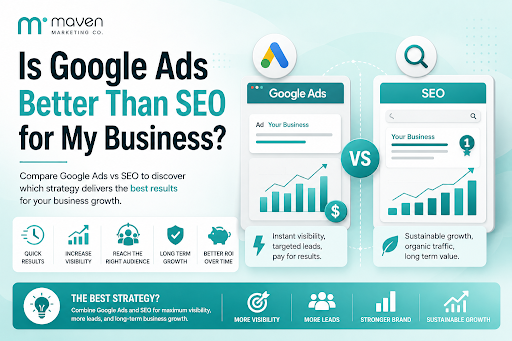
Is Google Ads Better Than SEO for My Business
One of the biggest questions business owners ask when they are planning online growth is whether they should invest in Google Ads or SEO. Both are strong marketing plays that help your company show up in Google search results, but they do things in separate lanes. Google Ads gives quicker visibility and can bring in leads fast, whereas SEO more or less focuses on slow, steady organic traffic that tends to grow the longer you keep building it. Picking the right direction depends on what you want to achieve, how much money you can spend, how crowded the market is, and how quickly you need results, like sooner rather than later. The good news is you don’t always have to choose one or the other; it’s not exactly a black-and-white situation. If you take time to understand the strongest points of both, you can put together a more sensible digital marketing plan that supports consistent expansion. In this guide, we’ll compare Google Ads vs SEO, explain the main differences, and help you figure out what option makes the most sense for your business.

When Should I Hire a Digital Marketing Agency
Growing a business today takes more than just having a website or throwing a post on social media; customers usually search around online, compare providers, skim reviews, and basically expect the brand to show up with a solid digital presence before they even think about buying. Many businesses try to run their marketing themselves, but there comes a point when “doing it all in-house” becomes clunky and hard to manage, all at once. Knowing when to hire a digital marketing agency can end up making a big, real difference for your growth. If you’re not getting enough leads, or your online visibility feels stuck, or sales are just not moving, the right agency can bring the know-how, plus a clear plan, to help you get noticeably better outcomes. In this guide, we’ll dig into what a digital marketing agency actually does, the usual signs it’s time to bring one on, and how picking the right marketing partner can help your business move forward at a faster pace.
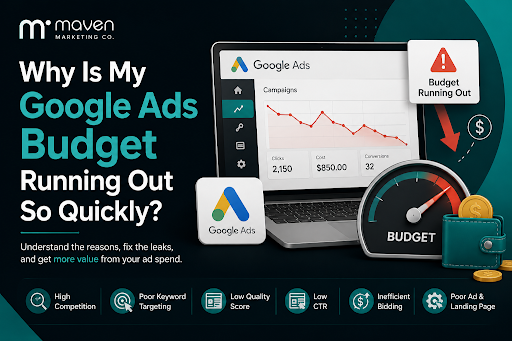
Why Is My Google Ads Budget Running Out So Quickly
Running a successful Google Ads budget isn’t only about throwing more money at it. It’s more like making every dollar, doing a bit extra. A lot of businesses start a Google Ads campaign with big hopes, then find out their daily budget is gone within a few hours, and that feels weird, right? After that, your ads stop showing effectively, new leads slip away, and your return on investment dips. So if your Google Ads budget is running out too fast, don’t stress. It’s a fairly common issue, and in most situations, it can be repaired with the right approach. There are multiple little things that can drain your advertising money quicker than you expected, from costly keywords to audience targeting that just doesn’t quite fit. In this guide, we’ll walk through why your budget disappears so quickly, how to cut wasteful spend, and the most reliable ways to boost your Google Ads ROI, even if your budget stays the same.