.svg)


%201.svg)

Key Takeaways
- Effective value propositions answer three questions in 10 seconds or less: What do you do? Who do you serve? Why should they choose you?
- Generic benefit claims create no differentiation, with 73% of businesses claiming identical attributes (quality, service, expertise) that prospects dismiss
- Specificity creates credibility and memorability, with concrete value propositions outperforming vague promises by 2.9x in customer recall and 3.4x in purchase intent
- Customer perspective trumps company perspective, with value propositions framed around outcomes converting 47% better than those focused on capabilities
- True differentiation comes from strategic trade-offs, with businesses saying "we're not for everyone" creating stronger positioning than those appealing to all equally
Walk into any Brisbane suburb and businesses desperately trying to differentiate sound exactly like competitors. The accounting firm promising "expert tax advice." The marketing agency offering "data-driven strategies." The cafe serving "quality coffee."
These aren't value propositions—they're participation trophies. The minimum required to compete, not reasons to win.
If your value proposition could work for any competitor by changing the company name, it's generic positioning creating zero advantage.
Understanding Value Propositions
Value proposition is the primary reason prospects should buy from you rather than competitors. It answers "why you?" instantly.
Mission statement describes organisational purpose (internal-facing). Tagline is memorable phrase associated with brand. Elevator pitch is 30-60 second verbal summary. USP focuses on single differentiating feature.
Value propositions sit at the intersection of what customers need, what you deliver uniquely well, and what competitors can't or won't match.

The Anatomy of Compelling Value Propositions
Clarity over creativity. Boring clarity beats clever confusion.
Customer-centric framing. "We help Melbourne retailers increase repeat purchases by 35%" beats "We're a customer retention consultancy with 15 years experience."
Specificity creates credibility. "We help food manufacturers reduce ingredient waste by 18-24% through real-time inventory optimization" is believable. "We reduce manufacturing waste" is vague.
Differentiation must be meaningful. Being different in ways customers don't value creates no advantage.
Proof and substantiation. Incorporate customer results, specific methodologies, measurable outcomes.
Identifying Genuine Differentiation
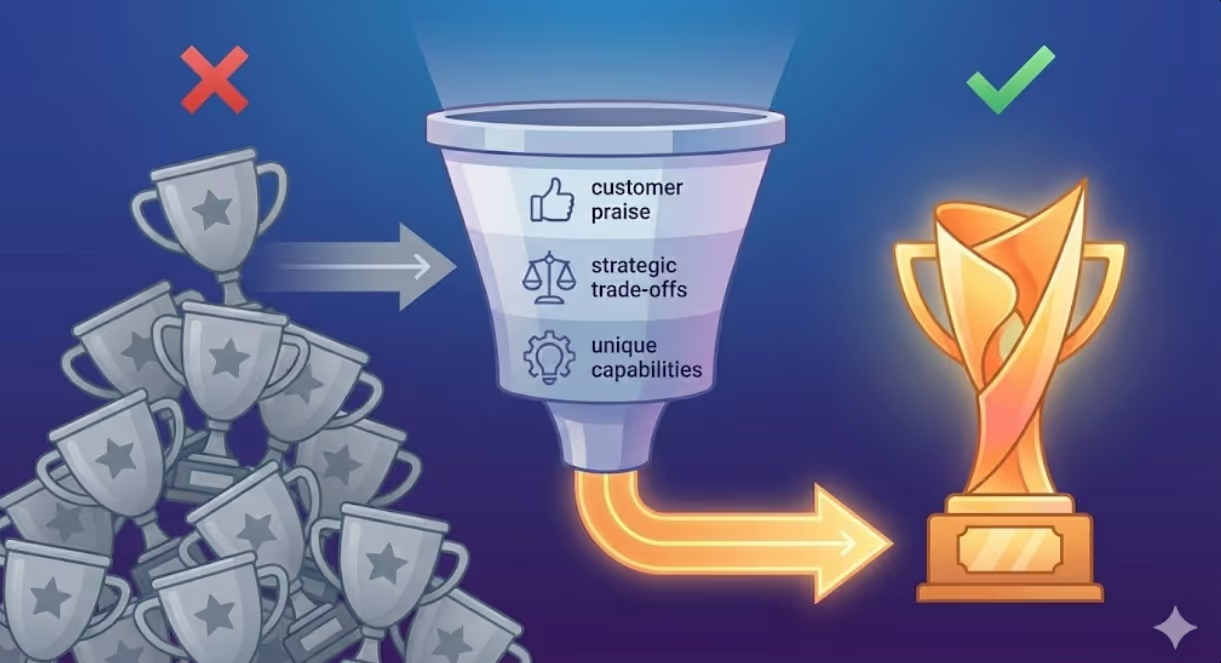
What you're good at isn't differentiation. Quality, service, expertise—table stakes. Everyone claims them.
Differentiation discovery questions:
What do customers praise about you they don't mention about competitors? What customers choose you despite higher prices—what do they value? What do you refuse to do that competitors accept? What can you deliver that competitors can't due to unique capabilities? What trade-offs have you made competitors haven't?
Warning signs of false differentiation:
Any competitor could claim same thing. Differentiation based solely on "we care more." You differentiate on everything (which means nothing). Differentiation addresses factors customers don't care about. You can't prove claimed difference.
Crafting Your Value Proposition Statement
Structure: [Customer segment] who [customer pain], [your company] provides [offering] that [key benefit] unlike [alternatives] which [competitor limitation].
Example for Melbourne e-commerce accounting:
"For e-commerce businesses struggling with multi-state sales tax compliance, TaxClear provides automated tax calculation and filing that eliminates audit risk and saves 15+ hours monthly, unlike traditional accountants who charge hourly for manual compliance that's error-prone and time-consuming."
Alternative structure: We help [segment] [achieve outcome] through [unique approach] so they can [ultimate benefit].
"We help Brisbane cafes reduce food waste by 40% through predictive inventory management so they can increase profitability while supporting sustainability."
One-sentence test: If you can't articulate in one clear sentence, it's not focused enough.
Differentiation Strategy Selection
Operational excellence: Compete on efficiency, reliability, price. Product leadership: Compete on innovation, features, quality. Customer intimacy: Compete on deep understanding and customisation. Niche specialisation: Dominate specific market segment.
For most Australian SMBs, customer intimacy or niche specialisation offer the most sustainable differentiation.
Testing Your Value Proposition
5-second test: Show unfamiliar person for 5 seconds. Can they articulate what you do, who you serve, why you're different?
Substitute test: Replace your name with competitor's. Does it still work? If yes, it's not differentiated.
Customer language test: Do customers describe needs using your language?
Competitive comparison: Place alongside competitors'. Does yours stand out meaningfully?
A/B testing: Test variations in headlines, landing pages, ad copy.

Case Study: Brisbane Web Development Agency
A Brisbane web agency competed in "we build websites" market. Value proposition: "We create beautiful, functional websites that drive results."
This positioned them identically to hundreds of competitors. Projects were one-off, revenue unpredictable, margins thin.
Analysis revealed: Happiest clients were real estate agencies. Team had built 40+ real estate websites—more than any other type.
Strategic decision: Specialise exclusively in real estate.
New value proposition:
"We build lead-generating websites exclusively for Queensland real estate agencies that integrate seamlessly with your property management software and typically generate 40%+ more qualified leads than generic business websites."
Results after 12 months:
Average project value increased from $8,500 to $18,200. Win rate improved from 18% to 67%. Customer lifetime value increased 340%. Revenue increased 180%.
Founder: "Before, we competed against everyone. After specialisation, we became the obvious choice for real estate agencies."
Case Study: Sydney Bookkeeping Service
A Sydney bookkeeper struggled with commoditisation. Value proposition: "Accurate, reliable bookkeeping services for small businesses."
Clients saw bookkeeping as necessary expense. Price pressure was constant. Churn was high.
Customer interviews revealed: Clients valued outcomes accurate bookkeeping enabled—confident decisions, stress-free tax time, early cash flow problem identification.
Strategic repositioning:
Sell business intelligence and financial confidence (valued outcomes) vs bookkeeping (commoditised service).
New value proposition:
"We turn your financial data into confident business decisions. Through weekly financial intelligence briefings and proactive cash flow alerts, you'll always know exactly where your business stands financially—never surprised by tax bills or cash crunches."
Results after 9 months:
Average retainer increased from $420 to $780. Client retention improved from 68% to 94%. Revenue per client increased 86% while workload increased only 12%.
Owner: "We were selling what we did—bookkeeping. Nobody values bookkeeping. When we shifted to selling what clients got—financial confidence—everything changed."
Common Mistakes
Being everything to everyone. Dilution destroys differentiation.
Feature-focused vs benefit-focused. "Advanced CRM technology" describes features. "Never lose track of customer conversations" describes benefits.
Vague superiority claims. "Better service" is meaningless without specificity.
Copying competitor language. If everyone uses identical terminology, differentiation is impossible.
Forgetting substantiation. Bold claims without proof are dismissed.
Internal perspective. "25 years in business" only matters if customers care about longevity.
Frequently Asked Questions
Can service businesses in commoditised industries really differentiate?
Absolutely. Service differentiation comes from approach, expertise, outcomes, experience. A Brisbane plumber differentiates through specialisation (commercial vs residential), service model (subscription vs emergency-only), customer experience (real-time tracking, flat-rate pricing), or outcomes (first-time fix rates, response times). Interview customers who pay premium prices—what do they value? That's differentiation potential.
How specific should value propositions be about target customers?
As specific as commercially viable. "Melbourne retail stores with 2-5 locations" resonates more than "small businesses." Balance specificity with market size. Start broader, narrow based on strongest resonance and commercial viability. Test: if making more specific increases win rates and deal values, keep narrowing until metrics plateau.
Should value propositions mention competitors explicitly?
Avoid naming competitors directly, but reference competitive alternatives. "Unlike traditional agencies that charge hourly..." works better than naming competitors. Direct mentions can appear unprofessional. Focus on your strengths versus alternative methods rather than attacking competitors.
Craft Your Competitive Edge
Value propositions are strategic business decisions determining who you serve, how you compete, and why customers choose you.
At Maven Marketing Co, we help Australian businesses craft value propositions creating genuine differentiation. We conduct strategic analysis identifying what makes you different, validate with customer research, and articulate positioning resonating with ideal customers.
Contact Maven Marketing Co today to develop your value proposition. We'll interview customers, analyse your competitive landscape, identify genuine differentiators, and craft the value proposition transforming your business from "another option" to "the obvious choice."

Table of contents
read more blogs
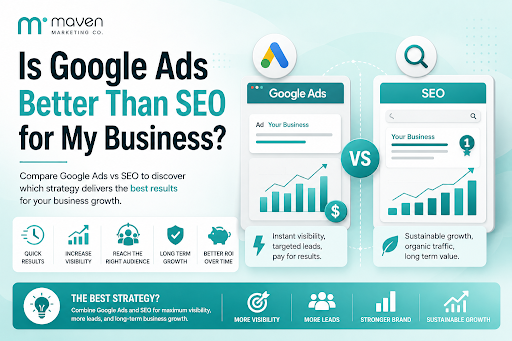
Is Google Ads Better Than SEO for My Business
One of the biggest questions business owners ask when they are planning online growth is whether they should invest in Google Ads or SEO. Both are strong marketing plays that help your company show up in Google search results, but they do things in separate lanes. Google Ads gives quicker visibility and can bring in leads fast, whereas SEO more or less focuses on slow, steady organic traffic that tends to grow the longer you keep building it. Picking the right direction depends on what you want to achieve, how much money you can spend, how crowded the market is, and how quickly you need results, like sooner rather than later. The good news is you don’t always have to choose one or the other; it’s not exactly a black-and-white situation. If you take time to understand the strongest points of both, you can put together a more sensible digital marketing plan that supports consistent expansion. In this guide, we’ll compare Google Ads vs SEO, explain the main differences, and help you figure out what option makes the most sense for your business.

When Should I Hire a Digital Marketing Agency
Growing a business today takes more than just having a website or throwing a post on social media; customers usually search around online, compare providers, skim reviews, and basically expect the brand to show up with a solid digital presence before they even think about buying. Many businesses try to run their marketing themselves, but there comes a point when “doing it all in-house” becomes clunky and hard to manage, all at once. Knowing when to hire a digital marketing agency can end up making a big, real difference for your growth. If you’re not getting enough leads, or your online visibility feels stuck, or sales are just not moving, the right agency can bring the know-how, plus a clear plan, to help you get noticeably better outcomes. In this guide, we’ll dig into what a digital marketing agency actually does, the usual signs it’s time to bring one on, and how picking the right marketing partner can help your business move forward at a faster pace.
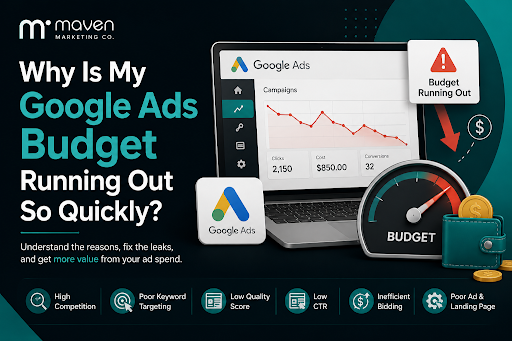
Why Is My Google Ads Budget Running Out So Quickly
Running a successful Google Ads budget isn’t only about throwing more money at it. It’s more like making every dollar, doing a bit extra. A lot of businesses start a Google Ads campaign with big hopes, then find out their daily budget is gone within a few hours, and that feels weird, right? After that, your ads stop showing effectively, new leads slip away, and your return on investment dips. So if your Google Ads budget is running out too fast, don’t stress. It’s a fairly common issue, and in most situations, it can be repaired with the right approach. There are multiple little things that can drain your advertising money quicker than you expected, from costly keywords to audience targeting that just doesn’t quite fit. In this guide, we’ll walk through why your budget disappears so quickly, how to cut wasteful spend, and the most reliable ways to boost your Google Ads ROI, even if your budget stays the same.