.svg)


%201.svg)
Key Takeaways
- Business cards remain strategically valuable in 2026 by creating tangible brand impressions, facilitating relationship building through physical exchange rituals, and serving as visual reminders that digital contacts alone don't provide
- Effective modern business card design balances essential contact information with white space, strategic typography, and thoughtful material choices while avoiding information overload that reduces impact and usability
- Digital integration through QR codes, NFC chips, and augmented reality bridges physical cards with digital profiles, creating seamless connection experiences that combine tactile impact with digital convenience
- Premium materials, finishes, and structural innovations justify business card investment by communicating quality, creating memorable sensory experiences, and differentiating in commodity-dominated professional service categories
- Strategic distribution focuses on quality interactions over quantity dispersal, using business cards as conversation tools, follow-up mechanisms, and relationship development assets rather than mass marketing materials
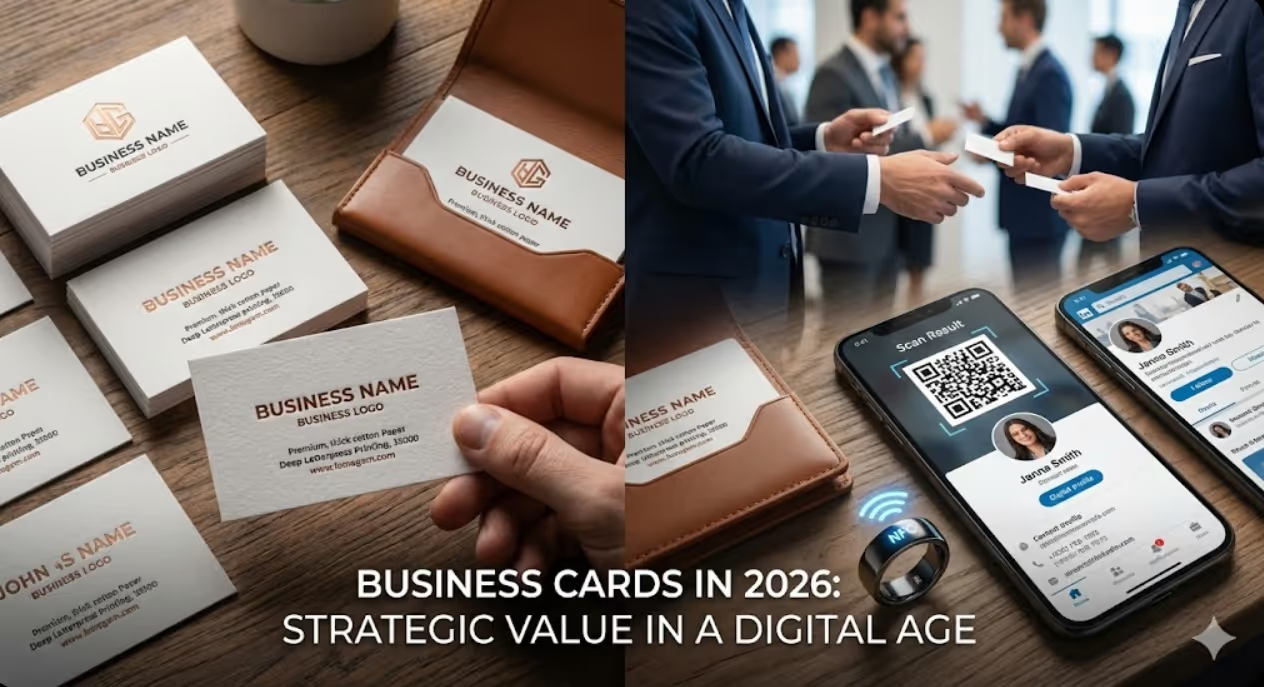
The first time someone hands you a business card printed on thick cotton paper with letterpress indentation you can feel, embossed metallic foil catching light, and a subtle texture that demands to be touched, you understand immediately that this person values quality, pays attention to details, and takes their professional identity seriously. Digital contact exchange creates none of these impressions.
Yet scroll through business networking discussions and you'll find confident declarations that business cards are dead, replaced by LinkedIn connections, digital contact sharing, and QR code scanners. The reality is more nuanced. Bad business cards—flimsy stock with cluttered information and outdated design—deserve obsolescence. Strategic business cards that deliver value and create memorable impressions remain powerful networking tools.
Australian businesses face a choice: abandon physical business cards entirely for digital alternatives, or invest in exceptional cards that justify their continued existence. The middle ground—mediocre cards that neither impress nor serve clear purpose—wastes money while undermining professional image.
Why Business Cards Still Matter in 2026
Despite digital transformation across business communication, physical business cards deliver specific advantages that digital alternatives struggle to replicate.
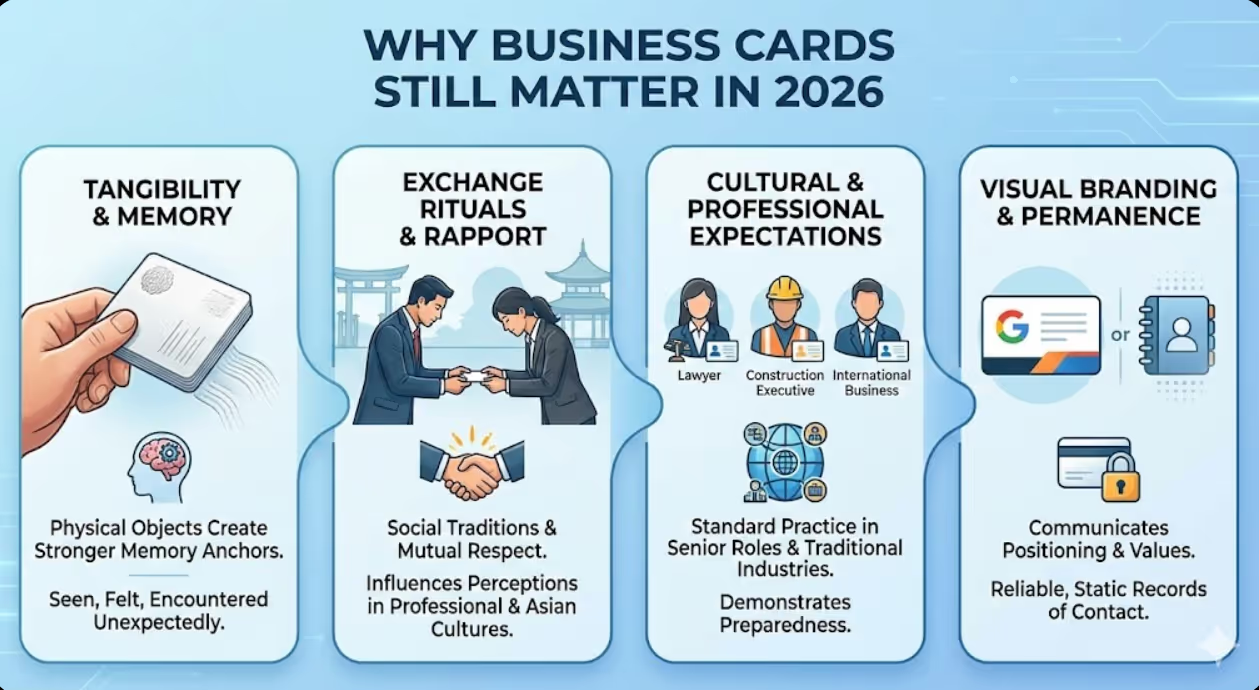
Tangibility creates memory anchors that digital contacts don't provide. Physical objects occupy space in the real world, creating stronger memory traces than digital information. When you hand someone a business card, you create a physical artifact they can see on their desk, feel in their pocket, or encounter unexpectedly in their wallet days later. Each physical encounter reinforces your memory and relationship in ways that buried digital contacts don't achieve.
Exchange rituals build rapport through social traditions that digital sharing skips. The physical exchange of business cards, particularly in professional contexts, creates a moment of acknowledgment and mutual respect. In many Asian business cultures represented strongly in Australian markets, business card exchange follows specific etiquette that demonstrates respect and seriousness. Research from the Japan External Trade Organization shows that proper business card exchange significantly influences initial business relationship perceptions in Japanese business culture, relevant for Australian businesses engaging with Asian markets.
Cultural expectations persist in many industries and demographics. Senior executives, traditional professions (law, finance, construction), and international business contexts often expect business card exchange as standard professional practice. Arriving at networking events or business meetings without cards can appear unprepared or dismissive of conventions in these contexts.
Visual branding extends beyond information to communicate positioning and values. Your business card design—colour choices, material quality, finish sophistication, structural innovation—communicates brand positioning instantly. A lawyer's heavy card stock with embossed firm name signals established authority differently than a startup founder's minimalist card with QR code focus. These design choices communicate before words are read.
Information permanence provides reliability that digital alternatives sometimes lack. Phone numbers change, email addresses update, but business cards remain static records of contact information at time of exchange. When digital profiles update or social platforms change, physical cards preserve original contact methods.
Decision friction differs between physical and digital contexts. Throwing away a physical business card someone handed you personally creates more psychological resistance than deleting a digital contact. This friction increases the likelihood that cards remain visible and accessible, extending their influence beyond initial exchange.
Serendipitous rediscovery happens with physical objects in ways digital contacts buried in phone lists don't experience. Finding a business card in a jacket pocket months after an event can trigger follow-up or remind you of a connection at opportune moment. Digital contacts require active searching to rediscover.
Essential Design Principles for Modern Business Cards
Effective business card design balances information delivery, visual impact, and brand communication within severe space constraints.
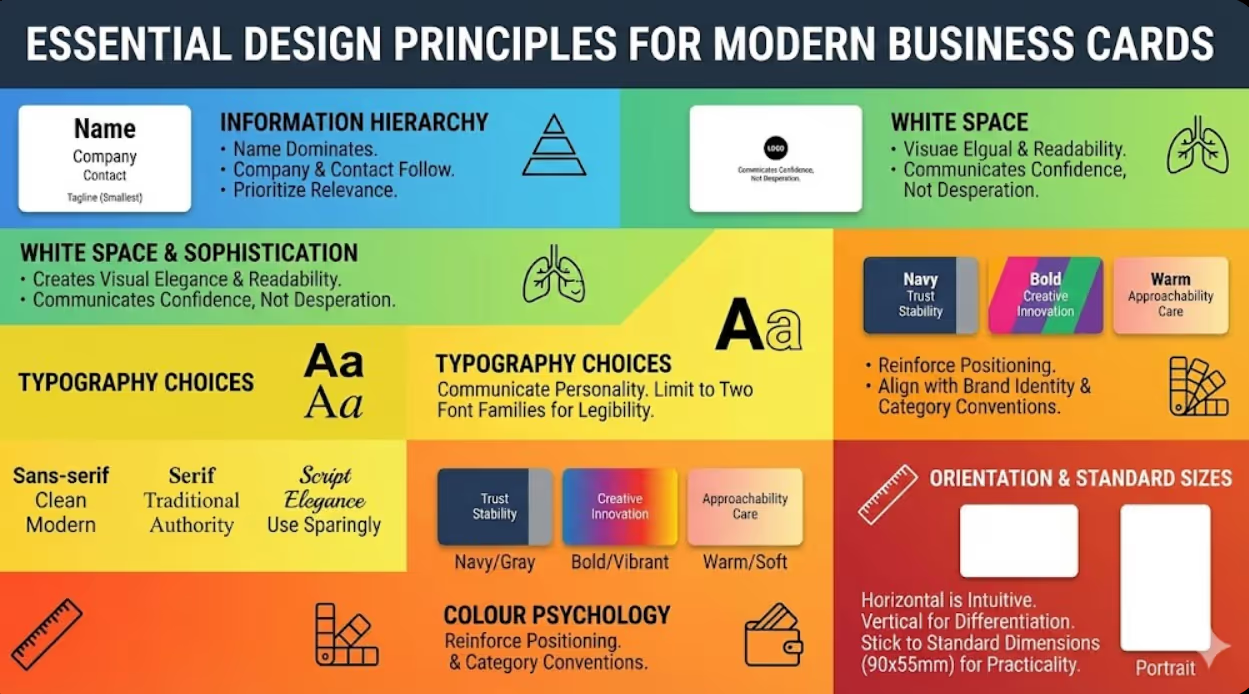
Information hierarchy determines usability. Your name should dominate—if recipients remember nothing else, they should remember who you are. Company or personal brand follows, establishing context for the relationship. Contact information comes next, prioritizing methods most relevant to your business context. Job titles, taglines, or credential letters appear smaller, providing context without overwhelming primary information.
White space creates sophistication and improves readability. Cramming every available millimeter with information makes cards difficult to parse and feel desperate. Strategic emptiness allows important elements to breathe, communicates confidence that you don't need to explain everything simultaneously, and creates visual elegance that commands respect. Premium brands use extensive white space to project luxury and refinement.
Typography choices communicate personality and ensure legibility. Sans-serif fonts generally provide cleaner, more contemporary feel while offering excellent readability at small sizes. Serif fonts suggest tradition, authority, or craftsmanship depending on style. Script fonts communicate elegance or creativity but sacrifice readability and risk appearing unprofessional if poorly executed. Limit yourself to two font families maximum—one for your name/brand, another for supporting information.
Colour psychology reinforces positioning. Conservative professionals (lawyers, accountants, financial advisors) often use blacks, navies, and grays suggesting stability and trustworthiness. Creative professionals leverage bold colours communicating personality and innovation. Service businesses might use warmer colours implying approachability and care. Your card colours should align with broader brand identity while considering category conventions and differentiation opportunities.
Logo placement and sizing creates brand recognition without overwhelming. Logos typically appear in corners or along edges, prominent enough for recognition but not dominating to the point of obscuring contact information. Oversized logos feel egotistical and waste space better used for information. Undersized logos become invisible and miss branding opportunities.
Two-sided design maximizes space efficiency when thoughtfully executed. Front-focused design places essential information (name, company, primary contact) on front, with supporting details (additional contacts, social media, tagline) on back. This approach maintains clean front design while accommodating comprehensive information. However, two-sided cards cost slightly more to print and risk important information being overlooked if recipients don't flip cards.
Orientation conventions guide reader expectations. Horizontal orientation (landscape) represents standard expectation, making information finding intuitive. Vertical orientation (portrait) creates differentiation and can suit specific design approaches, but feels unconventional enough that some recipients find it awkward to file or store. Choose based on whether differentiation value outweighs convention benefits.
Readability trumps creativity in size decisions. Standard business card dimensions (90mm x 55mm in Australia, following international standards) fit standard wallets and card holders. Creative size variations (mini cards, oversized cards, non-rectangular shapes) create impact but reduce practical usability. Business cards that don't fit standard storage often get discarded regardless of design quality.
Material and Finish Choices That Create Impact
Beyond graphic design, material and production choices dramatically influence how business cards are perceived and remembered.
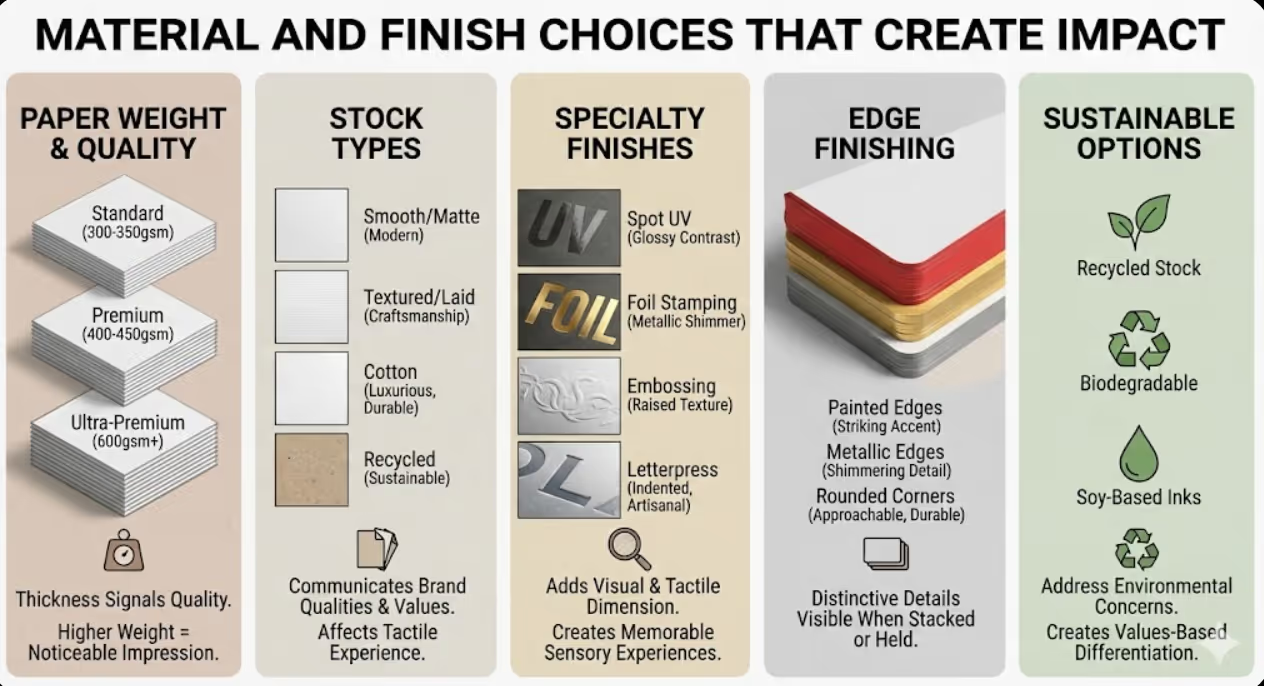
Paper weight signals quality through tactile experience. Standard business cards use 300-350gsm (grams per square metre) stock, providing adequate substance without premium feel. Upgrading to 400-450gsm creates noticeable quality impression through thickness and weight. Ultra-premium cards can reach 600gsm+, feeling almost like thin cardboard and communicating serious investment in professional image. The jump from standard to premium stock typically adds 30-50% to printing costs but significantly increases perceived value.
Paper stock types communicate different brand qualities. Smooth, bright white stock feels modern and clean, ideal for minimalist designs and vibrant colour reproduction. Textured or laid stock adds tactile interest and suggests craftsmanship. Off-white or cream stock feels classic and sophisticated. Recycled stock with visible fibers communicates environmental values. Cotton stock (made from cotton fibers rather than wood pulp) provides luxurious feel and durability while accepting letterpress beautifully.
Specialty finishes add visual and tactile dimension that standard printing can't achieve. Spot UV coating applies glossy varnish to specific design elements, creating contrast between matte and glossy surfaces that catches light and invites touch. Foil stamping uses metallic or holographic foils pressed into card stock, creating premium shimmer impossible with standard printing. Embossing raises design elements above card surface through pressing, creating subtle shadows and tactile texture. Debossing indents elements below surface, offering similar impact. Letterpress creates deeply impressed text through traditional printing technique, providing unmatched tactile quality and artisanal appeal.
Edge finishing adds distinctive details. Standard cut edges are clean but unremarkable. Painted edges apply colour to card edges, creating striking accent visible when cards are stacked or held. Metallic edges use foiling techniques for eye-catching shimmer. Rounded corners soften card appearance and feel, creating approachable impression while reducing corner damage during carrying.
Specialty structures create memorable physical forms. Die-cut cards use custom shapes or cutouts, creating distinctive silhouettes that stand out in card collections. Folded cards double available surface area, allowing more information or creative reveal experiences. Layered cards bond multiple stock layers creating dimensional effects or colour-edge reveals. Metal cards (steel, copper, or aluminum) create extreme premium impression for luxury brands or industries where durability and distinction justify significant cost.
Sustainable options address environmental concerns while potentially creating differentiation. Recycled stock, biodegradable materials, soy-based inks, and local printing all reduce environmental impact. Research from Two Sides Australia shows that 65% of Australian business professionals view sustainable business cards positively, creating opportunity for values-based differentiation without sacrificing quality when premium sustainable options are chosen.
Cost versus value calculation determines appropriate investment. Standard digital printing on basic stock costs $50-$100 per 500 cards. Premium stock with specialty finishes ranges $150-$400 per 500. Ultra-premium letterpress or metal cards can exceed $1,000 per 500. The question isn't absolute cost but return on investment through enhanced perception, memorability, and relationship building. Businesses where first impressions directly influence revenue (consultants, real estate agents, luxury service providers) often find premium card investment pays for itself through single client acquisition.
Integrating Digital Functionality into Physical Cards
Modern business cards bridge physical and digital worlds through technologies that make cards interactive gateways to comprehensive online presence.
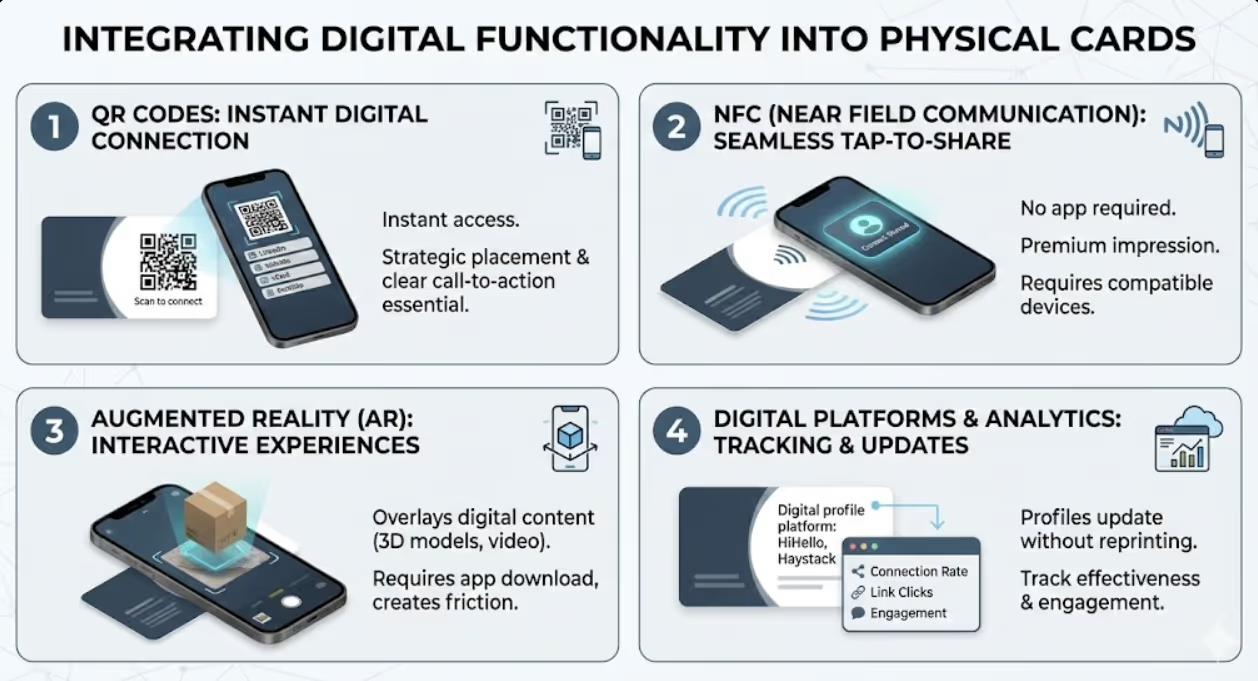
QR codes provide instant digital connection when scanned with smartphone cameras. QR codes can link to websites, LinkedIn profiles, digital portfolios, contact information files (vCard format), or custom landing pages. Strategic QR implementation includes: prominent placement without overwhelming design, clear text indicating what scanning will access ("Scan to connect on LinkedIn" or "View portfolio"), sufficient size for reliable scanning (minimum 20mm square), and high-contrast colour scheme (dark code on light background or vice versa) for readability.
NFC (Near Field Communication) chips embedded in business cards enable contact sharing by tapping cards against NFC-enabled smartphones. NFC offers more seamless experience than QR codes (no app opening or camera pointing required) and creates impressive tech-forward impression. However, NFC cards cost significantly more ($2-$5+ per card versus pennies for QR codes) and require compatible smartphones (iPhones 7 and newer, most modern Android devices). NFC suits businesses positioning around innovation and targeting tech-savvy audiences.
Augmented Reality (AR) activation uses smartphone apps to overlay digital content when cards are viewed through camera. AR might display 3D product models, play video introductions, showcase portfolio work, or create interactive experiences. While impressive, AR requires recipients to download specific apps and creates friction that many won't overcome. AR works best for creative industries where innovative presentation justifies complexity or when cards support sales processes where guidance through AR experience is provided.
Custom landing pages linked from QR codes or NFC create dedicated connection experiences beyond generic social profiles. Landing pages might include extended bio, video introduction, case studies, portfolio showcase, calendar booking, or comprehensive contact methods. Custom pages allow personalization and tracking that generic links don't provide. However, they require ongoing maintenance—outdated landing pages undermine rather than enhance professional image.
Digital business card platforms like HiHello, CamCard, or Haystack create digital equivalents that can be updated without reprinting. Physical cards with QR links to digital card profiles combine tangible impact with information flexibility. When contact details change, digital profiles update without card reprinting. This hybrid approach maximizes advantages of both physical and digital approaches.
Analytics and tracking possible through digital integrations reveal card effectiveness. URL shorteners with tracking show how many recipients visit links. Digital platform analytics track connection rates and engagement. This data informs whether business cards drive intended follow-through and which networking contexts generate highest engagement.
Information overload prevention requires restraint with digital integration. Adding QR code, NFC chip, and social media icons can clutter cards and confuse recipients about intended next action. Choose one primary digital integration that serves your specific networking goals rather than cramming every possible technology onto cards.
Strategic Distribution and Networking Tactics
How you use business cards matters as much as design quality. Strategic distribution maximizes return on investment while building professional relationships effectively.
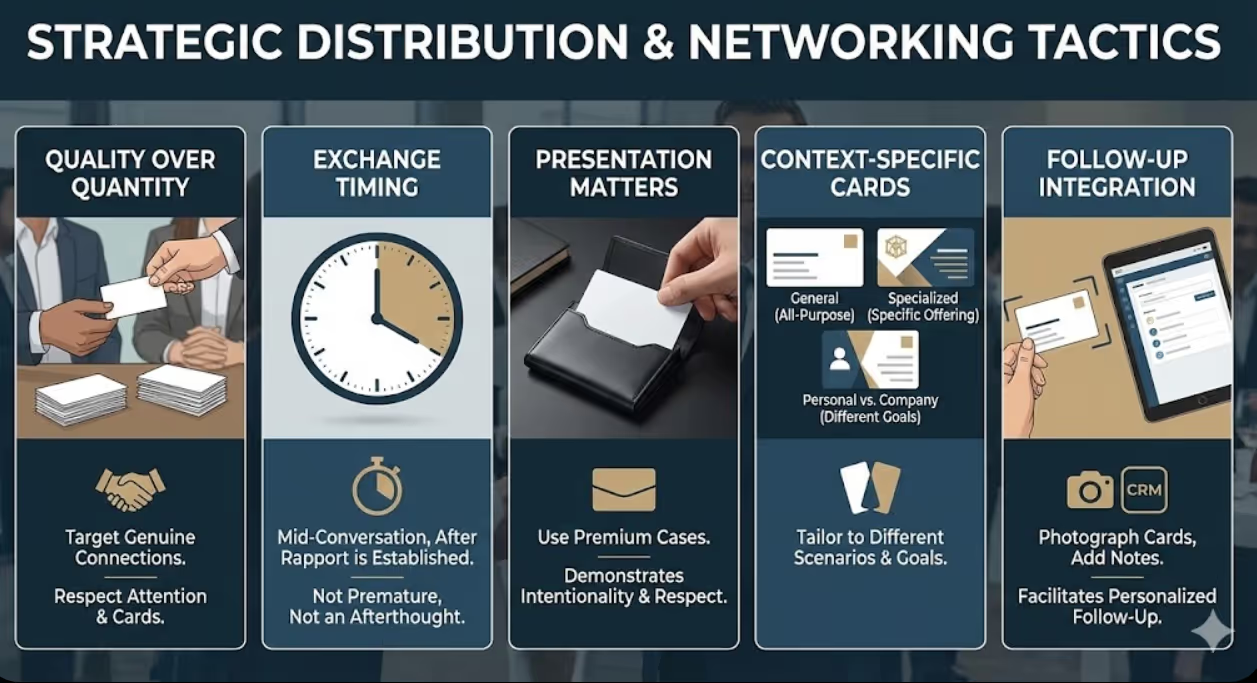
Quality over quantity should guide distribution philosophy. Handing cards to every person you encounter regardless of relationship potential wastes cards and cheapens their impact. Strategic distribution targets genuine connection opportunities where follow-up relationship building makes sense. This selective approach respects both your cards and recipients' attention.
Exchange timing influences effectiveness. Too early, before rapport is established, and cards feel pushy or premature. Too late, as conversations conclude rushed, and exchange feels obligatory afterthought. Optimal timing comes mid-conversation once mutual interest is established and specific follow-up reason exists. "I'd love to continue this conversation—may I give you my card?" feels natural and purposeful.
Presentation matters in exchange moment. Cards handed apologetically from worn cardholders or crushed from back pockets undermine quality impressions. Premium card cases protect cards while creating moment of intentionality as you retrieve and present cards. In Asian business culture, presenting cards with both hands while facing recipient and spending moment reviewing received cards demonstrates respect and attention.
Context-specific cards address different networking scenarios. General cards work for most situations. Specialized cards for specific offerings, events, or campaigns can include targeted messaging or calls-to-action. Personal cards versus company cards serve different purposes—entrepreneurs and consultants often carry both, using personal cards for individual networking and company cards for business development.
Follow-up integration transforms card exchange from transaction to relationship building. Photographing received cards immediately with notes about context prevents forgotten details. Entering contacts into CRM systems with conversation notes enables personalized follow-up. Referencing specific discussion points in follow-up emails demonstrates attention and builds connection. Business cards facilitate rather than conclude relationship development.
Event preparation ensures cards are available when opportunities arise. Carrying sufficient quantity (20-30 cards for typical networking event) prevents running out during productive conversations. Having cards in easily accessible location (jacket pocket, easily opened purse section) enables smooth exchange without fumbling. Checking card supply before events prevents discovering empty card cases at inopportune moments.
Digital supplement rather than replacement positions cards strategically. Use cards to initiate relationships, then move connections into digital ecosystem (LinkedIn, email list, CRM system) where ongoing engagement happens. Cards open doors; digital channels maintain relationships. This integration leverages strengths of both approaches.
Industry-Specific Business Card Strategies
Different industries and professional contexts require tailored approaches to business card design and usage.
Creative professionals (designers, photographers, artists) can push creative boundaries through unconventional materials, formats, or interactive elements that showcase their capabilities. Their cards function as mini-portfolios demonstrating design thinking and execution quality. However, creativity must remain functional—cards too avant-garde become conversation pieces rather than usable contact tools.
Professional services (lawyers, accountants, consultants) benefit from conservative, quality-focused design that communicates competence and trustworthiness. Premium materials and finishes justify premium pricing while demonstrating attention to detail. These industries often have internal cards for all staff and external cards for client-facing roles, with different design approaches for each context.
Sales professionals might include product information, QR codes to case studies, or compelling statistics that support their pitch. Cards become leave-behind sales tools that continue working after conversations end. However, they must avoid crossing into promotional flyer territory that feels less professional than relationship-building focused.
Executives and entrepreneurs often carry minimalist cards that project confidence through simplicity. Names might appear without job titles, suggesting their identity transcends specific roles. Premium materials and finishes match executive positioning. Email and phone might be only contact methods, avoiding clutter of social media icons or website URLs.
Real estate agents frequently use property photos, market statistics, or QR codes to listings. Cards need to stand out in competitive markets where prospects collect numerous agent cards. Photo inclusion (whether agent headshot or property imagery) aids recognition and creates talking points.
Healthcare practitioners must balance professionalism with approachability. Credentials (MD, DDS, specialist certifications) appear prominently. Contact information includes scheduling methods. Design communicates competence without clinical coldness that might feel uninviting.
Tradespeople and contractors often benefit from practical information—services list, service area, hours of operation. Durable card stock survives working environments. QR codes linking to photo galleries of completed projects showcase quality without requiring physical portfolios.
Frequently Asked Questions
Should Australian businesses invest in premium business cards with specialty finishes and materials or are standard digital-printed cards on basic stock sufficient for most professional networking situations?
The appropriate business card investment depends on your industry positioning, target market, and how first impressions influence business outcomes. Premium business cards with specialty finishes justify investment when your business competes on quality differentiation, targets affluent clients, or operates in industries where professionalism directly influences revenue (professional services, luxury goods, real estate, consulting). Research from the Business Card Industry Association found that 72% of recipients form impressions about companies based on business card quality alone, making cards significant brand touchpoints. In these contexts, $200-$400 investment for 500 premium cards ($0.40-$0.80 per card) delivers strong ROI if cards facilitate even one client acquisition worth hundreds or thousands in revenue. Standard cards on basic stock ($0.10-$0.20 per card) suffice for businesses where volume matters more than premium positioning, budget constraints are severe, contact information changes frequently requiring regular reprinting, or industry norms don't reward premium materials. Mid-tier approach uses quality stock (350-400gsm) with clean professional design but no specialty finishes, creating respectable impression at moderate cost ($0.20-$0.35 per card). This approach works well for most Australian small businesses balancing quality with budget. Consider your specific context honestly. If prospects make snap judgments about your quality and attention to detail based on brief interactions, premium cards provide tangible evidence supporting premium positioning. If your business competes primarily on price, efficiency, or digital capability, over-investing in cards misaligns with brand promise. Test approaches by ordering small quantities of different quality levels, using them in comparable networking situations, and tracking whether card quality correlates with follow-up engagement or client conversion. Many Australian businesses discover that modest upgrade from basic to quality stock provides most impact, with diminishing returns from ultra-premium options unless positioning specifically demands luxury impression. Remember that card quality must align with other brand touchpoints—premium cards combined with amateur website or poor email communication creates confusing mixed messages.
How should Australian business professionals balance physical business cards with digital alternatives like LinkedIn QR codes and digital business card apps in networking situations during 2026?
Optimal approach integrates physical and digital methods rather than choosing exclusively between them, leveraging strengths of each while compensating for weaknesses. Carry physical business cards for in-person networking events, client meetings, and conference situations where face-to-face interaction creates card exchange opportunities. Physical cards work best when building initial relationships with senior executives or traditional industries that expect conventional business etiquette, networking in professional contexts where thoughtful card design communicates brand positioning, or creating memorable impressions through premium materials and tactile experiences. Complement physical cards with digital alternatives for follow-up connections after initial card exchange (send LinkedIn invitation referencing your meeting), sharing contact information in digital-first contexts (virtual events, online communities, social media conversations), updating contact information without reprinting cards (maintain current digital profile even when card details become outdated), or tracking engagement through analytics that digital platforms provide. Practical integration strategy includes carrying 15-20 physical cards to any in-person networking event, maintaining updated LinkedIn profile with current contact information, using QR code on physical card linking to digital profile for seamless connection, photographing received cards immediately with context notes for CRM entry, and following up through digital channels within 48 hours of card exchange. Australian business culture generally accepts both approaches, making hybrid flexibility strategic. Gauge situations contextually—conservative industries, senior executives, and international business contexts often appreciate traditional card exchange, while tech startups, younger professionals, and digital-native businesses might prefer digital sharing. Signal flexibility by carrying physical cards but offering "I can also share digitally if you prefer" after initial exchange. This approach demonstrates preparedness while respecting recipient preferences. Don't let perfect digital tools prevent useful physical practices—while digital connections theoretically surpass physical cards in convenience and updatability, actual human behaviour shows physical cards often create stronger memory traces and follow-through likelihood. The card sitting on someone's desk serves as visual reminder that digital contact buried in phone list doesn't provide. Track which approach generates better follow-through in your specific contexts through simple observation—do physical card recipients connect and engage more than digital-only contacts? Use this data to refine your balanced approach rather than assuming either method is universally superior.
What essential information must appear on Australian business cards to remain useful and professional while avoiding cluttered designs that reduce impact and readability?
Essential business card information includes only elements necessary for recipients to identify you, contact you, and understand your professional context. Absolutely essential elements include: full name (formatted as you prefer to be addressed), company or business name (unless operating as pure personal brand), primary contact method (typically mobile phone number or email address most appropriate for your business context), and job title or specialty (unless your name alone establishes positioning). These four elements create functional business card enabling contact and context understanding. Highly recommended additions include: logo or personal brand mark for visual identity reinforcement, website URL for detailed information access, and one additional contact method (either phone if email is primary, or email if phone is primary). These elements enhance utility without cluttering design. Consider carefully whether to include: physical address (necessary for retail businesses or when location matters, but wastes space for virtual businesses or when address won't influence relationship), social media handles (relevant for businesses where social presence is central to value proposition, but typically better accessed through website or QR code), multiple phone numbers (usually unnecessary unless you specifically need separate business and mobile contacts), fax numbers (obsolete for most Australian businesses in 2026), lengthy descriptors or taglines (powerful if genuinely distinctive and brief, but often generic space-wasters). Avoid entirely: extensive services lists (belongs on website or brochure, not business card), multiple credentials or certifications unless critical to trust (CPA, MD, JD might be relevant; multiple lesser certifications clutter), excessive contact methods creating decision paralysis about how to reach you, QR codes without clear labeling of destination, decorative elements that serve no communication purpose. The principle guiding inclusion decisions: does this element help recipients contact me, remember me, or understand my value? If no clear affirmative answer, remove it. White space provides sophistication and readability worth more than cramming marginal information into every millimeter. Design research from Stanford University demonstrates that simpler business cards with clear hierarchy generate 43% higher recall than cluttered cards with comprehensive information. Recipients can always access detailed information through your website or digital profile—card's job is enabling that access, not replacing comprehensive marketing materials. Test readability ruthlessly—if you need reading glasses to decipher contact information, font sizes are too small regardless of how much information you've included. Most professional business cards successfully communicate identity and enable contact in 4-6 elements total, leaving generous white space that projects confidence and sophistication.
Strategic Business Cards Strengthen Professional Identity
Business cards haven't died—mediocre business cards have died. In 2026's digital-first business environment, physical business cards justify their existence only when designed and deployed strategically to create value that digital alternatives don't deliver.
Premium materials, thoughtful design, digital integration, and selective distribution transform business cards from obsolete formality into networking assets that create memorable impressions, facilitate relationship building, and communicate professional identity through tangible brand expression.
Australian businesses willing to invest in exceptional card design and strategic usage gain networking advantages that digital-only approaches miss, building stronger professional relationships through combinations of tactile impact and digital convenience.
Ready to design business cards that make print count in Australia's digital business landscape? Maven Marketing Co. creates strategic business card designs that integrate premium materials, digital functionality, and brand positioning to maximize networking impact. Let's build your professional identity toolkit.

Table of contents
read more blogs
Is Google Ads Better Than SEO for My Business
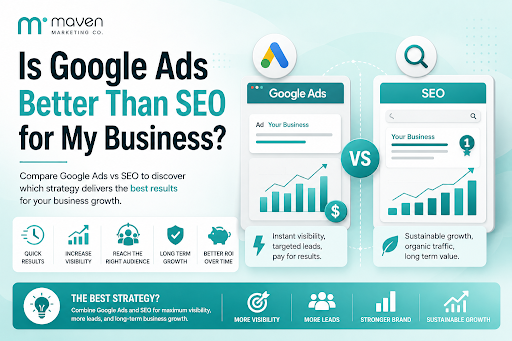
One of the biggest questions business owners ask when they are planning online growth is whether they should invest in Google Ads or SEO. Both are strong marketing plays that help your company show up in Google search results, but they do things in separate lanes. Google Ads gives quicker visibility and can bring in leads fast, whereas SEO more or less focuses on slow, steady organic traffic that tends to grow the longer you keep building it. Picking the right direction depends on what you want to achieve, how much money you can spend, how crowded the market is, and how quickly you need results, like sooner rather than later. The good news is you don’t always have to choose one or the other; it’s not exactly a black-and-white situation. If you take time to understand the strongest points of both, you can put together a more sensible digital marketing plan that supports consistent expansion. In this guide, we’ll compare Google Ads vs SEO, explain the main differences, and help you figure out what option makes the most sense for your business.

When Should I Hire a Digital Marketing Agency
Growing a business today takes more than just having a website or throwing a post on social media; customers usually search around online, compare providers, skim reviews, and basically expect the brand to show up with a solid digital presence before they even think about buying. Many businesses try to run their marketing themselves, but there comes a point when “doing it all in-house” becomes clunky and hard to manage, all at once. Knowing when to hire a digital marketing agency can end up making a big, real difference for your growth. If you’re not getting enough leads, or your online visibility feels stuck, or sales are just not moving, the right agency can bring the know-how, plus a clear plan, to help you get noticeably better outcomes. In this guide, we’ll dig into what a digital marketing agency actually does, the usual signs it’s time to bring one on, and how picking the right marketing partner can help your business move forward at a faster pace.
Why Is My Google Ads Budget Running Out So Quickly
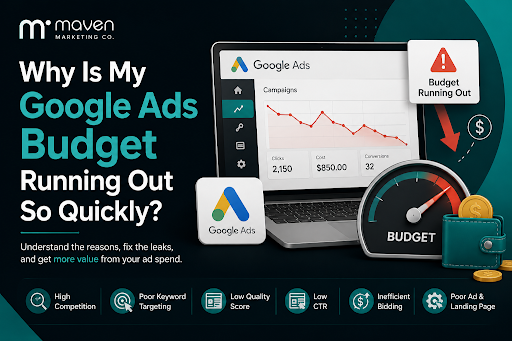
Running a successful Google Ads budget isn’t only about throwing more money at it. It’s more like making every dollar, doing a bit extra. A lot of businesses start a Google Ads campaign with big hopes, then find out their daily budget is gone within a few hours, and that feels weird, right? After that, your ads stop showing effectively, new leads slip away, and your return on investment dips. So if your Google Ads budget is running out too fast, don’t stress. It’s a fairly common issue, and in most situations, it can be repaired with the right approach. There are multiple little things that can drain your advertising money quicker than you expected, from costly keywords to audience targeting that just doesn’t quite fit. In this guide, we’ll walk through why your budget disappears so quickly, how to cut wasteful spend, and the most reliable ways to boost your Google Ads ROI, even if your budget stays the same.