.svg)


%201.svg)

Key Takeaways
- Full-funnel optimization outperforms stage-specific focus by 3-5x, with businesses systematically addressing awareness, consideration, and conversion generating substantially higher ROI than those concentrating on single stages
- Each funnel stage requires distinct content, messaging, and tactics, with TOFU educational content attracting cold audiences, MOFU comparison content nurturing consideration, and BOFU product-specific content converting buyers
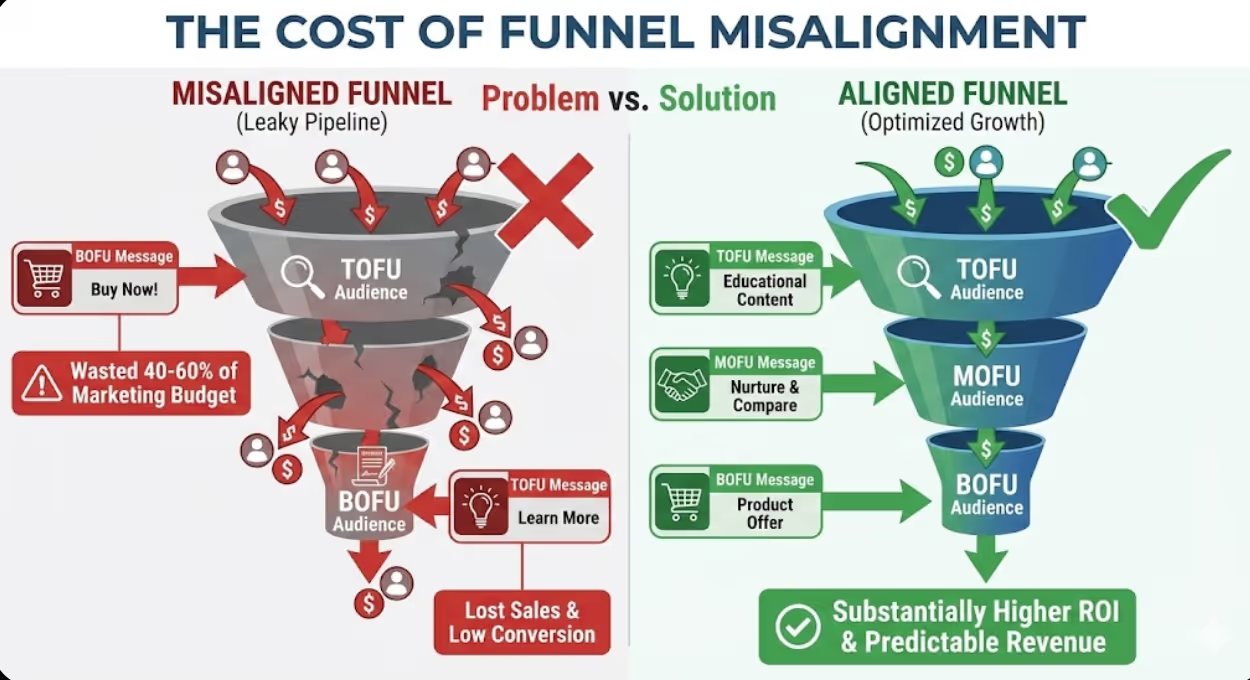
- Funnel stage misalignment wastes 40-60% of marketing budget, occurring when businesses show bottom-funnel conversion messages to top-funnel audiences or attempt awareness building with decision-ready prospects
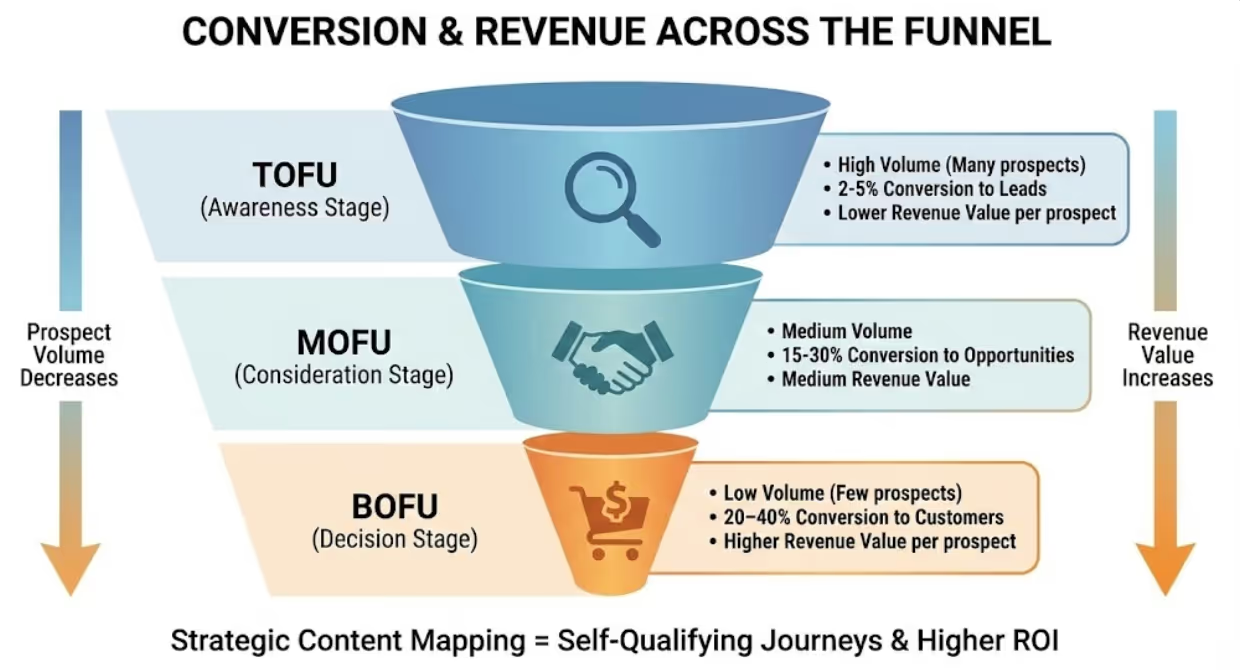
- Average conversion rates decrease as funnel stages progress but revenue value increases, with TOFU converting 2-5% to leads, MOFU converting 15-30% to opportunities, BOFU converting 20-40% to customers
- Strategic content mapping creates self-qualifying prospect journeys, with comprehensive funnel content allowing prospects to progress at their own pace while identifying their stage through behavioral signals
The marketing funnel isn't new, yet most Australian businesses struggle to operationalize it effectively.
Common scenarios: A business invests in Facebook ads driving traffic to their homepage, wondering why conversion rates are abysmal. Another creates detailed product comparisons but can't generate sufficient traffic. A third focuses entirely on Google Ads for bottom-funnel keywords, watching costs escalate.
Each represents funnel stage imbalance. Businesses generating consistent results understand that prospects move through predictable stages—from unaware to problem-aware to solution-aware to product-aware to purchase-ready. Each stage requires different approaches.
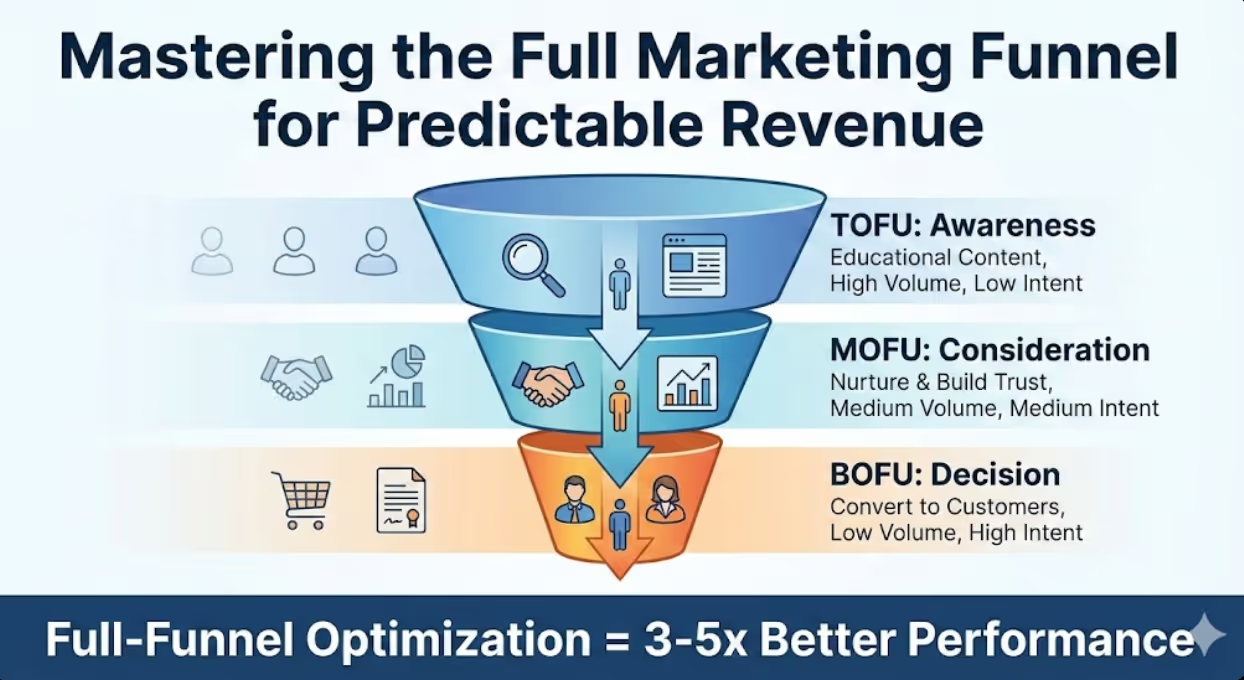
Understanding the Full Marketing Funnel
Top of Funnel (TOFU) - Awareness Stage
Prospects don't know you exist and may not recognize their problem.
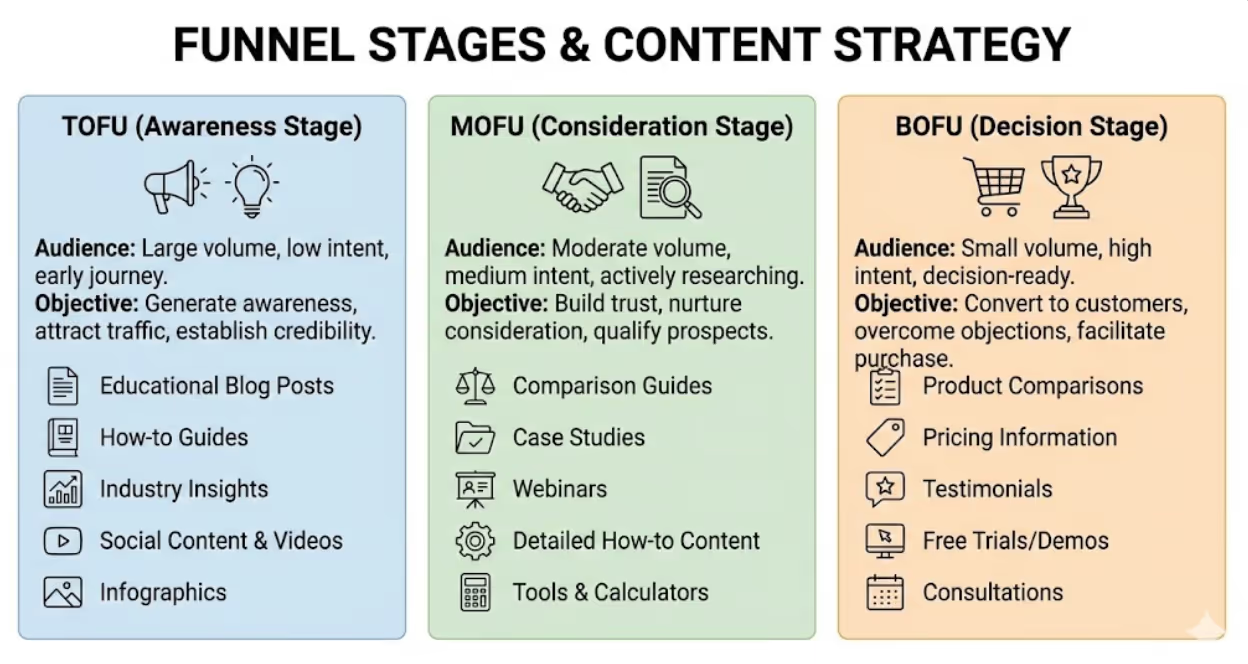
Audience: Large volume, low intent, early in journey, primarily researching.
Objectives: Generate awareness, attract traffic, capture attention, establish credibility.
Content types: Educational blog posts, how-to guides, industry insights, social content, videos, infographics, podcasts.
Channels: SEO (informational keywords), social media, content marketing, PR, display advertising.
Middle of Funnel (MOFU) - Consideration Stage
Prospects recognize their problem and are evaluating potential solutions.
Audience: Moderate volume, medium intent, actively researching solutions, comparing options.
Objectives: Build trust, demonstrate expertise, nurture consideration, qualify prospects, create preference.
Content types: Comparison guides, case studies, webinars, detailed how-to content, email nurture, tools and calculators.
Channels: Email marketing, retargeting, content upgrades, webinar funnels, LinkedIn, YouTube.
Bottom of Funnel (BOFU) - Decision Stage
Prospects are ready to purchase and comparing specific vendors.
Audience: Small volume, high intent, decision-ready, comparing specific options.
Objectives: Convert to customers, overcome objections, demonstrate value, differentiate, facilitate purchase.
Content types: Product comparisons, pricing information, testimonials, free trials/demos, ROI calculators, consultations.
Channels: Search ads (branded/transactional keywords), retargeting to engaged users, sales outreach, demo requests.
Top of Funnel (TOFU) Optimization
Content strategy for awareness:
Educational blog posts answering common industry questions. For a Melbourne accounting firm: "Small Business Tax Deductions Australian Owners Miss," "Understanding GST for New Business Owners."
How-to guides teaching valuable skills. For a Sydney agency: "How to Create Social Media Content Calendar," "Email Marketing for Beginners."
Industry insights providing valuable perspective. "Australian Business Technology Trends 2026," "Remote Work Technology Evolution."
TOFU content principles:
- Educational over promotional (90% value, 10% promotion)
- Broad appeal within target audience
- Search-optimized for informational keywords ("how to," "what is," "guide to")
- Easy consumption with minimal friction—no gating, freely accessible
- Clear next steps for interested prospects
TOFU advertising tactics:
Social media advertising reaches cold audiences cost-effectively with content offers, educational videos, valuable resources.
Display advertising builds awareness across content networks. Accept low click-through—display builds awareness, not immediate response.
YouTube advertising captures attention with educational or entertaining pre-roll ads.
TOFU success metrics: Traffic volume, engagement metrics (time on site, pages per session), brand awareness indicators (direct traffic growth, branded searches), MOFU conversion rate.
Middle of Funnel (MOFU) Optimization
Nurture content strategy:
Email nurture sequences providing progressive value. Welcome series introducing brand. Educational series teaching frameworks. Industry insights series building thought leadership.
Comparison guides helping prospects assess options. "Choosing the Right [Solution] for Your Business," "[Your Solution] vs [Alternative Approaches]."
Case studies demonstrating real-world results with detailed narratives, specific metrics, relatable scenarios.
Webinars providing deep-dive learning with live Q&A building relationships.
Tools and calculators providing interactive value. ROI calculators, assessments, comparison tools, planning templates.
MOFU content principles:
- Solution-focused while educational (70% value, 30% promotion)
- Address evaluation criteria naturally highlighting your strengths
- Multi-touch engagement (5-10+ touchpoints before purchase readiness)
- Progressive qualification using behavioral signals
MOFU advertising tactics:
Email marketing nurtures systematically with segmented audiences and personalized content.
Retargeting re-engages website visitors with comparison content, case studies, webinar promotions.
LinkedIn advertising reaches B2B prospects with sponsored content and lead generation forms.
Search advertising for consideration keywords ("[solution type] comparison," "best [solution]").
MOFU success metrics: Lead generation rate, engagement scores (email opens, clicks, content consumption), lead qualification rates, sales-qualified lead conversion.
Bottom of Funnel (BOFU) Optimization
Conversion-focused content:
Product-specific information detailing exact offerings. Feature descriptions, pricing details, package comparisons, implementation information.
Customer testimonials providing social proof. Video testimonials, written reviews with specific results, industry-specific case studies.
Free trials and demos allowing hands-on evaluation. Product demos, trial access, consultation offers.
Comparison content differentiating from competitors. Feature charts, "why choose us" positioning, addressing competitive objections.
Guarantee and risk-reduction removing barriers. Money-back guarantees, implementation support, cancellation flexibility.
BOFU content principles:
- Conversion-optimized with clear CTAs, minimal friction, streamlined paths
- Objection-addressing anticipating final hesitations
- Urgency without manipulation using genuine scarcity
- Personalized when possible based on demonstrated interests
BOFU advertising tactics:
Search advertising for transactional keywords. Branded keywords, competitor names (where appropriate), "[product] pricing/buy/demo" queries.
Retargeting to highly engaged users who viewed pricing, demos, product details.
Sales outreach for enterprise deals. Personalized emails, phone outreach, custom proposals.
Live chat removes final barriers with proactive offers on pricing/product pages.
BOFU success metrics: Conversion rate, sales cycle length, average deal value, customer acquisition cost, win rate.
Case Study: Sydney SaaS Full-Funnel Transformation
A Sydney project management SaaS relied almost exclusively on BOFU—Google Ads for product keywords, retargeting, sales outreach to trials.
Problems: Google Ads costs escalated, limited prospect volume, feast-or-famine revenue, competitive pressure.
In Q1 2024, they implemented full-funnel strategy with TOFU content library (blog posts 3x weekly, YouTube tutorials, Facebook ads promoting educational content), MOFU email nurture sequences, comparison guides, monthly webinars, and assessment tools, and BOFU trial optimization, comparison pages, testimonial videos, and live chat.
Results after 9 months:
TOFU generated 12,400 monthly organic visitors (up from 800). Email list grew from 1,200 to 8,900. MOFU converted 18% to trials (1,600 vs 300 previously). Revenue increased 340% with predictable pipeline. Google Ads spend decreased 40%.
Marketing director: "We'd been fishing in a small pond with expensive bait. Building full funnel created our own pipeline."
Case Study: Brisbane Consulting MOFU Investment
A Brisbane consulting firm had strong TOFU (thought leadership content) and decent BOFU (sales process), but massive MOFU leakage.
Website generated 2,200 monthly visitors. Only 3% (66) converted to email. Only 12% of those (8) became sales conversations. Total monthly pipeline: 8 conversations, 2 clients.
MOFU investment (Q2 2024):
Improved lead capture with industry-specific guides and exit-intent popups. Built 8-email welcome sequence and industry-specific nurture tracks. Offered webinars and free consultations to engaged subscribers.
Results after 6 months:
Email conversion increased from 3% to 11% (242 monthly vs 66). Sales conversations increased from 8 to 31 monthly. Client acquisition from 2 to 7 monthly. Revenue increased 280%.
Managing partner: "We assumed prospects would jump from blog posts to hiring us. MOFU investment transformed our business."
Frequently Asked Questions
How long should prospects stay in each funnel stage?
Timeframes vary by industry and purchase complexity. B2C low-consideration: TOFU minutes-to-days, MOFU days-to-weeks, BOFU hours-to-days. B2B SMB: TOFU days-to-weeks, MOFU weeks-to-months, BOFU days-to-weeks. B2B enterprise: TOFU weeks-to-months, MOFU months-to-quarters, BOFU months. Track your specific funnel velocity. Understanding typical progression times helps identify stalled prospects. Don't force progression—let prospects move at natural pace while providing value.
Should budget allocation match funnel stage proportions?
Balanced investment across all stages prevents pipeline problems. Common B2B allocation: 40% TOFU, 30% MOFU, 30% BOFU. B2C might weight more toward TOFU (50%) and BOFU (40%) with lighter MOFU (10%) for short purchase cycles. Adjust based on current funnel health—if MOFU is weak, shift budget there. Monitor funnel metrics identifying bottlenecks, allocate budget addressing specific weaknesses.
How do you optimize funnels for multiple product lines?
Create separate tracks when customer journeys differ substantially. Shared TOFU addressing common problems, branching MOFU based on product interests, product-specific BOFU. Use behavioral signals identifying interests early, route through appropriate tracks. Most businesses overestimate need for separate funnels—start unified, segment only when data proves distinct journeys require it.
Build Your High-Converting Funnel
Full-funnel optimization is systematic. Understand what prospects need at each stage, create experiences serving those needs, measure progression, optimize where leakage occurs.
At Maven Marketing Co, we help Australian businesses build complete, optimized marketing funnels generating predictable revenue. We architect strategic funnels matching content to stages, implement nurture systems, and continuously optimize based on data.
Contact Maven Marketing Co today to discuss your funnel optimization. We'll audit your current funnel identifying where prospects leak, develop stage-specific tactics addressing gaps, and implement the complete system transforming sporadic leads into predictable revenue.

Table of contents
read more blogs
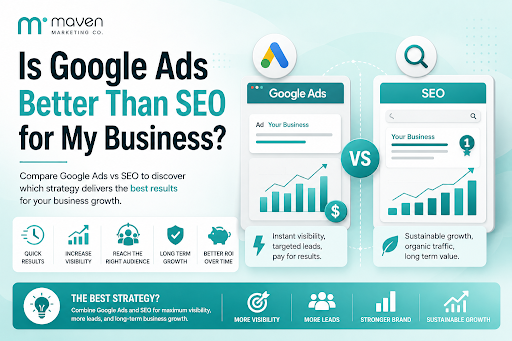
Is Google Ads Better Than SEO for My Business
One of the biggest questions business owners ask when they are planning online growth is whether they should invest in Google Ads or SEO. Both are strong marketing plays that help your company show up in Google search results, but they do things in separate lanes. Google Ads gives quicker visibility and can bring in leads fast, whereas SEO more or less focuses on slow, steady organic traffic that tends to grow the longer you keep building it. Picking the right direction depends on what you want to achieve, how much money you can spend, how crowded the market is, and how quickly you need results, like sooner rather than later. The good news is you don’t always have to choose one or the other; it’s not exactly a black-and-white situation. If you take time to understand the strongest points of both, you can put together a more sensible digital marketing plan that supports consistent expansion. In this guide, we’ll compare Google Ads vs SEO, explain the main differences, and help you figure out what option makes the most sense for your business.

When Should I Hire a Digital Marketing Agency
Growing a business today takes more than just having a website or throwing a post on social media; customers usually search around online, compare providers, skim reviews, and basically expect the brand to show up with a solid digital presence before they even think about buying. Many businesses try to run their marketing themselves, but there comes a point when “doing it all in-house” becomes clunky and hard to manage, all at once. Knowing when to hire a digital marketing agency can end up making a big, real difference for your growth. If you’re not getting enough leads, or your online visibility feels stuck, or sales are just not moving, the right agency can bring the know-how, plus a clear plan, to help you get noticeably better outcomes. In this guide, we’ll dig into what a digital marketing agency actually does, the usual signs it’s time to bring one on, and how picking the right marketing partner can help your business move forward at a faster pace.
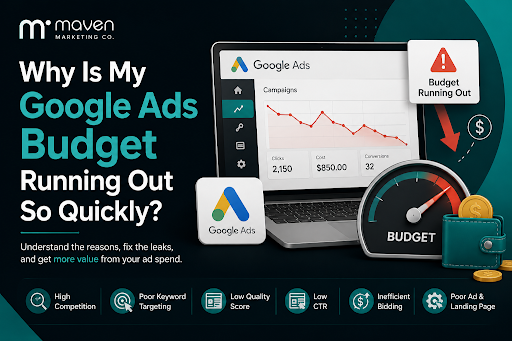
Why Is My Google Ads Budget Running Out So Quickly
Running a successful Google Ads budget isn’t only about throwing more money at it. It’s more like making every dollar, doing a bit extra. A lot of businesses start a Google Ads campaign with big hopes, then find out their daily budget is gone within a few hours, and that feels weird, right? After that, your ads stop showing effectively, new leads slip away, and your return on investment dips. So if your Google Ads budget is running out too fast, don’t stress. It’s a fairly common issue, and in most situations, it can be repaired with the right approach. There are multiple little things that can drain your advertising money quicker than you expected, from costly keywords to audience targeting that just doesn’t quite fit. In this guide, we’ll walk through why your budget disappears so quickly, how to cut wasteful spend, and the most reliable ways to boost your Google Ads ROI, even if your budget stays the same.