.svg)


%201.svg)

Key Takeaways
- Display advertising delivers brand awareness at $2-$8 CPM, enabling Australian SMEs to generate millions of monthly impressions on budgets of $1,000-$3,000 whilst search advertising costs $15-$45 per click serving only existing demand
- Layered audience targeting prevents waste through combining demographics, interests, behaviors, and remarketing creating qualified audiences rather than spray-and-pray broad campaigns
- Creative testing drives performance variation of 200-400% between winning and losing ads, with Australian businesses achieving optimal results through testing 4-6 creative variations rather than single static image
- Responsive display ads outperform static banners by 23-67% through automatic optimization across sizes and placements, whilst requiring 80% less production effort than creating individual banner dimensions
- View-through conversions prove display ROI, capturing customers who saw ads without clicking but later converted through direct or search channels, revealing display's hidden contribution to bottom-funnel results
Your monthly marketing budget is $3,500. Your marketing manager recommends allocating 100% to Google Search campaigns capturing "digital marketing Brisbane" and related purchase-intent keywords. The logic seems sound—search delivers measurable clicks and conversions whilst display advertising feels like expensive impression-chasing without accountability.
Six months later, search campaign performance plateaus. Cost per click increases 34% as competition intensifies. Conversion volume stagnates despite budget increases. Your manager can't explain why growth stopped.
The answer is simple: you're harvesting demand faster than you're creating it. Search advertising captures people already aware of their need and actively seeking solutions. Display advertising creates that awareness, introducing your brand to prospects who don't yet know they need your services or that you exist as solution provider.
Melbourne digital agency Luminary ran search-only campaigns for nine months achieving stable but unspectacular results. They allocated 25% of budget ($1,200 monthly) to display campaigns targeting their ideal customer demographics and interests. Within three months, branded search volume increased 43%, direct traffic grew 38%, and organic search improved 22%—all driven by display-generated awareness manifesting through other channels. Total conversions increased 31% despite search budget remaining constant.
Research examining display advertising effectiveness demonstrates that businesses combining search and display campaigns achieve 22-34% better overall marketing ROI than search-only strategies, with display generating awareness that amplifies performance across all channels through brand recognition and consideration development.
.avif)
Understanding Display Advertising Economics: Impressions vs Clicks
Display advertising operates on fundamentally different economics than search, prioritizing impression volume and brand exposure over immediate click-through and conversion.
CPM (cost per thousand impressions) pricing charges for ad views regardless of clicks, typically ranging $2-$8 for targeted campaigns. Sydney retailer achieved 340,000 monthly impressions on $1,400 budget ($4.12 CPM), exposing brand to potential customers repeatedly building recognition. Search advertising at $15-$45 per click would generate only 30-90 clicks for equivalent budget, reaching far fewer individuals.
Click-through rate expectations differ dramatically from search advertising. Display CTR typically ranges 0.05-0.35% compared to search CTR of 2-8%. Brisbane legal firm achieving 0.18% display CTR generated 612 clicks from 340,000 impressions—low click volume compared to search, but massive impression volume creating awareness among 340,000 potential clients repeatedly seeing firm name and messaging.
Impression frequency determines awareness effectiveness more than single exposures. Marketing research consistently shows 5-7 exposures required before brand recognition develops and purchase consideration begins. Display advertising's low CPM enables frequency achievement impossible through high-cost search clicks. Perth accounting firm capped frequency at 8 impressions per user over 30 days, ensuring sufficient exposure for awareness whilst preventing ad fatigue.
View-through conversion tracking captures display's hidden value by measuring users who saw ads without clicking but later converted through other channels. Adelaide e-commerce retailer discovered that whilst display generated only 47 direct conversions monthly, view-through analysis revealed 183 additional conversions from users exposed to display ads who later returned via direct, organic search, or branded search. Display's actual contribution was 4.9x higher than last-click attribution suggested.
.avif)
Audience Targeting Strategies: Precision Over Spray-and-Pray
Strategic audience targeting concentrates impressions on qualified prospects rather than wasting budget on broad untargeted campaigns reaching irrelevant audiences.
Demographic targeting filters by age, gender, household income, and parental status. Melbourne luxury retailer targeting women aged 35-54 with household income $150,000+ reduced impressions 67% whilst maintaining conversion volume, improving efficiency dramatically. However, demographics alone provide insufficient targeting—combining multiple layers creates qualified audiences.
Affinity audiences group users by long-term interests and habits based on browsing history. Google maintains pre-built audiences like "Business Professionals," "Home Improvement Enthusiasts," or "Foodies." Brisbane kitchen renovation company targeting "Home Décor Enthusiasts" and "DIY Enthusiasts" reached homeowners actively interested in property improvement, generating 3.2x higher engagement than broad campaigns.
In-market audiences identify users actively researching specific products or services demonstrating purchase intent. These audiences show recent browsing behavior indicating near-term purchase consideration. Sydney financial advisor targeting "In-Market: Financial Planning Services" reached prospects actively comparing advisors, achieving 0.42% CTR and $87 cost per lead compared to $134 from broader targeting.
Custom intent audiences use keyword and URL targeting building audiences based on specific search terms and websites visited. Adelaide software company created custom intent audience targeting users who searched "project management software," "team collaboration tools," and visited competitor websites. This precise targeting generated qualified impressions among actively shopping prospects.
Remarketing audiences target previous website visitors who demonstrated interest but haven't converted. These warm audiences show 5-10x higher conversion rates than cold prospecting. Perth e-commerce retailer remarketing to cart abandoners achieved 2.3% CTR and 8.7% conversion rate—dramatically outperforming prospecting campaigns whilst recovering revenue from interested prospects.
Layered targeting combines multiple audience types creating highly qualified segments. Melbourne B2B agency layered demographics (age 35-65, income $100,000+), affinity audiences ("Business Decision Makers"), and remarketing (website visitors past 30 days). This layered approach reduced impressions 73% whilst maintaining lead volume, improving cost per lead 64% through precision targeting.
.avif)
Creative Strategy: Visual Messaging That Builds Recognition
Display advertising creative quality determines whether impressions translate to awareness and consideration or simply blend into ignored banner blindness.
Responsive display ads provide automated creative optimization through uploading headlines, descriptions, images, and logos which Google automatically combines and tests across sizes and placements. Brisbane retailer uploaded 5 headlines, 4 descriptions, 15 images, and 2 logos generating thousands of creative combinations automatically optimized. This approach outperformed static banners by 34% CTR whilst requiring 80% less production effort than creating individual banner dimensions.
Visual hierarchy principles ensure key messages communicate within 1-2 seconds of exposure. Brand logo prominent in top-left or top-right corner establishes identity. Single clear headline communicating primary value proposition. Supporting image reinforcing message visually. Minimal text preventing overwhelming complexity. Strong contrasting CTA button directing action.
Sydney professional services firm tested display ads discovering clean designs with single focused message outperformed busy designs containing multiple competing elements by 127% CTR. Winning creative featured company logo, headline "Business Tax Specialists," supporting image of satisfied business owner, and green "Free Consultation" CTA button—nothing extraneous.
Brand consistency across display creatives builds recognition through repeated visual exposure. Consistent colour palette, typography, imagery style, and messaging tone enable users to recognize brand instantly after multiple exposures. Melbourne fashion retailer maintained signature teal and gold colour scheme, modern sans-serif typography, and lifestyle photography across all display creatives, building immediate brand recognition among target audience after 5-7 exposures.
Creative testing methodology identifies winning approaches through systematic variation testing. Test 4-6 creative variations simultaneously allowing Google's algorithm to identify top performers. Variables to test include headline approaches (benefit-focused vs feature-focused), imagery styles (product photos vs lifestyle images vs illustrations), CTA button copy ("Learn More" vs "Get Started" vs "Book Now"), colour schemes, and offer types (free trial vs discount vs consultation).
Adelaide software company tested six display creative variations discovering "Free 14-Day Trial" offer outperformed "Schedule Demo" by 340% CTR and "20% Off First Month" by 180% CTR. This insight drove creative strategy focusing on risk-free trial messaging rather than discounts or appointments.
Animation and HTML5 banners capture attention more effectively than static images through subtle movement, though production complexity increases. Perth travel agency created HTML5 banners with gentle animation revealing destination images sequentially, improving CTR 43% compared to static alternatives. However, ensure animations are subtle avoiding obnoxious flashing that triggers banner blindness.
.avif)
Placement Strategies: Where Your Ads Appear Matters
Google Display Network reaches 90% of internet users across 2+ million websites, apps, and videos, requiring strategic placement management ensuring ads appear in brand-safe, relevant contexts.
Automatic placements allow Google's algorithm to identify websites and apps likely to drive performance based on campaign objectives. This hands-off approach provides broad reach discovering placements you wouldn't manually identify. However, automatic placements require monitoring and exclusion management preventing waste on low-quality sites.
Manual placement targeting selects specific websites, YouTube channels, apps, or app categories for ad display. Brisbane fitness studio manually targeted health and wellness websites, fitness blogs, nutrition sites, and workout apps ensuring ads appeared in contexts aligned with target audience interests. This focused approach reduced wasted impressions on irrelevant sites.
Topic targeting displays ads on pages about specific subjects regardless of specific website. Sydney financial advisor targeted "Personal Finance," "Investment," and "Retirement Planning" topics ensuring ads appeared on relevant content discussing financial subjects attracting ideal prospects.
Placement exclusions prevent ads from appearing on inappropriate or low-performing sites. Review placement reports identifying sites generating impressions without engagement or conversions. Melbourne law firm excluded 340 low-quality sites including games, entertainment gossip, and parked domains that generated impressions but zero qualified traffic.
Content exclusion settings filter by content type preventing brand safety issues. Exclude sensitive categories like "Tragedy and Conflict," "Sexually Suggestive Content," or "Shocking Content" ensuring ads don't appear alongside inappropriate material damaging brand perception. Adelaide family-oriented business enabled all content exclusions maintaining conservative brand-safe positioning.
YouTube placement strategy offers powerful brand awareness through video advertising on relevant channels and content. Perth home improvement company placed display ads on DIY renovation channels, home tour videos, and property improvement content reaching homeowners actively interested in home projects. YouTube placements generated 67% higher engagement than standard display network.
Budget Allocation and Bidding Strategies
Strategic budget management and bidding approaches maximize impression volume and audience reach whilst maintaining cost efficiency.
Budget recommendations for brand awareness display campaigns vary by market size and competition. Small local businesses achieve meaningful awareness on $800-$1,500 monthly budgets generating 200,000-400,000 monthly impressions. Medium businesses in competitive markets allocate $2,000-$4,000 monthly reaching 500,000-1,000,000 impressions. Businesses in highly competitive industries or targeting broad audiences invest $5,000-$10,000+ monthly.
Brisbane accounting firm allocated $1,200 monthly to display campaigns generating 290,000 impressions among small business owners in Brisbane region. While modest compared to enterprise budgets, this impression volume built meaningful brand recognition among target audience driving 34% increase in branded search volume.
CPM bidding (cost per thousand impressions) optimizes for maximum impression delivery at target cost, ideal for awareness objectives. Set maximum CPM bid based on acceptable awareness cost—typically $3-$10 depending on audience competitiveness. Sydney luxury retailer bid $8.50 CPM for high-income demographic reaching qualified audience efficiently.
Viewable CPM bidding charges only for impressions that were actually viewable (50% of ad pixels visible for 1+ seconds), ensuring you pay for genuine exposure rather than below-fold impressions never seen. This bidding reduces waste from technical impressions that don't create awareness. Melbourne software company switched to vCPM reducing costs 23% whilst maintaining effective reach.
Target CPA bidding for display campaigns optimizes toward conversion goals rather than impressions, appropriate when combining awareness objectives with measurable outcomes. Adelaide e-commerce business used Target CPA bidding at $45 on display remarketing campaigns balancing awareness with conversion efficiency.
Budget pacing controls spend velocity preventing budget exhaustion early in month. Standard delivery spreads budget evenly throughout month ensuring consistent presence. Accelerated delivery spends budget as quickly as possible, appropriate for time-sensitive promotions but risky for month-long campaigns potentially depleting budget in days.
.avif)
Remarketing Campaigns: Converting Warm Audiences
Remarketing targets previous website visitors who demonstrated interest but haven't converted, representing most cost-effective display advertising opportunity.
Standard remarketing displays ads to all website visitors regardless of specific behavior. Perth consulting firm remarketed to all visitors from past 30 days keeping brand top-of-mind among prospects who researched services but didn't engage. This broad remarketing generated 0.67% CTR—significantly higher than 0.12% cold prospecting CTR.
Dynamic remarketing shows ads featuring specific products or services users viewed, creating personalized reminders. Melbourne e-commerce retailer implemented dynamic remarketing displaying exact products users browsed but didn't purchase. Ads dynamically populated with product images, names, and prices creating personalized shopping reminders. Dynamic remarketing achieved 2.1% CTR and 6.3% conversion rate dramatically outperforming standard remarketing.
Behavioral remarketing segments audiences by specific actions or engagement levels. Create separate campaigns for cart abandoners (highest intent), product page viewers (medium intent), and blog readers (awareness stage). Sydney software company created three remarketing segments with tailored messaging: cart abandoners received "Complete Your Purchase—Save 15%," trial users saw "Upgrade to Premium Features," and blog readers received general brand awareness messaging.
Sequential remarketing delivers different messages based on previous ad exposure and time elapsed since website visit. First exposure focuses on general value proposition, second exposure highlights specific features or benefits, third exposure introduces urgency or offer. Brisbane professional services firm sequenced remarketing messages: Day 1-3 "Accounting Services for Growing Businesses," Day 4-7 "Specializing in Small Business Tax Optimization," Day 8+ "Free Consultation—Limited Availability."
Remarketing exclusions prevent showing ads to converted customers or users who've seen excessive ad frequency. Exclude purchasers for 60-90 days preventing annoying recent customers with irrelevant ads. Adelaide retailer excluded recent purchasers whilst continuing remarketing to browsers and cart abandoners, improving ad relevance and efficiency.
Cross-device remarketing tracks users across desktop, mobile, and tablet ensuring consistent exposure regardless of device switching. Perth travel agency remarketing captured users researching holidays on mobile during commute, desktop at work, and tablet at home, maintaining consistent presence throughout consideration journey.
Measurement and Attribution: Proving Display ROI
.avif)
Display advertising value extends beyond direct conversions, requiring comprehensive measurement capturing full impact across customer journey.
View-through conversion tracking measures users who saw display ads without clicking but later converted through other channels. Attribution window typically set to 1-30 days determines how long after ad view to credit display influence. Melbourne B2B company discovered view-through conversions represented 67% of display's total conversion contribution, dramatically understated by last-click attribution showing only direct click conversions.
Assisted conversion analysis quantifies display's role in multi-touch conversion paths. Google Analytics Multi-Channel Funnels reports show how often display assists conversions completed through other channels. Sydney professional services firm found display appeared in 34% of conversion paths despite receiving only 8% last-click credit, validating awareness investment.
Brand lift studies measure awareness, consideration, and preference changes among exposed audiences compared to control groups. Google Brand Lift surveys randomly poll users exposed to campaigns measuring recall, awareness, and intent changes. Brisbane retailer's brand lift study showed 23% increase in brand awareness and 34% lift in purchase consideration among exposed audiences.
Search lift measurement tracks branded and non-branded search volume increases correlating with display campaign activity. Adelaide software company observed 45% branded search increase during display campaign months versus non-campaign periods, quantifying awareness impact driving subsequent search behavior.
Direct traffic analysis examines direct website visits that often represent brand awareness fruition. Users seeing display ads multiple times develop brand familiarity, later typing URL directly rather than searching. Perth consulting firm correlated display impression volume with direct traffic, discovering strong positive relationship validating awareness hypothesis.
Cost per thousand reached (CPTR) measures unique users exposed rather than total impressions, accounting for frequency. If 100,000 impressions reached 25,000 unique users at $400 spend, CPTR = $16. This metric ensures efficiency evaluation accounts for audience size not just impression volume.
Frequently Asked Questions
What's the minimum budget for effective display advertising in Australia?
Meaningful brand awareness display campaigns require minimum $800-$1,200 monthly budget for local or niche audiences, generating 200,000-400,000 impressions providing sufficient frequency for awareness development among target segments. Broader audiences or competitive markets need $2,000-$4,000+ monthly reaching impression volumes necessary for brand recall. Below $800 monthly, insufficient impression volume prevents frequency achievement required for awareness, making budget better allocated to search or social advertising delivering lower volume but higher-intent traffic. However, remarketing campaigns prove cost-effective at lower budgets ($400-$800 monthly) given warm audience targeting requiring less frequency for impact. The key is matching budget to audience size—small local service business can build awareness on $1,000 monthly whilst national e-commerce brand requires $5,000+ for equivalent impact.
How long until display advertising shows results?
Display awareness campaigns typically require 60-90 days before measurable impact materializes through brand lift, search volume increases, or direct traffic growth. Initial 30 days build frequency among target audience developing recognition. Days 30-60 awareness begins translating to consideration and search behavior. Days 60-90+ consideration manifests as conversions through search, direct, and organic channels. Melbourne businesses should commit to minimum 90-day display campaigns before evaluating effectiveness, as premature assessment (30 days) shows limited direct results whilst missing delayed awareness impact. However, remarketing campaigns show faster results with conversion impact often visible within 14-30 days given warm audience targeting. Set appropriate expectations—display builds pipeline feeding future conversions rather than generating immediate direct response like search advertising.
Should display campaigns target mobile or desktop?
Both, with strategic bid adjustments based on performance data and audience behavior patterns. Initial campaigns should target all devices gathering performance data revealing which generates better engagement and conversion. Most Australian audiences show 60-70% mobile usage making mobile targeting essential for reach. However, B2B campaigns often perform better on desktop where business decision-makers research during work hours. Review device performance after 30 days, applying bid adjustments increasing bids for strong-performing devices whilst decreasing for weak performers rather than excluding entirely. Sydney professional services firms typically increase desktop bids 20-40% given business audience, whilst Brisbane retailers increase mobile bids 15-30% reaching consumers browsing during leisure time. Responsive display ads automatically optimize across device sizes eliminating need for device-specific creative production.
Build Brand Awareness That Fuels Sustainable Growth
Display advertising separates Australian businesses building sustainable growth through awareness creation from those exclusively harvesting existing demand until markets exhaust. The most successful businesses understand marketing requires both awareness generation and demand capture, with display and search advertising serving complementary roles in comprehensive strategy.
Yet most Australian SMEs lack expertise for strategic display campaign development, either avoiding display entirely whilst limiting growth potential, or launching poorly targeted campaigns that waste budget without generating meaningful awareness or business outcomes.
Maven Marketing Co specializes in display advertising strategy for Australian businesses, providing audience targeting frameworks balancing reach with relevance, creative development and testing identifying winning approaches, placement strategy and management ensuring brand-safe contexts, remarketing campaign implementation converting warm audiences, and comprehensive measurement proving awareness ROI beyond last-click attribution.
From initial display strategy development through ongoing campaign optimization and performance analysis, we build awareness campaigns that generate millions of impressions efficiently whilst driving measurable business outcomes across all channels.
Schedule your display advertising consultation with Maven Marketing Co today and discover how to build brand awareness on SME budgets, which audiences deliver best awareness-to-conversion pathways, and how to measure display's full contribution to business growth.
Stop limiting growth to existing demand. Start building awareness that creates future customers.

Table of contents
read more blogs
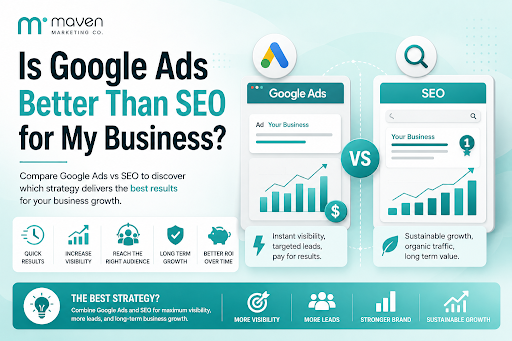
Is Google Ads Better Than SEO for My Business
One of the biggest questions business owners ask when they are planning online growth is whether they should invest in Google Ads or SEO. Both are strong marketing plays that help your company show up in Google search results, but they do things in separate lanes. Google Ads gives quicker visibility and can bring in leads fast, whereas SEO more or less focuses on slow, steady organic traffic that tends to grow the longer you keep building it. Picking the right direction depends on what you want to achieve, how much money you can spend, how crowded the market is, and how quickly you need results, like sooner rather than later. The good news is you don’t always have to choose one or the other; it’s not exactly a black-and-white situation. If you take time to understand the strongest points of both, you can put together a more sensible digital marketing plan that supports consistent expansion. In this guide, we’ll compare Google Ads vs SEO, explain the main differences, and help you figure out what option makes the most sense for your business.

When Should I Hire a Digital Marketing Agency
Growing a business today takes more than just having a website or throwing a post on social media; customers usually search around online, compare providers, skim reviews, and basically expect the brand to show up with a solid digital presence before they even think about buying. Many businesses try to run their marketing themselves, but there comes a point when “doing it all in-house” becomes clunky and hard to manage, all at once. Knowing when to hire a digital marketing agency can end up making a big, real difference for your growth. If you’re not getting enough leads, or your online visibility feels stuck, or sales are just not moving, the right agency can bring the know-how, plus a clear plan, to help you get noticeably better outcomes. In this guide, we’ll dig into what a digital marketing agency actually does, the usual signs it’s time to bring one on, and how picking the right marketing partner can help your business move forward at a faster pace.
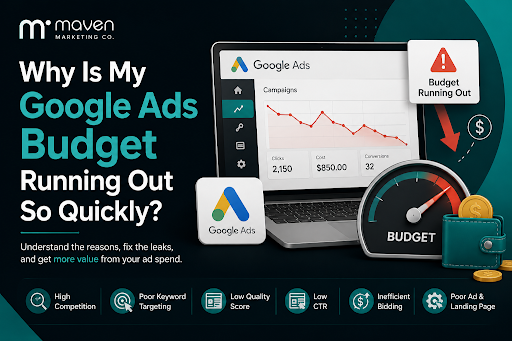
Why Is My Google Ads Budget Running Out So Quickly
Running a successful Google Ads budget isn’t only about throwing more money at it. It’s more like making every dollar, doing a bit extra. A lot of businesses start a Google Ads campaign with big hopes, then find out their daily budget is gone within a few hours, and that feels weird, right? After that, your ads stop showing effectively, new leads slip away, and your return on investment dips. So if your Google Ads budget is running out too fast, don’t stress. It’s a fairly common issue, and in most situations, it can be repaired with the right approach. There are multiple little things that can drain your advertising money quicker than you expected, from costly keywords to audience targeting that just doesn’t quite fit. In this guide, we’ll walk through why your budget disappears so quickly, how to cut wasteful spend, and the most reliable ways to boost your Google Ads ROI, even if your budget stays the same.