.svg)
.svg)
.svg)


%201.svg)
April 2, 2026
The Link Building Playbook That Still Works in 2026: Earn Authority Without Paying for It
Link building has a reputation problem it does not entirely deserve. When most Australian marketing teams hear the term, they picture one of two things: the paid link schemes that Google has been penalising for years and that still circulate in the shadier corners of the SEO industry, or the outreach programmes that require significant labour that produce a handful of marginal links per month at a cost that makes the return on investment look questionable at best. Both of these pictures miss the methods that actually work in 2026, which share a common characteristic: they earn links as a byproduct of producing something valuable rather than acquiring them as a standalone purchase or extraction exercise. The distinction matters commercially because earned links are structurally different from purchased links. They tend to come from more relevant and more authoritative sources. They are more stable because they are not contingent on a payment being maintained. They are more likely to produce lasting ranking improvements because they represent genuine signals of editorial endorsement. And they are not a liability that sits waiting for the next Google spam update to detonate. This article covers the link earning methods that Australian businesses and their marketing teams can execute in 2026 to build domain authority through genuine editorial signals rather than purchases or schemes.


Blog Content Packages: Post Frequency and Word Count Options
Publishing blog content is one of the most durable and commercially effective strategies available to Australian businesses looking to grow their organic search presence, but the results it produces are directly tied to the decisions made around how much content to publish and how often. A business that publishes one exceptional article per month and a business that publishes four shallow articles per week are both blogging, but their SEO trajectories, their audience relationships, and their returns on the time and budget invested will be entirely different. Post frequency determines how quickly a site accumulates topical coverage and how reliably an audience can expect new content. Word count determines how thoroughly each piece of content covers its subject and how competitive it is likely to be in search results for the queries it targets. Neither variable is fixed for all businesses. The right combination depends on the industry, the competitive landscape, the resources available, and the specific commercial goals the content programme is meant to serve. This article explains the options, the tradeoffs, and the framework Australian businesses should use to choose a blog content package that fits their situation and their ambitions.
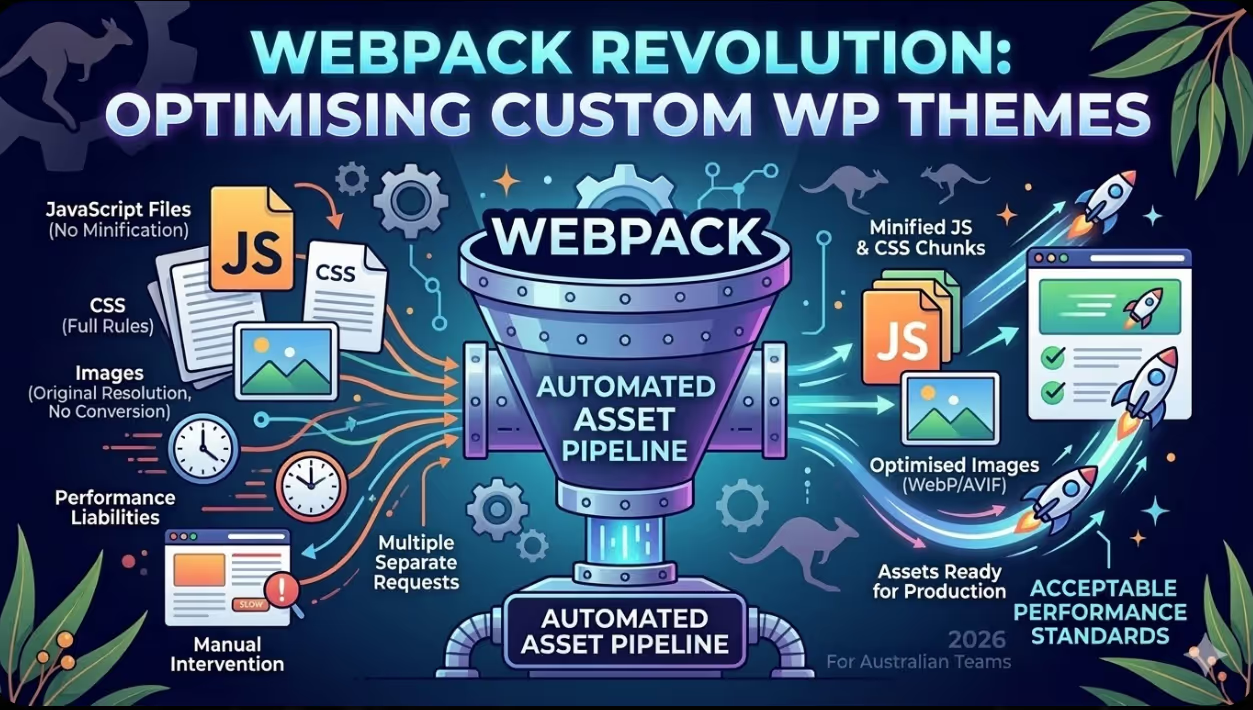
Webpack Configuration: Build Optimisation for Custom WordPress Themes
Custom WordPress themes built without a deliberate asset pipeline carry a familiar set of performance liabilities. JavaScript files are concatenated without minification, CSS is served in full regardless of which rules a given page actually needs, images are served at original resolution without format conversion, and the browser must make separate network requests for a collection of individual files that could be consolidated into a fraction of the total. Webpack is a module bundler that addresses all of these problems systematically, treating every file in a project as a module with dependencies, bundling and transforming assets according to a build configuration that the development team defines once and applies consistently on every build. For Australian development teams building and maintaining custom WordPress themes in 2026, understanding Webpack configuration is the difference between a theme that deploys assets ready for production automatically and one that requires manual intervention to reach acceptable performance standards. The investment in a solid Webpack configuration pays forward into every subsequent deployment, every new feature, and every performance audit the site undergoes.

JavaScript Framework SEO: Next.js and Nuxt.js Optimisation Guide
JavaScript frameworks like Next.js and Nuxt.js have become the standard choice for Australian development teams building commercial web applications, marketing sites, and ecommerce experiences that require both engineering flexibility and strong user experience performance. The SEO implications of this choice are substantial and frequently misunderstood. A Next.js or Nuxt.js site configured correctly can outperform a traditionally rendered WordPress site on every search visibility dimension. The same site configured incorrectly, relying on rendering on the client side for content Googlebot cannot reliably process, missing structured metadata configuration, or serving different content to crawlers than to users, can rank poorly despite a technically sophisticated codebase. The difference between these two outcomes is not a choice of framework. It is a set of deliberate configuration decisions that Australian development and marketing teams need to make together, with a clear understanding of how rendering mode, metadata management, URL structure, and Core Web Vitals interact with search crawler behaviour and search ranking signals in 2026.

Looker Studio Calculated Fields: Advanced Metric Creation
Looker Studio connects to an impressive range of data sources and surfaces a large number of standard metrics and dimensions out of the box. For most Australian marketing teams running basic reporting, the default fields available through Google Ads, Google Analytics 4, Search Console, and social media connectors cover the majority of what they need to see. But default fields reflect the data model of the source platform, not the commercial logic of the business using them. A blended cost per acquisition that accounts for multiple ad platforms simultaneously, a revenue attribution model that weights channels according to the business's own judgement, a segment classification that groups campaigns by strategic intent rather than by the naming conventions a platform imposes, none of these exist as standard fields. Calculated fields are the mechanism that closes this gap, allowing Australian marketers to define metrics and dimensions using formulas that apply the business's own logic to the underlying data. Used well, calculated fields transform Looker Studio from a data visualisation layer into a genuine business intelligence tool that surfaces the specific insights the marketing team actually needs to make decisions.

Font Loading Optimisation: FOUT, FOIT and Performance Impact
Every time a browser loads a web page that uses a custom font, it faces a decision it has to make before it has the font file in its possession: show the text immediately in a fallback font and swap it out when the custom font arrives, or show nothing at all until the custom font is ready. Neither of those defaults is ideal. The first produces a visible flash of unstyled text as the font swaps in, potentially shifting the layout and jarring the user. The second produces invisible text for as long as the font takes to load, which on a slow connection can mean seconds of blank space where readable content should be. These two behaviours have names in web performance: FOUT, the Flash of Unstyled Text, and FOIT, the Flash of Invisible Text. Both are symptoms of a font loading strategy that has not been deliberately optimised, and both have measurable consequences for Core Web Vitals scores, user experience, and the overall impression a brand's website makes on visitors. For Australian websites using custom typography as part of their brand identity, understanding and controlling font loading behaviour is one of the most impactful and most frequently overlooked performance improvements available.

Redis Caching Implementation: Object Caching for WordPress Performance
WordPress is the most widely used content management system in the world, and its default approach to delivering page content involves querying the database for every piece of data it needs on every request. On a site with low traffic with a small dataset, this is manageable. On a commercial Australian website with significant traffic, a large product catalogue, complex page templates, or heavy use of plugins, the cumulative cost of those database queries becomes a measurable performance liability. Redis is a data store held in server memory that sits between WordPress and its database, storing the results of expensive queries so they do not need to be recalculated on every request. When implemented correctly, Redis object caching can reduce WordPress response times by 50 to 80 percent on pages requiring intensive database queries, lower server CPU usage significantly, and enable a site to handle substantially more concurrent traffic without additional infrastructure. For Australian businesses running WordPress at any meaningful scale, understanding Redis and knowing how to implement it is one of the most commercially valuable technical performance improvements available in 2026.

Mailchimp Transactional API: Mandrill Alternative Setup Guide
Navigating the shift from Mandrill to the Mailchimp Transactional API? This comprehensive guide walks you through the essential setup process, including critical domain authentication (SPF and DKIM) to ensure high deliverability. Discover why separating your marketing broadcasts from crucial system alerts, like password resets and order confirmations, is vital for protecting your sender reputation. We also explore top Mandrill alternatives to help you secure the perfect transactional email infrastructure for your business. Finally, learn how partnering with the experts at Maven Marketing Co can streamline this technical burden so your team can focus on growth.
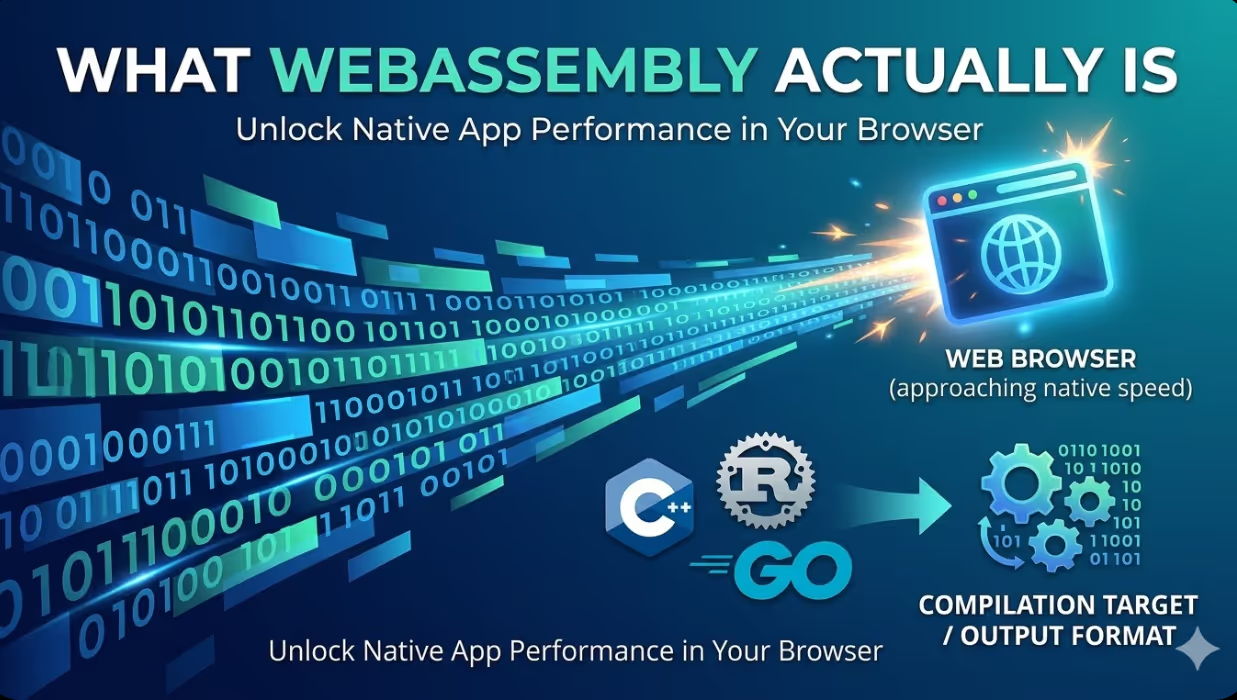
WebAssembly for Marketing: High Performance Web Applications
WebAssembly has been available in browsers since 2017, supported as a standard by all major browser vendors, and quietly deployed in some of the most web applications demanding the most from performance applications in the world. Most Australian marketers have never needed to think about it, and for most website use cases they still do not. But as the bar for interactive web experiences continues to rise and as marketing applications increasingly involve computation that JavaScript struggles to perform at the speeds users expect, WebAssembly is moving from a specialist engineering concern into territory that has direct implications for marketing outcomes. Interactive product configurators that run in real time, data visualisation running in the browser tools that process large datasets without a server round trip, personalisation engines that compute recommendations on the client side, and immersive experiences that would require a native application to perform smoothly on a desktop are all becoming practical web experiences because of what WebAssembly makes possible. This article explains what WebAssembly is in terms a marketing audience can act on, where it creates genuine commercial opportunities for Australian brands in 2026, and where its limitations mean simpler technologies are still the right choice.

Lazy Loading Strategy: Images, Videos and Iframes Performance
Most commercial Australian websites load every image, video, and embedded resource on a page the moment a user arrives, regardless of whether those resources are anywhere near what the user can currently see. A product page with forty images loads all forty on arrival. A blog post with an embedded YouTube video loads that video the moment the page opens. A landing page with six embedded maps loads all six immediately, even if the user never scrolls far enough to see them. This is wasteful by default, and the waste shows up directly in the metrics that matter: slower initial load times, heavier data transfer, worse Core Web Vitals scores, and a user experience that feels sluggish on mobile connections. Lazy loading is the technique that changes this default, deferring the loading of resources outside the current viewport until the user is actually approaching them. It is one of the most straightforward and highest return performance optimisations available for Australian websites with any significant amount of media content, and in 2026 the majority of it is achievable with native HTML attributes that require no JavaScript at all.

Critical CSS Extraction: Above the Fold Rendering Optimisation
Every time a browser loads a web page, it must download and process the page's CSS before it can render anything visible to the user. On most commercial Australian websites, that CSS file is a single large stylesheet containing styles for every page template, every component, and every breakpoint on the entire site. The browser has no way to know which of those styles are actually needed for the portion of the page the user can see right now, so it waits for the entire file to finish loading before rendering anything at all. This is what is meant by CSS that blocks rendering, and and it is one of the most significant and most fixable causes of poor First Contentful Paint scores across Australian commercial websites. Critical CSS extraction solves this by identifying exactly which styles are needed to render what is visible in the initial viewport, inlining those styles directly in the HTML document, and deferring the remainder of the stylesheet to load asynchronously after the visible content has been painted. The performance gains can be substantial and are directly measurable in Core Web Vitals reporting, PageSpeed Insights scores, and ultimately in the user experience metrics that influence both search rankings and conversion rates.

WebP and AVIF Implementation: Next Generation Image Formats for 2026
Page speed is no longer a technical nicety for Australian websites. It is a ranking signal, a conversion driver, and a direct measure of how seriously a business takes its users' time. Images consistently account for the majority of page weight on most commercial websites, and the format those images are delivered in has a direct and measurable impact on how quickly pages load, how well they score in Google's Core Web Vitals assessment, and how much bandwidth they consume for users on mobile connections. WebP and AVIF are the two formats that have fundamentally changed what is possible in web image delivery, offering file size reductions over traditional JPEG and PNG formats that translate into real and auditable improvements in site performance. In 2026, both formats enjoy broad browser support, mature tooling, and a clear implementation pathway that most Australian web development teams and sites managed through platforms can follow without significant technical overhead. This article covers what each format offers, how they compare, which Australian website types benefit most from switching, and how to implement them correctly regardless of the platform your site runs on.

Cloudflare Optimisation: CDN Configuration for Website Speed
Digital patience is extinct. You can invest tens of thousands of dollars into a visually breathtaking website, complete with compelling copy and a seamless user interface, but if that screen remains blank for more than three seconds, your potential customer is gone. Forever. In the hyper-competitive online arena, website speed is no longer just a technical metric; it is the foundational pillar of consumer trust and conversion optimisation. For Australian brands, battling the physical tyranny of distance to global servers makes this challenge even more acute. Implementing a robust Content Delivery Network (CDN) is no longer an optional luxury. This article provides a comprehensive masterclass on Cloudflare optimisation, unpacking the precise configurations required to slash latency, dominate Google’s Core Web Vitals, and transform your website into a frictionless, high-speed conversion engine.