.svg)


%201.svg)

Key Takeaways
- Chatbots excel at handling 60-80% of routine inquiries including FAQs, order status checks, and basic troubleshooting, freeing human agents for complex issues requiring empathy and creative problem-solving
- Implementation success hinges on appropriate use case selection: chatbots enhance experience for transactional, information-retrieval tasks but frustrate customers for emotionally-charged complaints, nuanced negotiations, or situations requiring human judgment
- Seamless human escalation is non-negotiable with 73% of customers abandoning interactions if chatbots can't quickly transfer to human agents when automation reaches limits, making handoff quality critical
- Australian businesses achieve average 34% reduction in support costs through strategic chatbot deployment whilst maintaining or improving customer satisfaction when automation complements rather than replaces human service
- Conversational AI quality determines adoption rates: natural language understanding, contextual memory across interactions, and personality-driven responses increase chatbot completion rates from 23% (basic keyword matching) to 67% (advanced NLU platforms)

Your customer service inbox contains 247 unread messages at 9:47 AM Monday morning. Seventy-three ask identical question about shipping timeframes during your EOFY sale. Forty-one want order status updates requiring simple tracking number lookups. Thirty-two seek password reset assistance following standard documented process. The remaining 101 span genuine issues requiring human attention, context understanding, and creative problem-solving.
Your three-person support team spends first 90 minutes answering repetitive questions whilst customers with real problems wait, frustration building with each passing minute.
This scenario reflects reality across Australian SMEs where limited support resources get consumed by routine inquiries whilst complex situations requiring human expertise languish in queues. Chatbot automation offers solution—but only when strategically deployed addressing genuinely automatable interactions whilst preserving human capacity for situations demanding empathy, judgment, and relationship preservation.
Research examining customer service automation effectiveness shows that businesses deploying chatbots for appropriate use cases achieve 30-40% support cost reduction whilst maintaining customer satisfaction scores, whilst those automating indiscriminately experience satisfaction declines averaging 18 points despite cost savings.
Strategic chatbot implementation requires identifying which customer interactions benefit from automation versus requiring human touch, selecting appropriate conversational AI platforms matching business needs, designing conversation flows that enhance rather than frustrate customer experience, and establishing seamless escalation ensuring customers reach humans when automation fails.
Understanding Chatbot Types: Matching Technology to Business Needs
.avif)
Chatbot capabilities vary dramatically across technological approaches, with appropriate selection depending on use case complexity and implementation resources available.
Rule-based chatbots follow predetermined decision trees responding to specific keywords or button selections. These simple bots operate like interactive FAQs guiding customers through structured options. Advantages include predictable behavior reducing risk of inappropriate responses, lower implementation cost and complexity, complete control over conversation flow and messaging, and minimal ongoing training or maintenance requirements. Limitations include inability to handle questions outside predefined scripts, frustration when customers can't find their specific issue in options, lack of natural conversation flow feeling robotic and impersonal, and extensive upfront work mapping all possible conversation paths.
Melbourne telecommunications provider Optus implemented rule-based chatbot for basic account management including balance inquiries, plan details, and payment due dates. The structured approach works well for these transactional queries where customers simply want specific information without conversational complexity. However, Optus preserves human support for billing disputes, technical troubleshooting, and retention discussions requiring nuanced understanding.
AI-powered chatbots using natural language processing understand intent behind customer messages regardless of specific phrasing. These conversational AI platforms interpret meaning, maintain context across multi-turn conversations, and generate dynamic responses. Benefits include natural conversation flow mimicking human interaction, ability to handle unexpected questions and phrasings, learning from interactions improving over time, and contextual understanding remembering previous conversation points. Challenges include higher implementation and subscription costs, potential for misunderstanding generating inappropriate responses, training requirements teaching system your business context, and less predictable behavior requiring ongoing monitoring.
Sydney e-commerce retailer THE ICONIC deployed AI-powered chatbot using natural language understanding to handle product questions, size recommendations, and return inquiries. The system understands questions like "Do these jeans run small?" and "What's your return policy if they don't fit?" generating contextual responses based on product attributes and policy documentation rather than requiring customers to navigate rigid decision trees.
Hybrid approaches combine rule-based structure for critical flows with AI understanding for flexible conversations. Core transactional processes like order placement or appointment booking follow scripted paths ensuring accuracy whilst general questions leverage NLU for natural interaction. This balanced approach provides reliability where needed with flexibility where valued.
Brisbane medical clinic HealthEngine uses hybrid chatbot with structured flows for appointment booking (requiring specific date, time, doctor, and reason selections) whilst employing natural language processing for symptom questions, preparation instructions, and general inquiries. The combination ensures booking accuracy critical for operational efficiency whilst providing conversational flexibility for information requests.
Generative AI chatbots powered by large language models like GPT-4 create dynamic responses rather than selecting from predefined options. These cutting-edge bots offer unprecedented conversational naturalness and flexibility but introduce risks including potential hallucination of incorrect information, inconsistent brand voice without careful prompting, higher operational costs from API usage, and privacy concerns from sending customer data to third-party AI services. Most Australian businesses should approach generative AI chatbots cautiously, testing thoroughly before production deployment given higher risk profile.
Identifying Optimal Use Cases: When to Automate Versus Preserve Human Touch
.avif)
Strategic chatbot deployment focuses automation on interactions where it genuinely enhances customer experience whilst preserving human support for situations requiring empathy and complex judgment.
Ideal chatbot use cases share common characteristics including high volume and repetition with same questions asked dozens or hundreds of times, clear information-based answers found in documentation or databases, transactional nature involving lookups, simple processes, or standard procedures, 24/7 availability value with customers benefiting from instant responses outside business hours, and low emotional stakes where wrong answer creates minor inconvenience rather than significant distress.
Specific automatable scenarios consistently deliver positive ROI across industries. Order status and tracking inquiries require simple database lookup returning shipment information. FAQ responses addressing common questions about policies, procedures, and capabilities. Basic troubleshooting following diagnostic decision trees for technical issues. Appointment scheduling and rescheduling managing calendar availability and confirmations. Lead qualification collecting initial information and routing to appropriate teams. Password resets and account recovery following security protocols. Business hours and location information providing basic operational details. Product availability checking inventory status without human intervention.
Adelaide furniture retailer Freedom automated order tracking inquiries that previously consumed 40% of support team capacity. Chatbot integration with shipping systems enables instant tracking updates in response to questions like "Where's my order?" or "When will my couch arrive?" Customer satisfaction for tracking inquiries improved as chatbot provides immediate answers versus 2-4 hour email response times, whilst human agents gained capacity for complex delivery coordination and damage claims.
Situations requiring human support resist automation regardless of technological sophistication. Complaints and emotionally-charged situations where customers feel wronged demand empathetic human response. Complex problem-solving requiring creative thinking beyond standard procedures. High-value negotiations including contract terms, pricing discussions, or retention offers. Sensitive personal situations involving health, financial hardship, or bereavement. Ambiguous requests where clarifying true need requires human intuition. Relationship-building conversations developing trust and long-term loyalty. Exceptions and edge cases falling outside standard policies requiring judgment calls.
Customer service automation research demonstrates that 89% of customers prefer human agents for complaint resolution even when chatbots can technically process complaints, as the emotional validation from human acknowledgment matters more than process efficiency.
Perth telecommunications provider Telstra learned this lesson after deploying chatbot handling all initial inquiries including complaints. Customer satisfaction plummeted as frustrated customers felt dismissed receiving automated responses to billing disputes and service outages. Telstra adjusted strategy implementing sentiment analysis detecting emotional language and immediately escalating to human agents, improving satisfaction whilst maintaining automation benefits for routine inquiries.
Gray area interactions require testing and measurement determining whether automation enhances or diminishes experience. Simple product recommendations based on stated needs and preferences. Basic technical support for straightforward issues with clear solutions. Appointment modifications changing times or details. Return and refund requests following standard policies. Subscription management including upgrades, downgrades, and cancellations. Billing inquiries about charges and payment methods.
For these ambiguous cases, pilot testing with subset of customers while measuring satisfaction and resolution rates determines whether automation works for your specific customer base and brand positioning.
Conversation Design: Creating Chatbot Experiences That Don't Frustrate
Effective chatbot conversations balance efficiency with humanity, providing quick answers whilst maintaining brand personality and acknowledging customer emotions.
Conversational flow optimization ensures natural progression preventing customers from feeling trapped in robotic loops. Clear welcome message immediately establishing chatbot identity and capabilities. Quick win provision offering immediate value early in conversation building confidence. Progressive disclosure revealing information incrementally rather than overwhelming with options. Contextual follow-ups asking relevant next questions based on previous responses. Escape hatches providing "talk to human" option at every stage rather than forcing automation.
Melbourne insurance company NRMA designed chatbot welcome stating "I'm NRMA's virtual assistant. I can help you get a quote, make a claim, or answer questions about your policy. What brings you in today?" This clarity manages expectations whilst offering clear pathways. Each response includes "or speak with a team member" button ensuring customers never feel trapped.
Personality and tone alignment maintains brand voice through automated interactions. Conversational writing mimicking natural speech patterns rather than formal corporate language. Brand personality expression through word choice, humor, and formality level matching human agent style. Emotional acknowledgment recognizing customer sentiment even if unable to fully address. Empathy statements validating feelings when customers express frustration. Error recovery grace handling misunderstandings with helpful redirection rather than "I don't understand" dead ends.
Sydney retailer Bonds implemented chatbot with friendly, slightly cheeky Australian personality matching their brand positioning. Responses include casual phrasing like "No worries, I can help with that!" and "Oops, not quite what you're after. Let me try again." This personality consistency prevents jarring disconnect between human-written marketing and robotic support.
Multi-turn conversation management maintains context across exchanges preventing repetitive questions frustrating customers. Session memory recalling information already provided in current conversation. Entity recognition identifying key details like order numbers, product names, or account information. Anaphora resolution understanding pronouns and references to previous statements. Intent persistence maintaining conversation thread even when customers digress. Confirmation summaries validating understanding before taking actions.
Brisbane airline Qantas chatbot demonstrates strong context management in flight rebooking scenarios, remembering destination, preferred dates, and seat preferences mentioned earlier rather than re-asking. When customer says "What about the next day?" bot understands reference to previously discussed dates without requiring full restatement.
Proactive assistance anticipates needs offering relevant help before customers ask. Typing indicators showing chatbot is processing preventing perception of system failure. Suggested questions presenting common next queries based on current topic. Related information offering additional relevant details. Problem prevention identifying potential issues and addressing preemptively. Satisfaction checking confirming resolution before closing conversation.
Technical Implementation: Building Versus Buying Chatbot Solutions
Australian businesses face build-versus-buy decision when implementing chatbots, with optimal choice depending on technical capabilities, customization needs, and budget constraints.
Chatbot platforms provide pre-built solutions requiring configuration rather than development from scratch. Leading platforms serving Australian businesses include Intercom offering integrated live chat with chatbot automation and CRM features priced from $74/month, Zendesk including robust ticketing system with Answer Bot automation starting at $89/month, Drift focusing on conversational marketing and sales automation with plans from $2,500/month, ManyChat specializing in social media chatbots particularly for Facebook Messenger and Instagram, and Tars providing no-code chatbot builder for lead generation and customer service.
Adelaide digital agency Showpo implemented Intercom for integrated customer communication combining live chat, email, and chatbot automation. The platform's unified interface allows agents to see complete customer history across channels whilst automation handles routine inquiries. Implementation required minimal development work with configuration completed in six weeks.
Custom development builds bespoke chatbot solutions tailored precisely to unique business requirements. Advantages include complete control over functionality and user experience, integration flexibility connecting to any internal systems, data ownership keeping all customer interactions in-house, unlimited customization matching exact business processes, and cost efficiency at scale when supporting volume justifies development investment. Disadvantages include substantial upfront development cost ($50,000-$200,000+ depending on complexity), longer implementation timeline (3-6 months typical), ongoing maintenance requirements, internal technical expertise needed, and feature gap compared to mature platforms investing millions in development.
Chatbot implementation analysis suggests most Australian SMEs achieve better outcomes through platform solutions unless highly specialized requirements or massive scale justify custom development costs.
Melbourne fintech company Afterpay developed custom chatbot given unique requirements around payment plans, merchant relationships, and fraud prevention that generic platforms couldn't address adequately. Their transaction volume (millions monthly) justified substantial development investment whilst proprietary payment logic required custom integration impossible with off-the-shelf solutions.
Integration requirements determine technical complexity regardless of build or buy approach. CRM connectivity syncing customer data and interaction history. Help desk systems creating tickets when escalating to human agents. E-commerce platforms accessing order history and product catalogs. Knowledge base integration pulling answers from documentation. Calendar and scheduling systems managing appointments. Payment processing enabling transactions through conversational commerce. Analytics platforms tracking chatbot performance and customer satisfaction.
Perth property management company Ray White integrated chatbot with their CRM (Salesforce), property management system (PropertyTree), and scheduling tool (Calendly) enabling automated appointment booking, property inquiry responses, and maintenance request logging. The integration complexity required three-month implementation timeline but delivered substantial efficiency as chatbot could perform complete workflows without human intervention.
Human Handoff Strategy: Seamless Escalation When Automation Fails

Even sophisticated chatbots reach limits requiring human intervention. Handoff quality determines whether automation enhances or damages customer experience.
Escalation triggers identify when conversation should transfer to human agent based on multiple signals. Explicit requests when customers type "speak to agent," "talk to human," or similar phrases. Sentiment detection identifying frustrated or angry language indicating emotional situation. Conversation loops recognizing when chatbot fails to understand after 2-3 attempts. Complexity indicators detecting issues beyond chatbot scope. High-value situations involving large transactions or strategic accounts. Time-based escalation after extended conversation without resolution. Confidence scoring when AI uncertainty about correct response exceeds threshold.
Sydney telecommunications company Telstra implemented sentiment analysis monitoring customer language for frustration indicators including profanity, caps lock text, repeated questions, and negative keywords. When detected, immediate escalation occurs with message like "I can see this is frustrating. Let me connect you with a specialist who can help" rather than continuing automated responses aggravating angry customers.
Context transfer ensures human agents receive complete conversation history preventing customers from repeating information already provided. Conversation transcript automatically appearing in agent interface. Extracted entities including order numbers, product names, and account details. Intent classification indicating what customer is trying to accomplish. Sentiment assessment showing emotional state. Previous interaction history across all channels. Customer profile information from CRM. Chatbot confidence scores revealing uncertainty areas.
Brisbane retail bank Suncorp passes comprehensive context to agents when escalating including complete chatbot conversation, customer account overview, recent transactions, previous support interactions, and chatbot's assessment of issue complexity. Agents receiving this context can immediately address problems without frustrating "let me look that up" delays whilst customer repeats their situation.
Queue management and routing assigns escalated conversations to appropriate agents based on skills, availability, and priority. Skill-based routing sending issues to agents with relevant expertise. Priority queuing positioning urgent or high-value customers ahead of routine inquiries. Availability checking ensuring agents aren't overwhelmed. Language matching for multilingual support. Workflow distribution balancing load across team. VIP designation fast-tracking strategic accounts.
Adelaide insurance company NRMA routes chatbot escalations differently based on issue type with claims going to claims specialists, policy changes to service team, and sales inquiries to business development. High-value customers ($10,000+ annual premiums) receive priority routing reducing wait times from 8 minutes average to 90 seconds.
After-hours handling addresses escalations occurring when human agents aren't available. Clear expectations setting stating "Our team is available Monday-Friday 9am-5pm AEST. I've logged your inquiry and someone will respond within 2 hours tomorrow morning." Email capture collecting contact information for follow-up. Callback scheduling allowing customers to book agent call at preferred time. Urgent issue triage offering alternative channels for emergencies. Self-service options providing resources customers can use immediately. Time zone awareness automatically adjusting responses based on customer location.
Perth e-commerce company Catch implemented intelligent after-hours handling with chatbot assessing issue urgency. Non-urgent inquiries receive next-business-day callback scheduling whilst urgent issues (failed payments, delivery problems, order modifications) trigger SMS notification to on-call support manager who responds within 30 minutes.
.avif)
Measurement and Optimization: Ensuring Chatbot Delivers Value
Systematic measurement reveals whether chatbot automation enhances customer experience and business efficiency or frustrates customers whilst wasting resources.
Operational efficiency metrics quantify automation impact on support team productivity. Containment rate measuring percentage of inquiries chatbot resolves without human escalation (target 60-80% for well-implemented bots). First contact resolution tracking how often chatbot completely resolves issues on first interaction. Average handling time showing time saved versus human agent handling. Deflection rate calculating inquiries prevented from reaching human queue. Agent capacity freed measuring hours returned to team for complex work. Cost per interaction comparing chatbot vs. human support costs.
Melbourne e-commerce retailer Kogan measured chatbot containment rate reaching 73% for routine inquiries (order tracking, return policies, product availability) whilst complex issues appropriately escalated. Analysis showed 847 monthly hours freed for human agents to handle escalated issues, equivalent to adding 5.3 full-time agents without hiring costs.
Customer experience metrics ensure automation doesn't sacrifice satisfaction for efficiency. Customer Satisfaction Score (CSAT) for chatbot interactions compared to human agent benchmark. Chatbot completion rate measuring how often customers finish conversations versus abandoning. Time to resolution tracking how quickly issues get resolved. Escalation satisfaction measuring whether handoffs to humans occur smoothly. Repeat contact rate indicating if chatbot resolutions stick or require follow-up. Net Promoter Score showing whether customers would recommend your service.
Chatbot performance benchmarking research reveals high-performing chatbots achieve 70-80% CSAT scores approaching human agent performance (75-85% typical), whilst poorly designed bots score 40-50% indicating customer frustration.
Sydney telecommunications provider Optus discovered their chatbot achieved 68% CSAT for billing inquiries but only 34% for technical support, indicating technical issues require more sophisticated handling or immediate human escalation. They restructured chatbot to route technical questions to agents after initial triage rather than attempting full automation.
Conversation analytics reveal optimization opportunities through understanding actual customer interactions. Intent distribution showing what customers ask most frequently informing content priorities. Failed utterances identifying questions chatbot doesn't understand requiring training. Conversation length tracking efficiency of resolution paths. Exit points revealing where customers abandon conversations. Sentiment progression showing how customer emotions evolve during interaction. Recurring themes highlighting systemic product or service issues creating support demand.
Brisbane airline Qantas analyzed chatbot conversations discovering 23% of inquiries involved flight credits issued during COVID-19 that customers struggled to redeem. This pattern revealed product issue (confusing redemption process) rather than just support issue, driving UX improvements simplifying credit usage and reducing inquiry volume 67%.
A/B testing optimizes conversation design and bot behavior through controlled experiments. Greeting message variations testing different welcome approaches. Response phrasing comparing formal vs. casual tone. Conversation flow alternatives testing linear vs. non-linear paths. Button vs. free text comparing structured vs. natural language input. Escalation threshold testing when to hand off to humans. Personality variations testing different brand voice expressions.
Industry-Specific Applications: Chatbot Use Cases Across Sectors
Chatbot effectiveness varies by industry based on interaction patterns, customer expectations, and regulatory requirements.
Retail and e-commerce chatbots excel at product discovery, transaction support, and post-purchase assistance. Product recommendations based on stated preferences and browsing behavior. Size and fit guidance helping customers choose appropriate options. Inventory checking showing stock availability across locations. Order tracking providing shipment status and delivery estimates. Return and exchange processing following standard policies. Abandoned cart recovery engaging customers who left items in cart. Promotional information answering questions about sales and discounts.
Adelaide fashion retailer Cue implemented chatbot handling size recommendations through conversational questions about fit preferences and body type, suggesting appropriate sizes based on product-specific sizing patterns. The bot increased conversion rates 12% by reducing size-related purchase hesitation whilst decreasing return rates 8% through better initial size selection.
Healthcare chatbots assist with appointment management and basic triage whilst preserving human touch for medical advice. Appointment booking and rescheduling managing provider calendars. Symptom checking providing general information about common conditions. Prescription refill requests routing to appropriate pharmacy or provider. Test results delivery notifying patients when results are available. Insurance verification checking coverage and explaining benefits. Facility directions helping patients find correct locations.
Melbourne medical network Healthscope deployed chatbot for appointment scheduling across 43 locations, handling 62% of booking requests without staff involvement. However, all symptom-related questions immediately escalate to nurses given medical advice liability and patient safety requirements.
Financial services chatbots handle routine banking transactions whilst escalating complex financial decisions. Account balance inquiries providing current balances and recent transactions. Payment processing facilitating transfers and bill payments. Card management reporting lost cards and requesting replacements. Transaction disputes logging fraud claims for investigation. Product information answering questions about accounts, loans, and services. Financial calculators providing loan estimates and savings projections.
Sydney bank Commonwealth Bank (CommBank) implemented "Ceba" chatbot handling 1.2 million customer interactions monthly including balance checks, transaction searches, spending insights, and money transfers. Complex financial advice, loan applications, and dispute resolution appropriately route to human bankers.
Professional services chatbots qualify leads and schedule consultations whilst preserving relationship-building for humans. Initial inquiry qualification collecting basic information about needs. Service information explaining offerings and processes. Pricing guidelines providing estimates based on scope. Appointment scheduling coordinating consultation availability. Document collection requesting necessary files and information. FAQ responses addressing common questions about services. Case status updates providing progress information on ongoing work.
Brisbane law firm Herbert Smith Freehills uses chatbot for initial client intake, collecting matter details, conflict checking, and scheduling consultations. Partner lawyers receive comprehensive briefing before client meetings enabling more productive conversations whilst administrative team avoids repetitive information gathering.
Privacy and Compliance: Chatbot Governance for Australian Businesses
.avif)
Chatbot deployment must navigate Australian privacy regulations and industry-specific compliance requirements governing customer data and automated decision-making.
Privacy Act compliance requires careful data handling throughout chatbot interactions. Personal information collection transparency clearly disclosing what data chatbot collects and why. Consent mechanisms obtaining appropriate permissions before collecting sensitive information. Data minimization collecting only information necessary for specific purposes. Secure storage and transmission protecting customer data from unauthorized access. Retention policies automatically deleting conversations after defined periods. Third-party disclosure informing customers if conversations shared with vendors. Access and correction enabling customers to review and update their data.
Perth healthcare provider Ramsay Health Care implemented strict privacy controls for patient chatbot limiting personal information collection, encrypting all conversations end-to-end, storing data in Australian data centers, deleting conversations after 90 days, and requiring explicit consent before discussing health conditions or booking appointments.
Australian chatbot compliance requirements mandate clear disclosure when customers interact with automated systems rather than humans, with penalties for deceptive practices suggesting chatbots are human agents.
Industry-specific regulations impose additional constraints on chatbot capabilities. Financial services regulations under ASIC requiring disclaimers that chatbot doesn't provide personal financial advice. Healthcare privacy under Privacy Act limiting health information collection and sharing. Consumer law under ACCC prohibiting misleading statements about products or services. Debt collection regulations restricting automated contact methods and frequency. Credit reporting requirements controlling credit information disclosure.
Melbourne financial advisor AMP ensures chatbot includes prominent disclaimer stating "I provide general information only. This is not personal financial advice. Please speak with an advisor for recommendations specific to your situation" on every interaction discussing investments, insurance, or financial products.
Automated decision-making transparency becomes critical when chatbots influence significant outcomes. Credit decisions explaining factors considered in automated assessments. Insurance quotes disclosing how premiums are calculated. Service denial clearly stating why chatbot couldn't fulfill requests. Appeals process enabling human review of automated decisions. Algorithm auditing ensuring fairness and non-discrimination. Explainability providing reasoning behind chatbot responses.
Implementation Roadmap: Launching Chatbot Successfully
Systematic chatbot deployment following structured implementation roadmap increases success probability while managing risks of poor customer experience during rollout.
Planning phase establishes foundation through strategic decisions before technical work begins. Use case definition identifying specific interactions to automate based on volume analysis and complexity assessment. Platform selection evaluating build vs. buy options and choosing appropriate vendors. Success metrics definition establishing measurement framework before launch. Stakeholder alignment ensuring customer service team, IT, and leadership support initiative. Budget allocation for platform costs, development/configuration, and ongoing maintenance.
Adelaide retail chain Coles spent three months in planning phase analyzing contact center data to identify highest-volume queries (store locations, opening hours, product availability, online ordering questions) representing 58% of total inquiries and strong automation candidates. This analysis justified chatbot business case through projected 847 monthly agent hours freed.
Content development creates knowledge base and conversation flows chatbot requires. Knowledge base building documenting policies, procedures, and answers to common questions. Conversation mapping designing flows for each use case scenario. Response writing crafting messages in brand voice for various situations. Entity training teaching chatbot to recognize product names, locations, dates, and other key information. Fallback responses preparing helpful messages when chatbot doesn't understand. Escalation protocols defining when and how to hand off to humans.
Melbourne airline Qantas invested four months developing content library covering flight booking, baggage policies, frequent flyer program, check-in procedures, and booking modifications. Initial knowledge base included 340 topics with 1,200+ response variations accounting for different phrasings and contexts.
Pilot launch tests chatbot with limited audience before full deployment. Soft launch to 10-20% of customers comparing chatbot vs. control group outcomes. Internal testing with staff identifying obvious issues before customer exposure. Beta participant recruitment inviting engaged customers to provide feedback. Performance monitoring tracking metrics intensively during pilot. Rapid iteration fixing problems and improving flows based on early data. Expansion criteria defining thresholds for broader rollout.
Sydney retailer Myer piloted chatbot with 15% of website visitors over eight weeks, closely monitoring satisfaction scores and containment rates. Pilot revealed that customers struggled with product search functionality, prompting redesign before full launch. Post-improvement pilot achieved 71% CSAT and 68% containment justifying broader rollout.
Full deployment and optimization rolls out chatbot broadly whilst continuously improving. Gradual rollout increasing chatbot visibility and coverage incrementally. Team training educating support staff on working alongside chatbot. Customer communication introducing chatbot capability through email, social media, and website announcements. Performance monitoring tracking all metrics against baselines. Monthly optimization reviews analyzing conversation data and implementing improvements. Continuous training expanding chatbot knowledge and capabilities over time.
Frequently Asked Questions
What's the typical ROI timeline for chatbot implementation in Australian SMEs?
Most Australian businesses see initial ROI within 4-8 months post-deployment as chatbot handles increasing query volume. Implementation costs range from $15,000-$45,000 for platform-based solutions (setup, configuration, initial training) with ongoing costs of $200-$2,000 monthly depending on platform and usage volume. Typical SME receiving 2,000-5,000 monthly support inquiries achieves 60-70% automation rate freeing 300-600 agent hours monthly. At $35/hour average support cost, this represents $10,500-$21,000 monthly savings ($126,000-$252,000 annually) versus $2,400-$24,000 annual platform costs, delivering strong returns. However, first 3-4 months involve configuration and optimization before automation rates stabilize, meaning substantial savings begin month 5-6 after initial investment period.
Should chatbots completely replace human customer service agents?
Absolutely not. The most effective customer service strategies use chatbots to complement human agents, not replace them entirely. Chatbots excel at high-volume, low-complexity inquiries (order tracking, FAQs, basic troubleshooting) that consume 60-80% of support capacity but require minimal expertise. This frees human agents to focus on complex problems, emotionally-charged situations, and relationship-building interactions where empathy and creative problem-solving add genuine value. Businesses attempting full automation typically experience customer satisfaction declines of 15-25 points as frustrated customers can't reach humans for nuanced situations. Optimal approach maintains skilled human team handling escalated issues, complaints, and high-value customers whilst chatbot provides instant answers to routine questions and 24/7 availability for basic needs.
How do I know if my business is ready for chatbot implementation?
Assess readiness across four dimensions before implementing chatbots. Volume threshold: You need sufficient inquiry volume (ideally 500+ monthly) to justify automation investment, with clear patterns showing repetitive questions. Knowledge documentation: Chatbots require comprehensive documentation of policies, procedures, and answers—if your team operates on institutional knowledge without written processes, document first before automating. Technical infrastructure: You need CRM or help desk system to integrate with, plus team capable of configuration and ongoing optimization. Cultural readiness: Your team must embrace automation as tool enhancing their work rather than threatening their jobs, requiring change management and clear communication about automation augmenting rather than replacing human roles. If you meet 3-4 criteria, proceed with pilot. If meeting only 1-2, address gaps before implementation.
Transform Customer Service Through Strategic Automation
Chatbot automation offers Australian businesses powerful opportunity to scale customer service without proportional cost increases whilst improving response times and 24/7 availability. However, success requires strategic deployment focusing automation on genuinely suitable use cases whilst preserving human expertise for complex, emotional, and relationship-critical interactions.
The difference between chatbots that enhance customer experience and those that frustrate users lies in thoughtful implementation matching technology capabilities to actual customer needs, seamless escalation when automation reaches limits, and continuous optimization informed by real interaction data.
Maven Marketing Co can help implement strategic chatbot solutions for Australian businesses, from use case analysis and platform selection through ongoing optimization that balances efficiency gains with customer experience quality.
Whether you're exploring chatbot feasibility, optimizing existing automation, or scaling successful pilots to broader deployment, we deliver expertise ensuring your automation enhances rather than damages customer relationships.
Schedule your chatbot strategy consultation with Maven Marketing Co today and discover which customer interactions benefit from automation, which require human touch, and how to implement solutions that reduce costs whilst maintaining or improving satisfaction.
Stop frustrating customers with poorly planned automation. Start deploying chatbots strategically where they genuinely add value.

Table of contents
read more blogs
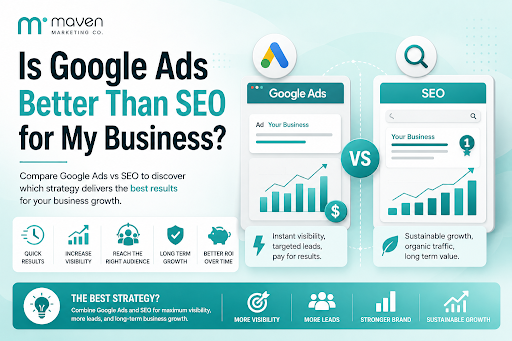
Is Google Ads Better Than SEO for My Business
One of the biggest questions business owners ask when they are planning online growth is whether they should invest in Google Ads or SEO. Both are strong marketing plays that help your company show up in Google search results, but they do things in separate lanes. Google Ads gives quicker visibility and can bring in leads fast, whereas SEO more or less focuses on slow, steady organic traffic that tends to grow the longer you keep building it. Picking the right direction depends on what you want to achieve, how much money you can spend, how crowded the market is, and how quickly you need results, like sooner rather than later. The good news is you don’t always have to choose one or the other; it’s not exactly a black-and-white situation. If you take time to understand the strongest points of both, you can put together a more sensible digital marketing plan that supports consistent expansion. In this guide, we’ll compare Google Ads vs SEO, explain the main differences, and help you figure out what option makes the most sense for your business.

When Should I Hire a Digital Marketing Agency
Growing a business today takes more than just having a website or throwing a post on social media; customers usually search around online, compare providers, skim reviews, and basically expect the brand to show up with a solid digital presence before they even think about buying. Many businesses try to run their marketing themselves, but there comes a point when “doing it all in-house” becomes clunky and hard to manage, all at once. Knowing when to hire a digital marketing agency can end up making a big, real difference for your growth. If you’re not getting enough leads, or your online visibility feels stuck, or sales are just not moving, the right agency can bring the know-how, plus a clear plan, to help you get noticeably better outcomes. In this guide, we’ll dig into what a digital marketing agency actually does, the usual signs it’s time to bring one on, and how picking the right marketing partner can help your business move forward at a faster pace.
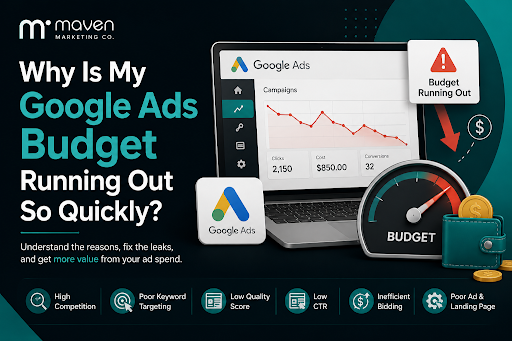
Why Is My Google Ads Budget Running Out So Quickly
Running a successful Google Ads budget isn’t only about throwing more money at it. It’s more like making every dollar, doing a bit extra. A lot of businesses start a Google Ads campaign with big hopes, then find out their daily budget is gone within a few hours, and that feels weird, right? After that, your ads stop showing effectively, new leads slip away, and your return on investment dips. So if your Google Ads budget is running out too fast, don’t stress. It’s a fairly common issue, and in most situations, it can be repaired with the right approach. There are multiple little things that can drain your advertising money quicker than you expected, from costly keywords to audience targeting that just doesn’t quite fit. In this guide, we’ll walk through why your budget disappears so quickly, how to cut wasteful spend, and the most reliable ways to boost your Google Ads ROI, even if your budget stays the same.