.svg)


%201.svg)

Key Takeaways
- Australian e-commerce conversion rates average 1.84%, meaning 98 of every 100 visitors leave without purchasing—yet a 0.5 percentage point improvement delivers revenue increase equivalent to 27% traffic growth at zero acquisition cost
- Checkout friction causes 69.8% of cart abandonment in Australian e-commerce, with shipping costs, forced account creation, and payment complexity representing the highest-impact optimization opportunities
- Behavioral analytics reveal conversion barriers invisible in traditional analytics, with heatmaps, session recordings, and user testing exposing exactly where and why visitors disengage before purchase
- Systematic testing frameworks outperform intuition-based changes by 340%, requiring hypothesis development, statistical rigor, and iterative refinement rather than implementing every trending "best practice"
- Mobile conversion rates lag desktop by 58% for Australian retailers despite mobile comprising 67% of traffic, creating urgent optimization imperative for responsive checkout experiences and thumb-friendly interfaces
Your e-commerce site received 47,000 visitors last month. Your analytics show 850 completed purchases. You celebrated the revenue whilst planning next month's advertising budget to drive more traffic.
This approach ignores the more profitable opportunity sitting in plain sight: the 46,150 visitors who left without buying represent vastly more revenue potential than marginal traffic increases you'll achieve through additional ad spend.
Conversion rate optimisation focuses relentlessly on this opportunity. Rather than acquiring more visitors at escalating costs, CRO extracts maximum value from traffic you're already paying for through systematic identification and removal of conversion barriers preventing purchases.
The mathematics prove compelling. Increasing conversion rate from 1.8% to 2.3%—a 0.5 percentage point improvement—delivers identical revenue impact to increasing traffic by 27%. Yet traffic growth requires proportional advertising investment whilst conversion improvements require one-time optimization effort delivering ongoing returns.
Australian e-commerce businesses that master conversion optimisation achieve sustainable competitive advantages, monetizing traffic more effectively than competitors whilst reducing customer acquisition costs that increasingly threaten profitability across the sector.

Understanding the Australian E-commerce Conversion Landscape
Conversion rate represents the percentage of site visitors who complete desired action, typically product purchase. Research examining Australian e-commerce performance benchmarks shows overall conversion rates averaging 1.84% across sectors, with significant variation by industry, device type, and traffic source.
Fashion and apparel average 1.6% conversion, challenged by fit uncertainty and high return rates that make Australian consumers cautious about online clothing purchases. Electronics and technology achieve 2.3% conversion, benefiting from standardized products where online research translates readily to purchase confidence. Home and garden reach 2.1% conversion, with furniture and decor categories performing strongly when augmented reality visualization reduces uncertainty. Health and beauty demonstrate 2.8% conversion, driven by subscription models and repurchase behavior once customers find preferred products.
These benchmarks provide context but shouldn't constrain ambition. Melbourne-based activewear retailer Lorna Jane achieves 4.2% conversion through relentless optimization of product photography, size recommendation algorithms, and streamlined checkout. Their performance demonstrates that systematic CRO effort can double or triple industry average conversion rates.
Device-specific conversion patterns reveal critical optimization priorities. Desktop traffic converts at 3.1% average whilst mobile converts at only 1.3% despite representing 67% of total traffic for Australian e-commerce sites. This mobile conversion gap represents the single largest optimization opportunity for most retailers, as closing even half this gap would increase overall conversion rates by approximately 40%.
Traffic source quality varies dramatically in conversion propensity. Organic search traffic converts at 2.9% average as visitors demonstrate purchase intent through search queries. Paid search achieves 2.6% conversion when keyword targeting and landing page relevance align appropriately. Social media traffic converts at only 1.1% average, reflecting browsers rather than buyers, though Instagram Shopping features have improved social conversion for visual product categories. Email marketing delivers 3.7% conversion among engaged subscribers, validating owned audience value. Direct traffic shows 4.3% conversion as returning customers demonstrate highest purchase intent.
Understanding these patterns guides strategic resource allocation. A retailer receiving substantial mobile traffic with poor mobile conversion should prioritize mobile experience optimization over new traffic acquisition campaigns. Similarly, strong email conversion rates justify investment in list growth and segmentation over channels showing weaker performance.
Diagnostic Phase: Identifying Your Conversion Barriers Through Data

Effective optimization begins with diagnosis, not treatment. Too many businesses implement generic "best practices" without understanding their specific conversion barriers, wasting resources on changes addressing problems they don't actually have.
Comprehensive conversion diagnosis combines quantitative analytics revealing what's happening with qualitative insights explaining why it's happening. Neither approach alone provides sufficient understanding for confident optimization decisions.
Google Analytics 4 provides foundational quantitative insights through several critical reports. Enhanced e-commerce tracking reveals exactly where visitors drop from your conversion funnel, showing what percentage abandon at product pages versus cart versus checkout stages. Landing page performance analysis identifies which entry points convert effectively versus which hemorrhage visitors immediately. Device and browser segmentation exposes technical issues affecting specific user configurations. Traffic source conversion comparison guides marketing budget allocation toward highest-performing channels.
Sydney-based homewares retailer Temple & Webster discovered through funnel analysis that 43% of visitors abandoned during product page viewing, significantly higher than industry benchmark of 28%. This pattern indicated product page optimization as highest-priority opportunity, focusing investigation on imagery quality, product information completeness, and social proof elements.
Behavioral analytics platforms like Hotjar, Microsoft Clarity, or FullStory expose the qualitative "why" behind quantitative patterns through several powerful techniques. Heatmaps aggregate thousands of user sessions showing where visitors click, how far they scroll, and where attention concentrates or dissipates. Session recordings capture actual user journeys allowing you to watch exactly where confusion, frustration, or disengagement occurs. Form analytics identify which checkout fields cause abandonment through revealing where users pause, correct errors, or exit entirely.
Brisbane-based supplement retailer Bulk Nutrients implemented Hotjar discovering that 67% of mobile users never scrolled past product hero image to reach "Add to Cart" button positioned below the fold. This single insight drove redesign placing call-to-action within initial viewport, increasing mobile conversion by 34% through addressing previously invisible barrier.
User testing with real customers provides irreplaceable qualitative insight that analytics cannot deliver. Moderated sessions where you watch customers attempt to complete purchases while thinking aloud reveal confusion, uncertainty, and frustration in real-time. Unmoderated remote testing through platforms like UserTesting scales feedback collection across diverse user segments. Post-purchase surveys asking what nearly prevented purchase surface objections and concerns your optimization should address.
Adelaide-based fashion retailer Gorman conducted user testing revealing that customers struggled to understand their sizing, with 73% expressing uncertainty about which size to order. This feedback drove implementation of detailed size charts, fit descriptions for each product, and customer photo galleries showing items on various body types. Subsequent testing showed sizing uncertainty decreased by 61%, with corresponding 23% reduction in return rates alongside conversion improvement.
Technical performance auditing identifies invisible barriers preventing conversions despite visitor intent. Page load speed directly impacts conversion, with each additional second of load time reducing conversion rates by approximately 7% on average. Mobile usability issues including tiny tap targets, horizontal scrolling, or non-responsive elements frustrate users sufficiently to abandon. Payment processor failures or errors during checkout create absolute conversion barriers even for highly motivated buyers. Browser compatibility problems affect specific user segments who encounter broken functionality invisible to your team testing on different configurations.
Perth-based electronics retailer JB Hi-Fi discovered through technical audit that their checkout page loaded in 7.2 seconds on 3G mobile connections common in regional Australia, compared to 2.1 seconds on desktop. Mobile checkout completion rates improved 41% after implementing aggressive mobile performance optimization reducing load time to 3.4 seconds.
Strategic Prioritization: The ICE Framework for Test Selection
.avif)
Comprehensive diagnosis typically reveals dozens of potential optimization opportunities. Limited resources demand strategic prioritization focusing effort on changes delivering maximum conversion impact.
The ICE framework provides structured prioritization methodology balancing three dimensions. Impact estimates the potential conversion lift if optimization succeeds, scored 1-10 based on how many users encounter the issue and how severely it prevents conversion. Confidence reflects certainty that the proposed change will actually improve conversion, scored 1-10 based on supporting data, user feedback, and precedent from similar changes. Ease quantifies implementation effort required, scored 1-10 with higher scores for changes requiring minimal development resources.
Each potential optimization receives ICE score by averaging the three dimensions, with highest-scoring opportunities prioritized for testing. This framework prevents common pitfalls of pursuing either easy changes with minimal impact or high-impact changes your team lacks confidence will actually work.
Melbourne furniture retailer Koala applied ICE framework to their conversion optimization roadmap, scoring 23 identified opportunities. Their highest-scoring optimization involved adding "Free shipping on orders over $150" banner to cart page, which scored Impact: 8 (cart abandonment data showed shipping cost as primary abandonment reason), Confidence: 9 (shipping threshold proven effective across e-commerce), and Ease: 9 (simple banner addition requiring no technical complexity). This 8.7 average ICE score justified immediate implementation over more complex product page redesign scoring lower despite potentially higher ultimate impact.
The framework should account for Australian market specifics that influence impact and confidence scores. Shipping costs represent greater conversion barrier in Australia than many international markets due to geographic distance and expensive last-mile delivery, elevating impact scores for shipping-related optimizations. Payment method preferences differ significantly, with PayPal, Afterpay, and bank transfer more prevalent than international markets, informing confidence in payment optimization impact. Mobile optimization deserves higher priority given Australia's high smartphone penetration and mobile commerce adoption rates exceeding many developed markets.
Sequential testing prevents resource waste on low-impact optimizations whilst high-impact opportunities remain unaddressed. The prioritized roadmap should stack tests implementing highest-ICE-score changes first, then systematically working through ranked opportunities rather than cherry-picking easy wins that deliver minimal conversion improvement.
A/B Testing Methodology: Statistical Rigor Over Hopeful Assumptions
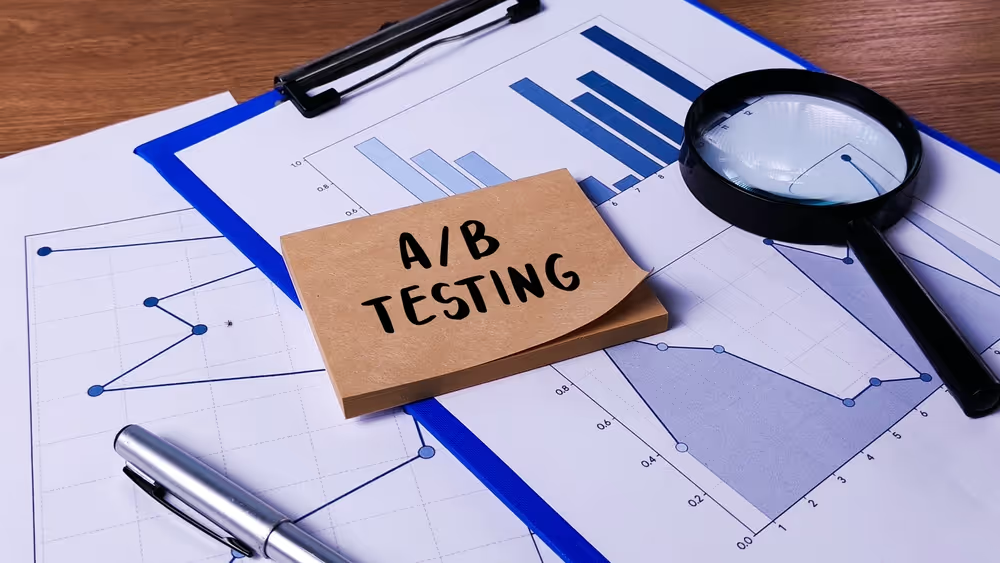
Implementing changes without testing creates risk of unintentionally harming conversion whilst confidently believing you've improved it. Rigorous A/B testing methodology provides statistical confidence that observed changes result from your optimization rather than random variation.
Proper test design begins with clear hypothesis articulating what you're changing, why you believe it will improve conversion, and what success looks like. "We believe that adding customer reviews to product pages will increase conversion by reducing purchase uncertainty, measured through add-to-cart rate increase of at least 15%" provides testable hypothesis. "Reviews are good, let's add them" does not.
Sample size calculation determines how many visitors must participate before results become statistically significant. Too small samples produce unreliable results where random variation appears as meaningful difference. Online calculators require inputting current conversion rate, minimum detectable effect you want to measure, and desired statistical confidence level (typically 95%).
Sydney skincare brand Sand & Sky wanted to test simplified checkout flow against their existing multi-step process. With current 2.1% checkout conversion rate, detecting 0.3 percentage point improvement (14% relative lift) with 95% confidence required 28,400 visitors per variation, indicating their test needed to run approximately three weeks to achieve required sample size given their traffic levels.
Traffic splitting must be truly random, with each visitor having equal probability of seeing either variation. Most A/B testing platforms handle this automatically, but implementation errors can create biased samples undermining result validity. Common mistakes include splitting by time period where different visitor types arrive at different times, using non-random assignment creating systematic differences between groups, or allowing users to switch between variations mid-session.
Test duration should span complete weekly cycle minimizing day-of-week effects where different visitor behaviors on weekends versus weekdays might bias results. Running tests for insufficient duration risks declaring winners based on early random variation rather than true performance difference. Conversely, running tests excessively long after reaching statistical significance wastes opportunity cost of implementing winning variation.
Brisbane pet supply retailer Pet Circle tested two product page layouts, reaching statistical significance after 11 days showing new layout converted 18% better than control. However, they continued test for full 21-day planned duration, discovering the early advantage evaporated as weekend shoppers (who comprised different demographic) showed no preference between variations. Final result showed only 4% improvement, still positive but dramatically less than premature analysis suggested.
Result interpretation requires statistical literacy preventing common misunderstandings. Statistical significance means observed difference is unlikely due to random chance, typically requiring 95% confidence that true difference exists. However, significance doesn't indicate magnitude—a statistically significant 2% conversion improvement matters far less than non-significant 15% improvement that hasn't yet reached required sample size. Practical significance asks whether observed improvement justifies implementation effort, sometimes rejecting statistically significant changes delivering negligible real-world impact.
Failed tests deliver value through validated learning about what doesn't work, preventing future resource waste on similar approaches. E-commerce optimization research shows approximately 60% of A/B tests produce neutral or negative results, meaning most optimization hypotheses prove incorrect. This failure rate doesn't indicate poor methodology—it reflects reality that converting browsers to buyers involves complex psychology where intuition frequently misleads.
High-Impact Optimization Areas: Where to Focus Testing Effort
.avif)
While every e-commerce site exhibits unique conversion barriers requiring customized optimization, certain areas consistently deliver disproportionate impact when improved.
Product page optimization determines whether browsers become buyers through several critical elements. Professional photography showing products from multiple angles with zoom capability reduces uncertainty about appearance and quality. Detailed specifications and dimensions prevent post-purchase disappointment creating returns and negative reviews. Customer reviews and ratings provide social proof overcoming purchase hesitation, with both positive reviews building confidence and negative reviews increasing credibility through authenticity. Clear shipping timeframes and cost transparency prevent checkout surprises causing abandonment. Prominent trust signals including security badges, return policy, and guarantees address risk concerns preventing purchase.
Melbourne mattress company Koala redesigned product pages emphasizing their 120-night trial guarantee and free returns prominently near "Add to Cart" button. This change increased conversion by 29% as risk reversal directly addressed primary purchase barrier for expensive product category where customers couldn't physically test before buying.
Checkout optimization represents highest-leverage opportunity for most Australian e-commerce businesses given that visitors reaching checkout demonstrate strong purchase intent that friction prevents from completing. Reducing required form fields to absolute minimum decreases abandonment significantly, with each additional field reducing completion by approximately 3%. Guest checkout option prevents forced account creation that causes immediate abandonment among visitors unwilling to create credentials for single purchase. Progress indicators showing checkout steps remaining reduce abandonment by providing completion confidence. Multiple payment methods accommodate diverse preferences, with Australian market requiring PayPal, Afterpay, bank transfer, and major credit cards as table stakes. Mobile-optimized checkout with large tap targets, autofill support, and minimal typing requirements addresses the mobile conversion gap plaguing Australian retailers.
Sydney fashion retailer THE ICONIC reduced their checkout from seven steps to three through aggressive field elimination and information consolidation, implementing guest checkout as default option whilst offering account creation after purchase completion. These changes increased checkout conversion by 37% whilst reducing average completion time from 4.2 minutes to 2.1 minutes.

Shipping and delivery optimization directly addresses the primary conversion barrier for Australian e-commerce. Free shipping thresholds encourage larger cart values whilst addressing cost concerns, with most effective thresholds set 20-30% above average order value incentivizing incremental purchases. Transparent shipping cost calculation early in journey prevents checkout surprises causing abandonment. Delivery timeframe clarity manages expectations preventing disappointment. Express shipping options serve urgency-driven purchases willing to pay premium for speed. Click-and-collect capabilities leverage physical retail presence reducing delivery costs and timeframes.
Adelaide retailer Harris Scarfe implemented free shipping threshold of $75 on site where average order value was $63, prominently displaying "Spend $X more for free shipping" message in cart. This change increased average order value to $81 whilst simultaneously improving conversion by 19% as shipping cost barrier disappeared for shoppers adding modest additional items to qualify.
Trust and credibility optimization proves particularly important for newer or lesser-known brands lacking established reputation. Security badges and SSL certificates signal payment security addressing fraud concerns. Money-back guarantees reduce purchase risk through consequence-free trial. Customer service accessibility through phone, chat, or email contact demonstrates post-purchase support availability. About page transparency including team photos, company story, and Australian business registration builds legitimacy. Media mentions and awards leverage third-party credibility when direct brand recognition is limited.
Perth-based natural skincare startup Biologi added comprehensive "Our Story" section detailing Australian origin, sustainable practices, and founder background alongside featuring media coverage from Vogue, Harper's Bazaar, and Australian Financial Review. Trust-focused landing page redesign increased conversion among new visitors by 43% whilst repeat customer conversion remained stable, validating that credibility signals specifically address new customer hesitation.
Mobile Commerce Optimization: Closing Australia's Conversion Gap

Mobile devices generate 67% of Australian e-commerce traffic yet deliver only 42% of revenue due to inferior conversion rates. This gap represents the single largest optimization opportunity for most Australian retailers.
Mobile-specific barriers require targeted solutions beyond merely responsive design. Thumb-zone optimization places critical buttons and links within comfortable reach of one-handed mobile use, with right-handed users comprising 85-90% of population favoring right-side placement. Image optimization balances quality with load speed on mobile networks, implementing lazy loading for below-fold images whilst prioritizing hero images for immediate display. Form input optimization uses appropriate keyboard types for different fields, implements autofill support for addresses and payment details, and provides clear error messaging preventing confusion. Navigation simplification reduces complexity appropriate for smaller screens through hamburger menus, sticky navigation bars, and prominent search functionality.
Brisbane electronics retailer JB Hi-Fi rebuilt their mobile product pages around thumb-friendly interaction zones, placing "Add to Cart" button in bottom-right corner consistently accessible during scrolling whilst relocating secondary actions like "Add to Wishlist" to less prominent positions. This change increased mobile add-to-cart rate by 31% through reducing interaction friction.
Mobile checkout deserves particular optimization attention given disproportionate abandonment rates. Single-column layouts prevent horizontal scrolling and simplify focus. Large, tappable buttons prevent mis-clicks causing frustration. Minimal text entry through dropdowns, toggles, and autofill reduces typing burden. Payment method flexibility including digital wallets like Apple Pay, Google Pay, and PayPal enables one-touch checkout for stored credentials. Progress saving allows users to complete purchase across multiple sessions without re-entering information if interrupted.
Melbourne fashion marketplace THE ICONIC implemented Apple Pay and Google Pay alongside PayPal Express Checkout, enabling returning customers with saved payment credentials to complete purchases in under 60 seconds without typing. Mobile checkout conversion increased 47% as friction essentially disappeared for their most common user scenario.
Mobile page speed optimization addresses the technical performance barrier preventing conversions despite user intent. Image compression reduces file sizes dramatically without visible quality degradation. Code minification removes unnecessary characters from CSS and JavaScript. Content delivery network usage serves static assets from geographically proximate servers reducing latency. Lazy loading defers non-critical resource loading until needed. Critical rendering path optimization ensures above-fold content displays immediately whilst below-fold elements load progressively.
Sydney supplement retailer Bulk Nutrients achieved mobile page load time reduction from 5.8 seconds to 2.1 seconds through comprehensive technical optimization including image format conversion to WebP, aggressive caching policies, and JavaScript deferral. Mobile conversion rate increased 52% following speed improvements, with analytics showing abandonment during page load decreased by 74%.
Personalization and Segmentation: Relevant Experiences Drive Conversion
.avif)
Generic experiences treating all visitors identically waste conversion potential from tailoring content and offers to specific visitor segments exhibiting different behaviors and needs.
Behavioral segmentation enables targeted experiences based on visitor actions and characteristics. New versus returning visitors require different approaches, with new visitors needing more education and trust-building whilst returning visitors benefit from personalized product recommendations and streamlined repurchase. Geographic targeting serves location-specific content including regional shipping timeframes, local currency display, and market-appropriate imagery. Device targeting optimizes experiences for mobile versus desktop capabilities and user contexts. Traffic source segmentation delivers landing experiences aligned with channel that drove visit, maintaining message consistency from ad through site experience.
Adelaide wine retailer Coonawarra Bottle Shop implemented geographically targeted free shipping offers, promoting local delivery within South Australia whilst offering different threshold for interstate shipping. This regional personalization increased conversion by 19% in South Australia where same-day delivery option also appeared, whilst interstate conversion improved 7% through explicit threshold transparency preventing checkout surprises.
Product recommendation engines leverage purchase data and browsing behavior to surface relevant products increasing average order value alongside conversion rates. Collaborative filtering shows "Customers who bought X also bought Y" recommendations leveraging aggregate purchase patterns. Content-based filtering suggests products similar to items customer previously viewed or purchased. Trending products highlight popular items creating social proof and urgency. Recently viewed items facilitate reconsideration of products customer showed interest in previously.
Melbourne furniture retailer Koala implemented sophisticated recommendation engine on cart page showing complementary products relevant to cart contents, such as suggesting pillows to customers who added mattress. This strategic placement captured customers already committed to purchase, with 34% adding recommended items increasing average order value by $87 whilst conversion rate remained stable.
Abandoned cart recovery through email remarketing recaptures visitors who demonstrated strong purchase intent but failed to complete transaction. Tactical cart abandonment emails should send 1-4 hours after abandonment whilst intent remains fresh, include cart contents with product images reinforcing desire, address common abandonment reasons through free shipping offers or payment flexibility, and create urgency through limited-time discount or inventory scarcity messaging.
Sydney activewear brand Lorna Jane implemented three-email abandoned cart sequence, with first email sending after two hours as gentle reminder, second email after 24 hours offering 10% discount to incentivize completion, and third email after 72 hours creating urgency through inventory messaging. This sequence recovered 18% of abandoned carts generating incremental revenue of approximately $340,000 monthly.
Continuous Improvement Culture: CRO as Ongoing Practice
Conversion optimization isn't project with completion point—it's ongoing practice of incremental improvement compounding over time into transformative competitive advantage.
Testing velocity determines how quickly you learn what works for your specific audience and business model. Mature optimization programs run simultaneous tests across different site areas, maintaining constant experimentation rhythm rather than episodic testing. Documentation of test results including hypotheses, designs, results, and learnings prevents repeating failed approaches whilst building institutional knowledge. Regular review and analysis of testing pipeline ensures highest-priority opportunities receive attention whilst lower-impact tests don't consume disproportionate resources.
Brisbane pet supply retailer Pet Circle maintains rolling 90-day testing roadmap with average 6-8 simultaneous tests running at any time across product pages, checkout flow, homepage, and category pages. This testing velocity generates approximately 75 completed tests annually, with cumulative impact of winning variations increasing baseline conversion from 2.1% to 3.4% over 18-month period representing millions in incremental revenue.
Cross-functional collaboration strengthens optimization through diverse perspectives and capabilities. Marketing brings customer insight and competitive intelligence. Design contributes user experience expertise and creative solutions. Development provides technical feasibility assessment and implementation capability. Customer service identifies common friction points and objections encountered during support interactions. Analytics translates data into actionable insights guiding prioritization.
Perth homewares retailer Temple & Webster established monthly CRO working group comprising representatives from each function, reviewing testing results and prioritizing upcoming experiments. This collaborative approach prevented siloed optimization decisions whilst ensuring technical feasibility informed test design before resources were committed.
External expertise through CRO agencies or consultants accelerates learning and prevents common mistakes, particularly for businesses establishing optimization capability. Specialists bring cross-industry experience revealing opportunities invisible to teams deeply familiar with their own sites. Technical expertise in testing platforms and statistical analysis ensures methodological rigor. Fresh perspective identifies assumptions and conventions your team no longer questions.
Building Your Conversion Optimization Foundation

Conversion rate optimization transforms e-commerce economics, extracting maximum value from traffic you're already paying to acquire. The Australian e-commerce businesses thriving despite intensifying competition and rising acquisition costs are those that master systematic conversion improvement.
Your opportunity exists in the gap between current performance and potential sitting unrealized in visitor behavior data. Every abandoned cart, every product page exit, and every checkout abandonment represents solvable problem preventing revenue you should be capturing.
The path forward requires commitment to data-driven decision making over intuition, systematic testing methodology over random changes, and sustained focus on incremental improvement compounding into transformative results. This discipline separates businesses that optimize conversion from those that merely tinker whilst wondering why growth stagnates.
Ready to Transform Browsers into Buyers?
Conversion rate optimization requires specialized expertise spanning behavioral analytics, statistical testing methodology, user experience design, and technical implementation. Most Australian e-commerce businesses lack internal capabilities to execute sophisticated optimization programs whilst managing daily operations.
Maven Marketing Co delivers comprehensive conversion optimization programs combining data diagnosis, strategic testing roadmaps, and expert implementation that measurably increase your revenue per visitor.
From behavioral analysis uncovering your specific conversion barriers through A/B testing execution and winning variation implementation, we provide complete CRO service transforming your traffic into maximum revenue.
Schedule your conversion optimization audit with Maven Marketing Co today and discover exactly how much revenue you're leaving on the table—then capture it systematically.
Stop paying for traffic that doesn't convert. Start optimizing the visitors you already have.

Table of contents
read more blogs

How to Build a Brand Positioning Strategy That Sets Your Business Apart
Most businesses can explain what they sell. Far fewer can explain, in a sentence or two, why the right customer should choose them instead of another credible option. That gap is where brand positioning matters.A strong brand positioning strategy gives your business a clear place in the market and a clear place in the customer's mind. It helps your team decide who you are speaking to, what you want to be known for, which benefits deserve the most attention and how your marketing should sound and look across every channel.It is not a slogan exercise and it is not something reserved for large consumer brands. For an Australian service business, e-commerce brand, professional firm, or growing B2B company, positioning can make everyday decisions easier, from website copy and campaign messaging to pricing, sales conversations, and brand identity. The goal is not to look different for the sake of it. The goal is to be meaningfully different in a way the right customers understand and value.

The Role of Digital PR in Long Term SEO Growth
Building a solid online presence is basically more than just posting content now and then or sprinkling keywords across your website. Search engines such as Google tend to point users toward businesses that feel trustworthy, useful, and backed up by others online, even if it’s not always obvious at first. When a company puts together a well-thought-out digital PR strategy, it can bring in solid media mentions, earning high-quality backlinks and stronger brand awareness, all of which feed long-term SEO progress. Rather than obsessing solely over rankings, digital PR helps you build credibility plus authority, so your site looks more appealing to search engines and also to real people who might become customers. In this guide, we’ll walk through how digital PR supports SEO, what makes it such a key part of modern marketing, and the most effective approaches for sustainable growth in search results.

Is Google Ads Better Than SEO for My Business
One of the biggest questions business owners ask when they are planning online growth is whether they should invest in Google Ads or SEO. Both are strong marketing plays that help your company show up in Google search results, but they do things in separate lanes. Google Ads gives quicker visibility and can bring in leads fast, whereas SEO more or less focuses on slow, steady organic traffic that tends to grow the longer you keep building it. Picking the right direction depends on what you want to achieve, how much money you can spend, how crowded the market is, and how quickly you need results, like sooner rather than later. The good news is you don’t always have to choose one or the other; it’s not exactly a black-and-white situation. If you take time to understand the strongest points of both, you can put together a more sensible digital marketing plan that supports consistent expansion. In this guide, we’ll compare Google Ads vs SEO, explain the main differences, and help you figure out what option makes the most sense for your business.