.svg)


%201.svg)

Key Takeaways
- Advanced Matching sends hashed customer data alongside pixel events, improving Meta's ability to match website conversions back to the ad interactions that drove them.
- The iOS 14 AppTrackingTransparency framework and browser restrictions on third party cookies have materially reduced the completeness of standard pixel tracking for most advertisers.
- Implementing Advanced Matching can recover a meaningful proportion of conversions that would otherwise go unattributed, improving both reporting accuracy and campaign optimisation.
- Automatic Advanced Matching is the lowest effort implementation path. Manual Advanced Matching gives advertisers more control and typically produces higher match quality.
- The Conversions API works alongside Advanced Matching to send server side conversion data to Meta, providing a more complete picture than browser only tracking can deliver.
- All customer data sent through Advanced Matching is hashed before transmission using SHA-256 encryption. Meta does not receive or store raw personal information.
- Australian advertisers should review their privacy policy to ensure it accurately reflects the data matching practices used in their Meta advertising setup.
Why Attribution Broke and What That Actually Means
Understanding why Advanced Matching matters requires understanding what happened to attribution in the Meta advertising ecosystem over the past few years.
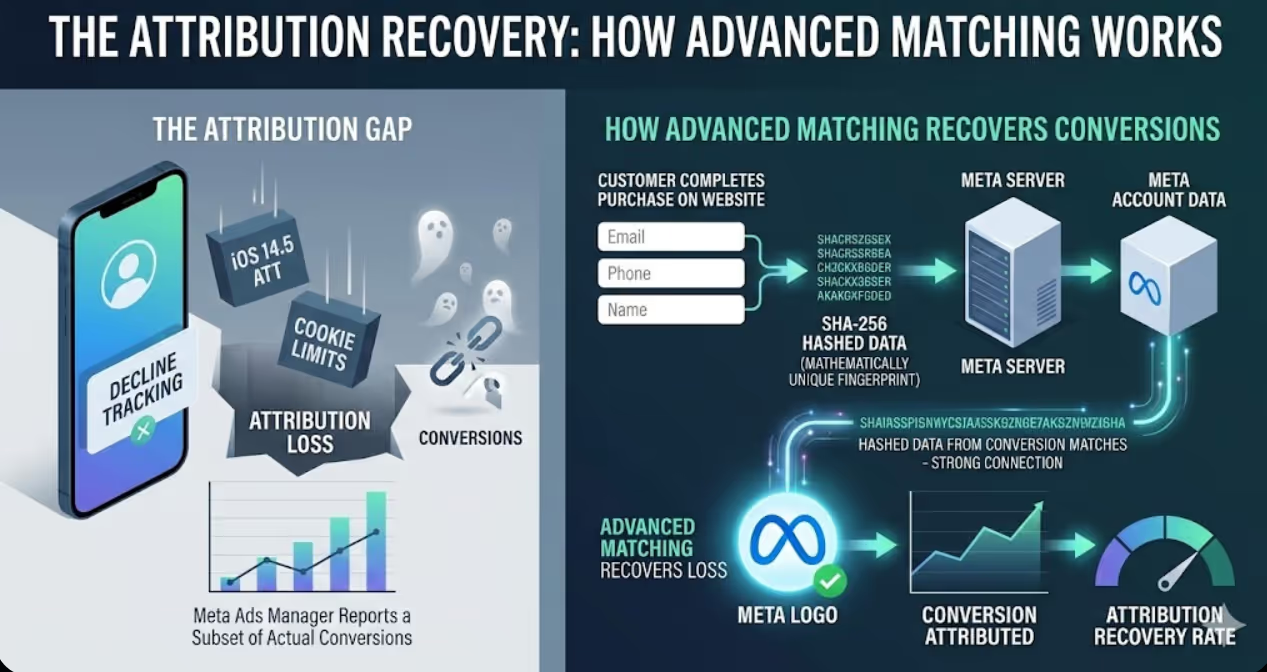
Before April 2021, the Facebook Pixel worked fairly reliably by placing a cookie in a user's browser when they visited your website. When that user later completed a purchase or signed up for a service, the pixel fired a conversion event, Meta matched that event back to the cookie, and the conversion was attributed to the ad that preceded the visit. It was not a perfect system, but it was functional enough that most advertisers had a reasonably accurate picture of their campaign performance.
Apple's AppTrackingTransparency (ATT) framework, introduced with iOS 14.5, changed this significantly. Users were now prompted to opt in to tracking across apps and websites, and the majority declined. For Meta specifically, this meant that a large proportion of users browsing on iPhone devices could no longer be tracked by the pixel in the standard way. Conversions driven by those users simply disappeared from reporting.
At the same time, browser based restrictions on third party cookies, already in place on Safari and Firefox and progressively tightening on Chrome, further eroded the pixel's ability to track users across sessions and devices. A user who first saw your ad on their phone, then converted on their laptop several days later, became increasingly invisible to standard attribution models.
The practical result for Australian advertisers is that Meta Ads Manager is now reporting a subset of actual conversions rather than a complete picture. The size of that gap varies by business, audience demographics, and product type, but research published by Meta's own Business Help Centre acknowledges that underreporting is a structural feature of the current tracking environment, not an anomaly.
What Advanced Matching Actually Does
Advanced Matching addresses the attribution gap by giving Meta additional data points to match a website conversion event back to a person who interacted with an ad, even when cookie based tracking has failed.
When a customer completes a purchase on your website, they typically provide identifiable information such as an email address, a phone number, or a name. Standard pixel tracking ignores this information entirely and relies on the browser cookie for matching. Advanced Matching captures that customer information, hashes it using SHA-256 encryption before any data leaves the browser, and sends those hashed values to Meta alongside the conversion event.
Meta then attempts to match those hashed values against the hashed profile data it holds for its own users. If the email address a customer used on your website matches the hashed email address associated with a Meta account that interacted with your ad, that conversion is attributed. The attribution that would have been lost due to cookie failure or cross device behaviour is recovered.
According to Meta's documentation on Advanced Matching, advertisers implementing Advanced Matching typically see meaningful improvements in their event match quality scores, and higher event match quality correlates directly with better conversion attribution and stronger algorithm optimisation signals.
The data that can be sent through Advanced Matching includes email address, phone number, first name, last name, date of birth, gender, city, state or province, postcode, and country. Each additional data parameter improves the probability of a successful match. Email address and phone number tend to be the most valuable individual parameters because they are both highly specific and consistently accurate.
Automatic vs Manual Advanced Matching
Meta offers two implementation paths for Advanced Matching, and the choice between them depends on your technical setup and how much control you want over what data is sent.
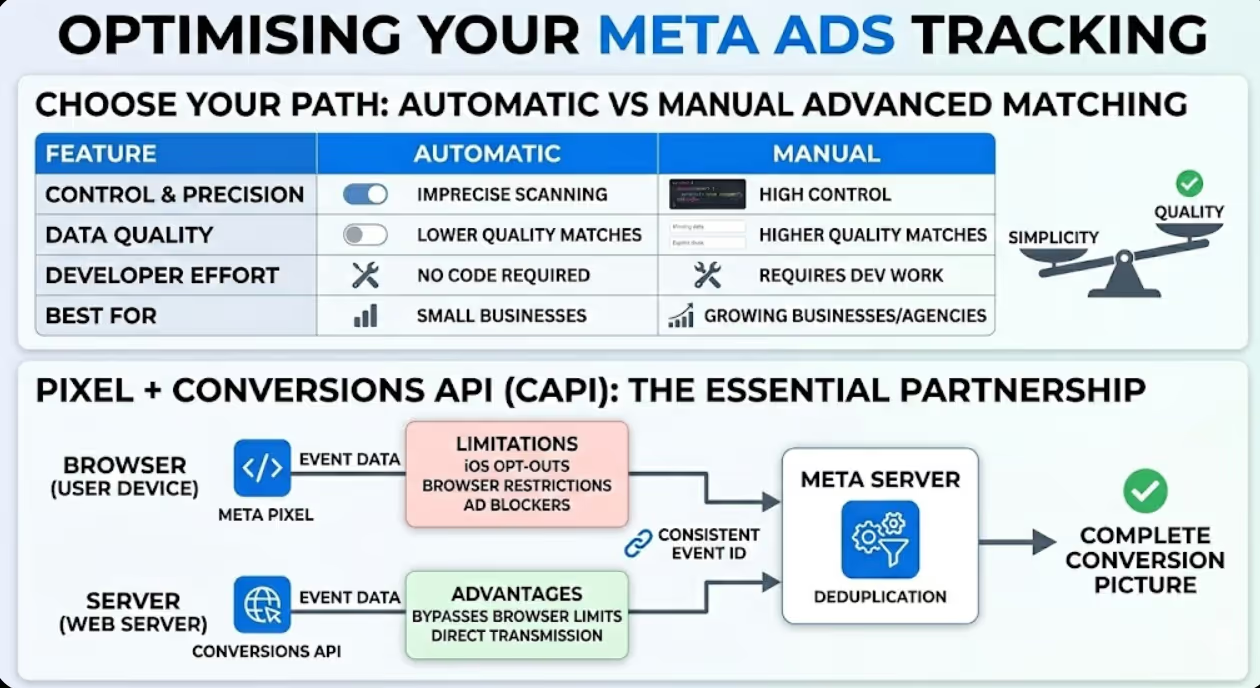
Automatic Advanced Matching is enabled directly in the Events Manager with a single toggle. Once turned on, Meta's pixel code scans your website pages for identifiable customer information in form fields and other input elements, hashes it automatically, and sends it with conversion events. The appeal is simplicity. No developer work is required, and the system is live within minutes.
The limitation is that automatic scanning is imprecise. It may pick up some data fields and miss others. It can occasionally capture data from fields where it is not appropriate to do so. And because the process is handled entirely by Meta's code rather than your own implementation, you have limited visibility into exactly what is being sent and when.
Manual Advanced Matching requires passing customer data parameters explicitly through your pixel event code. Rather than relying on Meta to detect form field values, you pass the relevant hashed data directly in the event function call. This approach produces higher and more consistent match quality, gives you precise control over which events send which parameters, and integrates cleanly with form submission workflows, checkout processes, and CRM data.
For Australian businesses with a developer resource or an agency managing their tracking implementation, manual Advanced Matching is almost always the better choice. The setup investment is modest and the data quality improvement is material.
The Conversions API: Advanced Matching's Essential Partner
Advanced Matching through the pixel is a browser side solution. It captures data from customer interactions on your website and sends it from the user's browser to Meta. This means it is still subject to browser restrictions, ad blockers, and the same iOS limitations that affect standard pixel tracking.
The Conversions API (CAPI) is a server side solution that sends conversion data directly from your web server to Meta, bypassing the browser entirely. It is not dependent on cookies, is not affected by browser privacy settings, and continues to function regardless of whether a user has opted out of tracking at the device level.
The most effective Meta tracking architecture combines both approaches. Advanced Matching through the pixel captures browser side conversion data with improved match quality. The Conversions API captures server side conversion data that the pixel cannot reach. Together they provide a more complete picture of conversion activity than either approach can deliver independently.
Deduplication is an important technical consideration when running both. When a conversion event is captured by both the pixel and CAPI simultaneously, Meta needs to know that these are the same event rather than two separate conversions. This is handled through event ID parameters that must be consistent across both the pixel and API calls for each conversion event.
For Australian businesses using Shopify, WooCommerce, or other major ecommerce platforms, native CAPI integrations are available that handle much of this technical complexity. Shopify's Meta sales channel, for example, includes a server side integration that works alongside the pixel without requiring custom development.
Event Match Quality: The Metric That Tells You If It Is Working
Meta's Events Manager provides an event match quality score for each conversion event tracked by your pixel. This score, rated on a scale from zero to ten, reflects how effectively Meta is able to match the conversion events it receives back to Meta accounts. A higher score means more conversions are being attributed, which means better reporting accuracy and stronger optimisation signals flowing to your campaigns.
Before implementing Advanced Matching, most Australian advertisers will find their event match quality scores sitting in a range that reflects meaningful attribution loss. After implementation, an improvement in these scores is typically visible within days as the additional matching parameters begin to improve match rates.
The factors that drive event match quality include the number and type of customer parameters being sent, the consistency with which those parameters are populated, the quality of the data itself (accurate email addresses and phone numbers match better than outdated ones), and whether the Conversions API is being used alongside the pixel.
Monitoring event match quality scores after implementation is the clearest way to evaluate whether your Advanced Matching setup is working as intended. If scores are not improving after implementation, the most common causes are parameters being sent inconsistently, the automatic scanning missing key form fields, or a mismatch between the data format being sent and what Meta expects to receive.
Privacy Compliance for Australian Advertisers
Advanced Matching involves collecting customer information and using it for advertising attribution purposes. For Australian businesses, this has implications under the Privacy Act 1988 and the Australian Privacy Principles, which govern how personal information can be collected, used, and disclosed.
The critical distinction is that Advanced Matching sends only hashed data to Meta. SHA-256 hashing is a single direction process, meaning the hashed values cannot be reversed to recover the original personal information. Meta receives a mathematical fingerprint, not the actual email address or phone number. This is a meaningful privacy protection.
However, the fact that customer data is being used for advertising matching purposes is still a data use that should be disclosed to customers. Australian Privacy Principle 1 requires organisations to have a clearly expressed and current and up to date privacy policy. If your website is implementing Advanced Matching, your privacy policy should reference the use of customer data for advertising purposes, the use of hashing before transmission, and the identity of Meta as the third party recipient of that information.
This is not a reason to avoid Advanced Matching. It is a reason to review and update your privacy policy before or alongside implementation. Brands that are transparent about their data practices build more trust with their audiences over time, and that transparency is both legally appropriate and commercially sensible.
Practical Implementation Steps
For Australian advertisers ready to implement Advanced Matching, the sequence below covers the essential steps regardless of which implementation path you choose.
Start by auditing your current event match quality scores in Meta Events Manager. Document the baseline scores for your key conversion events before making any changes. This gives you a clear before and after comparison to evaluate the impact of your implementation.
If you are using automatic Advanced Matching, enable it in Events Manager under your pixel settings. Check that the toggle is active, then review a sample of conversion events over the following week to assess whether match quality scores have improved and which parameters are being captured.
If you are moving to manual Advanced Matching, work with your developer or agency to identify the points in your website's conversion flows where customer data is available, such as checkout confirmation pages, lead form submissions, and account registration completions. Pass the available customer data parameters in the pixel event calls at those points, ensuring the data is being hashed correctly before transmission.
Implement the Conversions API alongside the pixel if you have not already done so. For major ecommerce platforms, use the native integration where available. For custom built websites, the implementation requires server side development work but is well documented in Meta's technical resources.
Set a review point at 30 days after implementation to evaluate event match quality scores, conversion volume changes, and any downstream impact on campaign optimisation and reported ROAS.
FAQs
Is Advanced Matching compatible with Australian privacy laws?
Advanced Matching is designed with privacy protection built in. All customer data is hashed using SHA-256 encryption before it leaves the browser, and Meta receives only hashed values rather than raw personal information. Australian businesses should ensure their privacy policy discloses the use of customer data for advertising matching purposes and names Meta as the third party recipient of hashed data. Consulting with a privacy professional for specific legal advice is recommended for businesses with complex data handling situations.
How much of a difference does Advanced Matching make to reported conversion numbers?
The impact varies depending on the proportion of your audience using iOS devices or privacy oriented browsers, the current completeness of your pixel implementation, and how much customer data is available to send as matching parameters. Australian advertisers with a significant mobile audience and strong customer data quality typically see meaningful improvements in attributed conversion volume. A reasonable expectation is a 10 to 30 percent improvement in attributed conversions for most implementations, though results outside this range are not uncommon.
Can Advanced Matching be used without the Conversions API?
Yes. Advanced Matching through the pixel and the Conversions API are independent tools that can be used together or separately. Advanced Matching alone will improve attribution compared to standard pixel tracking with no additional parameters. The Conversions API adds an additional layer of server side data collection that recovers conversions the pixel cannot track at all. For the most complete attribution picture, using both is recommended, but implementing Advanced Matching without CAPI is a worthwhile improvement in its own right.
Close the Gap in Your Meta Attribution
Attribution gaps in Meta advertising are not going away. The privacy trends driving them are structural and ongoing. Australian advertisers who accept incomplete data as a permanent condition will increasingly be making budget and optimisation decisions on a distorted picture of their campaign performance.
Advanced Matching, combined with the Conversions API, is the most practical response available within the Meta advertising ecosystem. It does not solve every attribution challenge, but it closes meaningful gaps and strengthens the optimisation signals that determine how effectively Meta's algorithm spends your budget.
Maven Marketing Co helps Australian businesses build Meta advertising setups that are technically sound, properly attributed, and structured to perform. If your current tracking setup is leaving conversions on the table, we can help.
Talk to the team at Maven Marketing Co →

Table of contents
read more blogs

How to Build a Brand Positioning Strategy That Sets Your Business Apart
Most businesses can explain what they sell. Far fewer can explain, in a sentence or two, why the right customer should choose them instead of another credible option. That gap is where brand positioning matters.A strong brand positioning strategy gives your business a clear place in the market and a clear place in the customer's mind. It helps your team decide who you are speaking to, what you want to be known for, which benefits deserve the most attention and how your marketing should sound and look across every channel.It is not a slogan exercise and it is not something reserved for large consumer brands. For an Australian service business, e-commerce brand, professional firm, or growing B2B company, positioning can make everyday decisions easier, from website copy and campaign messaging to pricing, sales conversations, and brand identity. The goal is not to look different for the sake of it. The goal is to be meaningfully different in a way the right customers understand and value.

The Role of Digital PR in Long Term SEO Growth
Building a solid online presence is basically more than just posting content now and then or sprinkling keywords across your website. Search engines such as Google tend to point users toward businesses that feel trustworthy, useful, and backed up by others online, even if it’s not always obvious at first. When a company puts together a well-thought-out digital PR strategy, it can bring in solid media mentions, earning high-quality backlinks and stronger brand awareness, all of which feed long-term SEO progress. Rather than obsessing solely over rankings, digital PR helps you build credibility plus authority, so your site looks more appealing to search engines and also to real people who might become customers. In this guide, we’ll walk through how digital PR supports SEO, what makes it such a key part of modern marketing, and the most effective approaches for sustainable growth in search results.

Is Google Ads Better Than SEO for My Business
One of the biggest questions business owners ask when they are planning online growth is whether they should invest in Google Ads or SEO. Both are strong marketing plays that help your company show up in Google search results, but they do things in separate lanes. Google Ads gives quicker visibility and can bring in leads fast, whereas SEO more or less focuses on slow, steady organic traffic that tends to grow the longer you keep building it. Picking the right direction depends on what you want to achieve, how much money you can spend, how crowded the market is, and how quickly you need results, like sooner rather than later. The good news is you don’t always have to choose one or the other; it’s not exactly a black-and-white situation. If you take time to understand the strongest points of both, you can put together a more sensible digital marketing plan that supports consistent expansion. In this guide, we’ll compare Google Ads vs SEO, explain the main differences, and help you figure out what option makes the most sense for your business.