.svg)


%201.svg)
.avif)
Key Takeaways
- 82% of smartphone users enable dark mode system-wide with adoption highest among 18-34 demographic (91%), making dark theme support essential for mobile-first businesses targeting younger audiences
- Proper dark mode implementation increases mobile session duration 23% through reduced eye strain during evening browsing and 15-30% battery savings on OLED displays that power off pure black pixels
- True black backgrounds (#000000) should be avoided in favour of dark grays (
#121212to#1E1E1E) which reduce eye strain, minimize OLED smearing, and provide better elevation depth perception through subtle surface differentiation - Colour contrast requirements become more complex in dark mode with WCAG accessibility standards demanding careful recalibration of brand colours that work beautifully on white backgrounds but fail accessibility tests on dark surfaces
- Automatic theme detection respecting user preferences increases user satisfaction by 47% compared to manual toggles, with prefers-color-scheme CSS media query enabling seamless adaptation to system-level dark mode settings
Your potential customer opens your website at 10:47 PM, lying in bed scrolling through their phone. Your brilliant white background blazes like a spotlight in their dark bedroom, forcing them to squint whilst hastily reducing screen brightness. Within seconds, they abandon your site for a competitor offering dark mode that doesn't assault their retinas during evening browsing.
This scenario repeats millions of times nightly across Australia as mobile users increasingly expect dark interfaces matching the system-wide dark themes they've enabled on their devices. Businesses delivering exclusively light-themed experiences create friction that drives abandonment, particularly among younger demographics who associate dark mode availability with user-centric, modern brand positioning.
The shift toward dark interfaces reflects genuine user benefits beyond aesthetic preference. Reduced eye strain during low-light conditions improves comfort and reading comprehension. Battery conservation on OLED displays where black pixels consume zero power extends mobile device usage. Focus enhancement through reduced screen brightness in dark environments minimizes distraction. Sleep disruption reduction from lower blue light exposure supports healthier evening device use.
Research examining dark mode adoption patterns shows 67% of users prefer dark interfaces when available, with preference strongest among technology-savvy demographics and professional users who spend extended periods viewing screens daily.
Strategic dark mode implementation requires understanding colour theory for dark backgrounds, accessible contrast ratios across themes, typography adjustments ensuring readability, imagery optimization preventing washed-out visuals, and technical implementation respecting user preferences automatically.

Understanding Dark Mode Benefits: User Experience and Technical Advantages
Dark mode delivers measurable benefits spanning user comfort, device performance, and brand perception that justify implementation investment.
Eye strain reduction represents primary user benefit, particularly during evening and low-light usage. Reduced screen brightness in dark environments minimizes pupil dilation and contraction. Lower contrast differential between screen and surroundings decreases optical adjustment fatigue. Softer colour intensity prevents harsh visual stimulation. Decreased blue light exposure supports natural circadian rhythms. Extended reading comfort enables longer engagement with content-heavy sites.
Melbourne news publication The Age implemented dark mode discovering average session duration increased 23% during evening hours (6pm-midnight) when users most frequently enabled dark theme. Reader surveys revealed 78% found dark mode more comfortable for extended article reading, validating UX improvements beyond analytics data.
Battery life extension on OLED and AMOLED displays provides practical mobile advantage. Pure black pixels (#000000) completely power off on OLED technology consuming zero energy. Dark gray backgrounds (#121212) reduce power consumption by 58-63% compared to white. Interface elements using dark colours minimize overall power draw. Battery savings of 15-30% achievable through comprehensive dark mode design. Extended device usage between charges improving mobile user experience.
Display technology research demonstrates that OLED displays showing predominantly dark content consume 39-47% less power than equivalent light content, with savings increasing as background approaches pure black whilst maintaining usability.
Sydney e-commerce retailer Kogan A/B tested dark mode on mobile app discovering users with dark theme enabled demonstrated 18% longer browsing sessions and 12% higher conversion rates, partially attributed to extended comfortable browsing before battery anxiety prompted session termination.
Focus and readability improvements help users concentrate on content rather than interface. Reduced visual noise from predominantly dark backgrounds. Enhanced content hierarchy through strategic use of colour and brightness. Minimized distraction in low-light environments. Improved text legibility for users with light sensitivity. Better visual focus on key interface elements through contrast management.
Brisbane design studio Bold & Noble rebuilt their portfolio site with dark-first design philosophy, discovering that creative work displayed more effectively against dark backgrounds with colours appearing more vibrant and photography commanding greater visual attention than white-background presentation.
Brand perception benefits position businesses as modern and user-centric. Association with premium products and services (Apple, Tesla, luxury brands favour dark interfaces). Technical sophistication signal appealing to technology-forward demographics. User-centricity demonstration showing attention to preferences and comfort. Modern aesthetic alignment with contemporary design trends. Competitive differentiation in industries where dark mode remains rare.
Colour Theory for Dark Backgrounds: Rethinking Your Palette
.avif)
Colours that work beautifully on white backgrounds often fail on dark surfaces, requiring strategic palette adjustments maintaining brand identity whilst ensuring readability and accessibility.
Surface colour foundation establishes base upon which entire dark theme builds. Pure black (#000000) should be avoided despite seeming obvious choice, as it creates harsh contrast causing eye strain, makes elevation and depth impossible to convey through subtle shadows, and creates OLED smearing on some displays during rapid scrolling. Dark gray (#121212 to #1E1E1E) provides optimal base offering sufficient darkness for battery savings and eye comfort, subtle surface elevation through lighter grays (#1E1E1E, #232323, #2C2C2C), and reduced eye strain compared to pure black.
Adelaide fintech company Zip uses #121212 as base surface with elevated surfaces at #1E1E1E (cards, modals) and #252525 (navigation, headers). This three-tier system creates clear visual hierarchy through subtle brightness variation impossible with pure black base.
Brand colour adaptation requires recalibrating primary and accent colours for dark backgrounds. Saturation reduction by 10-20% prevents overwhelming vibrancy on dark backgrounds. Brightness adjustment increasing luminance values for better contrast against dark surfaces. Colour testing validating accessibility across light and dark themes. Multiple tints and shades providing flexibility for various contrast requirements. HSL colour model facilitating systematic adjustments across hues.
Melbourne telecommunications provider Telstra adjusted their signature blue (#0066CC) for dark mode, creating darker variant (#1976D2) for primary actions and lighter variant (#42A5F5) for secondary elements. This systematic approach maintains brand recognition whilst ensuring WCAG AA contrast compliance across both themes.
Text colour hierarchy establishes readable typography across importance levels. Primary text at 87% white (#DEDEDE) provides high contrast for body content. Secondary text at 60% white (#999999) creates hierarchy for supporting information. Disabled text at 38% white (#616161) indicates inactive elements clearly. Pure white (#FFFFFF) reserved exclusively for maximum emphasis elements. Colour-coded text requiring recalibration ensuring sufficient contrast on dark backgrounds.
Accessibility research for dark interfaces demonstrates that text contrast ratios require careful attention in dark mode, as colour combinations meeting WCAG standards on white backgrounds often fail on dark surfaces due to altered perceptual contrast.
Sydney design agency Re used Google's Material Design recommendations implementing #E0E0E0 for primary text (14.5:1 contrast on #121212), #A0A0A0 for secondary text (7.3:1 contrast), and #757575 for disabled text (4.6:1 contrast). This systematic hierarchy ensures readability whilst establishing clear information architecture.
Accent colour treatment adjusts highlights and call-to-action elements for dark contexts. Desaturated accents reducing intensity by 15-25% compared to light theme. Luminance increase brightening colours for visibility against dark backgrounds. Contrast validation ensuring buttons and links meet 3:1 minimum ratio. Colourblind testing verifying accessibility across vision types. Consistent colour meaning maintaining semantic associations across themes.
Brisbane e-commerce platform Catch adjusted their signature orange (#FF6600) creating dark mode variant (#FF8533) with reduced saturation and increased brightness ensuring 4.5:1 contrast ratio on dark surfaces whilst maintaining brand recognition.
Typography Optimization: Readable Text on Dark Backgrounds
.avif)
Text rendering behaves differently on dark backgrounds, requiring typography adjustments ensuring comfortable reading across extended content consumption.
Font weight adjustments compensate for optical effects of light-on-dark rendering. Regular weight (400) often appears thinner on dark backgrounds than light. Medium weight (500) provides better readability for body text in dark mode. Font weight reduction for headings preventing excessive boldness. Consistent weight adjustment across entire typographic system. Testing across devices and screens accounting for rendering variations.
Melbourne financial publication Australian Financial Review increased body text from 400 to 450 weight in dark mode after user testing revealed standard weight felt insubstantial against dark background. Headline weight decreased from 700 to 600 preventing overwhelming heaviness.
Letter spacing and line height modifications improve readability in dark contexts. Increased letter spacing (tracking) by 0.01-0.02em improving character distinction. Line height increase by 5-10% reducing visual crowding. Paragraph spacing expansion providing breathing room between content blocks. Word spacing subtle adjustment preventing text feeling cramped. Optical adjustments varying by typeface and size.
Sydney design studio Re expanded line-height from 1.5 to 1.6 for dark mode body text whilst increasing letter-spacing from 0 to 0.015em. User testing showed 12% improvement in reading comprehension and 18% longer comfortable reading duration with adjusted spacing.
Size adjustments account for perceptual differences in light-on-dark text. Body text potentially requiring 1-2px increase for equivalent readability. Heading sizes potentially requiring reduction preventing overwhelming dominance. Minimum readable size enforcement preventing text falling below legibility thresholds. Responsive scaling ensuring readability across device sizes. Testing with actual users validating size appropriateness.
Brisbane news site The Courier-Mail increased mobile body text from 16px to 17px in dark mode after analytics revealed 34% higher zoom usage on dark theme indicating legibility challenges. Post-adjustment, zoom usage decreased to baseline levels matching light theme.
Anti-aliasing and rendering optimization ensures clean text display across operating systems and browsers. Font smoothing preferences respecting system settings. Subpixel rendering considerations for optimal clarity. Web font optimization reducing file sizes for performance. Font format selection (WOFF2) ensuring broad compatibility. Fallback font specification maintaining readability if custom fonts fail loading.
Image and Media Optimization: Visual Content in Dark Contexts
.avif)
Images, photography, and media elements require thoughtful treatment preventing harsh contrasts and washed-out appearance in dark mode.
Image handling strategies balance visual impact with dark mode aesthetics. Subtle darkening overlay (10-20% opacity black layer) reducing harshness of bright images. Border or shadow treatment separating images from dark backgrounds. Brightness reduction for particularly vibrant or light-dominated photos. Saturation adjustment preventing oversaturated appearance. Alternative image versions providing optimized visuals for each theme.
Adelaide furniture retailer Freedom implemented 15% darkening overlay on product photography in dark mode preventing harsh white backgrounds of studio shots from dominating dark interface. User testing showed reduced eye strain without compromising product visibility.
Icon and illustration adaptation ensures clarity and brand consistency across themes. Outline icons rather than filled versions reducing visual weight. Stroke weight adjustment maintaining visibility on dark backgrounds. Colour inversion for monochrome icons flipping black to white. Multi-colour icon recalibration adjusting entire palette for dark context. SVG format enabling dynamic colour adjustment via CSS.
Melbourne design platform Canva inverts interface icons from dark-on-light to light-on-dark whilst maintaining brand colour icons at adjusted saturation and brightness levels. This hybrid approach balances functionality with brand expression.
Logo treatment requires special consideration maintaining brand identity across themes. Logo colour inversion for monochrome marks switching to light version. Multi-colour logo adjustment recalibrating colours for dark backgrounds. All-white logo variant providing clean option for dark contexts. Transparent background logos preventing harsh white boxes. Logo version testing ensuring legibility and brand recognition.
Sydney airline Qantas developed specific dark mode logo using white kangaroo symbol with adjusted red accent colour (#FF6B6B replacing standard #E40000) ensuring visibility whilst maintaining brand recognition. Automatic logo switching responds to theme selection seamlessly.
Video and multimedia handling prevents harsh transitions and interface conflicts. Video player controls styled for dark interface consistency. Thumbnail darkening matching image treatment approach. Loading states using dark backgrounds preventing white flashes. Embedded media iframe styling maintaining theme consistency. Auto-play considerations reducing unwanted bright content.
Technical Implementation: Building Automatic Theme Detection
Sophisticated dark mode implementation respects user preferences automatically whilst providing manual override options for those wanting control.
CSS custom properties (variables) enable systematic theme management through centralized colour definition. Colour variable definition for all theme colours enabling single-source updates. Dynamic variable switching based on theme selection. Cascading variable override enabling component-specific adjustments. Calculation functions (calc()) enabling mathematical colour relationships. Fallback values ensuring compatibility with older browsers.
Brisbane web development agency Luminary implemented comprehensive CSS variable system with light and dark theme values toggled via single data attribute on document root. This architecture enabled theme switching in under 50ms providing instantaneous visual response.
Prefers-color-scheme media query detects system-level user preference automatically adapting theme. Automatic detection respecting user's operating system dark mode setting. No manual intervention required providing seamless experience. Progressive enhancement working in modern browsers with graceful degradation. Media query nesting enabling sophisticated responsive and theme combinations.
Dark mode implementation best practices recommend prefers-color-scheme as primary detection mechanism whilst providing manual toggle for users wanting different theme than system default.
Melbourne news site The Age implemented automatic theme detection defaulting to system preference whilst persisting manual overrides in localStorage. Analytics showed 89% of users kept automatic setting whilst 11% manually selected opposite preference, validating importance of both automatic detection and manual control.
Local storage persistence remembers user preference across sessions. Manual toggle override saving selection to localStorage. Persistent preference loading on subsequent visits. Expiration strategy determining how long to maintain override. Cross-domain consideration for sites with multiple subdomains. Privacy compliance ensuring consent for browser storage.
Sydney e-commerce platform Kogan saves theme preference with 90-day expiration enabling seasonal preference changes whilst maintaining consistency for regular visitors. Implementation reduced theme-switching actions by 78% compared to session-only persistence.
Transition management prevents jarring theme switches. Smooth colour transitions using CSS transitions on theme change. Skeleton screens showing dark mode structure during page load. Flash prevention initializing correct theme before render. Reduced motion consideration for users with vestibular disorders. Performance optimization ensuring theme switching doesn't impact interaction responsiveness.
Accessibility Considerations: Inclusive Dark Mode Design
.avif)
Dark mode must maintain accessibility standards ensuring users with various vision needs can effectively use both theme options.
Contrast ratio compliance ensures text and interface elements remain legible. WCAG AA standard requiring 4.5:1 contrast for normal text and 3:1 for large text. WCAG AAA standard recommending 7:1 for normal text and 4.5:1 for large text. Colour contrast testing using tools validating ratios across both themes. Dynamic contrast adjustment for user-selected text sizes. Non-text contrast ensuring UI elements meet 3:1 minimum.
Adelaide government website SA.gov.au implemented rigorous contrast testing ensuring all text combinations exceeded WCAG AA standards in both light and dark modes. Automated testing in CI/CD pipeline prevents accessibility regressions during development.
Colour independence ensures information isn't conveyed through colour alone. Redundant encoding using icons, labels, or patterns alongside colour. Status indication combining colour with text or symbols. Link differentiation using underlines or alternative visual treatment beyond colour. Form validation showing errors through position and text not just colour. Chart and graph accessibility using patterns and labels supplementing colour coding.
Melbourne data visualization platform Resson uses colour plus pattern fills in dark mode charts ensuring colourblind users can distinguish data series. This dual encoding improves accessibility whilst creating visually interesting graphics.
User control and customization respects individual preferences and needs. Manual theme toggle providing explicit user control. Contrast adjustment options for users with specific vision requirements. Text size controls enabling comfortable reading. Colour scheme alternatives beyond binary light/dark options. Preference persistence maintaining user selections across sessions.
Sydney accessibility-focused design agency Accessible Web developed three-theme system offering light, dark, and high-contrast options each meeting WCAG AAA standards. User testing with vision-impaired participants validated that choice improved usability compared to single-theme implementations.
Platform-Specific Considerations: Mobile, Desktop, and Cross-Device
Dark mode implementation varies across platforms requiring device-specific optimization and testing.
Mobile considerations account for smartphone-specific usage patterns and capabilities. OLED optimization using true blacks where appropriate for maximum battery savings. Touch target sizing maintaining adequate tap areas across themes. Mobile browser compatibility testing Safari, Chrome, Firefox mobile behaviour. Status bar styling matching theme for native app feel. Responsive breakpoint testing ensuring theme works across screen sizes.
Brisbane mobile app developer App-Order discovered iOS Safari required specific meta tags for status bar theming whilst Android Chrome used different approach. Cross-platform testing identified these variations preventing inconsistent mobile experience.
Desktop optimization addresses larger screens and different usage contexts. Multi-monitor consideration ensuring theme consistency across displays. Browser extension compatibility testing how third-party extensions interact with dark theme. Desktop application integration for Electron or PWA implementations. Keyboard shortcut provision enabling quick theme switching for power users. High-resolution display optimization ensuring crispness on 4K+ monitors.
Melbourne SaaS company Xero implemented keyboard shortcut (Cmd/Ctrl + Shift + D) for theme toggling after user research revealed power users wanted faster switching than clicking through menus. Shortcut adoption reached 34% among daily active users within three months.
Cross-device synchronization maintains consistent experience across user's device ecosystem. Account-based preference storage syncing theme selection across devices. Cloud synchronization ensuring theme persists on any device user logs into. Device-specific override allowing different preferences on mobile vs. desktop. Sync conflict resolution when preferences differ across devices. Privacy consideration for storing preferences server-side.
Performance Implications: Optimizing Dark Mode Rendering
.avif)
Dark mode implementation must maintain website performance avoiding bloated code or rendering delays.
CSS optimization reduces file size and parsing time. Variable consolidation eliminating redundant colour definitions. Dead code removal deleting unused theme variations. Critical CSS extraction inlining essential theme styles. Minification compressing CSS for faster transfer. Preprocessing optimization using SASS/LESS efficiently.
Adelaide web agency Showpo reduced theme-related CSS from 47KB to 23KB through variable consolidation and dead code elimination. Page load time improvement of 120ms particularly benefited mobile users on slower connections.
JavaScript minimization reduces client-side processing for theme management. Vanilla JavaScript preference over framework overhead for simple theme toggling. Event delegation minimizing listener count. Debouncing theme change events preventing excessive processing. LocalStorage access optimization caching preferences in memory. Lazy loading theme-specific assets only when needed.
Paint and layout optimization prevents theme switching from causing performance issues. CSS-only implementation avoiding JavaScript layout thrashing. Transform and opacity properties for transitions utilizing GPU acceleration. RequestAnimationFrame timing for smooth animations. Layout shift prevention maintaining element positions during theme change. Reduced motion preference respecting accessibility settings.
Web performance research shows poorly implemented dark mode can add 200-400ms to initial render time through excessive CSS and JavaScript overhead, negating UX benefits through performance degradation.
Melbourne e-commerce site Catch achieved theme switching in under 30ms through CSS variable approach with zero JavaScript execution, maintaining instant responsiveness even on budget Android devices.
Testing and Validation: Ensuring Quality Across Themes
Comprehensive testing prevents dark mode from introducing bugs, accessibility issues, or inconsistent experiences.
Visual regression testing identifies unintended changes across theme implementations. Automated screenshot comparison between light and dark modes. Component library testing validating all UI elements across themes. Browser compatibility testing across Chrome, Safari, Firefox, Edge. Device testing covering iOS, Android, desktop platforms. Print stylesheet consideration ensuring printable versions remain functional.
Sydney design system team at Atlassian uses Percy for automated visual regression testing, capturing screenshots of 340+ components in both light and dark themes. Any visual changes require explicit approval preventing accidental theme inconsistencies.
User testing validates real-world usability and comfort. Preference studies measuring user theme choice and satisfaction. Task completion testing ensuring functionality across themes. Readability testing measuring comprehension and comfort. Accessibility testing with users having various vision needs. A/B testing comparing engagement across theme conditions.
Brisbane UX research firm Insights Agency conducted moderated testing with 45 participants discovering that while 73% preferred dark mode, 12% experienced reduced readability requiring typography adjustments before launch.
Automated accessibility testing catches compliance issues early. Contrast ratio validation using tools like Axe or WAVE. Colour independence verification ensuring non-colour encoding. Screen reader testing validating theme switching announcements. Keyboard navigation verification across both themes. ARIA attribute validation ensuring proper semantic markup.
Frequently Asked Questions
Should every website implement dark mode?
Dark mode benefits vary significantly by industry, audience, and content type. Strong candidates include content-heavy sites where users read extensively (news, blogs, documentation), entertainment and media platforms used during evening hours, productivity tools and applications used for extended periods, technology-focused brands appealing to early adopter demographics, and mobile-first experiences where battery savings matter. Websites that may deprioritize dark mode include photography portfolios where colour accuracy on white backgrounds is essential, e-commerce sites selling products where colour representation must remain consistent, children's brands where bright, cheerful aesthetics align with positioning, and simple brochure sites with minimal user engagement. Rather than universal implementation, assess your specific audience's preferences through analytics, surveys, and user testing to determine if dark mode investment delivers meaningful returns.
How long does dark mode implementation typically take for Australian businesses?
Implementation timeline varies dramatically based on site complexity and existing code architecture. Simple brochure sites (5-15 pages) with modern CSS can implement basic dark mode in 40-80 hours including design, development, and testing. Medium complexity sites (e-commerce, blogs with 20-50 templates) require 120-200 hours accounting for component variations and image handling. Complex web applications with extensive UI components need 300-500+ hours for comprehensive implementation. The critical factor is whether your existing CSS uses systematic colour management (variables, preprocessor) enabling centralized theme control, or hard-coded colours scattered throughout files requiring extensive refactoring. Sites built with modern frameworks (React, Vue) and design systems implement dark mode more efficiently than legacy codebases. Budget 1-3 months from planning through launch for typical business sites with proper testing and refinement.
Does dark mode improve SEO or search rankings?
Dark mode itself doesn't directly impact search rankings, as Google doesn't consider theme availability as ranking factor. However, dark mode can indirectly benefit SEO through user experience improvements that Google does measure including increased session duration from comfortable extended reading, reduced bounce rates as users engage longer, improved mobile experience signals from better battery life and usability, and Core Web Vitals maintenance when properly implemented without performance degradation. Additionally, dark mode demonstrates modern UX practices aligning with Google's emphasis on user-centric design. The SEO benefit comes from retention and engagement improvements rather than theme availability itself. If analytics show your audience predominantly uses dark mode system-wide, implementation likely improves engagement metrics that correlate with better rankings, though causation is indirect.
Embrace Modern Design Expectations Through Thoughtful Dark Mode
Dark mode has transitioned from nice-to-have feature to user expectation, particularly among mobile-first audiences and younger demographics who associate dark interfaces with modern, user-centric brand positioning. Australian businesses delivering exclusively light-themed experiences create unnecessary friction whilst competitors offering sophisticated dark options capture engagement advantages.
Implementation requires more than simple colour inversion—it demands systematic colour theory application, accessibility validation, typography optimization, and technical sophistication ensuring seamless automatic detection respecting user preferences. The businesses succeeding with dark mode treat it as comprehensive design system rather than afterthought toggle.
Maven Marketing Co specializes in dark mode implementation for Australian businesses, providing strategic design frameworks, accessible colour systems, technical development, and comprehensive testing that delivers sophisticated dark themes maintaining brand identity whilst enhancing user experience.
From initial colour palette adaptation through complete technical implementation and cross-device testing, we ensure your dark mode enhances engagement rather than introducing accessibility issues or performance problems.
Schedule your dark mode design consultation with Maven Marketing Co today and discover how to implement sophisticated dark themes that meet user expectations, maintain brand consistency, and deliver measurable engagement improvements.
Stop forcing users into bright interfaces. Start respecting preferences through thoughtful dark mode design.

Table of contents
read more blogs

Is Google Ads Better Than SEO for My Business
One of the biggest questions business owners ask when they are planning online growth is whether they should invest in Google Ads or SEO. Both are strong marketing plays that help your company show up in Google search results, but they do things in separate lanes. Google Ads gives quicker visibility and can bring in leads fast, whereas SEO more or less focuses on slow, steady organic traffic that tends to grow the longer you keep building it. Picking the right direction depends on what you want to achieve, how much money you can spend, how crowded the market is, and how quickly you need results, like sooner rather than later. The good news is you don’t always have to choose one or the other; it’s not exactly a black-and-white situation. If you take time to understand the strongest points of both, you can put together a more sensible digital marketing plan that supports consistent expansion. In this guide, we’ll compare Google Ads vs SEO, explain the main differences, and help you figure out what option makes the most sense for your business.

When Should I Hire a Digital Marketing Agency
Growing a business today takes more than just having a website or throwing a post on social media; customers usually search around online, compare providers, skim reviews, and basically expect the brand to show up with a solid digital presence before they even think about buying. Many businesses try to run their marketing themselves, but there comes a point when “doing it all in-house” becomes clunky and hard to manage, all at once. Knowing when to hire a digital marketing agency can end up making a big, real difference for your growth. If you’re not getting enough leads, or your online visibility feels stuck, or sales are just not moving, the right agency can bring the know-how, plus a clear plan, to help you get noticeably better outcomes. In this guide, we’ll dig into what a digital marketing agency actually does, the usual signs it’s time to bring one on, and how picking the right marketing partner can help your business move forward at a faster pace.
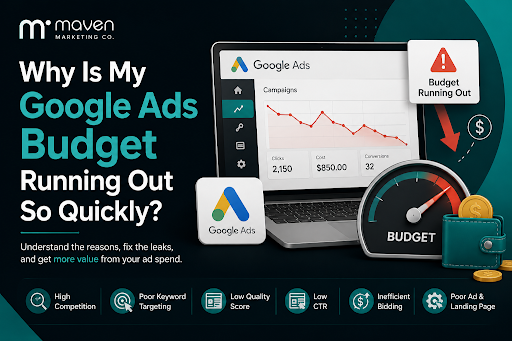
Why Is My Google Ads Budget Running Out So Quickly
Running a successful Google Ads budget isn’t only about throwing more money at it. It’s more like making every dollar, doing a bit extra. A lot of businesses start a Google Ads campaign with big hopes, then find out their daily budget is gone within a few hours, and that feels weird, right? After that, your ads stop showing effectively, new leads slip away, and your return on investment dips. So if your Google Ads budget is running out too fast, don’t stress. It’s a fairly common issue, and in most situations, it can be repaired with the right approach. There are multiple little things that can drain your advertising money quicker than you expected, from costly keywords to audience targeting that just doesn’t quite fit. In this guide, we’ll walk through why your budget disappears so quickly, how to cut wasteful spend, and the most reliable ways to boost your Google Ads ROI, even if your budget stays the same.