.svg)
.svg)
.svg)


%201.svg)
April 2, 2026
The Link Building Playbook That Still Works in 2026: Earn Authority Without Paying for It
Link building has a reputation problem it does not entirely deserve. When most Australian marketing teams hear the term, they picture one of two things: the paid link schemes that Google has been penalising for years and that still circulate in the shadier corners of the SEO industry, or the outreach programmes that require significant labour that produce a handful of marginal links per month at a cost that makes the return on investment look questionable at best. Both of these pictures miss the methods that actually work in 2026, which share a common characteristic: they earn links as a byproduct of producing something valuable rather than acquiring them as a standalone purchase or extraction exercise. The distinction matters commercially because earned links are structurally different from purchased links. They tend to come from more relevant and more authoritative sources. They are more stable because they are not contingent on a payment being maintained. They are more likely to produce lasting ranking improvements because they represent genuine signals of editorial endorsement. And they are not a liability that sits waiting for the next Google spam update to detonate. This article covers the link earning methods that Australian businesses and their marketing teams can execute in 2026 to build domain authority through genuine editorial signals rather than purchases or schemes.


Value Proposition Crafting: Differentiation in Competitive Markets
In saturated Australian markets, most businesses sound identical. Browse accounting firm websites—they all promise "expert service and personalised attention." Check marketing agency sites—everyone claims "results-driven strategies and creative excellence." Visit cafe Instagram accounts—all feature "artisan coffee and locally-sourced ingredients." This sameness isn't accidental; it's the predictable result of businesses failing to articulate genuine differentiation. When everyone claims the same benefits, no one stands out. Prospects can't distinguish between genuinely superior offerings and empty marketing claims. Price becomes the only differentiator, commoditising entire industries. Yet within every competitive market, some businesses command premium pricing, generate passionate customer loyalty, and grow consistently despite intense competition. The difference isn't superior products or services—it's superior value proposition articulation. These businesses have identified what makes them genuinely different and communicated it so compellingly that ideal customers immediately understand why they're the obvious choice. This comprehensive guide reveals how Australian businesses can craft value propositions that create meaningful differentiation even in the most crowded, competitive markets.

Marketing Funnel Optimization: Top, Middle and Bottom Stage Tactics
Most Australian businesses obsess over one stage of the marketing funnel while neglecting the others—pouring budget into awareness campaigns without nurturing mechanisms, or focusing exclusively on bottom-funnel conversions while starving the pipeline of new prospects. This imbalanced approach creates predictable problems: awareness campaigns generate traffic that bounces immediately, middle-funnel prospects stagnate without nurturing, bottom-funnel conversion tactics fail because insufficient qualified prospects exist. The reality is that effective marketing requires coordinated optimization across all three funnel stages—top of funnel (TOFU) generating awareness and attracting prospects, middle of funnel (MOFU) nurturing consideration and building trust, and bottom of funnel (BOFU) converting ready buyers into customers. Each stage requires distinct tactics, content types, success metrics, and strategic approaches. Yet most businesses either don't understand these distinctions or lack the frameworks to optimize each stage systematically. This comprehensive guide reveals the specific tactics that work at each funnel stage, how to move prospects smoothly between stages, and the measurement approaches that identify exactly where your funnel is leaking revenue.
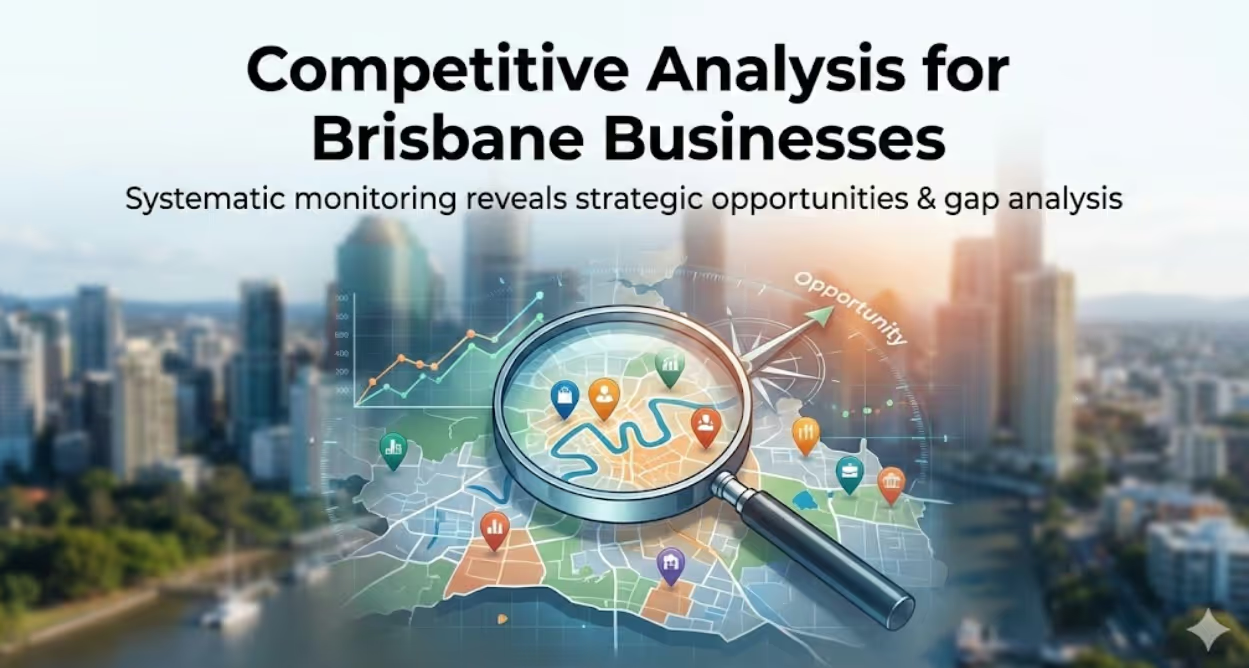
Competitive Analysis Framework: Benchmarking Brisbane Businesses
Brisbane's business landscape is intensely competitive across virtually every industry. Whether you're operating in hospitality on James Street, professional services in the CBD, retail in Paddington, or e-commerce competing nationally from Brisbane headquarters, understanding your competitive position isn't optional—it's fundamental to survival and growth. Yet most Brisbane businesses approach competitive analysis superficially: occasionally checking competitor websites, noticing their advertising, or reacting when they launch new offerings. This reactive approach misses the strategic intelligence competitors reveal through their digital presence, marketing tactics, pricing strategies, and customer engagement approaches. Systematic competitive analysis uncovers exploitable weaknesses, identifies emerging threats before they materialize, reveals untapped market opportunities, and provides the benchmarks necessary to evaluate your own performance objectively. This comprehensive framework reveals how Brisbane businesses can conduct strategic competitive analysis that generates actionable intelligence rather than surface-level observations.

Digital Marketing Roadmap Development: 90-Day Action Plans for Australian Businesses
Most Australian businesses approach digital marketing reactively—posting when inspiration strikes, running ads when sales slow, updating websites when competitors launch new designs. This reactive approach generates inconsistent results, wastes budget on unfocused tactics, and creates constant firefighting instead of strategic progress. The alternative isn't complex annual planning documents gathering dust—it's focused 90-day roadmaps balancing strategic direction with tactical flexibility. Quarterly planning aligns with business reality: markets shift, tactics evolve, and team capacity varies more than annual plans acknowledge. A well-structured 90-day roadmap provides clear priorities, measurable objectives, and accountable execution timelines while remaining adaptable to changing conditions. Yet most businesses either skip planning entirely or create overly ambitious plans guaranteeing failure. This comprehensive guide reveals how to develop realistic, executable 90-day digital marketing roadmaps that generate measurable progress toward business objectives without overwhelming your team or budget.

First-Party Data Strategy: Building Audiences Post-Cookie Apocalypse
The digital marketing foundation built on third-party cookies is crumbling. Google's ongoing Chrome cookie deprecation, following Safari and Firefox's earlier moves, represents the final death knell for the tracking mechanisms that have powered digital advertising for two decades. For Australian businesses that have relied on retargeting pixels, lookalike audiences, and cross-site tracking to drive conversions, this shift feels apocalyptic. Yet the cookie apocalypse isn't a crisis—it's a forced evolution toward more sustainable, privacy-respecting, and ultimately more effective marketing. Businesses building robust first-party data strategies aren't just surviving the transition; they're thriving with direct customer relationships, higher-quality data, and marketing performance that doesn't depend on invasive tracking. The competitive advantage is shifting from those with the cleverest tracking to those with the strongest direct customer relationships and most valuable owned data. This comprehensive guide reveals how Australian businesses can build first-party data strategies that outperform cookie-dependent approaches while respecting privacy and building customer trust.

Real Estate Marketing Strategies: Digital Tactics for Property Professionals
The Australian real estate landscape has transformed dramatically. Ten years ago, agents relied on newspaper classifieds, letterbox drops, and personal networks to generate leads. Today, 95% of property buyers begin their search online, spending an average of 10 weeks researching properties digitally before contacting an agent. For real estate professionals, this digital-first reality creates both challenge and opportunity—agents who master digital marketing dominate their markets, while those clinging to traditional tactics struggle to generate quality leads despite working harder than ever. The competition is fierce: Domain and realestate.com.au receive millions of monthly visitors, buyers research agents extensively before making contact, and vendors expect sophisticated digital strategies from their listing agents. Yet most real estate professionals approach digital marketing reactively, posting occasional social content and hoping leads materialize. This comprehensive guide reveals the digital marketing strategies that actually generate consistent, high-quality leads for Australian property professionals.

Site Migration SEO: Protecting Rankings During Website Redesigns
Website redesigns represent one of the highest-risk moments in a business's digital lifecycle. A fresh design promises improved user experience and modern aesthetics—but without proper SEO protection, that new website can destroy years of organic search equity in weeks. The statistics are sobering: 60% of businesses experience significant traffic drops following migrations, with the average site losing 15-30% of organic traffic that never fully recovers. For Australian businesses that have invested years building search visibility, a poorly executed migration can eliminate competitive advantages overnight. Yet most website agencies focus exclusively on design and functionality, treating SEO as an afterthought addressed only when traffic has already collapsed. This comprehensive guide reveals exactly how to protect your SEO equity during website redesigns, covering pre-migration planning, technical implementation, post-launch monitoring, and the recovery protocols that salvage migrations when things go wrong.
.avif)
Google Business Profile Mastery: Advanced Tactics for Local Visibility in 2026
Google Business Profile has evolved from a simple directory listing into the single most powerful local search asset available to Australian businesses. In 2026, your GBP doesn't just influence local rankings—it determines whether you exist in the eyes of local searchers. With 76% of people who search for something nearby visiting a business within 24 hours, and 28% of those searches resulting in purchases, GBP optimization directly drives revenue. Yet most Australian businesses treat their profile as an afterthought—claiming it, adding basic information, then ignoring it for months. Meanwhile, competitors who master advanced GBP tactics dominate local pack results, capture the majority of "near me" searches, and systematically outrank businesses with superior products or services but inferior profile optimization. This guide reveals the advanced GBP strategies that actually move rankings in 2026, going far beyond basic setup to the sophisticated tactics that separate local search winners from invisible also-rans.
.avif)
E-commerce SEO Checklist: Product Page Optimization for Australian Retailers
Product pages are the revenue engine of e-commerce businesses, yet most Australian online retailers treat them as afterthoughts—copying manufacturer descriptions, uploading basic product photos, and wondering why they're invisible in search results dominated by Amazon, eBay, and established competitors. Every unoptimized product page represents lost revenue, with studies showing properly optimized product pages generating 47% more organic traffic and converting 34% better than poorly optimized equivalents. For Australian e-commerce retailers competing against global giants and aggressive local competitors, product page optimization isn't optional—it's the difference between organic visibility that drives sustainable growth and expensive paid advertising dependency. This comprehensive checklist reveals exactly how to optimize product pages for maximum search visibility and conversion performance, covering technical SEO fundamentals, content optimization strategies, user experience enhancements, and the Australia-specific considerations that determine whether your products appear when local shoppers search.
.avif)
SEO for Professional Services: Ranking Strategies for Lawyers, Accountants & Consultants
Professional services SEO differs fundamentally from product-based or retail optimization. When potential clients search for lawyers, accountants, or consultants, they're not comparing prices on widgets—they're evaluating expertise, trust, and professional credibility before making decisions worth thousands or millions of dollars. Traditional SEO tactics focused on transactional keywords and conversion optimization miss the mark entirely for professional services, where the buyer journey spans weeks or months and revolves around relationship building rather than immediate purchases. Australian professional services firms face unique challenges: highly localized competition, strict advertising regulations, and clients who extensively research credentials before contact. This comprehensive guide reveals the SEO strategies that actually work for lawyers, accountants, consultants, and other professional services—approaches that build authority, demonstrate expertise, and attract high-value clients who've already decided you're the right choice before they pick up the phone.
.avif)
Local Citation Building: The Complete Australian Business Directory Guide
Local citations remain one of the most misunderstood yet powerful ranking factors in Australian local search. While businesses obsess over Google reviews and social media presence, the unglamorous work of building consistent, accurate citations across hundreds of directories quietly determines who appears in the local pack and who doesn't. For Australian businesses competing in local markets—whether you're a Bondi cafe, Perth tradie, or Melbourne professional service—citation building isn't optional. Research shows businesses with consistent citations across 50+ directories rank 64% higher in local search results. Yet most Australian businesses have inconsistent, incomplete, or entirely missing citations undermining their visibility. This comprehensive guide reveals exactly which directories matter for Australian businesses, how to build citations that actually improve rankings, and the citation audit process that separates local SEO winners from also-rans.
.avif)
Pillar Page Strategy: Creating Content Hubs That Drive Organic Traffic
Traditional blog posts scatter your SEO efforts across disconnected topics, diluting authority and confusing search engines about your expertise. Pillar pages flip this approach entirely, creating comprehensive content hubs that establish topical dominance and funnel organic traffic systematically. For Australian businesses competing in saturated markets, pillar page strategy isn't just another content marketing tactic—it's the difference between ranking for a handful of keywords and owning entire topic categories. When executed properly, a single pillar page can generate 10-15x more organic traffic than standalone articles while positioning your brand as the definitive authority in your niche. This guide reveals exactly how to architect, create, and optimize pillar pages that transform your content from noise into strategic assets driving measurable business results.