.svg)


%201.svg)
.avif)
Key Takeaways
- Professional services SEO must prioritize E-E-A-T signals (Experience, Expertise, Authoritativeness, Trust) over traditional keyword density, with Google's algorithms specifically evaluating credentials, qualifications, and professional recognition for YMYL (Your Money Your Life) queries
- The average professional services client conducts 12-15 searches before contact, consuming multiple content pieces to evaluate expertise, making content depth and thought leadership critical ranking and conversion factors
- Local SEO combined with practice area specificity drives 73% of professional services client acquisition, with "lawyer near me" and "[service] [city]" searches generating the highest-intent traffic for professional firms
- Professional services achieve 34% higher conversion rates from organic search than paid ads, as clients arriving through organic channels have invested more research time and demonstrate stronger purchase intent
- Thought leadership content generates 3-5x more qualified leads than service page optimization alone, establishing the expertise signals that differentiate professional services firms in competitive markets
Professional services marketing presents a paradox. The expertise that makes you valuable—specialized knowledge of tax law, complex financial structures, or strategic consulting frameworks—is precisely what makes marketing challenging. You can't demonstrate competence through flashy product photos or viral campaigns.
SEO solves this elegantly. When prospective clients search "corporate restructuring advisor Sydney" or "capital gains tax specialist Melbourne," they're declaring specific needs and actively researching solutions. These high-intent searches represent the exact moment professional services firms should appear—not with generic descriptions, but with content demonstrating the precise expertise those searchers need.
Yet most professional services firms approach SEO backwards. They optimize homepage keyword density, chase vanity metrics, and wonder why traffic doesn't convert to quality enquiries. Meanwhile, competitors who understand professional services SEO capture high-value clients systematically.
.avif)
Understanding Professional Services Buyer Behavior
Extended research cycles characterize professional services decisions. A consumer might search "running shoes" and purchase within hours. A business owner searching "employment law advice Sydney" will research for days or weeks, consuming content from multiple firms, checking credentials, and evaluating expertise before contacting anyone.
This extended cycle rewards comprehensive content over conversion optimization. A single optimized service page won't capture clients who need to see evidence of expertise across multiple touchpoints.
Risk aversion drives decisions. Hiring the wrong accountant risks compliance issues or missed tax advantages worth thousands. Choosing the wrong lawyer risks adverse legal outcomes. These high stakes make professional services buyers cautious, thorough researchers.
SEO strategies must address this risk aversion directly—showcasing credentials, professional memberships, case study results, and detailed expertise demonstrations that reduce perceived risk.
Expertise evaluation challenges complicate purchasing. Clients can't easily assess whether advice is superior to competitors'—they lack specialized knowledge to evaluate expertise. Instead, they rely on proxy signals: credentials, years of experience, published content, speaking engagements, and media mentions.
Professional services SEO must generate these proxy signals systematically.
E-E-A-T Optimization: The Foundation
Google's E-E-A-T framework (Experience, Expertise, Authoritativeness, Trustworthiness) determines rankings for professional services queries.
Experience demonstrates real-world application through case studies, client success stories, years in practice, and specific engagement examples. Create detailed case studies documenting challenges, your approach, and measurable outcomes.
Professional biographies should emphasize specificity: "15 years specializing in family law property settlements" outweighs "experienced family lawyer."
Expertise requires demonstrating deep knowledge through credentials, qualifications, and thought leadership. For Australian professional services:
- Professional certifications (CA, CPA, admitted solicitor credentials)
- University qualifications and specialized training
- Professional association memberships
- Published research, articles, or books
- Speaking engagements at industry conferences
Create dedicated team pages showcasing these expertise signals comprehensively.
Authoritativeness reflects recognition through media mentions, awards, leadership positions in professional associations, and backlinks from authoritative industry sources. Build authoritativeness proactively by contributing expert commentary, speaking at events, and publishing in industry publications.
Trustworthiness encompasses transparency, ethical practice, and reliability signals including clear fee disclosure, professional indemnity insurance, regulatory compliance transparency, and authentic client testimonials.
.avif)
Content Strategy: Thought Leadership That Converts
Topic cluster architecture organizes content around practice areas comprehensively. Rather than scattered blog posts, build content hubs demonstrating complete expertise.
A commercial law firm might create a pillar on "Commercial Contract Law in Australia" supported by clusters on specific contract types, dispute resolution strategies, and jurisdiction considerations. This architecture signals topical authority Google rewards.
Answer client questions deeply rather than superficially. Create content answering specific, nuanced questions: "Can I claim home office expenses as a sole trader?", "What's the difference between mediation and arbitration in commercial disputes?"
Don't gatekeep knowledge—demonstrating expertise freely builds trust and positions you as the obvious choice.
Case study content provides concrete evidence of expertise. Develop detailed case studies (maintaining confidentiality) demonstrating your approach, strategies implemented, and measurable outcomes.
Guides and resources position your firm as the authoritative source clients return to repeatedly. Create comprehensive guides (typically 3,000-5,000 words) ranking for competitive head terms while establishing thought leadership.
Local SEO: Dominating Geographic Markets
Google Business Profile optimization is foundational. Completely optimize your profile with accurate NAP, comprehensive descriptions emphasizing practice areas, high-quality photos, and regular posts highlighting expertise.
Location-specific content captures geographic search variations. Create location-specific landing pages for each practice area and location combination, addressing local courts, regional business characteristics, or area-specific client needs.
Local citations across Australian directories strengthen authority. Ensure consistent NAP across True Local, Yellow Pages, legal/accounting directories, and industry platforms.
Localized thought leadership demonstrates community engagement. Contribute to local business publications, speak at regional events, and create content addressing local market dynamics.
Case Study: Melbourne Accounting Firm's Organic Growth
A mid-sized Melbourne accounting firm relied entirely on referrals and expensive paid advertising. In January 2024, they implemented comprehensive professional services SEO including a pillar page on "Australian Small Business Tax Planning" supported by 22 cluster articles, rebuilt team pages highlighting qualifications, created location-specific pages for Melbourne suburbs, and improved site speed from 8.2 to 2.1 seconds.
Results after 10 months:
Organic traffic increased 312%. Organic enquiries increased 267%. The firm ranked first page for 47 competitive keywords. They acquired 31 new clients through organic search with average annual value of $4,200, generating $130,200 in new recurring revenue. Organic enquiries converted at 43% compared to 28% from paid ads.
The managing partner noted that content establishing expertise created consultative sales conversations rather than price negotiations.
Case Study: Sydney Law Firm's Practice Area Dominance
A Sydney commercial law firm specializing in employment law was virtually invisible in search results. Their SEO focused on extreme practice area specificity with deeply detailed content, 14 anonymized case studies, systematic pursuit of speaking opportunities and media commentary, and comprehensive schema implementation.
Results after 8 months:
First-page rankings for 23 competitive employment law queries. Organic enquiries increased from zero to 4-7 monthly with average matter values between $15,000-65,000. Total new client revenue exceeded $340,000 over eight months.
The enhanced online presence also strengthened positioning for referred matters, improving conversion rates even for non-organic leads.
.avif)
Common Mistakes to Avoid
Hiding expertise behind contact forms undermines SEO entirely. Demonstrating expertise freely builds trust and positions you as the obvious choice for implementation.
Generic, thin service pages fail to differentiate. Create comprehensive service pages (1,500-2,500 words) demonstrating specific expertise unique to your firm.
Neglecting author credentials wastes E-E-A-T opportunities. Display author qualifications prominently on every piece of content.
Inconsistent publishing signals inactive expertise. Publish at minimum bi-weekly, ideally weekly.
Frequently Asked Questions
How long does professional services SEO take to generate results?
Expect 4-6 months before seeing meaningful enquiry volume, with substantial results at 8-12 months. Professional services SEO requires longer timeframes because E-E-A-T signals build gradually and Google's algorithms for YMYL queries are conservative. However, once rankings establish, they're typically more stable. Many firms report continued organic growth 18-24 months post-implementation as thought leadership compounds and authority strengthens.
Should firms blog about general topics or only technical expertise?
Focus 80-90% on technical expertise directly related to practice areas, with 10-20% addressing adjacent topics ideal clients care about. Specialized technical insights differentiate your firm; generic business advice won't. Make technical content accessible—write for intelligent lay people, explaining complex concepts clearly while demonstrating expertise.
How do professional services handle confidentiality while creating case studies?
Thoroughly anonymize client details while preserving strategic and outcome specificity. Remove identifying information, replace with generic descriptors, and focus on your approach, methodology, and value delivered. Obtain explicit client permission when possible, or create composite case studies aggregating learnings from multiple matters. The goal is demonstrating how you think and the value you deliver while maintaining strict confidentiality.
Establish the Online Authority Your Expertise Deserves
Professional services SEO translates genuine expertise into online visibility connecting you with clients actively seeking what you offer. Every day prospects search for your exact services, comparing firms and evaluating credentials before contact.
At Maven Marketing Co, we specialize in SEO for Australian professional services firms. We understand E-E-A-T optimization, thought leadership content strategy, and the unique challenges lawyers, accountants, and consultants face building online authority.
Contact Maven Marketing Co today to discuss your professional services SEO strategy. We'll audit your current online presence, identify high-value opportunities in your practice areas, and develop the comprehensive approach that establishes your authority and attracts high-value clients your expertise deserves.

Table of contents
read more blogs
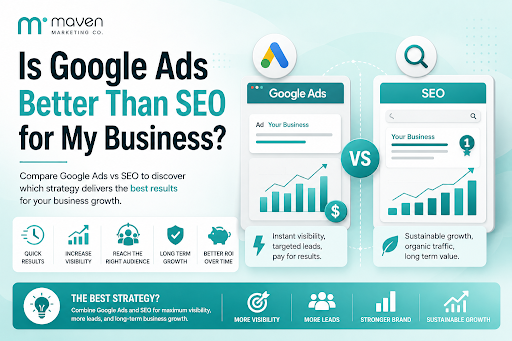
Is Google Ads Better Than SEO for My Business
One of the biggest questions business owners ask when they are planning online growth is whether they should invest in Google Ads or SEO. Both are strong marketing plays that help your company show up in Google search results, but they do things in separate lanes. Google Ads gives quicker visibility and can bring in leads fast, whereas SEO more or less focuses on slow, steady organic traffic that tends to grow the longer you keep building it. Picking the right direction depends on what you want to achieve, how much money you can spend, how crowded the market is, and how quickly you need results, like sooner rather than later. The good news is you don’t always have to choose one or the other; it’s not exactly a black-and-white situation. If you take time to understand the strongest points of both, you can put together a more sensible digital marketing plan that supports consistent expansion. In this guide, we’ll compare Google Ads vs SEO, explain the main differences, and help you figure out what option makes the most sense for your business.

When Should I Hire a Digital Marketing Agency
Growing a business today takes more than just having a website or throwing a post on social media; customers usually search around online, compare providers, skim reviews, and basically expect the brand to show up with a solid digital presence before they even think about buying. Many businesses try to run their marketing themselves, but there comes a point when “doing it all in-house” becomes clunky and hard to manage, all at once. Knowing when to hire a digital marketing agency can end up making a big, real difference for your growth. If you’re not getting enough leads, or your online visibility feels stuck, or sales are just not moving, the right agency can bring the know-how, plus a clear plan, to help you get noticeably better outcomes. In this guide, we’ll dig into what a digital marketing agency actually does, the usual signs it’s time to bring one on, and how picking the right marketing partner can help your business move forward at a faster pace.
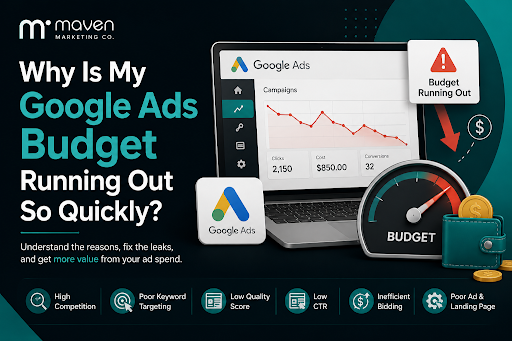
Why Is My Google Ads Budget Running Out So Quickly
Running a successful Google Ads budget isn’t only about throwing more money at it. It’s more like making every dollar, doing a bit extra. A lot of businesses start a Google Ads campaign with big hopes, then find out their daily budget is gone within a few hours, and that feels weird, right? After that, your ads stop showing effectively, new leads slip away, and your return on investment dips. So if your Google Ads budget is running out too fast, don’t stress. It’s a fairly common issue, and in most situations, it can be repaired with the right approach. There are multiple little things that can drain your advertising money quicker than you expected, from costly keywords to audience targeting that just doesn’t quite fit. In this guide, we’ll walk through why your budget disappears so quickly, how to cut wasteful spend, and the most reliable ways to boost your Google Ads ROI, even if your budget stays the same.