.svg)


%201.svg)

Key Takeaways
- The most reliable link earning method for any Australian business is producing something genuinely useful, original, or interesting that other websites want to reference. Content that earns links does so because it has inherent value to the people who link to it, not because of how actively it is promoted.
- Digital PR, the process of generating news coverage and editorial mentions through genuine newsworthiness, is the highest-authority link building channel available to Australian businesses. A single placement in a major Australian publication can produce more ranking impact than dozens of links from marginal sites.
- Resource page link building targets existing pages on relevant websites that link out to useful resources in a category. Where the business's content is genuinely the most useful available resource on a specific topic, a targeted outreach programme can secure placements on these resource pages.
- Original research and data is the content format most likely to earn natural, editorial links without any outreach effort. Australian market data that does not exist anywhere else is referenced by journalists, industry publications, and other content producers who need the data for their own content.
- Broken link building is a link earning approach based on genuine goodwill tactic: finding broken links on relevant websites, informing the website owner, and suggesting the business's own relevant content as a replacement. The link is earned through the value of identifying a problem and offering a solution.
- Unlinked brand mentions, instances where a publication or website mentions the business by name without linking to it, represent the most efficient link earning opportunity available. The content, the mention, and the editorial endorsement already exist: the only missing element is the link itself.
- The difference between link building activity that improves rankings and link building activity that wastes budget is almost entirely in the relevance and authority of the linking source. A single link from a genuinely relevant, authoritative Australian source outperforms dozens of links from irrelevant or low-quality sources.

Why Most Link Building Approaches Fail
Before covering what works, it is worth understanding why most approaches to link building fail to produce lasting commercial results.
Purchased links from link farms and networks. The most common failure mode. Paying for links from dedicated link selling services, private blog networks, and link brokers produces ranking improvements in some cases in the short term and a liability that accumulates with every link purchased. Google's spam detection systems are continuously improving their ability to identify unnatural link patterns, and the links purchased today are the ones that may produce a manual action or an algorithmic demotion in the next spam update cycle.
Generic guest posting at scale. Guest posting on websites with low authority and no topical relevance purely for the link is a strategy that Google has explicitly identified as a link scheme when conducted at scale. A guest post on a website that is editorially relevant to the business's topic, produced with genuine quality for the website's actual readership, is legitimate. A post produced by a link agency on a "travel" website that happens to link back to an Australian legal firm is not.
Outreach-only programmes without compelling assets. Many link building outreach programmes fail because they send requests without a genuinely compelling reason for the receiving website to link. "I noticed you don't link to our website, could you add a link?" is not a value proposition. An outreach programme succeeds when it has something genuinely worth linking to and can communicate the specific value of the link to the receiving website's editor or content manager.
Method 1: Original Research and Data
The content format most likely to earn links naturally, without outreach, is original research that produces data unavailable anywhere else. When a journalist, industry publication, or content producer needs data for an article on a specific topic, and a business has published the only available data on that specific question in the Australian context, the link is earned because the content is the only available source for that specific information.
Australian businesses have natural research advantages in their specific market: customer behaviour data from their own customer base, industry trends specific to their sector in Australia, survey data from their Australian audience, and operational data that reveals patterns in their specific category.
The practical process for original research content:
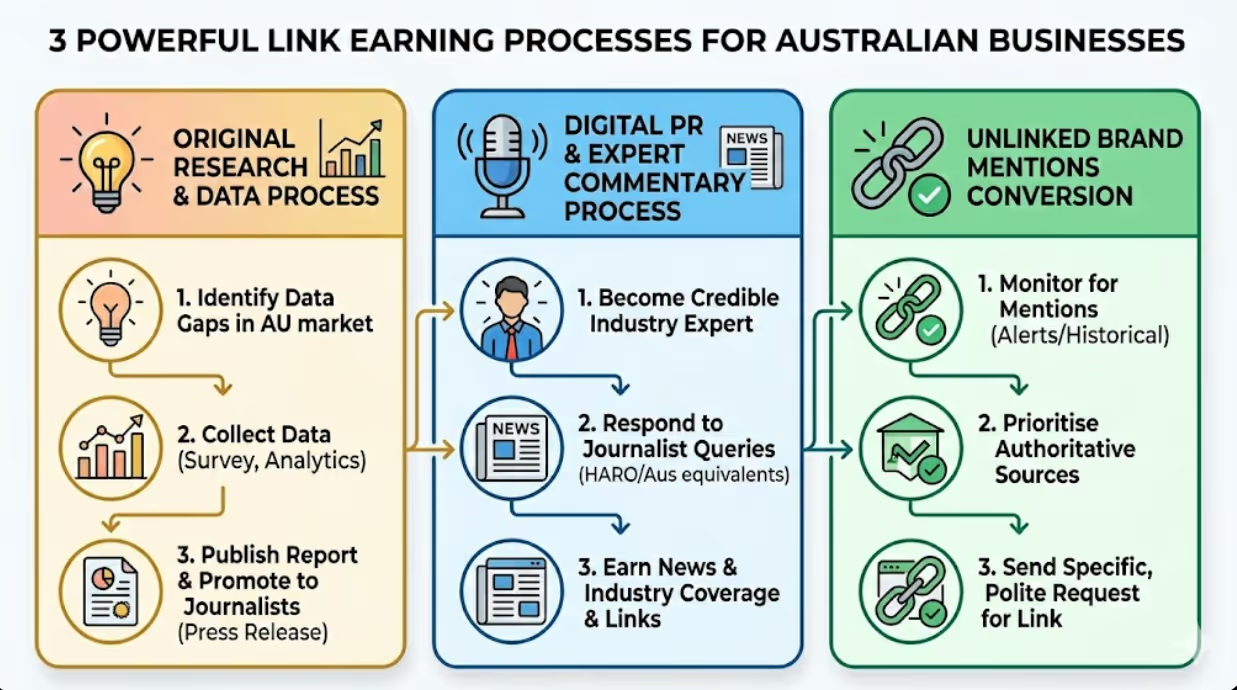
Identify the data gaps. What data about the Australian market in this category does not currently exist in a publicly accessible form? What questions do journalists covering this category regularly try to answer with data that is not available?
Collect the data. This might be a survey of the business's own customer base, an analysis of the business's operational data, a compilation of publicly available data that has not been analysed before, or a commissioned research project. The data does not need to be from a large sample to be useful: even a survey of 200 Australian consumers on a specific question produces data that no other source has.
Publish and promote to journalists. A press release summarising the key findings, sent to Australian journalists who cover the relevant category, with the full research report available as a resource on the website, is the distribution mechanism. Each story a journalist writes using the data typically includes a link to the original source.
Method 2: Digital PR
Digital PR is the practice of generating editorial coverage in online publications, the kind of coverage that produces links from genuinely authoritative sources rather than from link exchanges or purchased placements.
The most linkable stories for Australian businesses are:
Genuine newsworthiness. A business that makes a significant investment in its community, launches a product that is first in its market, produces research with genuinely newsworthy findings, or takes a position on an issue relevant to its industry creates material that journalists have an editorial reason to cover. The story must be genuinely interesting to the publication's readership rather than only to the business itself.
Expert commentary. Australian journalists regularly seek expert commentary from credible sources in specific industries. A business whose principals are positioned as credible industry experts, who are findable when a journalist searches for expertise in the relevant category, and who respond quickly and articulately when contacted, earn regular mentions and links in industry coverage over time. Registering with HARO (Help a Reporter Out) and its Australian equivalents, and responding to journalist queries with expert commentary, is one of the most efficient digital PR link earning methods available.
Response to industry events and data. When a significant industry event, government report, or economic development occurs in a category, the publications covering that development want expert comment from credible sources. A business that publishes a thoughtful, specific response to the event and makes its principals available for journalist interviews positions itself as a credible source of expert perspective in the category.
Method 3: Resource Page Outreach
Many websites in specific industries, professional associations, and educational institutions maintain resource pages: curated lists of useful tools, guides, and references for their audience. These resource pages exist because whoever manages the website wants to provide their audience with useful external resources. Where a business has produced content that is genuinely the most useful available resource on a specific topic for a specific audience, targeted outreach to these resource pages can produce relevant, editorially credible links.
The process is:
Identify resource pages in the relevant category. Search operators in Google including "resources + [category]," "useful links + [category]," and "recommended reading + [category]" surface existing resource pages in the relevant topic area.
Assess the fit. The resource page must be on a website that is relevant to the business's category, and the business's content must be genuinely the best available resource on the specific topic the resource page covers. Outreach to resource pages where the content is marginal or only loosely relevant is unlikely to succeed and damages the relationship with the website for future genuine opportunities.
Send a specific, genuine outreach message. The outreach message should name the specific resource page, explain the specific value of the content being suggested, and make the case for why the content belongs on the list. It should not be a template: a personalised message that demonstrates familiarity with the website and the resource page is significantly more likely to succeed than a generic pitch.
Method 4: Broken Link Building
Broken link building is a link earning approach oriented around genuine service tactic. When a relevant website has a broken link (a link pointing to a URL that no longer exists, returns an error, or redirects to an unrelated page), the website owner has a problem they probably do not know about. Identifying the broken link, informing the website owner, and suggesting the business's own relevant content as a replacement addresses their problem and earns the link as a byproduct.
The process:
Find broken links on relevant websites. Browser extensions such as Check My Links, and tools such as Ahrefs' broken link checker or Semrush's Site Audit, can identify broken outbound links on specific pages or across entire websites. The target websites should be editorially relevant to the business's category and should be the kinds of sites that would link to the business's content if given the opportunity.
Verify the match. The broken link must be pointing to content that the business has a genuine replacement for, or can produce one for. Suggesting a replacement that is only loosely related to the broken link's original destination is not a genuine service.
Outreach with the finding and the suggestion. The message identifies the broken link specifically (including the URL where it appears and the broken URL), explains why the business's content is an appropriate replacement, and makes it easy for the website owner to make the change. The tone is genuinely helpful rather than transactional.
Method 5: Unlinked Brand Mentions
The most efficient link building opportunity available to most established Australian businesses is not creating new content or conducting new outreach. It is converting existing unlinked brand mentions into links.
An unlinked brand mention is a page on an external website that mentions the business by name but does not link to the business's website. The editorial endorsement is already present. The content is already published. The only missing element is the link itself.
The process:
Find unlinked mentions. Tools including Ahrefs Alerts, Google Alerts, and Mention can track new instances of the brand name appearing on the web. For established businesses, a one-time historical search using Ahrefs' Content Explorer or a similar tool can surface existing unlinked mentions across multiple publications.
Prioritise by source authority. Not every unlinked mention is worth pursuing. A mention in an authoritative industry publication, a local news article, or a relevant curated resource is worth a personalised outreach message. A mention on a low-quality directory or a website of questionable quality is not.
Send a brief, specific request. The message thanks the publication for the mention, notes that the mention does not include a link, and asks whether a link could be added. The message should be brief and professional: the publication has already done the editorial work of mentioning the business, and the request is simply for a link to accompany that mention.
Method 6: Strategic Partnerships and Industry Involvement
Australian businesses that are active members of their industry communities build link opportunities organically as a byproduct of genuine industry participation.
Industry association memberships typically include a member directory listing with a link. Speaking at industry conferences or events produces coverage in event coverage and speaker profiles. Sponsoring industry events or awards programmes produces sponsor acknowledgement pages with links. Contributing to industry publications as a columnist or regular expert contributor produces author profiles with links. Participating in industry roundtables or collaborative research produces acknowledgement in the published output.
None of these are link building tactics in the traditional outreach sense. They are commercial activities with link earning as a byproduct. The distinction is commercially significant: the links earned from genuine industry participation are more likely to be from authoritative, relevant sources than links pursued through outreach alone, and they accumulate naturally over time without dedicated link acquisition overhead.
FAQs
How many links does an Australian business need to compete in its category?Link quantity is less important than link quality and topical relevance, and the number required depends entirely on the competitive landscape in the specific category and market. Rather than pursuing a target number of links, the practical approach is to compare the backlink profile of the pages ranking above the business's target pages in Australian Google search, using a tool such as Ahrefs or Semrush, and to understand the authority and relevance profile of those sites' inbound links. If the ranking competitors have twenty authoritative, topically relevant links and the business has three, the gap is meaningful. If the ranking competitors have three hundred links from sources with low authority and the business has fifty relevant editorial links, the business's profile may be qualitatively stronger despite the volume gap. The focus should be on earning links from sources at least as authoritative and relevant as those linking to the competing pages, not on matching or exceeding a specific link count.
How long does it take for a new editorial link to improve rankings?Google's crawlers discover new links at different rates depending on the authority and crawl frequency of the linking page. A link from a major Australian news publication may be discovered within hours and influence rankings within days. A link from a smaller industry website with less frequent crawling may take two to six weeks to be discovered and to begin influencing rankings. Once discovered, the link's influence on rankings builds over time as Google's systems assess its impact on the overall authority profile of the linked page. For Australian businesses working on link building over a twelve to eighteen month programme, the typical pattern is modest ranking improvements at three to six months, more significant improvements at six to twelve months, and the strongest results appearing in the twelve to eighteen month window as the compounding effect of multiple quality links accumulates.
Should an Australian business ever participate in link exchanges?Reciprocal link exchanges, where two websites agree to link to each other, are not inherently prohibited by Google's policies, but they are assessed sceptically when they appear at scale or when the linking relationship is clearly transactional rather than editorial. A link exchange where two complementary Australian businesses link to each other's genuinely useful resources as a natural part of their editorial content is different from a systematic link exchange programme where links are traded without genuine editorial intent. The practical guidance is that any link exchange should be one where the business would link to the partner site's content even if there were no reciprocal link, because the content is genuinely useful to the business's own audience. Exchanges that would not be made on this basis are transactional link schemes regardless of whether money changes hands.
Earned Links Are a Compound Asset. Purchased Links Are a Managed Risk.
Every editorial link an Australian business earns through genuine content quality, genuine industry participation, and genuine media relationships adds to a compounding authority profile that builds over time and does not carry the risk of unravelling during a Google spam update. Purchased links are different in kind, not just in degree: they represent a liability that sits in the backlink profile waiting for the next cycle of Google's spam detection to identify and discount or penalise them. The link building methods in this article are not the fastest ways to build a backlink profile. They are the most durable, and in competitive Australian categories where the difference between first and fifth position is built on years of accumulated authority, durable is what matters.
Maven Marketing Co builds link earning programmes for Australian businesses, including digital PR outreach, original research content production, resource page identification, and unlinked mention conversion campaigns.
Talk to the team at Maven Marketing Co →

Table of contents
read more blogs
Is Google Ads Better Than SEO for My Business
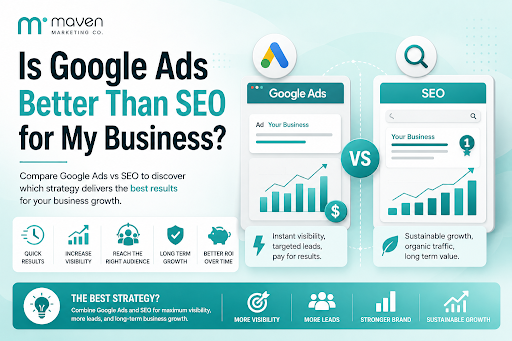
One of the biggest questions business owners ask when they are planning online growth is whether they should invest in Google Ads or SEO. Both are strong marketing plays that help your company show up in Google search results, but they do things in separate lanes. Google Ads gives quicker visibility and can bring in leads fast, whereas SEO more or less focuses on slow, steady organic traffic that tends to grow the longer you keep building it. Picking the right direction depends on what you want to achieve, how much money you can spend, how crowded the market is, and how quickly you need results, like sooner rather than later. The good news is you don’t always have to choose one or the other; it’s not exactly a black-and-white situation. If you take time to understand the strongest points of both, you can put together a more sensible digital marketing plan that supports consistent expansion. In this guide, we’ll compare Google Ads vs SEO, explain the main differences, and help you figure out what option makes the most sense for your business.

When Should I Hire a Digital Marketing Agency
Growing a business today takes more than just having a website or throwing a post on social media; customers usually search around online, compare providers, skim reviews, and basically expect the brand to show up with a solid digital presence before they even think about buying. Many businesses try to run their marketing themselves, but there comes a point when “doing it all in-house” becomes clunky and hard to manage, all at once. Knowing when to hire a digital marketing agency can end up making a big, real difference for your growth. If you’re not getting enough leads, or your online visibility feels stuck, or sales are just not moving, the right agency can bring the know-how, plus a clear plan, to help you get noticeably better outcomes. In this guide, we’ll dig into what a digital marketing agency actually does, the usual signs it’s time to bring one on, and how picking the right marketing partner can help your business move forward at a faster pace.
Why Is My Google Ads Budget Running Out So Quickly
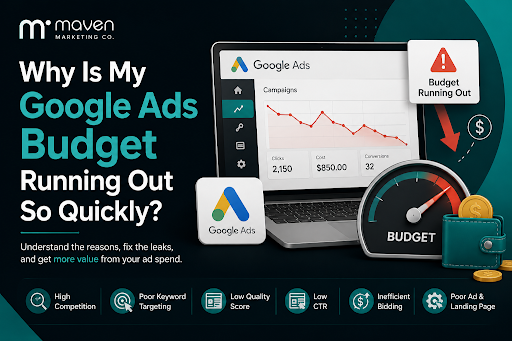
Running a successful Google Ads budget isn’t only about throwing more money at it. It’s more like making every dollar, doing a bit extra. A lot of businesses start a Google Ads campaign with big hopes, then find out their daily budget is gone within a few hours, and that feels weird, right? After that, your ads stop showing effectively, new leads slip away, and your return on investment dips. So if your Google Ads budget is running out too fast, don’t stress. It’s a fairly common issue, and in most situations, it can be repaired with the right approach. There are multiple little things that can drain your advertising money quicker than you expected, from costly keywords to audience targeting that just doesn’t quite fit. In this guide, we’ll walk through why your budget disappears so quickly, how to cut wasteful spend, and the most reliable ways to boost your Google Ads ROI, even if your budget stays the same.