.svg)


%201.svg)

Key Takeaways
- Social search behaviour is strongest among Australian consumers aged 18 to 35, and its commercial weight is growing as this cohort ages into higher spending brackets. Brands that ignore social search now are building a discoverability gap that will compound over the next three to five years.
- TikTok and Instagram each have their own search ranking logic, but both platforms weight recent, content that generates strong engagement and matches relevant keywords. The principles of discoverability on social search overlap with but are distinct from traditional SEO.
- The content format that ranks in social search is video, not text. Australian brands whose discoverability strategy consists entirely of blog posts and website pages are structurally absent from the discovery mechanism that a growing proportion of their target audience is using.
- Keyword placement in social search optimisation is different from keyword placement in web SEO. On TikTok and Instagram, keywords in captions, spoken in the video audio, and included in text overlays on the video all contribute to the platform's ability to classify and surface the content for relevant queries.
- Authenticity signals matter more in social search than polished production value. A genuine, specific review or demonstration from a real user consistently outperforms a corporate promotional video in social search results for queries made with research intent.
- User-generated content about a brand, and the brand's engagement with that content, contributes to the brand's overall discoverability on social platforms. Encouraging and resharing customer content is both a trust signal and a discoverability strategy.
- Social search and Google search are not competing strategies for Australian brands. The audiences, discovery mechanisms, and content formats are different enough that a comprehensive discoverability strategy requires investment in both rather than a choice between them.

Understanding the Social Search Behaviour Shift
The behaviour change is easier to understand when viewed from the searcher's perspective rather than the platform's. A 24-year-old Australian woman deciding where to eat in Melbourne's inner north does not necessarily want ten blue links to restaurant review aggregators. She wants to see what the food looks like on the plate right now, from someone whose aesthetic she recognises, in a format that communicates the atmosphere as well as the menu. TikTok and Instagram provide this. A restaurant with five hundred genuine pieces of video content created by customers about it is visible on social search in a way that a restaurant with a strong Google Business Profile listing and a website that is well designed is not, because the format of the information is fundamentally different.
The same dynamic applies across categories. Skincare products are researched through video demos, honest reviews, and skin transformation content rather than through written product reviews on comparison sites. Fashion is researched through styling videos that show how items look worn and moving rather than through product page photography. Restaurants, cafes, bars, and accommodation are researched through genuine visitor content that captures atmosphere in a way static photography cannot. And service businesses in categories with strong visual or experiential components, including salons, fitness studios, wellness practitioners, and food businesses, are increasingly judged by the quality and volume of social content associated with them before a potential customer visits a review platform or the business's own website.
How TikTok's Search Works
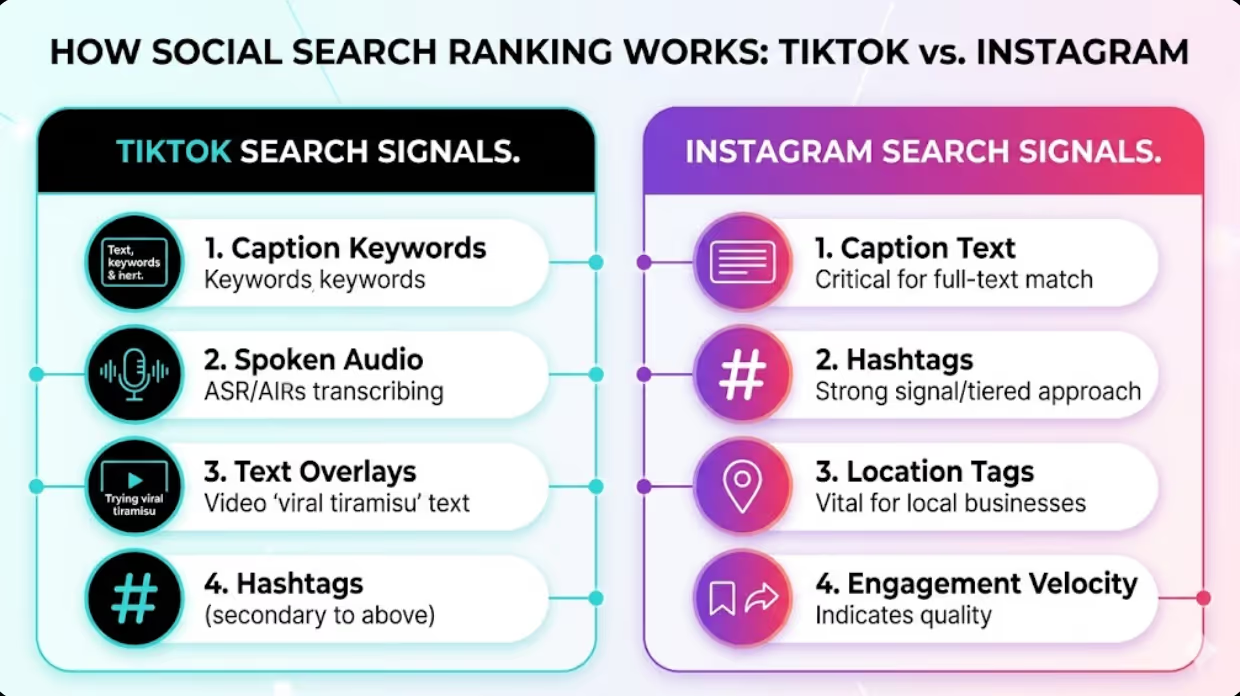
TikTok's search function operates as a search spanning full text across captions, hashtags, profile names, and, through automatic speech recognition, the spoken audio in videos. When a user searches for "best coffee Melbourne," TikTok's algorithm surfaces videos it has classified as relevant to that query, ranking them by a combination of relevance to the query, video engagement performance, recency, and the searcher's own behavioural history on the platform.
The signals TikTok uses to classify a video as relevant to a specific search query are:
Caption keywords. The text caption accompanying a TikTok video is indexed and searchable. Including the specific keywords and phrases that potential customers might search directly in the caption, not as hashtag spam but as natural language description, increases the probability that the video will surface for relevant queries.
Spoken audio. TikTok's automatic speech recognition transcribes the spoken content of videos and uses this transcription in its search classification. A video in which the creator specifically names the product, the location, and the key attributes of what they are reviewing or demonstrating in natural speech is classified more reliably for relevant searches than a video that relies entirely on text overlays.
Text overlays. Text overlays that include keywords relevant to the video's topic contribute to the classification. An overlaid heading that reads "Trying the viral tiramisu at [venue name] in [suburb]" is a clear keyword signal that helps TikTok surface the video for searches about that venue or that suburb.
Hashtags. Hashtags remain a classification signal on TikTok, though their weight is secondary to the above signals. Relevant, specific hashtags (venue name, suburb, product name, category) are more valuable than hashtags with very high volume for search discoverability.
Profile completeness and category. A business TikTok account with a complete profile, a clear category classification, and a location linked to the correct geographic area is more reliably surfaced in local search queries than an incomplete account.
How Instagram Search Works
Instagram's search operates differently from TikTok's in that it has historically been stronger at hashtag and account discovery than at full text content search. However, Instagram's search has expanded significantly to surface Reels content for topic and keyword queries, and the behaviour of users who turn to Instagram for product and venue research is now a commercially significant discovery pattern for Australian brands.
The signals Instagram uses to surface content in search include:
Caption text. Instagram indexes caption text for search and surfaces content where the caption matches the search query. Unlike TikTok, Instagram's automatic speech recognition for audio indexing is less comprehensive, making caption text relatively more important for discoverability on Instagram.
Hashtags. Hashtags on Instagram remain a stronger discovery signal than on TikTok, and the hashtag strategy for Instagram search optimisation follows a tiered approach: a small number of very specific hashtags (venue name, suburb, product name), a small number of category hashtags (cuisine type, product category, service type), and a minimal number of broader hashtags (city, general lifestyle category). Avoiding generic, hashtags with very high volume where the content will be immediately buried is more important for discoverability than maximising hashtag volume.
Location tags. The location tag on an Instagram post or Reel is a specific search signal that surfaces the content in searches for a specific location. For Australian businesses in categories that depend on location (hospitality, retail, fitness, healthcare), ensuring that every piece of content is tagged to the correct location is a basic discoverability requirement.
Engagement velocity. Content that receives strong engagement (saves, shares, and comments rather than just likes) quickly after publication is more likely to be surfaced in search results. The platform's algorithm treats content with strong engagement as more likely to satisfy the next searcher's interest, and saves in particular are treated as a strong quality signal because they indicate the viewer found the content worth returning to.
Reel format preference. Instagram's search results currently favour Reel content over static posts for most discovery queries, which means brands whose Instagram presence consists primarily of static product images are structurally disadvantaged in search discoverability compared to brands producing regular Reel content.
What Australian Brands Need to Create Differently
The practical implication of the social search shift for Australian brands is not that they should abandon their existing content strategy and produce only TikTok and Instagram content. It is that the types of content, the formats, and the keyword strategy for social content need to be deliberately adapted to serve the discovery intent of a searcher who is using these platforms to research rather than to be entertained.
Research-intent content. Australian brands should identify the specific questions their target customers are asking on social platforms (using TikTok's own search bar autocomplete suggestions, which reveal the actual queries users are making) and produce content that directly answers those questions in video format. A skincare brand asking "what does [product name] actually do for [skin concern]" as the opening hook of a Reel is addressing a genuine search query. A restaurant showing "what to order at [venue name] if you are dairy free" is addressing a genuine search query.
Genuine demonstration over promotion. Social search users are specifically trying to avoid promotional content. A business that produces content that is unmistakably promotional performs poorly in social search relative to content that demonstrates, shows, explains, or reveals in a way that respects the viewer's research intent. The most effective social search content for Australian brands is the content that provides the information a potential customer needs to make a decision, presented in a format that feels like a recommendation from a trusted source rather than an advertisement.
Keyword strategy adapted for social platforms. Australian brands producing content for social search should conduct basic keyword research specific to each platform: searching their product, service, or venue category in TikTok and Instagram to see what autocomplete terms and related searches the platforms suggest, and using those specific terms in captions, audio, and text displayed on screen.
Encouraging and engaging with customer content. The most powerful social search discoverability signal is not content produced by the brand but content created by genuine customers. A venue with hundreds of customer TikToks is more discoverable in social search than a venue with twenty videos produced by the brand, because the volume and authenticity of customer content is both a quantity signal and a credibility signal. Australian brands should create the conditions that encourage customers to produce and share content: distinctive visual environments, remarkable products or experiences that people want to document, and explicit invitations to share.
FAQs
Should Australian businesses be on TikTok at all if their target audience is primarily over 40?The demographic argument for avoiding TikTok based on the current average user age is weakening for two reasons. First, TikTok's Australian user base is ageing upward as the platform's earlier adopters age and as older Australians adopt the platform. The 35 to 49 demographic on TikTok is growing. Second, even for brands whose primary paying customer is currently over 40, the cohort aged 18 to 35 who uses TikTok for discovery will age into the target demographic within a planning horizon of five to ten years. Brands that establish discoverability on TikTok now are building for the audience those customers will become. That said, for categories with exclusively older demographics and no plausible pathway to younger audience relevance, the resource investment in TikTok may not be justified compared to other channels. The decision should be made against the actual demographic profile of the target audience, present and near future, rather than a blanket assumption about TikTok as a platform.
How does social search discoverability interact with Google SEO for Australian brands?Social content increasingly influences Google search results in ways that make the two strategies mutually reinforcing rather than independent. TikTok videos and Instagram Reels that have strong engagement are indexed by Google and appear in Google search results, particularly for queries where Google judges that a video answer is more useful than a traditional web page. A brand that produces social content that performs strongly about a relevant topic may find that content appearing in Google's video results for related searches. Additionally, strong social search discoverability contributes to overall brand awareness that increases branded search volume, which is itself a positive signal in Google's quality assessment. Australian brands that treat social search optimisation and Google SEO as parallel programmes serving different discovery moments for the same target audience will produce better combined results than those that treat them as competing priorities.
How can Australian brands measure whether their social search optimisation is working?Both TikTok and Instagram provide analytics that include views generated from search, which is the most direct measurement of social search performance. On TikTok, the video insights breakdown includes "Search" as a traffic source, showing how many views each video has generated from searches versus other discovery sources. On Instagram, the Reach breakdown includes "Hashtags" and "Explore" as discovery sources, which are proxies for search discoverability. For brands tracking overall social search performance, monitoring the trend in search-driven views across the account's content over time reveals whether the optimisation effort is improving discoverability. Third-party analytics tools including Later, Sprout Social, and Iconosquare provide more detailed social search performance breakdowns than the native platform analytics. Beyond platform analytics, Australian brands can test their own social search discoverability by searching for the queries their target customers would use and observing whether the brand's content appears in the results.
The Search Is Happening. The Question Is Whether You Are In the Results.
The behaviour change is already underway. A portion of the potential customers who might have found an Australian brand through a Google search three years ago are now looking for the same information on TikTok and Instagram. The brands that are visible in those results are capturing discovery intent that the brands still waiting for those customers to open Google are missing. Social search does not require a different brand identity, a different product, or a different price point. It requires content in the format these platforms surface, optimised for the queries these searchers are making, and authentic enough to satisfy the intent of a person who is actively trying to make a purchasing decision. That is a content and strategy challenge, not a fundamental business change, and it is one that Australian brands at any scale can begin addressing now.
Maven Marketing Co develops social search strategies for Australian brands, including TikTok and Instagram content programmes designed for discovery, keyword strategy specific to each platform, and campaigns that build organic social search visibility through genuine customer content.
Talk to the team at Maven Marketing Co →

Table of contents
read more blogs
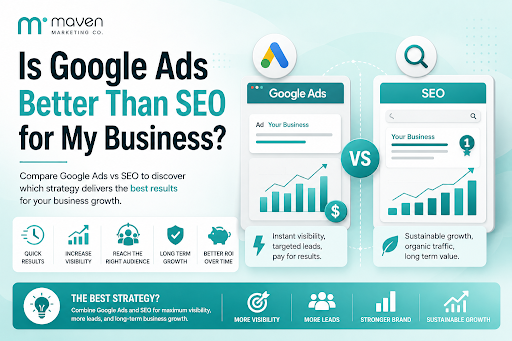
Is Google Ads Better Than SEO for My Business
One of the biggest questions business owners ask when they are planning online growth is whether they should invest in Google Ads or SEO. Both are strong marketing plays that help your company show up in Google search results, but they do things in separate lanes. Google Ads gives quicker visibility and can bring in leads fast, whereas SEO more or less focuses on slow, steady organic traffic that tends to grow the longer you keep building it. Picking the right direction depends on what you want to achieve, how much money you can spend, how crowded the market is, and how quickly you need results, like sooner rather than later. The good news is you don’t always have to choose one or the other; it’s not exactly a black-and-white situation. If you take time to understand the strongest points of both, you can put together a more sensible digital marketing plan that supports consistent expansion. In this guide, we’ll compare Google Ads vs SEO, explain the main differences, and help you figure out what option makes the most sense for your business.

When Should I Hire a Digital Marketing Agency
Growing a business today takes more than just having a website or throwing a post on social media; customers usually search around online, compare providers, skim reviews, and basically expect the brand to show up with a solid digital presence before they even think about buying. Many businesses try to run their marketing themselves, but there comes a point when “doing it all in-house” becomes clunky and hard to manage, all at once. Knowing when to hire a digital marketing agency can end up making a big, real difference for your growth. If you’re not getting enough leads, or your online visibility feels stuck, or sales are just not moving, the right agency can bring the know-how, plus a clear plan, to help you get noticeably better outcomes. In this guide, we’ll dig into what a digital marketing agency actually does, the usual signs it’s time to bring one on, and how picking the right marketing partner can help your business move forward at a faster pace.
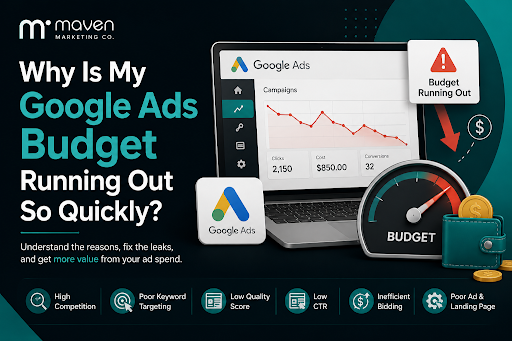
Why Is My Google Ads Budget Running Out So Quickly
Running a successful Google Ads budget isn’t only about throwing more money at it. It’s more like making every dollar, doing a bit extra. A lot of businesses start a Google Ads campaign with big hopes, then find out their daily budget is gone within a few hours, and that feels weird, right? After that, your ads stop showing effectively, new leads slip away, and your return on investment dips. So if your Google Ads budget is running out too fast, don’t stress. It’s a fairly common issue, and in most situations, it can be repaired with the right approach. There are multiple little things that can drain your advertising money quicker than you expected, from costly keywords to audience targeting that just doesn’t quite fit. In this guide, we’ll walk through why your budget disappears so quickly, how to cut wasteful spend, and the most reliable ways to boost your Google Ads ROI, even if your budget stays the same.