.svg)


%201.svg)
.avif)
Key Takeaways
- Properly optimized product pages drive 47% more organic traffic than poorly optimized equivalents, with SEO-driven traffic converting 25% better than paid advertising for e-commerce
- Unique, detailed product descriptions of 300-500 words outperform manufacturer descriptions by 73% in search rankings, eliminating duplicate content issues while providing the detailed information Australian shoppers demand
- Product schema markup increases click-through rates by 30-40% by displaying rich snippets with pricing, availability, and ratings directly in search results
- Page speed under 2.5 seconds on mobile improves conversion rates by 35%, with Australian shoppers abandoning slow-loading product pages at rates exceeding 60% after 3 seconds
- High-quality product images with proper alt text improve SEO and conversion simultaneously, with products featuring 5+ images converting 65% better than single-image listings while providing crucial accessibility and search signals
.avif)
Australian e-commerce operates in a uniquely challenging environment. You're competing against Amazon Australia's massive inventory, international retailers offering global shipping, and aggressive local competitors. Paid advertising costs escalate annually, squeezing margins.
Product page SEO offers an escape from this expensive treadmill. When your product pages rank organically for high-intent searches like "men's running shoes Australia" or "organic baby skincare Melbourne," you capture customers actively searching for what you sell—without paying for every click.
Yet most Australian retailers fundamentally misunderstand product page optimization. They copy-paste manufacturer descriptions creating duplicate content disasters. They ignore schema markup leaving money on the table. They neglect technical fundamentals like page speed and mobile optimization. Meanwhile, competitors who optimize systematically capture organic traffic that converts sustainably.
Product Title Optimization: The Foundation
Product titles must appeal to human shoppers while incorporating keywords those shoppers actually use when searching.
Include primary keywords naturally. If selling running shoes, your title should include "running shoes" plus modifying attributes: brand, model, color, gender. "Nike Air Zoom Pegasus 40 Men's Running Shoes - Black/White" works better than creative but unsearchable titles.
Follow hierarchical structure: [Brand] [Product Type] [Key Attributes] - [Additional Details]. This front-loads important keywords while remaining scannable.
Avoid keyword stuffing. Google recognizes manipulation; customers find it unprofessional. One natural mention of each important keyword suffices.
Consider character limits. Google displays 50-60 characters in search results. Your most important keywords should appear within this limit.
Product Description Optimization: Content That Converts
Write unique descriptions for every product. Manufacturer descriptions create duplicate content across hundreds of competitor sites. Google typically ranks only one version, and it likely won't be yours.
Aim for 300-500 words for primary products. This allows comprehensive coverage of features, benefits, use cases, and comparison points while incorporating semantic keywords naturally.
Structure descriptions strategically:
Open with a compelling 2-3 sentence overview incorporating primary keywords naturally. Detail features and benefits in scannable format using subheadings, bullet points, or short paragraphs. Address customer questions proactively. Include usage suggestions, sizing guidance, or care instructions.
Incorporate semantic keywords naturally. Don't just repeat exact-match keywords; include related terms and variations. For running shoes: athletic footwear, training shoes, workout sneakers, performance running, cushioned sole, breathable mesh.
Write for Australian customers using Australian English spelling, currency (AUD $), and local context. Reference Australian sizing, mention Australian delivery timeframes, and address Australia-specific use cases.
.avif)
Technical Product Page SEO
URL structure should be clean and keyword-inclusive. Good: yourstore.com.au/products/nike-air-zoom-pegasus-40-mens-running-shoes. Poor: yourstore.com.au/p?id=8473629.
Meta titles should incorporate primary keywords early. Format: "[Product Name] | [Key Benefit] | [Store Name]". Keep under 60 characters.
Meta descriptions should be compelling 150-160 character summaries encouraging click-through. Include primary keyword, key benefit, differentiator, and call-to-action.
Schema markup is non-negotiable. Implement Product schema including name, description, images, brand, price, availability, and reviews. This enables rich snippets showing star ratings, pricing, and availability in search results—increasing click-through rates 30-40%.
Page speed optimization directly impacts rankings and conversions. Optimize for sub-2.5 second load times on mobile by compressing images, implementing lazy loading, minimizing JavaScript/CSS, and using CDNs.
Mobile optimization is critical with 71% of Australian e-commerce traffic mobile-originated. Ensure responsive design, touch-friendly buttons, readable text, and streamlined mobile checkout.
Image Optimization
High-quality photography serves both conversion and SEO. Products with 5+ images from multiple angles convert 65% better than single-image listings.
File optimization balances quality with load speed. Compress images to 100-200KB maximum. Use descriptive file names before upload: "nike-air-zoom-pegasus-40-mens-black.jpg" instead of "IMG_8472.jpg".
Alt text serves accessibility and SEO. Describe images concisely while incorporating keywords: "Nike Air Zoom Pegasus 40 men's running shoes in black and white colorway, side view showing mesh upper."
.avif)
User-Generated Content
Customer reviews provide fresh content while improving conversion rates. Products with reviews convert 63% better than products without them. Implement review platforms and incentivize reviews with discount codes.
Review schema markup displays star ratings in search results, dramatically improving click-through rates.
Product Q&A sections address customer concerns while providing unique content targeting question-based searches.
Case Study: Melbourne Activewear Retailer
A Melbourne activewear retailer with 340 products relied 90% on paid ads. In March 2024, they rewrote descriptions for 60 highest-revenue products (350-450 words each), implemented Product schema across all products, optimized images reducing page weight from 3.2MB to 580KB, improved mobile speed from 5.7 to 2.1 seconds, added 4-6 images per product, and integrated customer reviews.
Results after 8 months:
Organic traffic increased 267%. Nineteen products ranked first page for primary keywords. Organic revenue grew from 8% to 34% of total. Organic traffic converted at 4.2% vs 2.1% from paid ads. The optimization generated $127,000 in additional organic revenue with ongoing compounding benefits.
Case Study: Sydney Homewares Store
A Sydney homewares store with 520 products competed against major retailers and Amazon. They implemented detailed Product schema, optimized for long-tail keywords ("Scandinavian oak coffee table Sydney," "round marble coffee table Australia"), emphasized Australian stock and local delivery, and published detailed buying guides linking to products.
Results after 6 months:
Organic traffic increased 198%. They ranked for 142 long-tail keywords. Conversion rates from organic reached 5.8% vs 2.3% from ads. Organic revenue grew from zero to 28% of total within six months.
.avif)
The Essential Product Page SEO Checklist
Content:☐ Unique 300-500 word description☐ Primary keyword in first 100 words☐ Semantic keywords throughout☐ Australian English spelling☐ Features and benefits clear☐ Customer questions answered
Technical:☐ Clean, keyword-inclusive URL☐ Optimized meta title (under 60 chars)☐ Compelling meta description (150-160 chars)☐ Product schema markup implemented☐ Schema validated error-free☐ Page speed under 2.5 seconds mobile☐ Mobile-responsive design☐ HTTPS security
Images:☐ 5+ high-quality product images☐ Images compressed under 200KB☐ Descriptive file names☐ Alt text on all images☐ Lazy loading implemented
User Experience:☐ Customer reviews enabled☐ Review schema displaying ratings☐ Product Q&A implemented☐ Clear pricing and availability☐ Related products recommended
Frequently Asked Questions
Should I optimize every product or prioritize certain products?
Prioritize strategically. Start with your 20-50 highest-revenue products. Then expand to products with good margins, lower competition keywords, or unique differentiators. For large catalogs (500+ products), accept that full optimization may require 6-12 months. Focus on the 20% of products generating 80% of revenue first, then systematically expand coverage. Basic optimization (unique descriptions, proper schema, technical fundamentals) suffices for commodity products competing purely on price.
How do I handle product variations (sizes, colors) for SEO?
Consolidate minor variations (sizes, colors of identical products) on single pages with variant selectors. Use canonical tags preventing duplicate content. Implement Product schema with "offers" arrays showing all variations' pricing and availability. Optimize the parent product page comprehensively. Exception: if different colors represent distinct products with separate search demand, create separate optimized pages. Let search behavior guide variation structure.
How often should I update product pages for SEO?
Update when substantive changes occur—price changes, availability shifts, new reviews, or feature updates. For evergreen products, quarterly reviews ensure accuracy. Add customer reviews continuously. Don't make changes purely for freshness. Let performance data guide priorities—products ranking positions 4-10 particularly benefit from content expansion pushing them into top-3 positions.
Transform Product Pages Into Revenue Engines
Every unoptimized product page represents lost revenue. Product page SEO is the systematic process of ensuring your products appear when high-intent shoppers search. Unlike paid advertising requiring ongoing budget, optimization is largely one-time work generating compounding returns.
At Maven Marketing Co, we've helped Australian e-commerce retailers transform underperforming product catalogs into organic revenue engines. We execute comprehensive optimization—writing unique descriptions

Table of contents
read more blogs
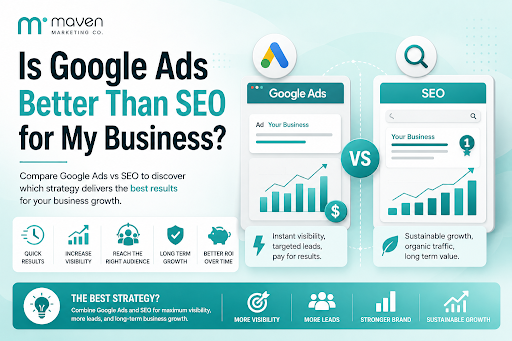
Is Google Ads Better Than SEO for My Business
One of the biggest questions business owners ask when they are planning online growth is whether they should invest in Google Ads or SEO. Both are strong marketing plays that help your company show up in Google search results, but they do things in separate lanes. Google Ads gives quicker visibility and can bring in leads fast, whereas SEO more or less focuses on slow, steady organic traffic that tends to grow the longer you keep building it. Picking the right direction depends on what you want to achieve, how much money you can spend, how crowded the market is, and how quickly you need results, like sooner rather than later. The good news is you don’t always have to choose one or the other; it’s not exactly a black-and-white situation. If you take time to understand the strongest points of both, you can put together a more sensible digital marketing plan that supports consistent expansion. In this guide, we’ll compare Google Ads vs SEO, explain the main differences, and help you figure out what option makes the most sense for your business.

When Should I Hire a Digital Marketing Agency
Growing a business today takes more than just having a website or throwing a post on social media; customers usually search around online, compare providers, skim reviews, and basically expect the brand to show up with a solid digital presence before they even think about buying. Many businesses try to run their marketing themselves, but there comes a point when “doing it all in-house” becomes clunky and hard to manage, all at once. Knowing when to hire a digital marketing agency can end up making a big, real difference for your growth. If you’re not getting enough leads, or your online visibility feels stuck, or sales are just not moving, the right agency can bring the know-how, plus a clear plan, to help you get noticeably better outcomes. In this guide, we’ll dig into what a digital marketing agency actually does, the usual signs it’s time to bring one on, and how picking the right marketing partner can help your business move forward at a faster pace.
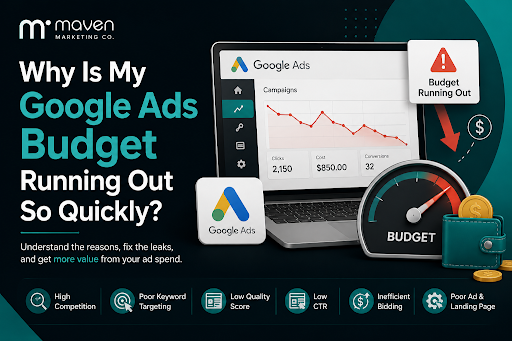
Why Is My Google Ads Budget Running Out So Quickly
Running a successful Google Ads budget isn’t only about throwing more money at it. It’s more like making every dollar, doing a bit extra. A lot of businesses start a Google Ads campaign with big hopes, then find out their daily budget is gone within a few hours, and that feels weird, right? After that, your ads stop showing effectively, new leads slip away, and your return on investment dips. So if your Google Ads budget is running out too fast, don’t stress. It’s a fairly common issue, and in most situations, it can be repaired with the right approach. There are multiple little things that can drain your advertising money quicker than you expected, from costly keywords to audience targeting that just doesn’t quite fit. In this guide, we’ll walk through why your budget disappears so quickly, how to cut wasteful spend, and the most reliable ways to boost your Google Ads ROI, even if your budget stays the same.