.svg)


%201.svg)
.avif)
Key Takeaways
- Consistent NAP (Name, Address, Phone) data across 50+ directories can improve local pack rankings by up to 64%, making citation building one of the highest-ROI local SEO tactics available
- Australia has 12 core citation sources that every local business must claim, including Google Business Profile, True Local, Yellow Pages, and Bing Places, with industry-specific directories adding 20-40 additional opportunities
- Citation inconsistencies confuse Google's algorithms, causing 73% of businesses with NAP discrepancies to experience suppressed local rankings even when other SEO factors are strong
- Building citations is a one-time effort with ongoing maintenance requirements—initial buildout takes 8-15 hours but creates lasting ranking improvements that compound over time
- Quality trumps quantity in citation building, with 30 accurate, consistent citations on authoritative directories outperforming 100 low-quality, inconsistent listings on spam directories
Local search has become the battleground where Australian small businesses win or lose customers. When someone in Newtown searches "plumber near me" or a Southbank resident looks for "best Italian restaurant," Google's local pack displays just three businesses. The difference between appearing in that coveted trio and languishing in obscurity often comes down to citations.
Yet most Australian business owners either don't understand citations or dramatically underestimate their importance. They've claimed their Google Business Profile, perhaps listed on Yellow Pages, then wonder why they're not ranking. Meanwhile, competitors with comprehensive citation profiles dominate local search results—not because they have better products or services, but because they've done the unglamorous work of citation building properly.
The opportunity is substantial. Local search drives 46% of all Google searches, and 88% of consumers who do a local search visit or call a business within 24 hours. Citations directly influence whether your business appears in those high-intent searches. This guide eliminates the confusion, providing the exact citation strategy Australian businesses need to dominate local search.
.avif)
Understanding Local Citations: Why They Matter for Australian Businesses
A local citation is any online mention of your business's NAP—Name, Address, Phone number. Citations appear on business directories, websites, apps, social platforms, and review sites. They exist in two forms: structured citations (directory listings with standardized NAP fields) and unstructured citations (mentions in blog posts, news articles, or websites without formal structure).
Google uses citations as trust signals. When the search engine sees your business listed consistently across dozens of authoritative directories, it interprets this as validation that your business exists, operates at the stated location, and deserves to rank in local results. Conversely, inconsistent citations create algorithmic confusion—if your business appears as "Smith Plumbing" on one directory, "Smith's Plumbing Services" on another, and "John Smith Plumbing" on a third, Google struggles to confidently connect these references to a single entity.
The psychological mechanism mirrors real-world trust building. If you asked ten people where to find a reliable electrician and all ten mentioned the same business, you'd trust that recommendation. Google's algorithms operate similarly—consistent mentions across authoritative sources build algorithmic trust.
Australian citation landscape differs from other markets. While international SEO advice often focuses on Yelp, Angie's List, or region-specific American directories, Australian businesses need different citation sources. True Local, Start Local, Hotfrog Australia, and Australia-specific versions of global directories form the foundation of effective Australian citation strategies.
Geographic specificity matters enormously. A Sydney business benefits more from citations on Sydney-specific directories than generic international platforms. State-based business directories, suburb-focused sites, and Australia-verified profiles on global platforms all carry more weight for Australian local rankings than international equivalents.
The Core Australian Citation Sources Every Business Needs
.avif)
Not all directories carry equal weight. Strategic citation building prioritizes high-authority, widely-recognized directories that Google trusts, then expands to industry-specific and location-specific opportunities.
Essential universal citations form your foundation. Every Australian business, regardless of industry or location, should claim these core listings:
Google Business Profile stands as the single most critical citation. This isn't technically a "citation" in traditional terms, but it functions as your primary local presence. Complete optimization—accurate NAP, comprehensive business description, proper category selection, regular posts, review management—is non-negotiable.
Bing Places for Business provides your second search engine citation. While Bing commands smaller Australian market share than Google, it still drives significant local search traffic, particularly among certain demographics. Claiming your Bing listing takes fifteen minutes and provides lasting value.
Apple Maps has become increasingly important as iPhone usage dominates Australian mobile markets. Apple Maps powers Siri's local search responses and the default mapping application for millions of Australians. Register through Apple Business Connect.
True Local serves as Australia's largest independent local business directory. High domain authority and strong Australian user base make this a priority citation.
Yellow Pages Australia maintains relevance despite declining print usage. The online directory carries substantial authority and ranks well in organic search results, creating citation value plus potential referral traffic.
White Pages Australia provides another high-authority Australian citation source with strong brand recognition and user trust.
Start Local offers free business listings with good Australian visibility and reasonable domain authority.
Hotfrog Australia provides free business directory listings with decent authority and local relevance.
Australian Business Register through business.gov.au provides government validation of your business existence and ABN verification—a unique Australian citation source carrying exceptional trust signals.
Facebook Business Page functions as a social citation with massive reach. Ensure NAP consistency with other citations.
LinkedIn Company Page serves professional service businesses particularly well, providing both citation value and B2B discovery opportunities.
Industry-specific directories multiply citation opportunities based on your business type. Tradies should prioritize HiPages, ServiceSeeking, and Oneflare. Restaurants need Zomato, TripAdvisor, and OpenTable. Professional services benefit from industry association directories and licensing body listings. Healthcare providers should claim HealthEngine and relevant medical directories.
Research your industry specifically—most verticals have 5-15 industry-specific directories providing valuable citation opportunities that general directories can't match.
Location-specific directories include suburb guides, local council business directories, chamber of commerce listings, and region-specific business associations. A Fitzroy cafe should pursue Fitzroy-specific directories and Melbourne CBD business listings that a Brisbane business wouldn't prioritize.
NAP Consistency: The Make-or-Break Factor
.avif)
Citation value depends entirely on consistency. Google's algorithms need perfect matches to confidently connect citations to your business entity. Even minor variations undermine citation effectiveness.
Name consistency requires using your exact registered business name identically across all citations. If your registered name is "Melbourne Property Services Pty Ltd," don't shorten it to "Melbourne Property Services" on some directories and "MPS Property" on others. Choose one version—ideally your registered business name—and use it everywhere without exception.
The temptation to optimize names with keywords ("Best Melbourne Plumber - Smith Plumbing") undermines citation value. Use your actual business name, not keyword-stuffed variations.
Address formatting creates frequent consistency problems. Australia's address conventions allow multiple valid formats: "Suite 5, 123 Smith Street" versus "5/123 Smith St" versus "123 Smith Street, Suite 5." Choose one format and replicate it exactly.
Critical formatting decisions: abbreviate or spell out "Street/St," "Road/Rd," "Avenue/Ave"? Include or omit suite/unit numbers? Use "Level" or "Lvl"? Make these decisions once, document them, then apply consistently.
Google recognizes some format variations as equivalent, but perfect consistency eliminates any algorithmic confusion. When in doubt, match your Google Business Profile address format exactly—this ensures at minimum your most important citation aligns with all others.
Phone number formatting presents similar challenges. Australian numbers can appear as 0X XXXX XXXX, (0X) XXXX XXXX, +61 X XXXX XXXX, or various other formats. Choose one format and use it universally.
Recommendation: use the format Google displays on your Business Profile. If Google shows "(03) 9XXX XXXX," use that exact format across all citations. This guarantees consistency where it matters most.
Additional consistency considerations extend beyond basic NAP. Business categories, descriptions, website URLs, and business hours should also maintain consistency. While these don't carry the same critical importance as NAP, inconsistencies across these elements can still create trust issues.
The Citation Building Process: Step-by-Step Implementation
.avif)
Systematic citation building follows a predictable process that transforms overwhelming directory proliferation into manageable projects.
Step 1: Citation Audit identifies your current state. Use tools like Moz Local, BrightLocal, or Whitespark to scan existing citations. This reveals where you're already listed, identifies inconsistencies requiring correction, and highlights priority opportunities you're missing.
Manual searches complement automated tools. Google your business name plus city, check major directories individually, and search your phone number to find citations automated tools might miss. This audit typically takes 2-3 hours but provides the roadmap for all subsequent efforts.
Step 2: Standardize Your NAP by documenting the exact name, address, and phone format you'll use universally. Create a simple reference document containing your standardized NAP, business description (short and long versions), business categories, website URL, and any other details you'll need repeatedly.
This reference document ensures consistency as you build citations across dozens of directories. Copy-paste from this document rather than retyping information—this eliminates transcription errors that create inconsistencies.
Step 3: Claim and Optimize Priority Citations starting with the core universal directories listed earlier. Work through Google Business Profile, Bing Places, Apple Maps, True Local, Yellow Pages, and other tier-one sources methodically. Fully complete every available field using your standardized information.
This phase typically requires 4-6 hours spread across several sessions. Don't rush—accuracy matters more than speed. Verify each submission before finalizing to catch errors before they become citation inconsistencies requiring later correction.
Step 4: Expand to Industry and Location-Specific Directories relevant to your business. Research which directories serve your industry, compile a target list, then systematically claim listings on each. This expansion phase varies dramatically by business type—a restaurant might identify 25 relevant directories while a B2B consultant finds only 8.
Prioritize quality over quantity. One accurate listing on a high-authority, relevant directory provides more value than ten listings on low-quality spam directories.
Step 5: Monitor and Maintain your citation portfolio quarterly. Directories occasionally change information without notification, competitors sometimes claim your listings maliciously, and address or phone changes require updating across all citations. Set calendar reminders for quarterly citation audits ensuring ongoing consistency.
Case Study: Brisbane Tradie's Local Dominance
A Brisbane-based air conditioning service operated for seven years with minimal online presence beyond a basic website. They'd claimed Google Business Profile but nothing else. Local pack rankings were non-existent—searches for "air conditioning repair Brisbane" showed competitors exclusively.
In March 2024, they implemented comprehensive citation building. Initial audit revealed they had exactly three citations: Google Business Profile, an old Yellow Pages listing with outdated phone number, and an unclaimed Bing Places listing displaying incorrect business hours.
Citation buildout strategy:
They standardized NAP formatting, created their reference document, then systematically built citations across 47 directories over three weeks. This included:
- Universal directories (Bing, Apple Maps, True Local, Yellow Pages, White Pages, Facebook, LinkedIn)
- Tradie-specific directories (HiPages, ServiceSeeking, Oneflare, hipages, ServiceCentral)
- Brisbane-specific directories (Brisbane Business Directory, Brisbane City Council listings, local chamber of commerce)
- Review platforms (Google reviews, ProductReview.com.au, TrueLocal reviews)
They also corrected the two existing incorrect citations, ensuring perfect consistency across all 47 listings.
Results after 5 months:
Local pack rankings transformed. They now appeared in local pack results for 23 different search variations around air conditioning services in Brisbane suburbs. Organic local traffic increased 156%. Phone enquiries from local search grew 89%, with clear attribution to improved visibility.
Most significantly, the citation buildout cost approximately $800 in labour (contractor managing the buildout) plus $200 in directory fees, yet generated an additional $47,000 in revenue over five months directly attributed to improved local search visibility. The ROI was extraordinary—5,787% return on a modest investment in unsexy citation work.
The business owner noted something unexpected: citation building created authority that extended beyond rankings. Customers mentioned seeing the business "everywhere online," which built trust before first contact. Citations weren't just ranking signals—they were trust signals creating psychological advantages in conversion conversations.
Case Study: Melbourne Cafe's Suburb Supremacy
A small Fitzroy cafe faced the challenge common to hospitality: intense local competition in a small geographic area. Dozens of cafes competed for the same Fitzroy breakfast and lunch customers. Traditional marketing—social media, local partnerships, quality products—wasn't creating sufficient differentiation.
Their citation audit revealed scattered, inconsistent presence. Google Business Profile existed but was poorly optimized. Some directories listed them as "The Fitzroy Cafe" while others showed "Fitzroy Cafe" or "Fitzroy Coffee House" (they'd rebranded eighteen months prior but hadn't updated citations). Their address appeared in three different formats across various directories, and their phone number showed two different formats.
Systematic citation correction and building:
They first corrected all existing citations, ensuring perfect NAP consistency. They then expanded their citation portfolio strategically, focusing heavily on hospitality-specific and Melbourne-specific directories:
- Food/hospitality directories (Zomato, TripAdvisor, Broadsheet Melbourne, Concrete Playground, Urban List Melbourne)
- Melbourne suburb guides (Fitzroy-specific directories, inner-north Melbourne guides)
- Google Maps optimization with high-quality photos, regular posts, comprehensive menu information
- Review platform optimization ensuring consistent NAP across all review sites
Total citation count grew from 8 inconsistent citations to 38 consistent, optimized listings.
Results after 4 months:
The cafe began appearing in local pack results for valuable searches like "best breakfast Fitzroy," "Fitzroy cafe," and "brunch near me" (when searched from Fitzroy). Weekend walk-in traffic increased noticeably, with many customers mentioning they'd found the cafe through Google searches.
More interestingly, their citation presence on food-focused platforms (Zomato, TripAdvisor, Broadsheet) drove referral traffic beyond just ranking improvements. These platforms ranked well themselves for food searches, and the cafe's presence on them created multiple discovery pathways.
Revenue attribution was challenging given hospitality's walk-in nature, but trackable metrics told the story: Google Business Profile views increased 234%, direction requests increased 178%, and phone calls from the profile increased 145%. The cafe owner estimated citation work contributed to a 15-20% revenue increase over the subsequent four months—substantial impact from systematic but unglamorous directory work.
Common Citation Mistakes That Sabotage Rankings
Even businesses investing in citation building often undermine their efforts through preventable mistakes.
Inconsistent business names represent the most common error. Using "Smith & Associates" on some directories, "Smith and Associates" on others, and "Smith + Associates" elsewhere fragments your citation value. Choose one version and use it everywhere, every time, without exception.
Incomplete citations waste opportunities. Directories offering fields for business description, hours, website, categories, and photos deserve complete information. Minimal citations—just NAP without additional details—provide less value than fully optimized listings that enhance user experience while signaling completeness to search algorithms.
Ignoring duplicate listings allows multiple profiles for your business on single directories, often with conflicting information. These duplicates confuse Google while diluting citation value. Claim and merge duplicates systematically, preserving the oldest listing when possible (age provides authority).
Neglecting citation maintenance after initial buildout allows degradation over time. Directories occasionally revert information, competitors sometimes claim your listings, and business changes (phone numbers, addresses, hours) require updating across all citations. Quarterly audits prevent these issues from undermining your citation portfolio's value.
Prioritizing quantity over quality leads to citations on spam directories providing negligible value while consuming time building and maintaining them. Focus on authoritative, relevant directories users and search engines actually trust rather than pursuing vanity citation counts.
.avif)
Measuring Citation Impact: What Success Looks Like
Citation building creates measurable improvements across multiple metrics when executed properly.
Local pack appearance provides the clearest success indicator. Track whether your business appears in local pack results for target keywords. Use rank tracking tools monitoring local pack positions for relevant searches. Successful citation strategies typically show local pack appearances increasing 40-80% within 3-6 months.
Organic local traffic growth measures whether improved visibility drives actual visits. Monitor organic traffic from local searches specifically—most analytics platforms allow geographic filtering showing traffic from your target service area. Expect 25-50% organic local traffic increases within 4-6 months of comprehensive citation buildout.
Google Business Profile insights provide valuable leading indicators. Monitor profile views, search queries showing your profile, direction requests, phone calls, and website clicks. These metrics often improve before ranking changes become apparent, providing early validation that citation work is generating impact.
Citation consistency scores from tools like Moz Local or BrightLocal quantify improvement. These platforms scan directories and score your NAP consistency. Scores should improve from typically 40-60% initially to 85-95% post-optimization. Perfect 100% scores are rare due to directories outside your control, but 90%+ indicates strong citation health.
Business listing accuracy across directories should approach 95%+. Audit random samples of your citations quarterly, verifying NAP accuracy. High accuracy rates indicate successful maintenance preventing degradation.
Frequently Asked Questions
How many citations does an Australian business actually need?
Most Australian businesses achieve optimal results with 40-60 high-quality, consistent citations across universal directories, industry-specific platforms, and location-specific sources. Quality dramatically outweighs quantity—30 accurate citations on authoritative directories provide far more value than 150 scattered across low-quality spam directories. Start with the 12 essential universal citations (Google Business Profile, Bing, Apple Maps, True Local, Yellow Pages, etc.), then expand into 15-25 industry-specific directories relevant to your vertical. Location-specific directories add another 10-20 opportunities depending on your geographic market. The exact number matters less than consistency and authority—perfect NAP across 40 relevant directories beats inconsistent presence across 100 random directories every time.
Can I outsource citation building or must I do it myself?
Citation building can absolutely be outsourced, but choose providers carefully. Quality services like Moz Local, BrightLocal, or Australian-specific providers offer citation building and monitoring that saves substantial time while ensuring accuracy. Alternatively, hire virtual assistants or local SEO contractors to build citations systematically using your standardized NAP reference document. The critical requirement: whoever builds citations must prioritize accuracy over speed. One person meticulously building 40 perfect citations provides more value than a team rapidly creating 100 inconsistent listings. If outsourcing, provide detailed NAP formatting instructions, verify samples before full buildout, and conduct quality audits post-completion. Many Australian businesses successfully outsource initial buildout while maintaining citations in-house quarterly—a hybrid approach balancing efficiency with quality control.
How do I fix existing inconsistent citations without starting over?
Fixing inconsistent citations requires systematic correction rather than starting fresh. First, audit comprehensively using tools plus manual searches to identify every existing citation. Document each citation's current information and its inconsistencies. Then, prioritize corrections by directory authority—fix Google Business Profile, Bing, True Local, and other tier-one directories first. Claim unclaimed listings, update information on claimed listings, and request removal of duplicate listings you can't claim. For citations on directories where you lack direct control, submit correction requests through directory support channels. Most directories allow business owners to claim listings and update information, though some require verification processes. Budget 4-8 hours for correction work depending on how many inconsistent citations exist. This cleanup creates the consistent foundation allowing future citations to build value rather than adding to confusion. Once corrected, implement quarterly monitoring preventing inconsistencies from reappearing.
Build the Citation Foundation Your Rankings Deserve
Citation building isn't glamorous. It doesn't provide the immediate gratification of social media engagement or the creativity of content marketing. It's systematic, detail-oriented work requiring accuracy over inspiration.
Yet this unglamorous work determines whether your business appears when local customers search for your services. While competitors chase algorithmic shortcuts and trendy tactics, citation building provides the foundational trust signals Google needs to rank your business confidently in local results.
Your competitors aren't all doing this correctly. Most Australian businesses have scattered, inconsistent citations undermining their local SEO efforts. This creates opportunity—systematic citation building provides disproportionate advantages when competitors neglect fundamentals.
The investment is modest. Fifteen hours of focused work builds a citation portfolio generating ranking improvements for years. The ROI is exceptional—case studies consistently show 3,000-5,000% returns as improved local visibility drives enquiries and revenue.
At Maven Marketing Co, we've helped hundreds of Australian businesses build citation portfolios that transform local search performance. We don't just submit your business to random directories—we conduct comprehensive audits, develop customized citation strategies targeting directories that actually matter for your industry and location, ensure perfect NAP consistency across every listing, and provide ongoing monitoring preventing citation degradation.
Stop letting inconsistent citations suppress your local rankings. Stop missing enquiries because competitors appear in local packs while you don't. Stop leaving this high-ROI opportunity to chance.
Contact Maven Marketing Co today to discuss your citation strategy. We'll audit your current citation profile, identify critical gaps and inconsistencies, and build the comprehensive, accurate citation foundation that puts your business in front of local customers actively searching for your services. Your local rankings won't improve by accident—let's build them systematically, starting now.

read more blogs
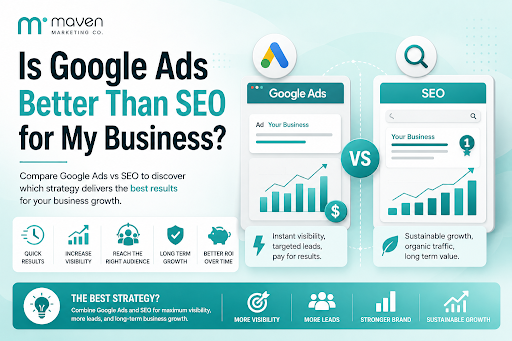
Is Google Ads Better Than SEO for My Business
One of the biggest questions business owners ask when they are planning online growth is whether they should invest in Google Ads or SEO. Both are strong marketing plays that help your company show up in Google search results, but they do things in separate lanes. Google Ads gives quicker visibility and can bring in leads fast, whereas SEO more or less focuses on slow, steady organic traffic that tends to grow the longer you keep building it. Picking the right direction depends on what you want to achieve, how much money you can spend, how crowded the market is, and how quickly you need results, like sooner rather than later. The good news is you don’t always have to choose one or the other; it’s not exactly a black-and-white situation. If you take time to understand the strongest points of both, you can put together a more sensible digital marketing plan that supports consistent expansion. In this guide, we’ll compare Google Ads vs SEO, explain the main differences, and help you figure out what option makes the most sense for your business.

When Should I Hire a Digital Marketing Agency
Growing a business today takes more than just having a website or throwing a post on social media; customers usually search around online, compare providers, skim reviews, and basically expect the brand to show up with a solid digital presence before they even think about buying. Many businesses try to run their marketing themselves, but there comes a point when “doing it all in-house” becomes clunky and hard to manage, all at once. Knowing when to hire a digital marketing agency can end up making a big, real difference for your growth. If you’re not getting enough leads, or your online visibility feels stuck, or sales are just not moving, the right agency can bring the know-how, plus a clear plan, to help you get noticeably better outcomes. In this guide, we’ll dig into what a digital marketing agency actually does, the usual signs it’s time to bring one on, and how picking the right marketing partner can help your business move forward at a faster pace.
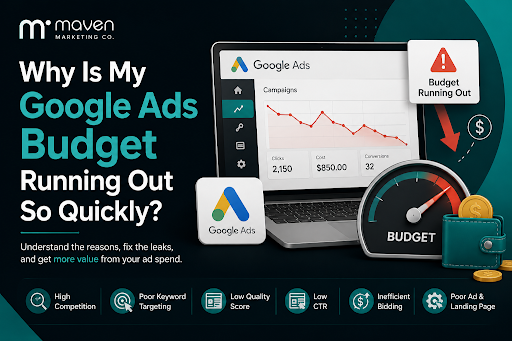
Why Is My Google Ads Budget Running Out So Quickly
Running a successful Google Ads budget isn’t only about throwing more money at it. It’s more like making every dollar, doing a bit extra. A lot of businesses start a Google Ads campaign with big hopes, then find out their daily budget is gone within a few hours, and that feels weird, right? After that, your ads stop showing effectively, new leads slip away, and your return on investment dips. So if your Google Ads budget is running out too fast, don’t stress. It’s a fairly common issue, and in most situations, it can be repaired with the right approach. There are multiple little things that can drain your advertising money quicker than you expected, from costly keywords to audience targeting that just doesn’t quite fit. In this guide, we’ll walk through why your budget disappears so quickly, how to cut wasteful spend, and the most reliable ways to boost your Google Ads ROI, even if your budget stays the same.