.svg)


%201.svg)
Key Takeaways
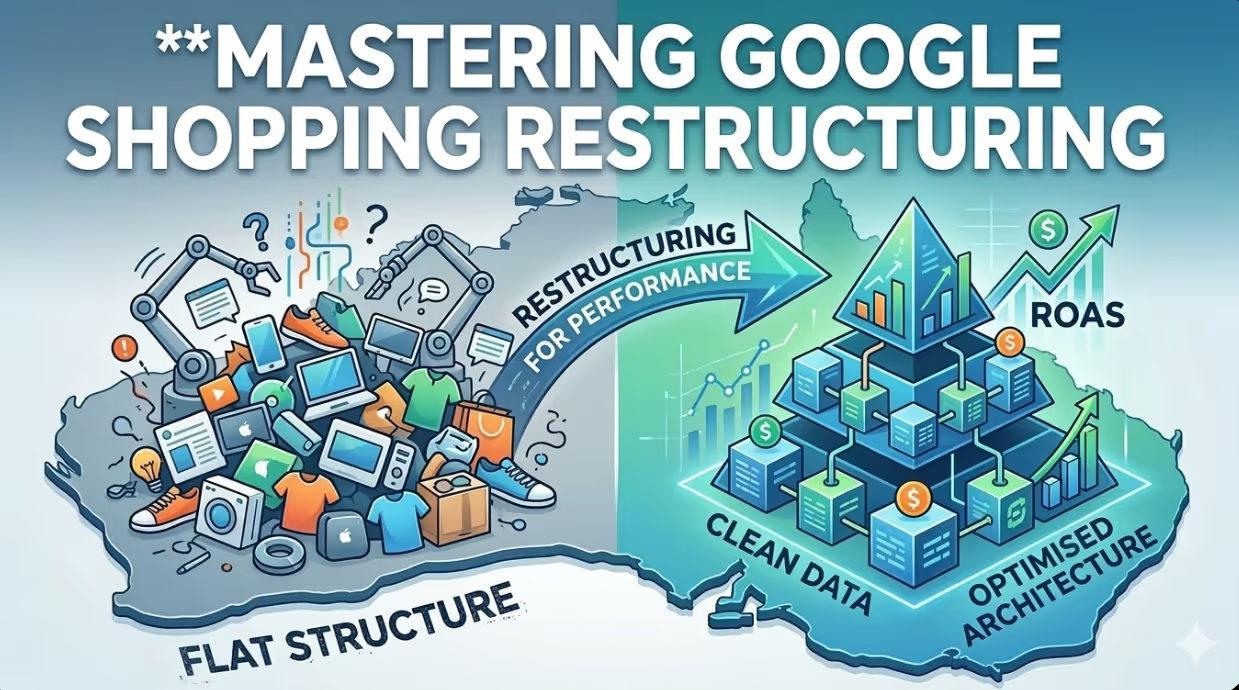
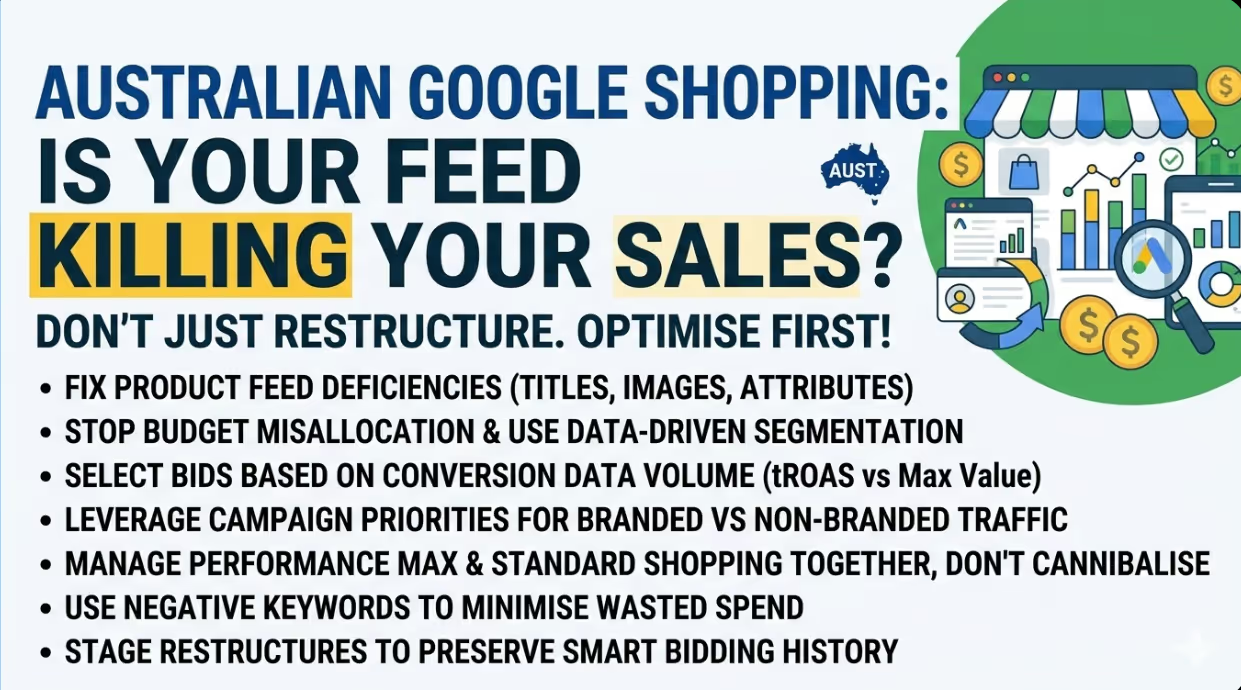
- Product feed quality is the foundation of Shopping campaign performance. Before restructuring campaign settings, the feed should be audited for title optimisation, attribute completeness, image quality, and category accuracy, because feed deficiencies limit performance regardless of how the campaign is structured.
- The most common structural problem in underperforming Shopping campaigns is budget misallocation: the campaign is distributing spend across all products proportionally when the performance differences between product categories, price points, and margin profiles justify a segmented campaign structure with independent budget control.
- Bid strategy selection must match the campaign's conversion data volume. A target ROAS or target CPA strategy on a campaign generating fewer than 30 conversions per month will produce worse results than a maximise conversion value strategy with a manual ROAS floor, because insufficient data prevents the smart bidding algorithm from optimising effectively.
- Priority settings in Standard Shopping campaigns, when used correctly, allow different campaigns to be given different levels of access to the same product set, creating a tiered structure that captures branded and product queries that do not include brand terms at appropriately differentiated bid levels.
- Performance Max campaigns that are running alongside Standard Shopping campaigns need deliberate structural management to prevent them from cannibalising the more controllable and transparent Standard Shopping spend rather than generating genuinely incremental sales.
- Negative keywords are as important in Shopping campaigns as they are in Search campaigns. A Shopping campaign without a rigorous negative keyword framework will match against irrelevant queries at scale, producing clicks and spend that do not convert and diluting the campaign's quality signals.
- Restructuring should be staged to preserve the conversion history that smart bidding strategies depend on. Campaigns rebuilt from scratch lose their optimisation data, which typically produces a period of underperformance during the algorithm's relearning phase that can be avoided with a carefully managed structural migration.
Diagnosing Before Restructuring
The first error in most Shopping campaign restructuring attempts is starting with the campaign structure before diagnosing the actual source of underperformance. Not all underperforming Shopping campaigns have the same problem, and the restructuring approach that fixes a feed quality issue is different from the one that addresses a budget allocation problem or a bid strategy mismatch. A systematic diagnostic sequence prevents misdiagnosis.
Diagnosing Feed Quality
The product feed is the primary input that determines which queries the Shopping campaign can match against and how relevant the resulting impressions are. A feed with poor title construction, missing attributes, incorrect categorisation, or images of low quality will generate impressions on broad or irrelevant queries regardless of how the campaign is structured, because Google uses the feed attributes to determine when to show the ads.
Feed title quality is the single most impactful attribute in the feed for query matching. A title that uses the manufacturer's internal product code rather than descriptive language, or that places the brand name before the descriptive product terms in a category where searchers do not search by brand, is a title that is not working as hard as it could. A Shopping title that is well constructed follows the pattern of the queries the product should appear for: [brand] + [product type] + [key attribute] + [model or variant] in a sequence that places the most relevant terms for search matching early in the title.
The Google Merchant Center diagnostic tools identify specific feed errors and warnings for each product, including missing required attributes, disapproved products, and items excluded from serving. Clearing all errors and warnings in Merchant Center is a prerequisite for any restructuring, because disapproved or excluded products cannot generate impressions regardless of the campaign structure above them.
Custom labels in the feed, which allow the advertiser to tag products with attributes specific to the business that Google does not have a standard field for, are among the most powerful and underused feed optimisation tools available. Custom labels can be used to tag products by margin tier, by sales velocity, by promotional status, or by any other attribute that the campaign structure needs to reference for budget and bidding decisions. A product feed without custom labels in an account that needs bidding that accounts for product margin is a structural gap at the feed level that no amount of restructuring at the campaign level can address.
Diagnosing Campaign Structure
With the feed assessed, the campaign structure should be examined to determine whether the current organisation is creating the budget and bidding control the account needs.
The most common structural problem is a flat Shopping campaign where all products are in a single ad group or in product category divisions that do not reflect meaningful performance differences. If the account contains products with very different margins, conversion rates, or competitive intensities, and those products are in the same campaign sharing the same budget and the same ROAS target, the bid strategy cannot optimise independently for each product's economics. The products with the highest volume will tend to receive the most spend regardless of their margin, and the algorithm will optimise toward the conversion volume that the campaign objective rewards rather than toward the commercial value the business needs.
The search terms report for Shopping campaigns, accessed through the Search Terms view rather than the Keywords view, reveals which queries are triggering impressions. A high proportion of irrelevant queries is a structural signal: the campaign is matching too broadly because its negative keyword framework is insufficient, its product categories are too broad, or its product titles are attracting the wrong queries.
Diagnosing Bid Strategy
The bid strategy diagnostic question is whether the current strategy is appropriate for the campaign's conversion data volume. Smart bidding strategies including target ROAS, target CPA, and maximise conversion value require sufficient historical conversion data to model how different bids will affect conversion outcomes. A campaign generating fewer than 30 conversions per month on target ROAS will oscillate between underbidding and overbidding as the algorithm struggles to build a reliable prediction model, producing erratic impression share, volatile CPCs, and inconsistent ROAS.
The correct bid strategy for a Shopping campaign with low conversion volume is typically maximise clicks (to build initial volume) or maximise conversion value with a manual budget constraint rather than a ROAS target, allowing the algorithm to optimise for value without being constrained by a target it cannot reliably hit given the available data.
Restructuring the Product Feed
Feed restructuring is the first physical change to make once the diagnostic is complete, because improvements to the campaign structure will not produce full results until the feed is providing Google with the quality signals it needs.
Title restructuring. For each product category, identify the query structure that represents the searches with the highest value and strongest conversion rate for that category in Australian Google results. Rewrite the product titles to begin with the most important descriptive terms while retaining the brand and model identifiers the product legitimately carries. For an Australian electronics retailer, a title restructured from "Sony BRAVIA XR-55A80L" to "Sony 55 Inch OLED TV BRAVIA A80L 4K Android Smart Television" will match against substantially more relevant queries while retaining the brand and model specificity that searchers with specific brand and model intent use.
Custom label implementation. Define the custom label schema before populating it, because the label values need to be consistent and meaningful across the full product catalogue. A typical custom label structure for an Australian ecommerce account might use:
- Custom label 0 for margin tier (high, medium, low)
- Custom label 1 for sales velocity (fast, medium, slow)
- Custom label 2 for promotional status (on sale, clearance, regular)
- Custom label 3 for seasonality (seasonal, evergreen)
- Custom label 4 for stock status (in stock, limited stock, made to order)
These labels, once applied in the feed, become the segmentation criteria for campaign structure decisions without requiring the advertiser to maintain separate product lists manually.
Image quality audit. Products with lifestyle images often outperform those with plain white background images in Shopping results for categories where the use context matters to the purchase decision. For Australian categories including homewares, fashion, outdoor products, and fitness equipment, ensuring that at least the best performing products have contextually relevant images of high quality is a feed improvement with direct conversion rate implications.
Restructuring the Campaign Architecture
With the feed improvements in progress, the campaign structure can be rebuilt around the segmentation criteria the custom labels now provide.
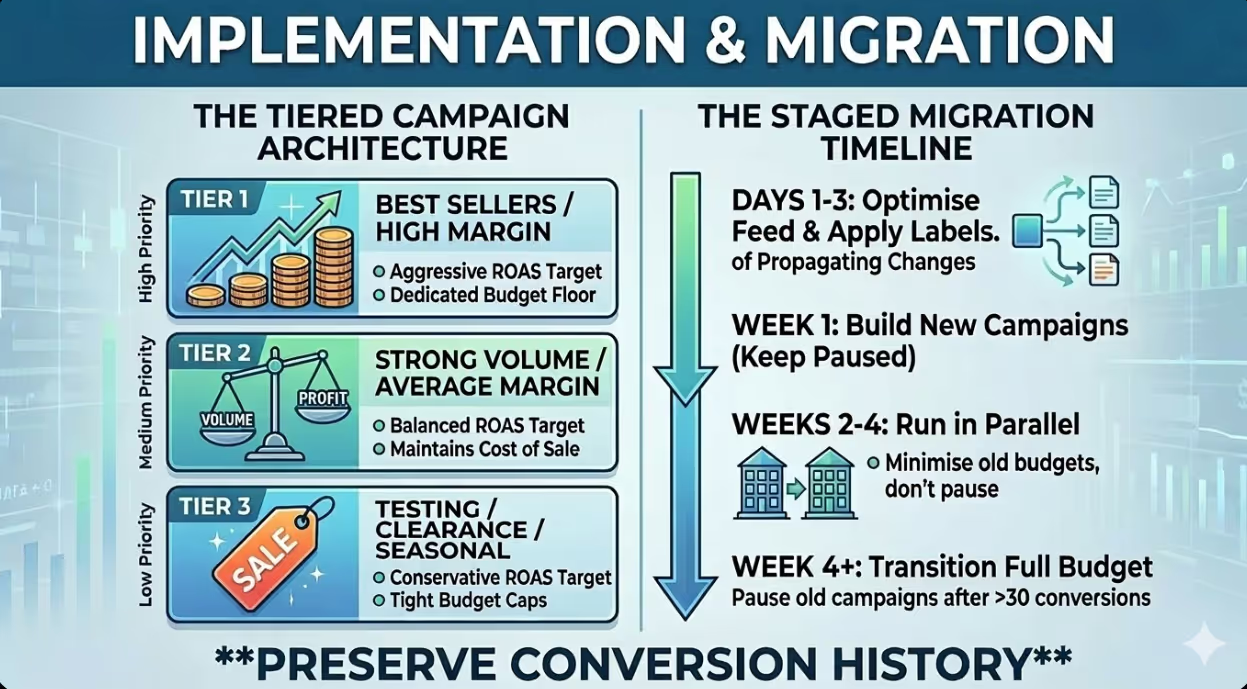
The tiered campaign approach. A restructured Shopping account for an Australian ecommerce business typically uses a tiered campaign structure that separates product sets by their strategic priority and applies independent budgets and ROAS targets to each tier.
Tier 1 contains the products that combine high margin with strong conversion rate: the products that should receive the most budget and the most aggressive ROAS target because their economics justify it. These products are tagged in the feed with the custom label identifying it as high margin and are placed in their own campaign with a budget floor that ensures they are never rationed out of the auction during peak periods.
Tier 2 contains the products that have strong volume or strategic importance but lower margins, requiring a more conservative ROAS target to remain profitable. These products share a campaign with a higher ROAS target (meaning lower maximum bid) that keeps their cost of sale within the acceptable margin.
Tier 3 contains the products being tested, the inventory that is moving slowly being cleared, or the seasonal items that should receive limited budget outside their peak window. These products may be in a separate campaign with a tight budget cap or may be paused outside their relevant season.
Ad group organisation within campaigns. Within each tier, products should be organised into ad groups by product category or product type at the level of granularity that allows meaningful performance monitoring. An ad group containing 5,000 products across unrelated categories cannot be monitored at the product attribute level. An ad group containing 50 to 200 products within a specific category can be assessed for performance patterns that inform bid adjustments and negative keyword additions.
Priority settings. Standard Shopping campaigns allow a priority setting of Low, Medium, or High that determines which campaign serves when multiple campaigns are eligible to show for the same product. Priority settings enable a structure where a branded product query campaign (set to High priority with conservative bids) captures searches for specific product names, while a broader campaign that covers all remaining queries (set to Low priority with higher maximum bids) captures the broader queries that the branded campaign excludes through negative keywords. This structure allows different bidding logic for different query intents without requiring separate product feeds.
Rebuilding the Negative Keyword Framework
Shopping campaign negative keywords should be rebuilt as part of the restructuring rather than preserved from the previous structure, because the existing negatives may be both incomplete (missing irrelevant query patterns identified in the diagnosis) and too broadly applied (blocking legitimate queries that the restructured campaign should be capturing).
The negative keyword framework for a restructured Shopping campaign should include:
An shared negative list applied at the account level covering the universal irrelevant intents identified during the diagnostic: employment queries, academic research queries, queries indicating intent to make rather than buy, and any geographic terms outside the delivery area.
A negative list applied at the campaign level for each tier that excludes the product types and categories within the broader catalogue that belong to a different tier's campaign. This prevents a Tier 1 campaign from serving ads for products that have been deliberately allocated to Tier 2 or Tier 3.
A negative list built from query analysis built from the search terms analysis conducted during the diagnostic, targeting the specific irrelevant query patterns that were generating impressions and spend in the previous structure.
Staging the Migration
A Shopping campaign restructure should be staged to avoid gaps in conversion history that destabilise smart bidding strategies. The recommended migration sequence is:
First, implement the feed improvements and allow them to propagate through Merchant Center, typically a 24 to 72 hour process depending on the size of the catalogue.
Second, build the new campaign structure in the account but do not activate it yet. Configure the new campaigns with the correct bid strategies, negative keyword frameworks, and priority settings.
Third, reduce the budget of the existing campaigns to a minimal maintenance level rather than pausing them entirely. This preserves the conversion history associated with the existing campaigns while directing the majority of new spend toward the restructured campaigns.
Fourth, run both the old and new campaign structures in parallel for two to four weeks, monitoring performance in the new structure as it accumulates conversion data. Once the new campaigns have accumulated sufficient conversion history for the smart bidding strategies to function reliably (typically 30 or more conversions per campaign), the old campaigns can be paused or removed.
This staged approach preserves the operational continuity of the account and prevents the sharp revenue drop that a rebuild from scratch of Shopping campaigns often produces when the smart bidding strategies enter their learning phase without historical data to work from.
FAQs
How long does it take for a restructured Shopping campaign to return to full performance after the migration?
The recovery timeline depends on the size of the conversion history the new campaigns inherit and the volume of conversions they generate during the period when both structures run in parallel. Campaigns that inherit meaningful conversion history from the staged migration approach typically stabilise within two to three weeks of taking the majority of the budget. Campaigns that start with limited conversion history, typically those in product categories with lower conversion volume with fewer than ten conversions per week, may take four to six weeks to produce stable ROAS data as the smart bidding strategies accumulate sufficient signals. During this period, performance metrics will be more variable than at steady state, which is a normal characteristic of the algorithm's learning phase rather than a signal that the restructure has not worked.
Should Australian ecommerce businesses run Performance Max alongside restructured Standard Shopping campaigns?
Performance Max and Standard Shopping can coexist productively in the same account if the structural relationship between them is deliberately managed. The key risk is that Performance Max will absorb spend from the Standard Shopping campaigns by competing for the same queries and products, effectively cannibalising conversions that the Standard campaigns would have generated rather than finding genuinely incremental sales. To manage this, Performance Max should be given a separate product set (using a feed label to exclude the Tier 1 products that Standard Shopping should always serve), a separate budget, and a clear attribution window so its incremental contribution can be assessed independently. Accounts where Performance Max is running on the full product catalogue without these structural controls will typically see Standard Shopping impression share decline as Performance Max absorbs budget, which is not the same as Performance Max generating additional revenue.
What ROAS target is realistic for a restructured Google Shopping campaign in the Australian market in 2026?
Realistic ROAS targets for Shopping campaigns vary so significantly by product category, price point, competitive intensity, and business model that any generic benchmark is more misleading than useful. As a practical reference point, Australian ecommerce businesses with typical margins in the 40 to 60 percent range often target Shopping ROAS of between 400 and 800 percent, which equates to a cost of sale of between 12 and 25 cents per dollar of revenue. Businesses in categories with lower margins such as consumer electronics or commodity products may need to accept ROAS targets of 200 to 400 percent to remain competitive in the auction. The correct target ROAS is the one that produces the maximum profitable revenue at the business's acceptable cost of sale, not the highest number that can be achieved at the expense of sales volume. Setting a ROAS target too high in a competitive category reduces impression share and revenue to the point where the efficient ROAS is achieved on a tiny fraction of the available opportunity, which is rarely the right commercial outcome even when the efficiency metric looks strong.
Structure Is What the Data Learns From
A Shopping campaign restructure does not directly produce better results. It produces a better environment for the algorithm to learn in, a better signal-to-noise ratio in the conversion data, and a clearer commercial logic that connects the budget and bidding decisions to the actual margins and revenue objectives of the business. The results follow from that better environment, with a consistency and durability that incremental setting adjustments to a structurally compromised campaign cannot produce.
Maven Marketing Co conducts Shopping campaign audits and restructuring engagements for Australian ecommerce businesses, from product feed optimisation through to tiered campaign architecture and migration guided by performance data.
Talk to the team at Maven Marketing Co →

Table of contents
read more blogs
Is Google Ads Better Than SEO for My Business
One of the biggest questions business owners ask when they are planning online growth is whether they should invest in Google Ads or SEO. Both are strong marketing plays that help your company show up in Google search results, but they do things in separate lanes. Google Ads gives quicker visibility and can bring in leads fast, whereas SEO more or less focuses on slow, steady organic traffic that tends to grow the longer you keep building it. Picking the right direction depends on what you want to achieve, how much money you can spend, how crowded the market is, and how quickly you need results, like sooner rather than later. The good news is you don’t always have to choose one or the other; it’s not exactly a black-and-white situation. If you take time to understand the strongest points of both, you can put together a more sensible digital marketing plan that supports consistent expansion. In this guide, we’ll compare Google Ads vs SEO, explain the main differences, and help you figure out what option makes the most sense for your business.

When Should I Hire a Digital Marketing Agency
Growing a business today takes more than just having a website or throwing a post on social media; customers usually search around online, compare providers, skim reviews, and basically expect the brand to show up with a solid digital presence before they even think about buying. Many businesses try to run their marketing themselves, but there comes a point when “doing it all in-house” becomes clunky and hard to manage, all at once. Knowing when to hire a digital marketing agency can end up making a big, real difference for your growth. If you’re not getting enough leads, or your online visibility feels stuck, or sales are just not moving, the right agency can bring the know-how, plus a clear plan, to help you get noticeably better outcomes. In this guide, we’ll dig into what a digital marketing agency actually does, the usual signs it’s time to bring one on, and how picking the right marketing partner can help your business move forward at a faster pace.
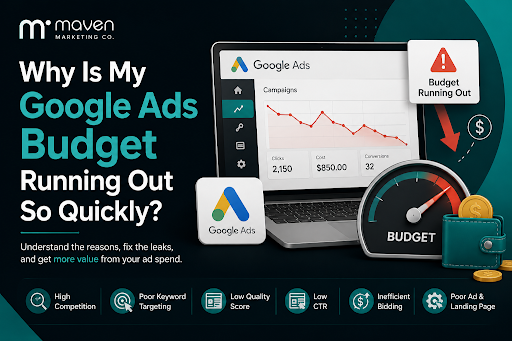
Why Is My Google Ads Budget Running Out So Quickly
Running a successful Google Ads budget isn’t only about throwing more money at it. It’s more like making every dollar, doing a bit extra. A lot of businesses start a Google Ads campaign with big hopes, then find out their daily budget is gone within a few hours, and that feels weird, right? After that, your ads stop showing effectively, new leads slip away, and your return on investment dips. So if your Google Ads budget is running out too fast, don’t stress. It’s a fairly common issue, and in most situations, it can be repaired with the right approach. There are multiple little things that can drain your advertising money quicker than you expected, from costly keywords to audience targeting that just doesn’t quite fit. In this guide, we’ll walk through why your budget disappears so quickly, how to cut wasteful spend, and the most reliable ways to boost your Google Ads ROI, even if your budget stays the same.