.svg)


%201.svg)

Building a solid online presence is basically more than just posting content now and then or sprinkling keywords across your website. Search engines such as Google tend to point users toward businesses that feel trustworthy, useful, and backed up by others online, even if it’s not always obvious at first.
When a company puts together a well-thought-out digital PR strategy, it can bring in solid media mentions, earning high-quality backlinks and stronger brand awareness, all of which feed long-term SEO progress. Rather than obsessing solely over rankings, digital PR helps you build credibility plus authority, so your site looks more appealing to search engines and also to real people who might become customers.
In this guide, we’ll walk through how digital PR supports SEO, what makes it such a key part of modern marketing, and the most effective approaches for sustainable growth in search results.
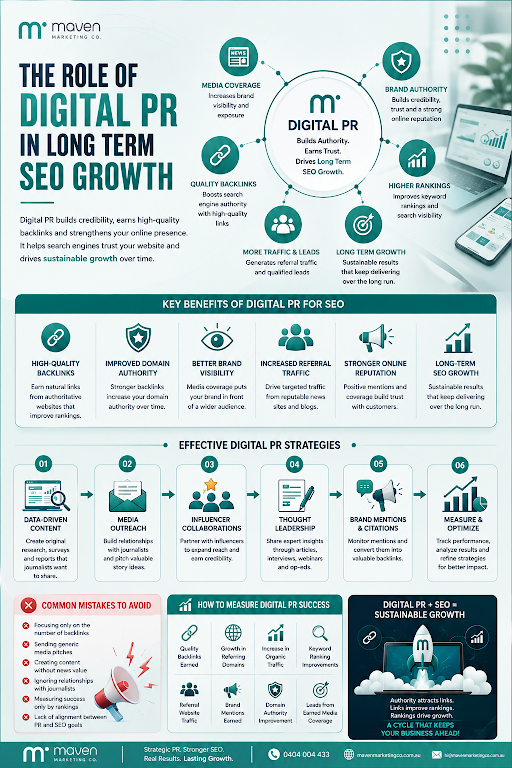
What Is Digital PR?
Digital PR is the process of getting your business in front of people by using online publications, news websites, blogs, influencers, and other digital media platforms, all to lift your online visibility and reputation a bit.
Unlike traditional public relations, which usually leans on newspapers, magazines, television, and radio, digital PR is more focused on building up your online footprint and, at the same time, helping improve SEO performance.
A successful digital PR strategy focuses on:
- Building those ties with journalists and also publishers, in a steady way.
- Getting some media attention first.
- Picking up top-notch backlinks.
- Boosting brand awareness.
- Growing online credibility slowly.
By weaving together online PR and SEO best practices, businesses can bolster their web footprint and get these more lasting, steady results.
How Digital PR Supports SEO Growth
Search engines use a bunch of signals to figure out which websites should rank higher. And one of the strongest ranking factors is the quality of those sites that link back to your content, like literally from other pages.
When well-known websites mention your business or drop a link to what you publish, Google treats that as a trust cue. Those authority backlinks basically tell search engines that your site is delivering useful information and that it’s dependable too.
Digital PR also helps businesses:
- Increase website authority
- Build trust with search engines
- Improve keyword rankings
- Generate referral traffic
- Strengthen overall SEO authority
Unlike those quick short-term marketing moves, digital PR actually builds longer-lasting value, and it keeps helping your SEO crawl, and it stays relevant over time.
Key Benefits of Digital PR for SEO
High-Quality Backlinks
One of the biggest perks of digital PR is getting natural, high-quality backlinks from trusted websites, and it matters more than people think.
Instead of buying links or leaning on outdated SEO tricks, digital PR is more about real link earning through useful content and honest media mentions.
Those backlinks help boost your site’s reputation and, at first, support better search engine rankings.
Improved Domain Authority
When reputable sites keep linking back to your business, your website slowly builds more authority over time.
Higher domain authority often leads to:
- Better keyword rankings
- Increased search visibility
- Improved trust with search engines
- Greater long-term SEO performance
This makes digital PR an important part of any successful off page SEO strategy.
Better Brand Visibility
Showing up in reputable online outlets helps a lot more people stumble upon your business in the first place. Whether someone comes across your brand via a niche blog, a news post somewhere, or an expert interview, each mention adds a bit of visibility and slowly builds credibility, too, even if you’re not directly “selling” that moment. You can also monitor your AI search visibility to understand how your brand appears across AI-powered search platforms. On top of that, solid brand mentions make customers feel safer and more confident before they ever click through to your website.
Increased Referral Traffic
Digital PR not only boosts your SEO but also sends real people to your site.
When folks click links placed on respected news websites, blogs, or other online publications, they typically land already genuinely curious about what you offer.
That referral traffic can turn into qualified leads, and in the same motion, it helps the whole business keep growing.
Stronger Online Reputation
Customers trust businesses they recognize.
Regular media coverage, expert insights, and favorable online mentions make it easier for your company to sit as a credible authority in your industry.
Having a solid reputation doesn’t just boost SEO; it also strengthens customer confidence and influences buying choices.
Digital PR vs Traditional Link Building
Although both try to make SEO better, they work in separate ways.
Traditional SEO link building usually centers on getting backlinks via guest posts, directories , or outreach campaigns.
Digital PR is more of a wider approach; it leans into crafting stories that feel newsworthy, original research, expert viewpoints, and other helpful content that naturally pulls in media interest.
So instead of just asking for links, digital PR builds openings for journalists and publishers to mention your business because the material you provide actually has real worth.
In the end, you tend to get backlinks that look more organic, and they’re often stronger and steadier over time.
Effective Digital PR Strategies for SEO
Data-Driven Content Campaigns
Original research, surveys, industry reports, and those special statistics will often pull in media attention anyway.
Journalists tend to lean on new information, so content grounded in research becomes one of the more effective digital PR maneuvers.
Online Media Outreach
Building relationships with journalists, bloggers, and online publishers helps open up more chances for media coverage in a less formal way. A personalized outreach that brings useful story ideas usually ends up getting quality backlinks and then wider exposure too. It’s like you’re not just sending a message, you’re connecting, even if it feels a bit fiddly at first.
Influencer Collaborations
When you work alongside trusted industry influencers, your reach grows, and your credibility also gets a real boost.
These influencer partnerships can bring in useful content, spark social interaction, and even pull in extra media attention, too.
Thought Leadership Content
Publishing expert articles, interviews, webinars, and even some opinion pieces helps your business feel like an industry leader. And once you know how it is properly recognized, publishers tend to mention your work more often, they’ll reference your content, and link back to your website as well.
Brand Mentions and Citations
Not every mention comes with a backlink, but even those unlinked brand mentions seem to help boost overall online visibility indirectly. When you also monitor what’s being said, you can spot chances to ask for a backlink where it makes sense, and that tends to strengthen your entire link-building push, bit by bit over time.
Common Mistakes in Digital PR for SEO
Many businesses reduce the effectiveness of their campaigns by making avoidable mistakes.
Some common examples include:
- Focusing only on the number of backlinks instead of quality.
- Sending generic media pitches.
- Creating content without news value.
- Ignoring relationships with journalists.
- Measuring success only by rankings.
- Failing to align PR activities with SEO goals.
Successful digital PR requires patience, consistency, and a focus on creating genuinely valuable content.
How to Measure Digital PR Success in SEO
Tracking results helps you understand whether your digital PR efforts are contributing to business growth.
Some important metrics include:
- Number of quality backlinks that got earned,
- Growth in referring domains,
- Increase in organic traffic,
- Keyword ranking improvements,
- Referral website traffic,
- Brand mentions across online publications,
- Domain authority improvements
- Lead generation coming from earned media coverage
Measuring multiple performance indicators provides a more complete picture of campaign success.
Conclusion
Digital PR is now a necessity in order to achieve lasting SEO successes. Once one gets to have stable media mentions, quality backlinks, increased brand awareness, and improved stability of their reputation online, everything starts to generate lasting value rather than just a fleeting spike in their rankings. Rather than chasing fast results only, companies that commit to a real digital PR strategy tend to see their authority rise, and they pull in more relevant traffic too, while still keeping growth that actually lasts.
At Maven Marketing Co, we blend a data-driven SEO approach with digital PR tactics, so companies can build durable online credibility. That can look like press mentions, authority backlinks, and also tuning up your overall SEO strategy. We focus on outcomes you can feel and measure, not those shiny but shallow wins.
Frequently Asked Questions
1. What is digital PR in SEO?
Digital PR is basically the craft of getting online media mentions and backlinks, so you can build digital authority for your website, and also make sure there’s better visibility.
2. How does digital PR help SEO growth?
Digital PR can help with getting solid backlinks, better exposure, and an improved domain authority.
3. Is digital PR better than link building?
Digital PR is often looked at as a more sustainable practice because it focuses on getting organic media mentions and backlinks without doing the link acquisition thing, the usual way in conventional PR practices.
4. How long does digital PR take to impact SEO?
Digital PR results are usually more long-term than short-lived, even though some campaigns do end up getting media coverage almost right away. In any case, the SEO upsides don’t really show up until after a few months, because you’re basically building authority and stacking backlinks over time.
5. What are examples of digital PR strategies?
Commonly, the playbook is like creating unique research and then doing media outreach online, plus teaming up with influencers, and finally publishing thought leadership content.

Table of contents
read more blogs

How to Build a Customer Journey Map for Your Digital Marketing Strategy
A strong digital marketing strategy is not just about channels, creative or traffic. It is about understanding how real people move from first awareness through to enquiry, purchase and ongoing loyalty. That is exactly why customer journey mapping matters.Without a clear view of the journey, businesses often optimise in fragments. They improve the website without thinking about the ad that drove the visit, produce content without considering where the audience is in the decision process, or judge conversion performance without understanding the friction points that sit earlier in the experience.A customer journey map helps you step back and see the bigger picture. It shows the stages people move through, the touchpoints they interact with, the questions they ask, the barriers they face and the moments where your marketing can either help or lose them.This guide explains how to build a practical customer journey map for your digital marketing strategy, what information to include, how to use the map to improve performance and which common mistakes to avoid. The goal is not to create a pretty workshop artefact that gets forgotten. It is to build a working tool that improves messaging, user experience, channel decisions and conversion outcomes.

Why Your Google Ads Campaign Is Not Getting Results: Common Mistakes and Solutions
If your Google Ads campaign is getting impressions or clicks but not producing enough enquiries, sales, or qualified leads, the problem is usually not Google Ads itself. It is more often a strategy, tracking, or conversion issue somewhere in the system.That matters because paid search can look busy without being commercially effective. You can have traffic coming in, a reasonable click-through rate and money leaving the account every day, yet still have very little to show for it if your keywords are weak, your ad copy is misaligned, your landing pages do not convert or your tracking is incomplete.A strong campaign works as one connected chain. Search intent, keyword targeting, ad relevance, bidding, landing-page experience, and conversion tracking all need to support the same commercial outcome. If one link breaks, results usually suffer quickly.This guide explains the most common reasons a Google Ads campaign is not getting results, what those issues normally look like in practice and how to fix them without relying on guesswork. The focus is not on vanity metrics. It is on improving lead quality, conversion rate, and return on spend.

6 Ways Digital Marketing Can Boost B2B Lead Generation
B2B lead generation is not about filling a CRM with as many names as possible. The real objective is to attract businesses that fit your offer, give the right people a reason to engage and create enough confidence for a genuine sales conversation to start.That distinction matters because B2B buying is usually more targeted than consumer marketing and often involves several people influencing the decision. Current LinkedIn lead-generation guidance makes the same point: more leads do not automatically mean better results if only a small proportion are genuinely relevant or likely to progress.Digital marketing helps by creating multiple paths into the business. Search can capture active demand. Paid media can put an offer in front of a tightly defined audience. Content can build authority before a buyer is ready to talk. Social media can keep the brand visible across a long decision cycle. Your website turns interest into action, while email helps nurture that interest over time.The strongest B2B digital marketing strategies do not treat these as six separate activities. They use them as one connected system designed to generate quality B2B leads, support sales and build a more dependable pipeline