.svg)


%201.svg)
.avif)
What are AI visibility tracking tools and why do Australian businesses need them in 2026?
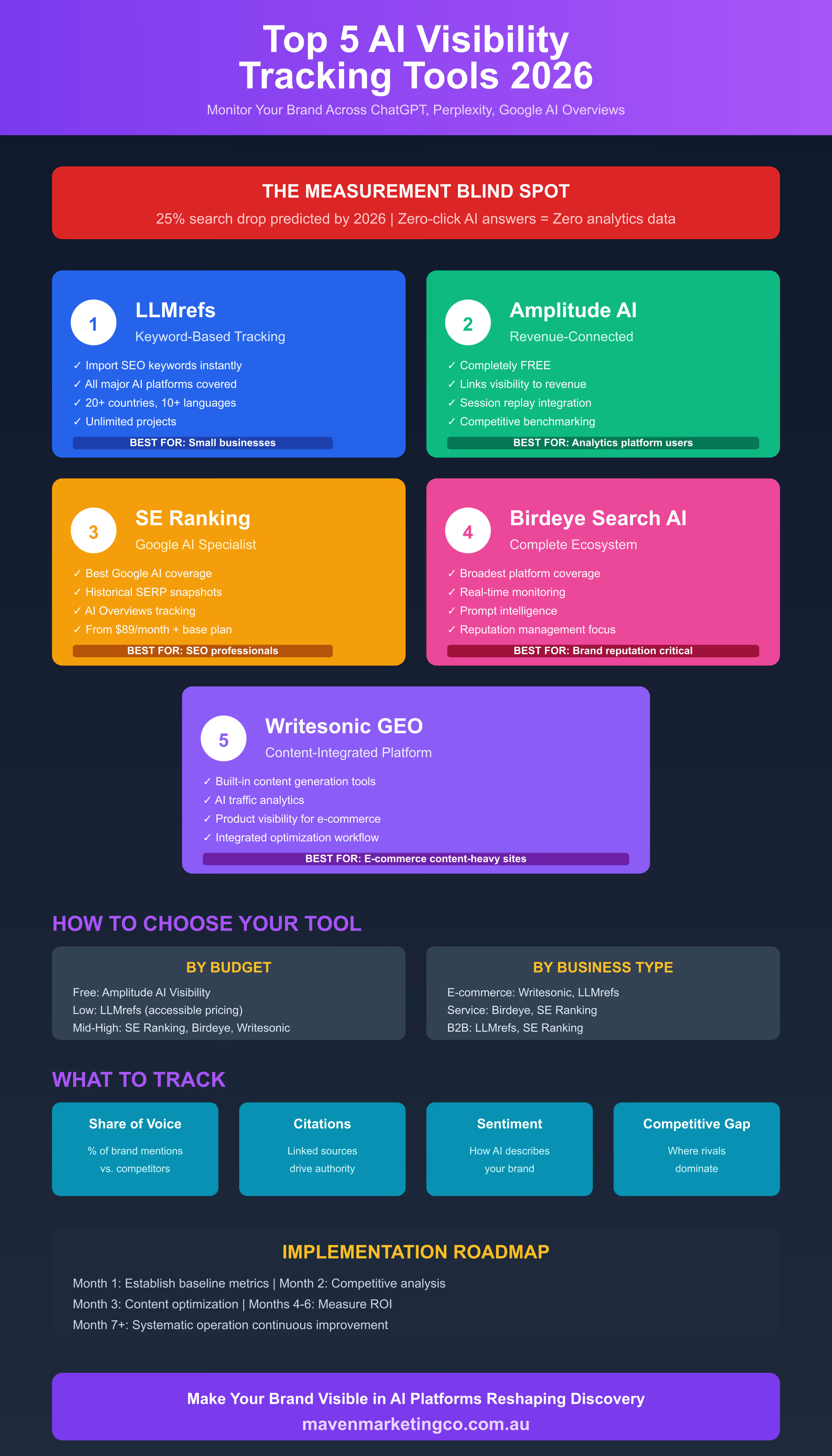
AI visibility tracking tools monitor when and how your brand appears in responses from large language models like ChatGPT, Google AI Overviews, Perplexity, Claude, and Gemini. These platforms track brand mentions, content citations, share of voice versus competitors, sentiment analysis showing how AI describes your brand, and the specific queries triggering your brand's appearance. Australian businesses need these tools because AI search represents zero-click discovery where users never visit websites but still form brand perceptions and make purchase decisions based on AI recommendations. Without tracking, you cannot know if AI platforms recommend your products, cite your expertise, mention competitors instead, or worse, include negative sentiment about your brand. Traditional web analytics cannot capture this AI-driven awareness because no website visit occurs. AI visibility tools tell you when your brand shows up in AI answers, which platforms mention you, and how often your content gets cited, providing the measurement framework essential for optimising your presence in this growing discovery channel that influences purchase decisions before prospects ever reach your website.
Which AI visibility tracking tool is best for small Australian businesses in 2026?
The best AI visibility tracking tool depends on budget, technical capability, and specific needs, but for small Australian businesses, LLMrefs and Amplitude AI Visibility offer the most accessible entry points. LLMrefs starts at affordable pricing with keyword-based tracking across major AI platforms including ChatGPT, Google AI Overviews, Perplexity, Claude, and others, allowing you to import existing SEO keyword lists and immediately see LLM visibility without learning complex prompt engineering. The platform automates the difficult aspects of prompt tracking by generating fan-out prompts based on real user conversations, aggregating responses into simple dashboards showing share of voice, citation frequency, and competitor comparisons. Amplitude AI Visibility stands out as completely free whilst offering sophisticated capabilities including visibility score tracking, competitive benchmarking, connection to revenue metrics through Amplitude's analytics platform, and session replay showing how AI-sourced visitors behave on your site. For businesses already using Amplitude for analytics, AI Visibility integrates seamlessly without additional cost. Both platforms avoid the complexity and expense of enterprise-focused tools whilst providing actionable insights that small teams can implement immediately. Start with Amplitude if you already use their analytics platform, or choose LLMrefs if you need comprehensive multi-platform tracking with minimal setup complexity.
Your competitor just closed a deal with a prospect who explicitly mentioned discovering them through ChatGPT. Your sales team has no idea whether your brand even appears when prospects ask AI tools for recommendations in your category.
You are flying blind in the channel reshaping discovery.
Why AI Visibility Tracking Matters in 2026
The zero-click phenomenon has arrived. People are getting answers directly from AI platforms instead of clicking through to websites. When someone asks ChatGPT "What are the best accounting software options for Australian small businesses?", they receive recommendations, pricing insights, and feature comparisons without visiting a single website.
If your brand appears in that response, you gain awareness and consideration. If competitors appear whilst you remain absent, you lose market share invisibly. Your Google Analytics shows nothing. Your traditional SEO tools remain silent. Yet brand perception and purchase decisions are forming without your awareness.
AI visibility tools solve a measurement problem. They monitor which LLM platforms cite your content and your brand mentions in AI Overviews. They measure changes over time so you can evaluate whether your LLM SEO efforts are actually working.
Without this data, you are guessing about what resonates with AI platforms. With it, you see exactly what content drives citations and what gets ignored. These tools reveal patterns in what content formats, topics, and structures earn the most AI citations.
For Australian businesses, AI visibility tracking provides competitive intelligence unavailable through traditional analytics. You discover which local competitors dominate AI recommendations, which content topics generate citations, how sentiment around your brand compares to competitors, and whether prospects discover you before or after competitors in AI responses.

How AI Visibility Tracking Actually Works
AI visibility tools use systematic polling methodologies adapted from election forecasting. Rather than attempting to track every possible prompt variation, they use representative samples of high-intent queries functioning as population proxies.
The leading method defines 250 to 500 high-intent queries for your brand or category, running them daily or weekly to capture repeated samples from the underlying distribution of LLM responses. Tools record when your brand and competitors appear as citations (linked sources) or mentions (text references), enabling share of voice calculations across platforms.
This variability requires different tracking approaches than traditional SEO. Traditional search behaviour is repetitive, with millions of identical phrases driving stable volume metrics. LLM interactions are conversational and variable. People rephrase questions differently, often within single sessions. That makes pattern recognition harder with small data sets but feasible at scale.
The best current approach layers multiple tracking signals. Share of voice tracking measures how often your brand appears as mentions and citations across consistent high-value queries, providing benchmarks to track over time and compare against competitors. Referral tracking in GA4 uses custom dimensions identifying traffic originating from LLMs. Branded homepage traffic in Google Search Console captures users who discover brands through LLM responses, then search directly in Google to validate or learn more.
Tool #1: LLMrefs - Keyword-Based AI Tracking at Scale
LLMrefs positions itself as the keyword-focused solution for brands, agencies, and SEOs transitioning from traditional search to generative engine optimisation without needing to master complex prompt engineering.
.avif)
What Makes LLMrefs Unique
The platform's core innovation is keyword tracking rather than prompt tracking. You import existing SEO keyword lists and immediately see LLM visibility without manually crafting hundreds of prompts. LLMrefs automatically generates fan-out prompts based on real conversations users have with AI chatbots, aggregating responses, citations, and brand data into simple dashboards.
LLMrefs tracks all major AI models including ChatGPT GPT-5, Google AI Overviews, AI Mode, Gemini, Perplexity, Claude, Grok, Copilot, Meta, and DeepSeek. The platform automatically includes updates for each AI model and search engine as they become available, future-proofing your tracking without manual configuration.
Platform Coverage and Geo-Targeting
Comprehensive geo-targeting across 20 plus countries and 10 plus languages enables Australian businesses to track local market visibility specifically. Filter results by answer engines and country, comparing performance across models and markets to understand where your brand performs strongest.
The platform emphasises data quality over volume, ensuring statistically significant brand ranking outcomes for each tracked keyword. This methodological rigour matters because LLMs are non-deterministic, meaning the same prompt can produce variations. LLMrefs handles this variability through statistical sampling rather than single-query snapshots.
Practical Implementation
Setup takes minutes. Sign up for a free account, create a project with your brand name and domain, add your core SEO keywords, and within five minutes your dashboard shows LLM visibility insights including share of voice, citation frequency, and competitor comparisons.
The content gap identification feature proves particularly valuable, uncovering hidden relationships between entities, topics, and terms whilst mapping content clusters and improving relevance with less guesswork. This guided approach helps Australian businesses without dedicated SEO teams understand exactly what content to create for improved AI visibility.
Pricing and Scalability
LLMrefs offers transparent, scalable pricing without forcing businesses into expensive enterprise tiers. All accounts can set up unlimited projects to monitor multiple brands, ensuring each gets its own visibility tracking. You can upgrade to add more keywords anytime to match usage and growth.
For Australian small businesses, LLMrefs represents the most accessible entry point into comprehensive AI visibility tracking without requiring deep technical knowledge or significant budget investment.
Tool #2: Amplitude AI Visibility - Free and Revenue-Connected
Amplitude AI Visibility stands out through two unique differentiators: comprehensive free access and deep integration with Amplitude's Digital Analytics Platform connecting AI visibility directly to business outcomes.
The Free Advantage
Unlike other AI visibility tools running from moderately to extremely expensive, Amplitude AI Visibility is completely free. This eliminates budget barriers for Australian businesses wanting to start tracking AI presence without financial commitment. The free tier includes visibility score tracking, competitive benchmarking, AI search analytics, and connection to revenue metrics through Amplitude's platform.
Revenue Attribution Integration
The critical differentiator is platform integration. Since AI Visibility lives within Amplitude, it connects with your organisation's data to uniquely link AEO insights with ROI. You tie visibility scores directly to traffic, conversion, and revenue metrics. You measure how AI-sourced visitors behave across your funnels, journeys, and cohorts.
Watch real sessions of users who came from AI search to understand exactly how they engaged with your site or app. Validate which content or experiences improve AI search visibility. This closed-loop attribution separates Amplitude from standalone tools providing visibility data without business context.
Competitive Intelligence
The competitive rankings feature highlights exactly which prompts and keywords lead to competitor mentions in AI search. It provides recommendations about how to close gaps, combining visibility data with actionable optimisation guidance.
Instantly see your AI visibility score, competitor mentions, and topics, then track progress over time to prove your efforts are working. Pinpoint exactly where rivals outperform you in AI answers and close the gap through systematic improvement rather than guesswork.
Implementation Considerations
Amplitude AI Visibility works best for businesses already using Amplitude for digital analytics. The platform integration creates seamless workflows connecting AI visibility to existing measurement frameworks. For businesses not currently using Amplitude, adopting the platform represents more significant commitment than standalone tools.
However, the free pricing combined with sophisticated analytics capabilities makes Amplitude attractive for Australian businesses willing to consolidate analytics platforms. You gain both traditional digital analytics and AI visibility tracking without paying separately for multiple tools.

Tool #3: SE Ranking AI Search Toolkit - Comprehensive Coverage
SE Ranking has established itself as one of the most recognised SEO tools globally, and their AI Search Toolkit extends that comprehensive approach into AI visibility tracking with particular strength in Google's ecosystem.
Multi-Platform Tracking
SE Ranking's AI Search Toolkit analyses answers generated by ChatGPT, ChatGPT Search, and Gemini, with planned expansion to cover more tools in future updates. The platform currently offers the strongest coverage for Google's AI features including AI Overviews, AI Mode, and traditional search, making it ideal for businesses prioritising Google visibility.
The AI Results Tracker monitors brand mentions and links for target keywords, showing whether your brand appears in AI answers triggered by your queries, where it ranks, and how visibility changes over time. The AIO Research Tool analyses domain visibility and Google's AI snippets, tracking citation frequency, collecting average positions, and estimating traffic from AIOs.
Historical Data and Context
SE Ranking excels at providing historical context through cached SERP snapshots showing exactly how your brand appeared in AI answers at different times. This temporal dimension proves invaluable for understanding which optimisation efforts drive improvements versus random variation.
You see not just whether you appear, but also how you appear. Ranking position within AI results helps predict visibility impact. The detailed breakdown of how brands are mentioned, including format, content type, and positioning, provides sophisticated optimisation opportunities beyond basic visibility tracking.
Competitor Benchmarking
Track how often competitors get featured in AI Mode snippets. See AI visibility distribution by business category, topic, and sub-topic. Find out which of your competitors' content is used most often. The "No cited" feature showing where competitors are mentioned whilst your brand is not has been praised as providing content idea gold.
For Australian businesses operating in competitive local markets, this granular competitive intelligence reveals exactly where competitors gain advantages and which content gaps to prioritise filling.
Pricing Structure
SE Ranking's AI Search add-on starts at $89 per month tracking up to 200 prompts, $179 for 450 prompts, and $345 for 1,000 prompts. These plans add to existing SE Ranking subscriptions starting at $52 monthly for the Essential plan. Total costs range from $141 to $552 monthly depending on needs.
For businesses already using SE Ranking for traditional SEO, the AI toolkit integrates seamlessly without platform switching. For those not currently using SE Ranking, evaluate whether the combined traditional SEO and AI tracking justifies platform migration versus using standalone AI tools.
Tool #4: Birdeye Search AI - Complete Ecosystem View
Birdeye Search AI targets brands wanting comprehensive visibility across the AI ecosystem with particular strength in multi-platform monitoring and prompt intelligence.
Broad Platform Coverage
Birdeye tracks how your brand appears across major AI systems including ChatGPT, Google AI Overviews, Perplexity, Gemini, Claude, Copilot, and smaller emerging platforms. Each engine uses different sources, so broad coverage eliminates blind spots and gives brands complete views of online presence.
The platform reveals prompts customers use, themes AI engines associate with your business, and citations influencing how these systems form answers. This prompt intelligence helps Australian businesses understand not just whether they appear, but also what questions and contexts trigger their visibility.
Real-Time Monitoring
Top tools surface real-time or near-instant details about mentions, citations, and keyword activity in AI-generated answers. For rapidly evolving situations like product launches, crisis management, or competitive responses, real-time monitoring enables immediate awareness when AI representation changes.
Implementation and Positioning
Birdeye positions itself for brands needing reliability and completeness. When reputation management across AI platforms matters critically, comprehensive coverage outweighs cost considerations. The platform's strength lies in showing when your brand is mentioned, how it is described, and where it may be overlooked, giving teams reliable views of their presence across the AI ecosystem.
For Australian businesses where brand reputation drives customer acquisition, particularly in service industries, finance, healthcare, and professional services, Birdeye's comprehensive monitoring justifies investment through risk mitigation and opportunity identification.
Tool #5: Writesonic GEO Platform - Content-Integrated Tracking
Writesonic's Generative Engine Optimisation platform uniquely combines AI visibility tracking with content generation and optimisation tools, creating integrated workflows from measurement through creation to improvement.
Content Generation Integration
The platform's defining characteristic is built-in AI SEO and content tools. Track how AI sees your brand, find exactly where you fall short, and create optimised content to take control all in one powerful platform. This integrated approach eliminates friction between analysis and action.
AI Traffic Analytics reveals which content AI systems value. Brand Presence Explorer shows how you rank against competitors. Get AI-specific content and visibility recommendations based on what AI rewards. Generate and optimise content using Writesonic's built-in tools. Track improvements in both AI crawler activity and brand mentions.
Multi-Platform Product Visibility
For e-commerce businesses, Writesonic tracks how products show up in AI-generated shopping results, optimises their placement, and drives more traffic and conversions. Break down visits by platform including ChatGPT, Gemini, Perplexity, and Claude, tracking changes over time.
This shopping-focused capability makes Writesonic particularly valuable for Australian retailers and e-commerce businesses where product discovery through AI platforms directly impacts revenue.
Positioning for Different Users
Writesonic serves three distinct user types with tailored positioning. Agencies and consultants offer cutting-edge services clients did not know they needed, showing exactly how brands appear in AI-generated answers and how to improve them for real business impact. Stand out with data and insights competitors cannot deliver.
In-house marketers control brand narrative in AI platforms like ChatGPT and Gemini, tracking how they are mentioned and ensuring AI platforms reflect positioning and messaging. E-commerce businesses track product visibility and optimise for AI-driven shopping results driving traffic without needing technical expertise.
Choosing the Right Tool for Your Australian Business
Selection depends on budget, existing tools, business model, and technical capability. Evaluate these factors systematically rather than defaulting to the most expensive or feature-rich option.
Budget Considerations
If cost is primary concern, start with Amplitude AI Visibility at zero cost or LLMrefs at accessible pricing. Both provide genuine value without enterprise expenses. Australian small businesses should prioritise these options unless specific needs demand more comprehensive solutions.
Existing Tool Integration
Already using SE Ranking for SEO? The AI Search Toolkit integrates seamlessly justifying additional cost through workflow efficiency. Using Amplitude for analytics? AI Visibility becomes obvious choice connecting visibility to revenue without platform switching.
Business Model Alignment
E-commerce businesses prioritise tools tracking product visibility like Writesonic or those with strong shopping result monitoring. Service businesses focus on brand reputation and sentiment tracking favouring Birdeye or SE Ranking. B2B companies emphasise competitive intelligence and content gap identification making LLMrefs or SE Ranking ideal.
Technical Capability
Teams without deep SEO expertise benefit from LLMrefs' keyword-based approach or Amplitude's guided analytics avoiding complex prompt engineering. Experienced SEO teams leverage SE Ranking's comprehensive features and granular control. Agencies serving multiple clients need scalable platforms like LLMrefs supporting unlimited projects or SE Ranking's white-label reporting.
Platform Priority
Businesses targeting Google-heavy audiences prioritise SE Ranking's unmatched Google AI coverage. Those needing broad multi-platform visibility choose Birdeye or LLMrefs tracking the widest range of AI engines. Companies focused on ChatGPT specifically might find SE Ranking or specialised ChatGPT trackers sufficient.

Implementation Best Practices
Successful AI visibility tracking requires systematic approaches beyond simply signing up for tools and reviewing dashboards occasionally.
Define Your Tracking Framework
Start by identifying the 50 to 100 most important keywords and topics for your business. These should represent high-intent queries prospects actually use when discovering solutions in your category. For Australian businesses, include local variations and Australian English terminology competitors might miss.
Import these core keywords into your chosen tool and establish baseline metrics. Document current share of voice, citation frequency, and competitor positioning. This baseline enables measuring improvement over time versus guessing whether efforts are working.
Establish Monitoring Cadence
Check AI visibility metrics weekly initially to understand natural variation versus significant changes. As patterns emerge, monthly reviews often suffice unless actively running optimisation campaigns requiring closer monitoring.
Set alerts for significant changes including sudden drops in visibility, new competitor appearances, negative sentiment mentions, and keyword opportunities where competitors dominate. Alerts enable reactive responses before small issues become major problems.
Connect to Business Outcomes
Track correlation between AI visibility metrics and business results. Does increased share of voice correlate with branded search volume growth? Do AI citations precede website traffic increases? Does improved sentiment align with conversion rate improvements?
This attribution analysis proves AI visibility impact to leadership whilst identifying which specific visibility improvements drive the most valuable business outcomes. Not all AI mentions matter equally. Focus optimisation where visibility connects to revenue.
Coordinate with Content Strategy
Use content gap identification from AI visibility tools to inform editorial calendars. When tools reveal topics where competitors dominate whilst you lack presence, prioritise creating comprehensive content addressing those gaps.
Monitor which existing content generates most AI citations. Double down on those topics and formats, creating additional content in similar veins. Let AI citation data guide content investment rather than guessing what resonates.
Benchmark Competitors Systematically
Track 3 to 5 key competitors consistently, monitoring their share of voice, citation frequency, and sentiment trends. When competitors experience visibility surges, analyse what changed. Did they publish new content? Earn major backlinks? Implement schema markup? Reverse engineer their tactics and adapt them.
For Australian businesses in local markets, competitive intelligence proves even more valuable given smaller competitor sets and greater ability to identify specific tactics driving advantages.
The Measurement Framework: Beyond Vanity Metrics
AI visibility tracking generates numerous metrics, but not all matter equally for business outcomes. Focus measurement on metrics connecting to strategic objectives.
Share of Voice
Share of voice measures what percentage of total brand mentions in your category belong to your brand versus competitors. A 25% share of voice means your brand appears in one quarter of AI responses mentioning brands in your category.
Track share of voice trends over time and across platforms. Increasing share of voice indicates growing AI prominence. Platform-specific share of voice reveals where you perform strongest and where competitors dominate.
Citation Frequency and Type
Distinguish between citations (linked sources) and mentions (text references without links). Citations drive more value by enabling click-through whilst establishing authority. Mentions build awareness but lack attribution.
Track both absolute citation counts and citation rates as percentages of total queries. A brand cited in 15% of relevant queries performs stronger than one cited in 3%, regardless of absolute numbers.
Sentiment Analysis
Monitor how AI platforms describe your brand. Positive sentiment reinforces brand value. Neutral descriptions provide awareness without advocacy. Negative sentiment actively damages consideration.
Track sentiment trends over time and investigate sudden changes. Negative sentiment spikes often indicate specific issues like product problems, customer service failures, or competitive attacks requiring immediate response.
Competitor Context
All metrics gain meaning through competitive context. A 10% citation rate means little without knowing whether competitors achieve 5% or 25%. Benchmark against the 3 to 5 most relevant competitors in your specific market segment.
Track competitive gaps showing topics where competitors dominate. These gaps represent either weaknesses to address or strategic decisions to accept based on business priorities.
The Australian Advantage in AI Visibility
Australian businesses possess unique advantages implementing AI visibility tracking that international competitors often miss.
Local Market Specificity
Australian market queries, regulations, and consumer behaviours differ meaningfully from US, UK, or Asian markets. Content addressing Australian-specific contexts earns citations that generic international content cannot capture. AI tools seeking locally relevant sources favour Australian businesses for Australian queries.
Track Australian English terminology specifically. "Accountant Brisbane" versus "Brisbane accountant", "holiday" versus "vacation", "thongs" versus "flip-flops". These linguistic nuances matter for local visibility whilst international content misses them entirely.
Lower Competitive Intensity
Australian markets feature less competitive intensity for many keywords compared to global markets. Fewer Australian businesses are aggressively optimising for AI visibility currently, creating first-mover advantages for those implementing systematic tracking now.
This window narrows as awareness grows. Early adopters establishing strong AI presence before competitors invest gain compound advantages through citation history, brand recognition, and content authority that later entrants struggle to overcome.
Cultural Understanding
Australian cultural references, humour, and contexts resonate with local audiences whilst confusing AI trained primarily on international content. Content demonstrating genuine Australian cultural understanding performs better for local queries even when international content might be technically comprehensive.
For service businesses particularly, this cultural alignment builds trust and authority that generic international competitors cannot replicate without significant local investment.
Looking Forward: The Evolution of AI Visibility Tracking
AI visibility tracking remains in early stages with rapid evolution expected throughout 2026 and beyond. Understanding likely developments helps Australian businesses choose tools and strategies with staying power.
Improved Attribution Models
Current attribution from AI platforms to website traffic remains limited. Expect significant improvements in 2026 as platforms implement better referral tracking and tools develop more sophisticated attribution methodologies connecting AI visibility to downstream conversions.
This improved attribution will enable more precise ROI measurement, likely increasing executive buy-in and investment in AI optimisation as business impact becomes clearer.
Expanded Platform Coverage
New AI platforms emerge regularly whilst existing platforms expand capabilities. Tracking tools continuously add coverage for new platforms whilst improving accuracy for established ones. Choose tools with demonstrated commitment to platform expansion rather than those supporting limited fixed sets.
Conversational Analytics
Beyond tracking whether brands appear, sophisticated tools will analyse entire conversation flows showing how users refine queries, what follow-up questions they ask, and where in conversations brands get mentioned. This conversational context reveals intent and journey stages more accurately than isolated query analysis.
Integration with Traditional SEO
The boundary between traditional SEO and AI visibility tracking will blur as tools integrate both capabilities seamlessly. Expect consolidated platforms where keyword research, content optimisation, traditional rankings, and AI visibility all exist within unified workflows rather than requiring separate tools.
Your Implementation Roadmap

Start tracking AI visibility systematically through phased implementation avoiding overwhelming teams or budgets.
Month One: Establish Baseline
Select one tool matching your budget and needs. For most Australian small businesses, start with LLMrefs or Amplitude depending on whether you prioritise keyword tracking or revenue connection.
Import your top 50 keywords and establish baseline visibility metrics. Document current share of voice, citation frequency, competitor positioning, and sentiment. This baseline enables measuring future improvements.
Month Two: Competitive Analysis
Add your top 3 to 5 competitors to tracking. Analyse where they dominate versus where you perform stronger. Identify the biggest competitive gaps representing either opportunities or accepted strategic differences.
Reverse engineer competitor content earning most citations. What topics do they cover? What formats do they use? What authority signals do they demonstrate? Adapt successful tactics whilst maintaining your distinct positioning.
Month Three: Content Optimisation
Based on gap analysis, prioritise creating 5 to 10 pieces of content addressing topics where competitors dominate. Focus on comprehensive coverage demonstrating genuine expertise rather than superficial keyword targeting.
Implement or improve schema markup on existing high-value content. Many AI platforms rely heavily on structured data for understanding content relationships and authority signals.
Months Four to Six: Measurement and Refinement
Track whether optimisation efforts drive visibility improvements. Measure correlation between AI citation increases and business metrics including branded search volume, direct traffic, and revenue.
Refine strategy based on results. Double down on tactics driving measurable visibility improvements. Abandon approaches showing no impact after reasonable testing periods.
Month Seven Plus: Systematic Operation
Establish ongoing processes incorporating AI visibility into regular marketing operations. Review metrics monthly, track competitive changes, optimise high-potential content, and test new platforms as they emerge.
Treat AI visibility as permanent strategic priority rather than temporary project. The businesses winning long-term are those building systematic capabilities rather than running one-time campaigns.
The Reality for Australian Businesses
AI visibility tracking is not optional for businesses wanting to remain competitive as search behaviour shifts. The question is not whether to track, but when to start and which tools to use.
The businesses dominating their markets in 2027 will be those that began systematic AI visibility tracking and optimisation in 2026. They will have established citation history, built AI-recognised authority, and developed content strategies aligned with how AI platforms understand and recommend brands.
The alternative is progressive invisibility as prospects discover competitors through AI platforms whilst your brand remains absent from these crucial conversations. Your products might be superior, your service excellent, and your expertise deep. But if AI platforms cannot find, understand, and cite your brand, none of that matters to the growing percentage of prospects discovering solutions through conversational AI.
The technical barriers are not insurmountable. The tools exist. The methodologies are proven. The only question is whether Australian businesses will implement systematically now or scramble to catch up later after competitors have established advantages.
Ready to make your brand visible in the AI platforms reshaping how Australians discover businesses? The specialists at Maven Marketing Co. implement complete AI visibility strategies for Australian businesses. We do not just recommend tools. We conduct comprehensive keyword and topic audits identifying exactly what prospects search for in AI platforms, implement systematic tracking across ChatGPT, Google AI Overviews, Perplexity, and emerging platforms, develop content strategies addressing competitive gaps revealed through AI visibility data, optimise existing content with schema markup and authority signals AI platforms reward, and create measurement frameworks connecting AI visibility to actual business outcomes proving ROI. Stop guessing whether prospects discover you or competitors when they ask AI for recommendations. Contact us today for an AI visibility audit revealing exactly where your brand appears across the AI ecosystem and creating your roadmap to systematic visibility in the discovery channels replacing traditional search.

Table of contents
read more blogs
Is Google Ads Better Than SEO for My Business
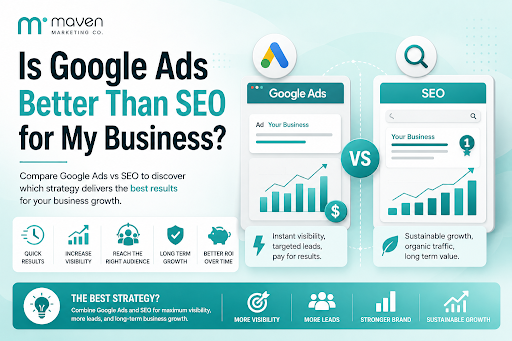
One of the biggest questions business owners ask when they are planning online growth is whether they should invest in Google Ads or SEO. Both are strong marketing plays that help your company show up in Google search results, but they do things in separate lanes. Google Ads gives quicker visibility and can bring in leads fast, whereas SEO more or less focuses on slow, steady organic traffic that tends to grow the longer you keep building it. Picking the right direction depends on what you want to achieve, how much money you can spend, how crowded the market is, and how quickly you need results, like sooner rather than later. The good news is you don’t always have to choose one or the other; it’s not exactly a black-and-white situation. If you take time to understand the strongest points of both, you can put together a more sensible digital marketing plan that supports consistent expansion. In this guide, we’ll compare Google Ads vs SEO, explain the main differences, and help you figure out what option makes the most sense for your business.

When Should I Hire a Digital Marketing Agency
Growing a business today takes more than just having a website or throwing a post on social media; customers usually search around online, compare providers, skim reviews, and basically expect the brand to show up with a solid digital presence before they even think about buying. Many businesses try to run their marketing themselves, but there comes a point when “doing it all in-house” becomes clunky and hard to manage, all at once. Knowing when to hire a digital marketing agency can end up making a big, real difference for your growth. If you’re not getting enough leads, or your online visibility feels stuck, or sales are just not moving, the right agency can bring the know-how, plus a clear plan, to help you get noticeably better outcomes. In this guide, we’ll dig into what a digital marketing agency actually does, the usual signs it’s time to bring one on, and how picking the right marketing partner can help your business move forward at a faster pace.
Why Is My Google Ads Budget Running Out So Quickly
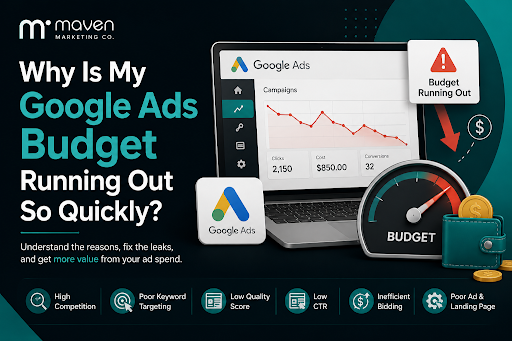
Running a successful Google Ads budget isn’t only about throwing more money at it. It’s more like making every dollar, doing a bit extra. A lot of businesses start a Google Ads campaign with big hopes, then find out their daily budget is gone within a few hours, and that feels weird, right? After that, your ads stop showing effectively, new leads slip away, and your return on investment dips. So if your Google Ads budget is running out too fast, don’t stress. It’s a fairly common issue, and in most situations, it can be repaired with the right approach. There are multiple little things that can drain your advertising money quicker than you expected, from costly keywords to audience targeting that just doesn’t quite fit. In this guide, we’ll walk through why your budget disappears so quickly, how to cut wasteful spend, and the most reliable ways to boost your Google Ads ROI, even if your budget stays the same.