
.svg)


%201.svg)

If your Google Ads campaign is getting impressions or clicks but not producing enough enquiries, sales, or qualified leads, the problem is usually not Google Ads itself. It is more often a strategy, tracking, or conversion issue somewhere in the system.
That matters because paid search can look busy without being commercially effective. You can have traffic coming in, a reasonable click-through rate and money leaving the account every day, yet still have very little to show for it if your keywords are weak, your ad copy is misaligned, your landing pages do not convert or your tracking is incomplete.
A strong campaign works as one connected chain. Search intent, keyword targeting, ad relevance, bidding, landing-page experience, and conversion tracking all need to support the same commercial outcome. If one link breaks, results usually suffer quickly.
This guide explains the most common reasons a Google Ads campaign is not getting results, what those issues normally look like in practice and how to fix them without relying on guesswork. The focus is not on vanity metrics. It is on improving lead quality, conversion rate, and return on spend.
Key takeaways
· Poor Google Ads performance is usually caused by problems in targeting, conversion, tracking or landing-page relevance rather than one isolated metric.
· Search intent and search-term quality matter more than simply adding more keywords or chasing more clicks.
· Ad copy, bids and landing pages need to work together; fixing only one part of the account rarely solves the whole issue.
· Accurate conversion tracking is essential if you want to make sound bidding and optimisation decisions.
· The best way to improve results is to diagnose the real issue, fix one priority area at a time, and test changes against meaningful commercial metrics.
Why Is Your Google Ads Campaign Not Delivering Results?
Most underperforming campaigns suffer from one of two broad problems. Either they are attracting the wrong people, or they are attracting relevant people but failing to turn that interest into an action that matters to the business. Sometimes both happen at once. Google Ads works best when it is connected with a broader lead generation strategy. Combining paid search with content, SEO and conversion optimisation can help businesses attract better-quality prospects and build a stronger sales pipeline.
Google itself frames ad quality around expected click-through rate, ad relevance, and landing-page experience. Those ideas are useful because they force you to look beyond a single metric and assess whether the account is actually matching a real searcher need. A keyword can trigger the ad, but that does not automatically mean it is the right opportunity for the business.
When a campaign is not working, start by asking practical questions. Are the search terms commercially relevant? Does the ad clearly match the query? Is the budget sufficient for the market? Does the landing page continue the promise made in the ad? Are you tracking the outcomes you actually care about? Working through those questions in order usually reveals where the real bottleneck sits.
1. Targeting the Wrong Keywords
Keyword selection is one of the most common reasons campaigns underperform. It is easy to build a list that looks relevant on the surface but attracts research traffic, job seekers, irrelevant locations or queries with weak commercial intent.
A campaign for a service business does not need every broad phrase in the category. It needs the searches that signal a realistic need, a suitable customer and some level of readiness to act. That is why search intent matters more than simple keyword volume.
Look closely at the Search terms report rather than relying only on the keywords you added to the account. In many accounts, the real problem appears there. You may discover that a supposedly relevant keyword is matching to informational or loosely related searches that burn budget without producing qualified leads. Strong SEO services help businesses capture high-intent searches, reduce dependency on paid traffic, and create additional opportunities to reach potential customers.
A practical fix is to tighten match control, remove weak intent patterns, segment themes more cleanly, and build the account around commercial intent clusters. Use the data to decide which searches deserve dedicated ad groups or landing pages and which ones should be excluded.
2. Using Weak or Irrelevant Ad Copy
A keyword can be right and the campaign can still struggle if the ad does not make a compelling or relevant offer. Weak ad copy often sounds generic, fails to reflect the user’s problem or gives no strong reason to click over another advertiser.
Good ad copy is not about squeezing every keyword variation into a headline. It is about matching the searcher’s intent, signalling relevance quickly and making the next step feel worthwhile. The clearer the offer, the easier it is for the right person to recognise that your business may be a fit.
If clicks are low, relevance may be weak. If clicks are acceptable but conversions are poor, the problem may be that the ad is promising something the landing page does not properly deliver. Review your core headlines, descriptions, assets and calls to action together rather than as separate pieces.
In practice, stronger ad copy often comes from clarifying who the offer is for, what specific benefit is available, why the business is credible and what the next step should be. That message then needs to carry through to the page the visitor sees after clicking.
3. Setting the Wrong Bids or Budget
Budget and bidding settings have a major effect on how often your ads appear, which auctions you can compete in and whether the system has enough room to learn. A campaign can be strategically sound but still underperform because its budget is too restricted or its bid strategy does not match the business goal.
If the budget is extremely tight in a competitive market, your ads may rarely enter the most useful auctions. If you use a bidding strategy that chases volume without good conversion data, you can end up with cheaper clicks that do not turn into leads. The issue is not simply spend level. It is whether the spend and bidding approach are aligned to the outcome you want.
Google’s Smart Bidding guidance makes it clear that automated bidding strategies are designed to optimise around conversions or conversion value when the account has the right signals available. That means inaccurate or thin conversion data can lead to weak optimisation decisions. Manual bidding, meanwhile, can become too reactive if changes are made without enough evidence.
The practical fix is to set realistic budgets for the intent and competitiveness of the market, choose a bidding strategy that suits the campaign objective and give the account a sensible testing window before making major changes. Budget limitations, learning periods and impression-share issues should be reviewed together rather than in isolation.
4. Sending Traffic to an Unoptimised Landing Page
Many campaigns fail because the ad click is treated as the finish line. In reality, it is only the beginning of the conversion experience. A conversion-focused website and landing page structure are essential for turning paid traffic into enquiries. Professional web development services help businesses create user-friendly websites designed around performance and conversions. A visitor who arrives on a slow, confusing or generic page has to do extra work before taking action, and many simply will not bother.
Matching Landing Page Content to Your Ads
The landing page should feel like a continuation of the ad, not a change of subject. If the ad talks about a specific service, industry or offer, the page should immediately confirm that message and make the next step obvious.Improving Google Ads results is not only about campaign settings. The landing page experience, messaging, page structure and conversion-focused website also influence whether visitors become leads.
A strong page generally answers a few core questions quickly: what is being offered, who it is for, why it is credible, what happens next and why the visitor should trust the business enough to enquire. Generic homepages often struggle because they force the user to start that process from scratch.
This is also where conversion friction shows up. Weak calls to action, unclear form structure, distracting navigation and limited proof can all reduce performance even when the traffic quality is sound. Message match and page relevance are often the fastest wins in a struggling account.
Improving Page Speed and Mobile Experience
Landing-page performance is not just about copy. Speed and mobile usability affect whether people stay long enough to act. If the page is slow, hard to read or awkward to use on a phone, you lose opportunities before the visitor even evaluates the offer properly.
That is especially important because many service-based and local campaigns receive a meaningful share of mobile traffic. A page that looks acceptable on desktop may still convert poorly if the mobile version buries the form, makes numbers hard to tap or loads too slowly on a normal connection.
The fix is to simplify the path to action. Make the page relevant, fast and easy to scan. Keep the CTA prominent, reduce unnecessary friction and ensure the page supports both the promise in the ad and the decision the user is being asked to make.
5. Using Incorrect Audience or Location Targeting
Campaigns can also lose efficiency when they are shown to the wrong audience or in the wrong places. This issue is common in local service campaigns, B2B accounts and multi-location businesses where geography, exclusions and audience layering need tighter control.
For example, a Brisbane-focused campaign may waste spend if it is eligible to show too broadly across Australia. A B2B service might generate low-quality enquiries if its audience signals are too loose, or if it treats every click as equally valuable regardless of industry, role or business size.
Review whether your settings reflect where you can actually service clients, which audiences are most useful and whether exclusions have been set thoughtfully. Audience signals should sharpen strategy, not distract from core search intent. In many accounts, location settings and audience overlays need simple but important corrections.
6. Failing to Track Conversions Properly
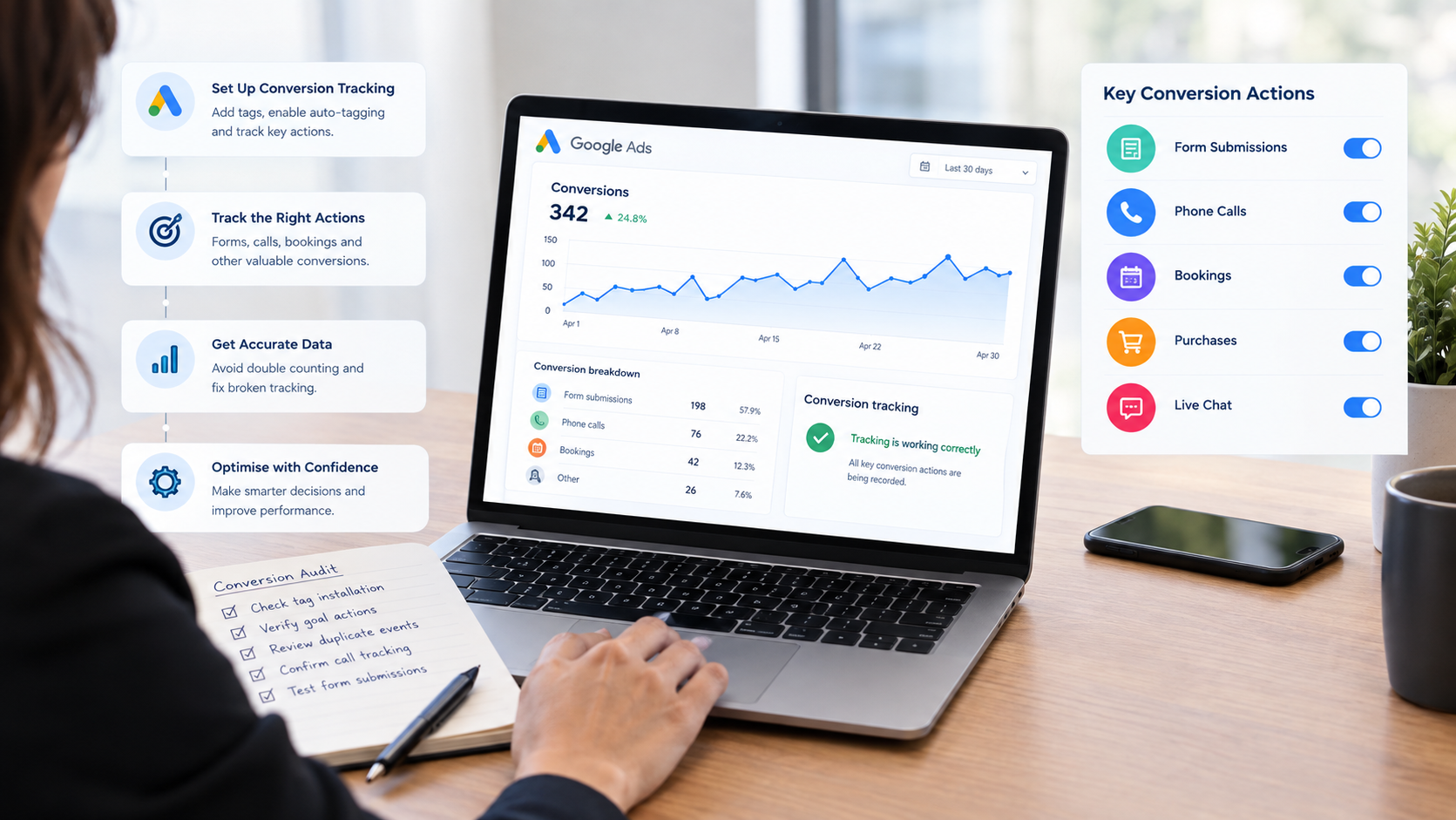
A campaign cannot be managed properly if the account does not measure the actions that matter. This is one of the biggest reasons businesses feel their Google Ads is not working. Often the campaign is producing some value, but nobody can see it clearly enough to optimise with confidence.
Google’s conversion-tracking documentation highlights the importance of proper tagging, auto-tagging and accurate website conversion measurement. If forms, calls, bookings or other meaningful lead actions are not tracked correctly, bidding decisions become weaker and reporting becomes misleading.
This problem commonly appears in a few ways: counting the wrong conversion action as the primary goal, double-counting events, failing to track phone calls, missing form submissions after a site update or using imported data that does not map cleanly to the real sales process.
The practical response is to audit tracking before making major strategic decisions. Confirm what counts as a conversion, whether it reflects a real business objective and whether the data can be trusted. Once the measurement is sound, campaign decisions become much easier and much more commercially useful.
7. Overlooking Negative Keywords
Negative keywords are often one of the simplest ways to improve efficiency, yet they are regularly underused. Without them, the account can continue paying for irrelevant or poor-fit searches that add activity but not value.
Google explains that negative keywords help exclude terms you do not want your ads to show for. In practical terms, they protect budget by reducing low-quality matches and keeping the campaign closer to the intent you actually want to buy.
Common examples include excluding job-related terms, DIY intent, free options, unrelated locations, competitors where appropriate, or sub-services you do not offer. The specific list depends on the business, but the principle is simple: if certain query types consistently waste spend, stop paying for them.
Used properly, negative keywords help sharpen traffic quality, improve reporting clarity and make it easier to evaluate the performance of the searches you do want. They are not a substitute for strategy, but they are one of the most practical cleanup tools in a Search campaign.
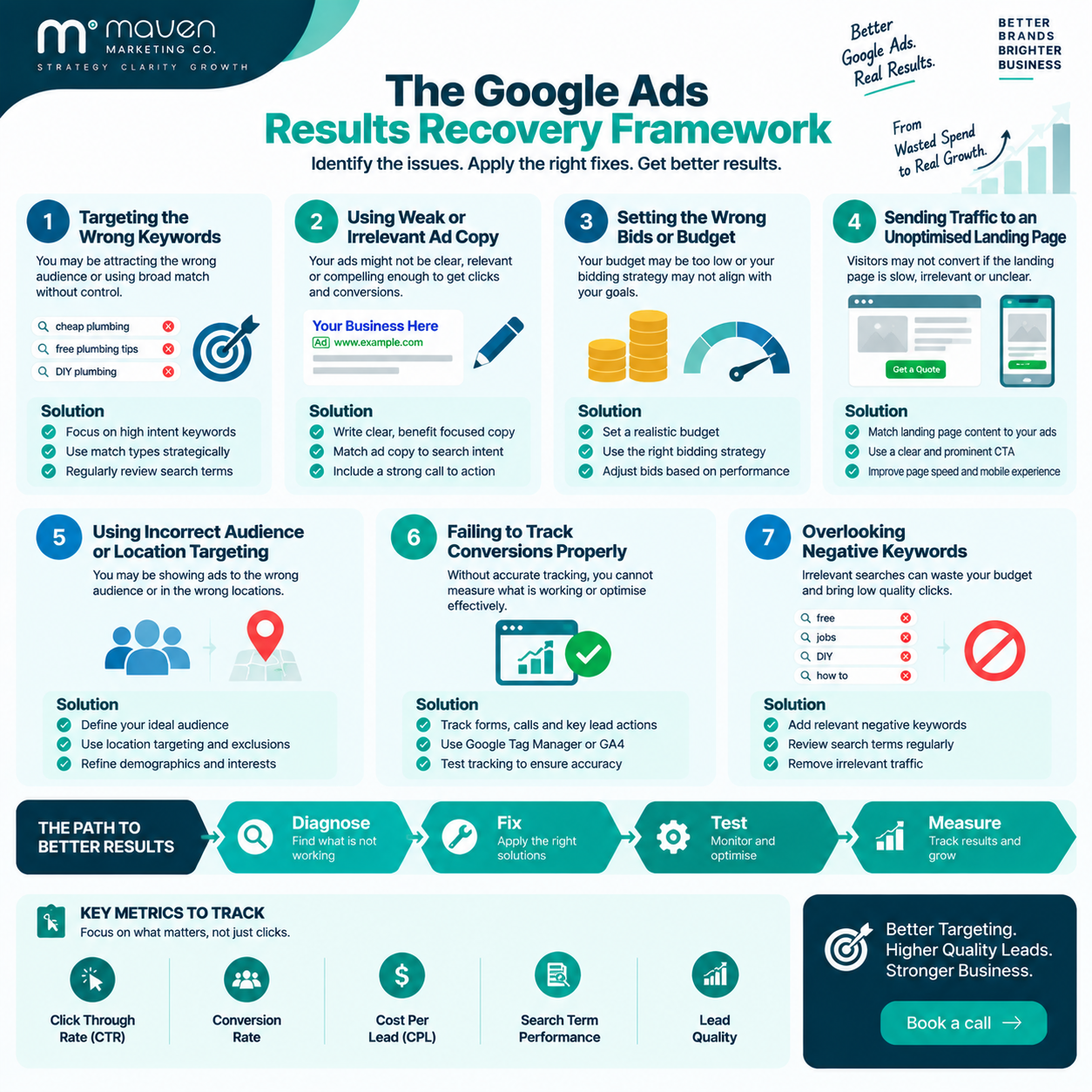
Infographic: The Google Ads Results Recovery Framework
How to Improve Your Google Ads Campaign Results
The best improvements normally come from diagnosis rather than random changes. If a campaign is underperforming, resist the urge to rewrite everything at once. Professional Google Ads management services help businesses audit campaign performance, improve targeting, optimise bidding strategies and focus ad spend on generating qualified leads.Start by identifying where the commercial chain is weakest, fix that priority area, then review the outcome before moving to the next.
A practical optimisation process usually looks like this: review search terms and intent, tighten the account structure, improve ad relevance, check budgets and bid strategy, strengthen landing-page message match, audit tracking and then test changes against meaningful outcomes such as lead quality, cost per lead and conversion rate.
Testing matters because every improvement is partly contextual. What works for one market, offer or sales process may not be the same for another. Instead of chasing a universal formula, build a measurement framework that helps you learn what actually improves performance in your own account.
It also helps to separate diagnostic metrics from commercial metrics. Click-through rate, Quality Score and impression share can point you toward an issue, but they are not the final goal. Better-fit enquiries, stronger conversion rates, cleaner data and improved return from spend are the outcomes that matter most.
FAQs
Why is my Google Ads campaign not getting results?
The most common reasons are poor keyword targeting, weak ad relevance, insufficient or misaligned budgeting, low-performing landing pages, inaccurate conversion tracking and a lack of negative keywords. In many cases, several of those problems exist at the same time.
What are the most common Google Ads mistakes?
Common mistakes include targeting the wrong search intent, using generic ad copy, sending traffic to a broad or weak landing page, failing to track leads properly, letting poor-fit searches consume budget and judging success mainly by clicks rather than business outcomes.
How can I improve my Google Ads campaign performance?
Start with a structured audit. Review search terms, ad relevance, bids and budget, landing-page message match, audience and location settings, conversion tracking and negative keywords. Prioritise the biggest commercial issue first, then test changes with enough time and data to judge the outcome properly.
How long does it take for Google Ads to produce results?
It depends on the market, the competitiveness of the category, the quality of the account setup and how quickly you can generate reliable data. Some campaigns can produce useful leads early, while others need a proper learning and testing period before they become efficient. The important point is to assess progress using real lead quality and conversion data rather than only short-term click activity.
Why are my Google Ads getting clicks but no conversions?
That usually points to one of three issues: the clicks are coming from the wrong intent, the landing page is not persuasive or usable enough, or the conversions are not being tracked correctly. A click on its own is not proof that the traffic was valuable.
Improve Google Ads performance with better diagnosis, not more guesswork
When a Google Ads campaign is not getting results, the answer is rarely to keep adding more spend and hoping performance improves. Stronger results usually come from tightening intent, improving relevance, fixing measurement and making the landing-page experience work harder.
Maven Marketing Co. helps businesses diagnose what is holding their Google Ads back and build a more commercially effective paid search strategy. If you want to review where your campaigns are losing efficiency and where the strongest improvement opportunities sit, book a call with the team.

Table of contents
read more blogs

6 Ways Digital Marketing Can Boost B2B Lead Generation
B2B lead generation is not about filling a CRM with as many names as possible. The real objective is to attract businesses that fit your offer, give the right people a reason to engage and create enough confidence for a genuine sales conversation to start.That distinction matters because B2B buying is usually more targeted than consumer marketing and often involves several people influencing the decision. Current LinkedIn lead-generation guidance makes the same point: more leads do not automatically mean better results if only a small proportion are genuinely relevant or likely to progress.Digital marketing helps by creating multiple paths into the business. Search can capture active demand. Paid media can put an offer in front of a tightly defined audience. Content can build authority before a buyer is ready to talk. Social media can keep the brand visible across a long decision cycle. Your website turns interest into action, while email helps nurture that interest over time.The strongest B2B digital marketing strategies do not treat these as six separate activities. They use them as one connected system designed to generate quality B2B leads, support sales and build a more dependable pipeline

How to Build a Brand Positioning Strategy That Sets Your Business Apart
Most businesses can explain what they sell. Far fewer can explain, in a sentence or two, why the right customer should choose them instead of another credible option. That gap is where brand positioning matters.A strong brand positioning strategy gives your business a clear place in the market and a clear place in the customer's mind. It helps your team decide who you are speaking to, what you want to be known for, which benefits deserve the most attention and how your marketing should sound and look across every channel.It is not a slogan exercise and it is not something reserved for large consumer brands. For an Australian service business, e-commerce brand, professional firm, or growing B2B company, positioning can make everyday decisions easier, from website copy and campaign messaging to pricing, sales conversations, and brand identity. The goal is not to look different for the sake of it. The goal is to be meaningfully different in a way the right customers understand and value.

The Role of Digital PR in Long Term SEO Growth
Building a solid online presence is basically more than just posting content now and then or sprinkling keywords across your website. Search engines such as Google tend to point users toward businesses that feel trustworthy, useful, and backed up by others online, even if it’s not always obvious at first. When a company puts together a well-thought-out digital PR strategy, it can bring in solid media mentions, earning high-quality backlinks and stronger brand awareness, all of which feed long-term SEO progress. Rather than obsessing solely over rankings, digital PR helps you build credibility plus authority, so your site looks more appealing to search engines and also to real people who might become customers. In this guide, we’ll walk through how digital PR supports SEO, what makes it such a key part of modern marketing, and the most effective approaches for sustainable growth in search results.


