
.svg)


%201.svg)

B2B lead generation is not about filling a CRM with as many names as possible. The real objective is to attract businesses that fit your offer, give the right people a reason to engage and create enough confidence for a genuine sales conversation to start.
That distinction matters because B2B buying is usually more targeted than consumer marketing and often involves several people influencing the decision. Current LinkedIn lead-generation guidance makes the same point: more leads do not automatically mean better results if only a small proportion are genuinely relevant or likely to progress.
Digital marketing helps by creating multiple paths into the business. Search can capture active demand. Paid media can put an offer in front of a tightly defined audience. Content can build authority before a buyer is ready to talk. Social media can keep the brand visible across a long decision cycle. Your website turns interest into action, while email helps nurture that interest over time.
The strongest B2B digital marketing strategies do not treat these as six separate activities. They use them as one connected system designed to generate quality B2B leads, support sales and build a more dependable pipeline.
Key takeaways
· Define what a qualified lead looks like before optimising for lead volume.
· Use SEO and paid media to capture existing demand, while content and social build familiarity and trust earlier in the buying journey.
· Treat your website as the conversion layer that connects every acquisition channel.
· Use email to nurture permission-based leads with useful information rather than repetitive sales messages.
· Measure sales acceptance, opportunities and pipeline alongside clicks, traffic and form submissions.
Why Digital Marketing Matters for B2B Lead Generation
B2B buyers rarely move in a straight line from seeing an ad to signing a contract. They search, compare, read, watch, ask colleagues, revisit supplier websites and often involve people from different functions before a decision is made. That means a single-channel approach can leave large gaps in the journey.
LinkedIn's 2025 B2B buyer research describes modern buying journeys as nonlinear and cross-channel, with buyers gathering information across platforms before speaking with sales. The practical lesson is not that every business needs every channel. It is that your marketing should create consistent, credible touchpoints wherever your best prospects do their research.
For a B2B business, digital marketing can play two jobs at once. First, it captures demand from organisations already looking for a solution. Second, it builds demand and confidence among people who have a problem but are not yet ready to enquire. Both matter if you want a lead pipeline that is less dependent on referrals, one-off campaigns or a single salesperson.
The focus should stay on quality. A lead from the right company, with a real problem, realistic fit, and meaningful buying intent is worth far more than a large batch of low-intent form fills. The six strategies below are designed around that principle.
1. Use SEO to Reach High-Intent B2B Buyers
SEO is one of the strongest ways to capture B2B demand because it puts your business in front of people who are already searching for answers, suppliers, services, or solutions. Through professional SEO services, businesses can improve search visibility, attract high-intent prospects and build a stronger pipeline through targeted organic traffic.
Build Around Commercial Search Intent
A useful B2B search strategy normally includes several layers of intent. High-intent service and solution searches should lead to clear commercial pages. Problem-led searches can be answered through useful articles and guides. Comparison, cost, process, and implementation questions can support buyers who are further into their research.
For example, a software company might target searches around the category itself, a specific operational problem, integrations, implementation, pricing considerations and comparisons. A professional-services firm may need strong service pages supported by sector-specific content, FAQs, case studies and expert articles that answer the questions prospects ask before contacting anyone.
Create Useful Content Buyers Can Trust
Google's current guidance on helpful, reliable, people-first content emphasises original information, substantial coverage and demonstrable expertise. Its 2026 guidance for generative search also says established SEO best practices remain relevant and encourages useful, non-commodity content built from genuine experience rather than generic summaries.
That is particularly relevant for B2B. Detailed service pages, practical guides, original examples, subject-matter expertise, and clear evidence can help a business become more useful in traditional search and easier for AI-driven search experiences to understand. The goal is not to manufacture separate 'AI SEO' content. It is to publish material that answers real commercial questions clearly and credibly.
For Maven, this section should internally link to the SEO service page so readers who move from education to commercial investigation have an obvious next step.
2. Use Paid Advertising to Generate Targeted Leads
Paid advertising can generate faster visibility than organic search and gives B2B marketers more control over who sees an offer, when they see it, and what action they are asked to take. With effective PPC services, businesses can reach targeted audiences, manage campaign performance and generate qualified enquiries based on buyer intent.
Match Campaigns to Buyer Intent
Search advertising is strongest when a prospect is actively looking for a solution. Professional social advertising can be useful when you need to reach people by role, industry, company type, or account. Remarketing can support buyers who have already visited the site or engaged with content but are not ready to enquire.
The mistake is optimising every campaign toward the cheapest possible lead. A low cost per form submission can look good in a dashboard while producing poor sales conversations. B2B campaign management should distinguish between enquiry volume and the leads that fit your target market, progress into opportunities, and create pipeline.
Send Paid Traffic to Relevant Landing Pages
The ad and landing page need to feel like one continuous experience. Google Ads' landing-page guidance identifies usefulness, relevance, ease of navigation, and alignment with the expectations created by the ad as factors in landing-page experience.
If an ad promotes one specific service to one specific audience, sending the visitor to a generic homepage forces them to start their research again. A focused landing page should restate the problem or outcome, explain the offer, show relevant proof, and provide a clear next step. That can be a consultation, quote, demo, assessment, or another action that matches the buying stage.
Maven's PPC service page is the natural internal link from this section. Keep detailed Google Ads troubleshooting for the dedicated Google Ads article later in the series.
3. Build Authority With Valuable Content
Content marketing supports B2B lead generation because buyers need information before they need a salesperson. Useful content lets your business demonstrate how it thinks, explain complex issues, and provide evidence that it understands the problems its customers are trying to solve. Building authority is not only about publishing content, but also about creating a consistent brand experience. Effective branding services help businesses communicate their value clearly, strengthen trust and create a recognisable position in competitive markets.
Create Content for Real Buying Questions
Start with the questions that come up in sales calls, proposals, onboarding, and lost opportunities. What does a prospect need to understand before they can confidently choose a provider? What objections slow a decision down? Which risks do internal stakeholders need to justify? Those questions are usually more valuable than publishing broad industry commentary simply because it is easy to produce.
This also matters beyond the obvious decision-maker. LinkedIn's 2025 research on hidden B2B buyers found that internal stakeholders outside the primary user group also consume and use thought leadership when evaluating vendors. For complex B2B purchases, content therefore needs to help the wider buying group understand the commercial case, risk, and credibility of the supplier.
Use Content Across the Buying Journey
Different formats can support different stages. Problem-led articles and practical guides are useful early. Case studies, webinars, detailed comparisons and implementation content can build confidence during consideration. Process pages, proof, FAQs and commercial information help people closer to a decision.
Not every useful resource needs to sit behind a form. If the content is primarily designed to build search visibility or answer an important question, making it easy to access can create more value than forcing a lead capture. Reserve gated assets for resources that genuinely justify the exchange, such as a detailed benchmark, template, assessment or high-value webinar.
The aim is to create content that salespeople are happy to send to prospects because it moves the conversation forward. That is a much stronger test than asking whether the business published enough blog posts this month.
4. Use Social Media to Reach B2B Decision-Makers
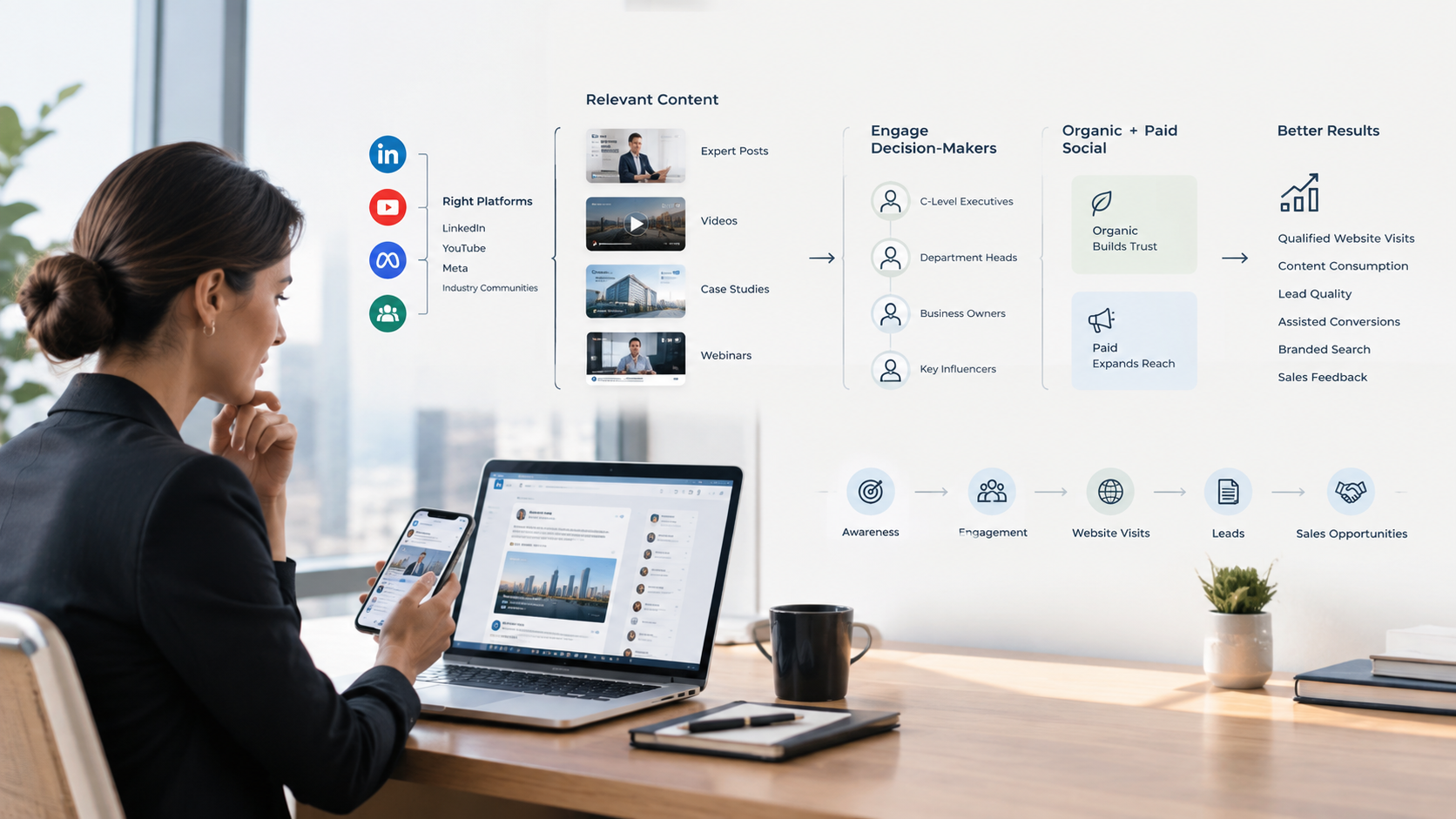
Social media gives B2B brands a way to stay visible between active buying moments. Professional social media marketing services help businesses distribute valuable content, engage decision-makers and build stronger relationships with their target audience. It can distribute useful content, expose expertise, amplify subject-matter experts, and create repeat contact with people who may not be ready to fill in a form today.
Focus on the Platforms Your Buyers Actually Use
For many B2B businesses, LinkedIn will be an obvious part of the mix because of its professional context and targeting options. But it should not be selected automatically. Some technical, trade, property, healthcare, or owner-led audiences may also spend meaningful time on YouTube, Meta, industry communities, or specialist platforms. Channel choice should follow buyer behaviour, not fashion.
The content should also suit the platform. A technical insight may work as a short expert post, a visual explainer, a video or a longer article. Customer proof can become a case-study post. A webinar can be promoted organically, supported with paid media and repurposed into several smaller assets.
Use Organic and Paid Social Together
Organic social builds familiarity and gives people a reason to follow or investigate the brand. Paid social adds reach, audience control, and retargeting. Used together, they can support both awareness and lead capture without expecting every post to generate an enquiry on its own.
Measure social by more than followers and engagement. Look at qualified website visits, content consumption, lead quality, assisted conversions, branded search and sales feedback. For B2B, an influential piece of content may contribute to a future opportunity long after the original post was published.
5. Optimise Your Website for Lead Conversion
SEO, advertising, content and social can all bring the right people to your website. If the site is unclear, slow to understand or difficult to act on, the acquisition work is being wasted. Professional web development services help create conversion-focused websites that support lead generation and improve user experience. Your website is the conversion layer that connects the rest of your B2B digital marketing.
Create Clear Conversion Paths
A strong B2B page should quickly explain who the offer is for, what problem it solves, what is included, why the business is credible, and what the visitor should do next. Service pages, campaign landing pages and high-intent articles should each have an appropriate path forward rather than relying on a generic contact link buried in the navigation.
Calls to action can also reflect intent. Someone researching a complex service may not be ready to 'buy now', but they may be willing to book a consultation, request an assessment, view a case study, or download a useful resource. The right action makes the next step feel proportionate to the commitment the buyer is ready to make.
Qualify Leads Without Creating Unnecessary Friction
Forms should collect enough information to make the enquiry useful without asking the prospect to complete a mini tender before they have spoken to anyone. Google's GA4 lead-generation guidance notes that form placement and the information required can affect how many people start and submit a form, and that form-start and form-submit interactions can be measured.
In practice, ask for information sales will genuinely use at the first step. Business name, contact details, service need, and one or two qualification fields may be enough for many offers. More detailed qualification can happen after the initial conversion, particularly when the service has a longer or more consultative sales process.
Maven's web development service page is the natural internal link here. The later article on turning website traffic into qualified leads should carry the deeper conversion-path discussion so the two pieces support rather than compete with each other.
6. Use Email Marketing to Nurture B2B Leads
Not every good lead is ready to buy when they first engage. Email helps you continue the conversation after someone has requested information, downloaded a resource, attended an event or otherwise given permission to hear from you.
Segment by Need, Role and Buying Stage
Effective lead nurturing is more useful than a sequence of repeated sales prompts. Start with what the person originally engaged with. A prospect who downloaded a guide about improving lead quality should receive different follow-up content from someone who requested a Google Ads assessment or attended a technical webinar.
A simple sequence might deliver the promised resource, follow with a related practical insight, provide proof through a relevant case study, and then offer a sensible next step. Segmenting by industry, role, problem or stage can make the content more relevant without turning the system into an overcomplicated automation project.
Keep Australian Email Marketing Compliant
For Australian campaigns, email marketing also needs to follow the Spam Act and current ACMA spam guidance. ACMA says businesses sending marketing emails or messages must have consent, identify the sender, and provide an easy way to unsubscribe; it also identifies express consent as best practice.
That makes purchased, scraped, or poorly governed lists a poor foundation for sustainable B2B lead generation. Build permission-based audiences, keep records of consent, and make it simple for people to control what they receive. This is not only a compliance issue; it is also better marketing because the list contains people who have a real reason to recognise your brand.
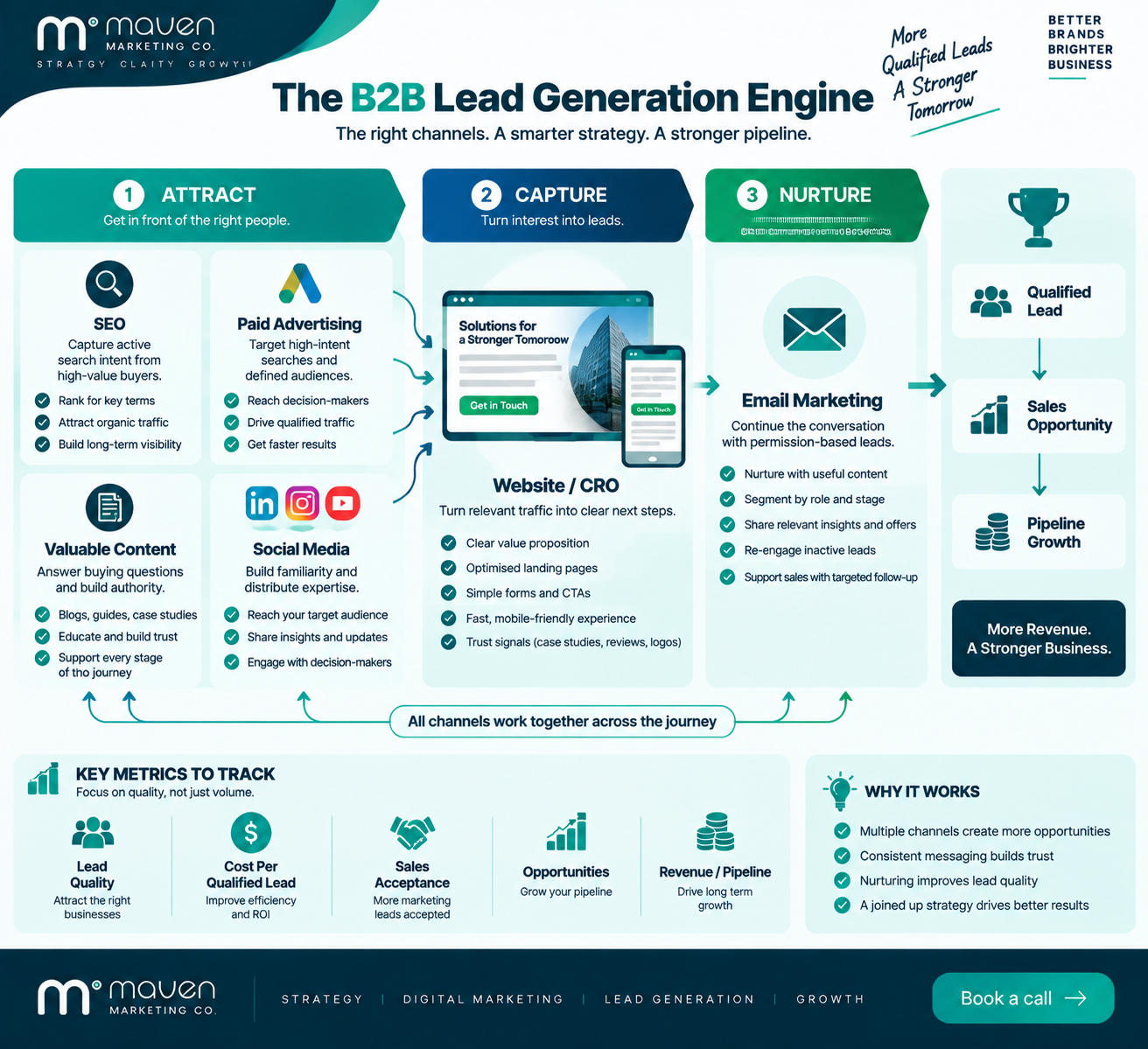
Infographic: The B2B Lead Generation Engine
How to Create a B2B Digital Marketing Strategy
A B2B digital marketing strategy should start with the customer and the commercial outcome, not a checklist of channels. Before deciding how much to spend on SEO, paid media or social, agree on who you are trying to reach, what makes a lead valuable, and what happens after that lead is created.
Define a Qualified Lead Before Choosing Channels
Marketing and sales should share a practical definition of lead quality. That might include company size, industry, location, service need, role, urgency, budget range or another signal that reflects genuine fit. The exact criteria will differ by business, but the definition should be clear enough that both teams can look at the same lead and broadly agree on whether it is worth pursuing.
This prevents a common reporting problem where marketing celebrates lead volume while sales reports that the enquiries are poor. It also changes optimisation decisions. If one channel produces fewer leads but more opportunities, it may be commercially stronger than a channel generating a cheaper but lower-quality form fill.
Give Every Channel a Clear Job
Once the audience and qualification criteria are clear, assign each channel a role. SEO might capture high-intent search demand. Paid search can accelerate that demand capture. Social can build familiarity with decision-makers and distribute expertise. Content can answer objections and support multiple stages. The website converts and qualifies. Email nurtures people who are not ready to speak yet.
The message should remain consistent across those touchpoints, even though the format changes. A prospect who sees one promise in an ad, a different story on the landing page, and a third message in the follow-up email will have more work to do before they trust the business.
Start with the smallest channel mix that can reasonably support the buyer journey, measure it properly, then expand when the data shows where the next opportunity sits. More channels are not automatically a better strategy.
Measuring B2B Lead Generation Results
B2B lead-generation reporting should connect marketing activity to sales outcomes. Traffic, impressions, click-through rate, and cost per lead are useful diagnostic metrics, but they do not tell you whether the leads were worth generating.
Track Lead Quality and Pipeline, Not Just Lead Volume
Build reporting in layers. At the top of the funnel, monitor qualified visibility and traffic. At the conversion stage, track form submissions, calls, demo requests, or other meaningful lead actions. Then move beyond the website to sales acceptance, qualified opportunities, pipeline value, win rate, customer acquisition cost, and revenue where the data is available.
Useful B2B metrics can include cost per qualified lead, lead-to-opportunity rate, sales-accepted lead rate, opportunity value by source, and the percentage of pipeline influenced by marketing. The right set depends on the sales process, but the principle is consistent: judge channels by the commercial quality they create, not by how busy the dashboard looks.
Close the Loop Between Marketing and Sales
Website analytics can show where people came from and which conversion actions they completed. The CRM can show whether those leads progressed. Bringing those views together is what lets marketing learn which keywords, campaigns, content, and channels generate real opportunities.
Create a simple feedback rhythm between marketing and sales. Which leads were genuinely strong? Which enquiries were outside the target market? Which content helped a prospect move forward? Which objections keep appearing? Those answers should flow back into targeting, landing pages, content and nurture campaigns.
That is how digital marketing for B2B becomes a compounding system rather than a collection of disconnected campaigns.
FAQs
What is B2B lead generation?
B2B lead generation is the process of attracting, identifying, and nurturing businesses or decision-makers that may be a fit for your product or service. A lead can come from search, advertising, content, social media, referrals, email, or other channels. The goal is not simply to collect contact details; it is to create a pipeline of prospects with a realistic chance of becoming customers.
How does digital marketing help generate B2B leads?
Digital marketing creates multiple ways for potential buyers to discover, evaluate, and contact a business. SEO and paid search can capture active demand, content and social media can build credibility, the website converts interest into an enquiry, and email can nurture prospects who need more time before speaking with sales.
Which digital marketing strategies work best for B2B businesses?
There is no single channel that works best for every B2B business. The right mix depends on how buyers research, the length and value of the sales cycle, available budget, and how easily the audience can be targeted. A common starting point is strong search visibility, clear commercial pages, paid media where intent or targeting is strong, useful content, and disciplined follow-up.
How can SEO improve B2B lead generation?
SEO helps a B2B business appear when prospects search for services, solutions, and answers related to the problems it solves. High-intent service pages can capture commercial searches, while useful articles and resources can support earlier research. Strong SEO also improves the depth and clarity of information available to buyers before they make contact.
How can I generate higher-quality B2B leads online?
Start by defining your ideal customer and what makes a lead qualified. Align campaigns and content to the problems that audience is actively trying to solve, use landing pages that match the promise of the campaign and collect enough information to assess fit. Most importantly, feed sales outcomes back into marketing so channels are optimised toward opportunities and customers rather than raw lead volume.
Build a B2B lead generation system that sales actually values
Strong B2B lead generation comes from connecting the right audience, message, channels, conversion path and follow-up process. If your marketing is producing traffic but not enough qualified conversations, the answer is usually not 'do more marketing'. It is to find where the system is losing relevance, trust or intent and fix that first.
Maven Marketing Co helps businesses connect SEO, paid media, content, social media and website optimisation into a complete digital marketing strategy designed to generate qualified B2B leads and create sustainable growth.

Table of contents
read more blogs
How to Build a Brand Positioning Strategy That Sets Your Business Apart
Most businesses can explain what they sell. Far fewer can explain, in a sentence or two, why the right customer should choose them instead of another credible option. That gap is where brand positioning matters.A strong brand positioning strategy gives your business a clear place in the market and a clear place in the customer's mind. It helps your team decide who you are speaking to, what you want to be known for, which benefits deserve the most attention and how your marketing should sound and look across every channel.It is not a slogan exercise and it is not something reserved for large consumer brands. For an Australian service business, e-commerce brand, professional firm, or growing B2B company, positioning can make everyday decisions easier, from website copy and campaign messaging to pricing, sales conversations, and brand identity. The goal is not to look different for the sake of it. The goal is to be meaningfully different in a way the right customers understand and value.

The Role of Digital PR in Long Term SEO Growth
Building a solid online presence is basically more than just posting content now and then or sprinkling keywords across your website. Search engines such as Google tend to point users toward businesses that feel trustworthy, useful, and backed up by others online, even if it’s not always obvious at first. When a company puts together a well-thought-out digital PR strategy, it can bring in solid media mentions, earning high-quality backlinks and stronger brand awareness, all of which feed long-term SEO progress. Rather than obsessing solely over rankings, digital PR helps you build credibility plus authority, so your site looks more appealing to search engines and also to real people who might become customers. In this guide, we’ll walk through how digital PR supports SEO, what makes it such a key part of modern marketing, and the most effective approaches for sustainable growth in search results.

Is Google Ads Better Than SEO for My Business
One of the biggest questions business owners ask when they are planning online growth is whether they should invest in Google Ads or SEO. Both are strong marketing plays that help your company show up in Google search results, but they do things in separate lanes. Google Ads gives quicker visibility and can bring in leads fast, whereas SEO more or less focuses on slow, steady organic traffic that tends to grow the longer you keep building it. Picking the right direction depends on what you want to achieve, how much money you can spend, how crowded the market is, and how quickly you need results, like sooner rather than later. The good news is you don’t always have to choose one or the other; it’s not exactly a black-and-white situation. If you take time to understand the strongest points of both, you can put together a more sensible digital marketing plan that supports consistent expansion. In this guide, we’ll compare Google Ads vs SEO, explain the main differences, and help you figure out what option makes the most sense for your business.


