.svg)


%201.svg)

Most businesses can explain what they sell. Far fewer can explain, in a sentence or two, why the right customer should choose them instead of another credible option. That gap is where brand positioning matters.
A strong brand positioning strategy gives your business a clear place in the market and a clear place in the customer's mind. It helps your team decide who you are speaking to, what you want to be known for, which benefits deserve the most attention and how your marketing should sound and look across every channel.
It is not a slogan exercise and it is not something reserved for large consumer brands. For an Australian service business, e-commerce brand, professional firm, or growing B2B company, positioning can make everyday decisions easier, from website copy and campaign messaging to pricing, sales conversations, and brand identity. The goal is not to look different for the sake of it. The goal is to be meaningfully different in a way the right customers understand and value.
Key takeaways
· Positioning defines who you are for, what you want to be known for and why the right customer should prefer you.
· Strong positioning balances relevance, differentiation and credibility rather than chasing uniqueness for its own sake.
· Customer and competitor research should shape the position before visual identity or campaign messaging is developed.
· The position needs to be delivered consistently through messaging, identity, sales, service and customer experience.
· Measure whether customers actually understand the intended position and refine it when evidence or the market changes.
What Is a Brand Positioning Strategy?
Brand positioning is the deliberate process of defining how you want your business to be understood relative to the other choices available to your customer. The American Marketing Association describes brand positioning as defining an organisation's position in the market relative to competitors, while guiding how its value and benefits are communicated to a target audience.
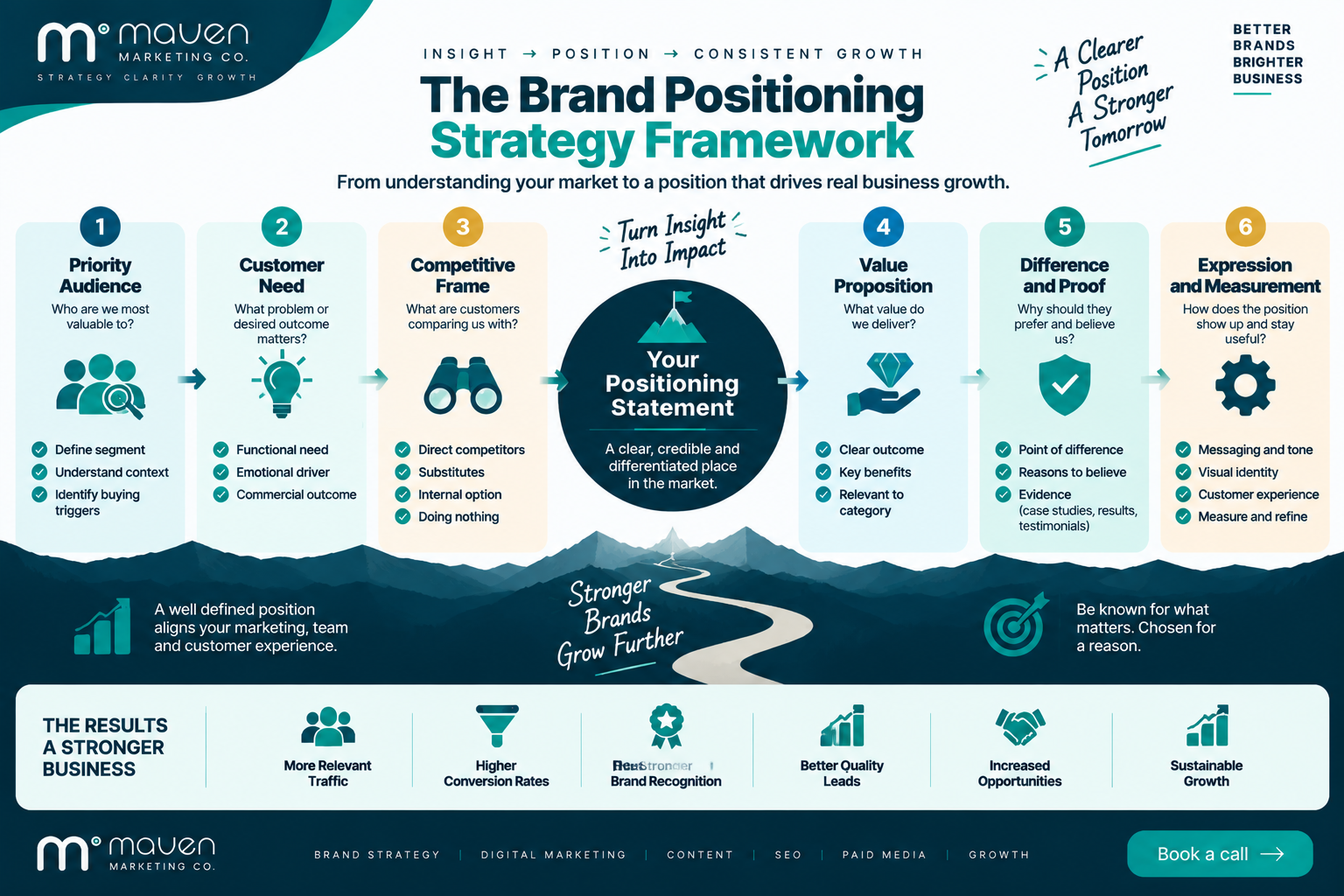
A brand positioning strategy takes that idea and turns it into a practical system. It connects your audience, category, customer problem, value proposition, competitive position, proof and brand expression so that people receive a coherent message rather than a collection of unrelated marketing claims.
That distinction matters because brand strategy services, brand positioning and brand identity are closely connected, but they are not interchangeable. Brand strategy is the broader direction for how the brand will create value and grow. Brand positioning defines the competitive space you want to own. Brand identity is the visual and verbal expression that makes the strategy recognisable - your logo, typography, colour, tone of voice, imagery and messaging system.
A polished brand identity without clear positioning can still leave customers asking, 'Why you?' Strong positioning gives the identity something meaningful to express.
Concept
Role
Brand strategy
The broader direction: where the brand is going, how it creates value and how it supports business growth.
Brand positioning
The competitive space: who the brand is for, what it stands for and why it should be preferred.
Brand identity
The expression: visual and verbal assets that make the strategy and position recognisable.
Why Brand Positioning Matters for Your Business
When positioning is unclear, marketing usually becomes harder than it needs to be. Websites try to say everything. Sales teams describe the same business in different ways. Paid campaigns compete on generic promises. Social content shifts tone from week to week. Price becomes one of the easiest ways for a buyer to compare options because the non-price differences are difficult to see.
Clear positioning also improves paid marketing performance because campaigns can focus on the right audience, messaging, and value proposition. Google Ads services help businesses promote their offers with targeted campaigns designed around customer intent and business goals.
It also helps customers make sense of the business faster. That is important because your real competitive set is rarely limited to businesses that look exactly like yours. A buyer may compare a specialist against a larger full-service provider, an outsourced service against an internal hire, a premium solution against a cheaper workaround, or simply choose to do nothing. Good market positioning acknowledges those alternatives instead of assuming every customer is choosing from the same neat list of competitors.
Harvard Business Review has explored the tension between being central to a category and being distinctive within it. Its brand strategy mapping framework is a useful reminder that customers still need to understand what category you belong to before your differences can become meaningful.
How to Define Your Target Audience
A positioning strategy gets weaker as the audience gets broader. 'Australian businesses' is usually not an audience. It is a market. Effective positioning starts by deciding which people or organisations matter most and what creates relevance for them.
Start with evidence you already have. Look at your best existing customers, profitable projects, repeat buyers, lost opportunities, enquiry quality, customer feedback, reviews, sales notes and search behaviour. Then fill the gaps with direct research. Surveys can help identify patterns at scale, while interviews and sales conversations are better for understanding language, motivations, objections and the context behind a decision.
Target audience research should go further than demographics. SurveyMonkey's current guide to target audience research distinguishes a broad target market from the more specific audience a particular message or campaign needs to reach. For B2B, firmographics such as company size, sector, geography, role and buying committee may matter. For consumer businesses, life stage, needs, behaviours, values, purchase triggers and level of category knowledge may be more useful. In both cases, the important question is the same: what is happening in the customer's world that makes your offer relevant now?
Understanding Customer Needs and Expectations
Customers do not experience your business as a list of features. They experience a problem, a goal, a risk, a deadline or a desired outcome. Strong brand positioning translates what you do into the value that matters in that situation.
For example, a software platform may technically offer automation, integrations and dashboards. The customer may actually care about reducing manual administration, improving visibility across locations and avoiding errors at month end. A construction company may talk about workmanship and project management, while the client may be looking for certainty around communication, budget and deadlines.
This is why customer language matters. Pay attention to the words people use when they first enquire, what they ask before buying, what makes them hesitate and what they praise after the work is complete. Those phrases often reveal stronger positioning territory than a boardroom brainstorm.
Identifying Your Ideal Customer
An ideal customer profile should be specific enough to guide a decision, not so detailed that it becomes a fictional character with a favourite coffee order and no commercial value.
For each priority audience, document the problem or opportunity they are dealing with, the trigger that makes them act, the outcome they want, their biggest objections, the criteria they use to compare options, the proof they trust and the language they naturally use.
If you serve several audiences, you do not necessarily need a different brand position for each one. You do need to identify the common strategic thread, then adapt examples and supporting messages by segment. When two audiences value completely different outcomes, however, trying to force them under one generic message can weaken the position for both.
How to Identify Your Unique Value Proposition
Your unique value proposition is the clearest articulation of the value you provide and why that value is preferable to the alternatives. The word 'unique' can be misleading. You do not need to invent something no other business on earth can claim. You need a proposition that is relevant, distinctive and credible in the competitive set your customer is actually considering.
A useful way to pressure-test a value proposition is to look at three questions: Does the customer genuinely care about it? Can competitors make the same claim just as easily? Can you prove or consistently deliver it? If the answer is weak on any of the three, the positioning needs more work.
This is where many businesses fall back on phrases such as 'quality service', 'tailored solutions', 'experienced team' or 'customer focused'. Those qualities may be important, but they are usually points of parity - the basic expectations required to compete. They only become a differentiator when they are made specific and supported by evidence, process or an operating model that others do not match in the same way.
A simple positioning statement can help turn the thinking into a usable internal guide: For [priority audience], [brand] is the [category or frame of reference] that [primary value or point of difference] because [reason to believe]. NielsenIQ's brand positioning guide similarly identifies the target customer, market category, delivered benefit and customer value as core parts of a positioning statement.
Keep the statement internal at first. Its job is to guide decisions, not to become a clever homepage headline word for word. Once the position is clear, it can be translated into website copy, sales messaging, campaign creative and brand identity in language that feels natural to the audience.
How to Differentiate Your Brand From Competitors
Brand differentiation starts with understanding what customers already expect from the category and where the genuine gaps sit. Competitor research should therefore look at more than logos and taglines. Review how competing businesses describe their offer, who they appear to target, what they lead with, how they price or package their services, what proof they use, which objections they address and what customers say about them in reviews.
Then compare that with your own customer research. The most useful opportunities are often the spaces where customers place high value on something but the market communicates or delivers it poorly.
One helpful concept is the difference between points of parity and points of difference. Points of parity are the things customers expect you to have before they will seriously consider you. Points of difference are the associations or benefits that give them a reason to prefer you. Harvard Business Review's work on competitive brand positioning argues that effective positioning needs attention to both - standing out without forgetting the category expectations that make the offer credible.
Finding Your Competitive Advantage
Competitive advantage can come from many places. It might be specialist expertise in a narrow sector, a better service model, proprietary technology, a more convenient buying process, a strong distribution network, faster access to support, a distinctive product range, a particular methodology, a geographic strength, a business model or a level of proof that competitors struggle to match.
The important part is defensibility. If your advantage disappears the moment a competitor copies a sentence from your website, it is probably a message rather than an advantage.
A competitive positioning map can help make the market easier to see. Choose two attributes that customers genuinely use to make decisions - not two dimensions that simply make your brand look good - and map the main alternatives. Harvard Business Review's centrality-distinctiveness framework is one example of how perception mapping can help businesses assess where brands sit relative to competitors and how that position changes over time.
Use maps as a thinking tool, not a substitute for research. The axes need to be based on real customer perceptions and buying criteria; otherwise the picture can give false confidence.
Communicating What Makes Your Brand Different
Once your differentiation is clear, consistent communication across channels becomes essential. Social media marketing services help businesses share their brand story, strengthen audience relationships, and maintain a recognisable presence across social platforms.
Start with the outcome or value the audience cares about. Explain what is different about your approach. Then support it with evidence: process, specialist experience, results, credentials, customer proof, product features, guarantees where valid, or other tangible reasons a buyer should believe the claim.
The wording should also sound like your brand. A premium advisory business, a challenger e-commerce brand and a family-owned trade business may each occupy a strong position, but their language should feel completely different. Positioning creates strategic consistency; it should not flatten personality.
Building a Consistent Brand Position
Positioning only becomes real when the rest of the business reinforces it. If your position is built around simplicity but the buying process is confusing, the brand promise breaks. If you claim premium expertise but the website, proposals and customer service feel generic, the position becomes harder to believe.
Consistency does not mean repeating the same sentence everywhere. It means the same strategic idea shows up across your website, search campaigns, social content, email, sales presentations, proposals, service delivery and customer experience. The message can flex by channel while the underlying position stays recognisable.
Your visual and verbal brand identity should reinforce the same idea. Typography, imagery, colour, tone of voice and layout all contribute to the cues people use to interpret a brand. Professional graphic design services help transform your positioning strategy into visual assets that communicate your brand personality consistently across digital platforms. Maven's branding services move from discovery and competitor research through strategy and positioning before visual identity, messaging and rollout. That order matters because creative execution is much stronger when it has a clear strategic foundation.
For businesses considering a major visual change, positioning should also be reviewed before deciding whether the right answer is a light brand refresh or a complete rebrand. Maven's guide to brand refresh versus complete rebrand looks at that decision in more detail. Changing the surface without fixing an unclear position often creates a better-looking version of the same strategic problem.
How to Measure and Refine Brand Positioning
Brand positioning is not a set-and-forget document. Markets change, competitors move, customer expectations evolve and your own business may add new products, locations or capabilities. The position should be stable enough to build recognition, but not so rigid that it ignores evidence.
Start by measuring whether people understand the position you intended. Qualitative interviews can reveal the words customers use to describe you. Surveys can test awareness, consideration and key brand associations. Win-loss feedback can show why buyers choose you or another option. Search data, branded search trends, direct traffic, enquiry quality, conversion performance and sales feedback can provide useful supporting signals.
The key is to connect perception with commercial outcomes. A positioning strategy is not working simply because the team likes the language. Look for evidence that the intended audience understands the value, sees the difference as credible and is moving through the buying process in the way you expected.
Review the position when there is a meaningful business trigger: a new market, a change in target customer, a major competitor shift, falling relevance, a merger, a rebrand, a new product category or repeated evidence that customers see the business differently from how you intend. Refinement should be based on research, not boredom with the current tagline.
Common Brand Positioning Mistakes to Avoid
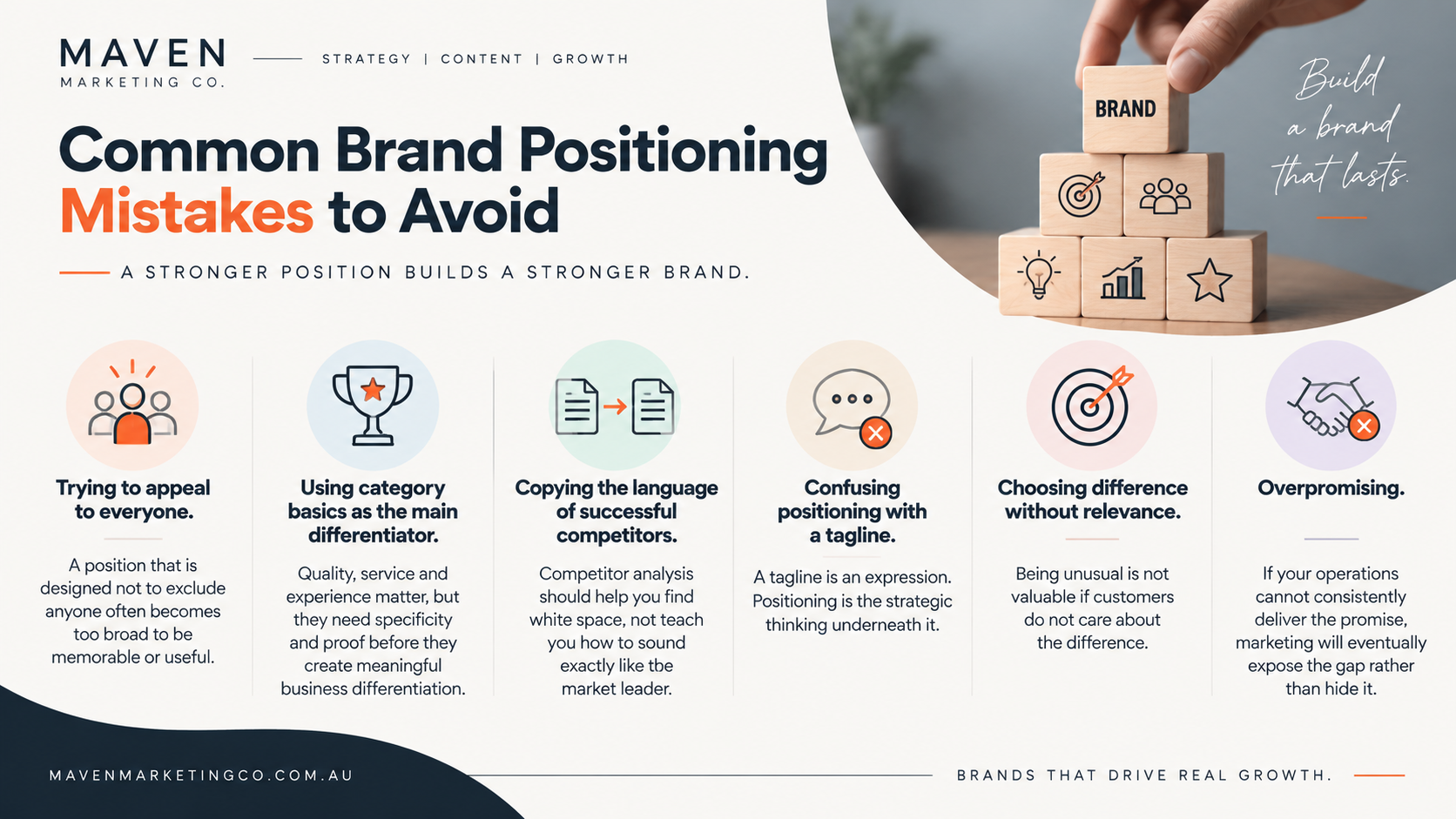
Trying to appeal to everyone. A position that is designed not to exclude anyone often becomes too broad to be memorable or useful.
Using category basics as the main differentiator. Quality, service and experience matter, but they need specificity and proof before they create meaningful business differentiation.
Copying the language of successful competitors. Competitor analysis should help you find white space, not teach you how to sound exactly like the market leader.
Confusing positioning with a tagline. A tagline is an expression. Positioning is the strategic thinking underneath it.
Choosing difference without relevance. Being unusual is not valuable if customers do not care about the difference.
Overpromising. Strong positioning still needs to be true. If your operations cannot consistently deliver the promise, marketing will eventually expose the gap rather than hide it.
FAQs
What is a brand positioning strategy?
A brand positioning strategy defines how you want your business to be understood by a priority audience relative to other available choices. It brings together your target customer, category, value proposition, differentiators, proof and the way those elements are communicated across the business.
Why is brand positioning important for a business?
Brand positioning creates clarity. It helps customers understand why your business is relevant and different, while giving your marketing, sales and creative teams a consistent strategic direction. Without that clarity, businesses often rely on generic claims or price to compete.
How do I create a strong brand position?
Start with customer and competitor research, define the priority audience, identify the customer problem or outcome that matters most, clarify your value proposition, choose a credible point of difference and support it with reasons to believe. Then translate the position consistently across messaging, identity and customer experience.
What is the difference between brand positioning and brand identity?
Brand positioning is the competitive space you want to own in the customer's mind. Brand identity is how that strategy is expressed visually and verbally through elements such as logo, colour, typography, imagery, messaging and tone of voice. Positioning should guide identity, rather than the other way around.
How can a business differentiate itself from competitors?
Look for a difference that is relevant to the customer, credible for your business and difficult for competitors to match in the same way. Differentiation can come from expertise, process, product, service model, technology, convenience, customer experience, distribution, pricing structure or proof - but it needs to matter to the audience.
Build a position your marketing can actually use
If your business is hard to explain, attracting the wrong enquiries or starting to sound like everyone else in the category, the answer may not be more marketing. Maven Marketing Co helps businesses build stronger brand foundations through strategy, positioning, creative direction and digital marketing solutions.

Table of contents
read more blogs

Is Google Ads Better Than SEO for My Business
One of the biggest questions business owners ask when they are planning online growth is whether they should invest in Google Ads or SEO. Both are strong marketing plays that help your company show up in Google search results, but they do things in separate lanes. Google Ads gives quicker visibility and can bring in leads fast, whereas SEO more or less focuses on slow, steady organic traffic that tends to grow the longer you keep building it. Picking the right direction depends on what you want to achieve, how much money you can spend, how crowded the market is, and how quickly you need results, like sooner rather than later. The good news is you don’t always have to choose one or the other; it’s not exactly a black-and-white situation. If you take time to understand the strongest points of both, you can put together a more sensible digital marketing plan that supports consistent expansion. In this guide, we’ll compare Google Ads vs SEO, explain the main differences, and help you figure out what option makes the most sense for your business.

When Should I Hire a Digital Marketing Agency
Growing a business today takes more than just having a website or throwing a post on social media; customers usually search around online, compare providers, skim reviews, and basically expect the brand to show up with a solid digital presence before they even think about buying. Many businesses try to run their marketing themselves, but there comes a point when “doing it all in-house” becomes clunky and hard to manage, all at once. Knowing when to hire a digital marketing agency can end up making a big, real difference for your growth. If you’re not getting enough leads, or your online visibility feels stuck, or sales are just not moving, the right agency can bring the know-how, plus a clear plan, to help you get noticeably better outcomes. In this guide, we’ll dig into what a digital marketing agency actually does, the usual signs it’s time to bring one on, and how picking the right marketing partner can help your business move forward at a faster pace.

Why Is My Google Ads Budget Running Out So Quickly
Running a successful Google Ads budget isn’t only about throwing more money at it. It’s more like making every dollar, doing a bit extra. A lot of businesses start a Google Ads campaign with big hopes, then find out their daily budget is gone within a few hours, and that feels weird, right? After that, your ads stop showing effectively, new leads slip away, and your return on investment dips. So if your Google Ads budget is running out too fast, don’t stress. It’s a fairly common issue, and in most situations, it can be repaired with the right approach. There are multiple little things that can drain your advertising money quicker than you expected, from costly keywords to audience targeting that just doesn’t quite fit. In this guide, we’ll walk through why your budget disappears so quickly, how to cut wasteful spend, and the most reliable ways to boost your Google Ads ROI, even if your budget stays the same.