



A strong digital marketing strategy is not just about channels, creative or traffic. It is about understanding how real people move from first awareness through to enquiry, purchase and ongoing loyalty. That is exactly why customer journey mapping matters.
Without a clear view of the journey, businesses often optimise in fragments. They improve the website without thinking about the ad that drove the visit, produce content without considering where the audience is in the decision process, or judge conversion performance without understanding the friction points that sit earlier in the experience.
A customer journey map helps you step back and see the bigger picture. It shows the stages people move through, the touchpoints they interact with, the questions they ask, the barriers they face and the moments where your marketing can either help or lose them.
This guide explains how to build a practical customer journey map for your digital marketing strategy, what information to include, how to use the map to improve performance and which common mistakes to avoid. The goal is not to create a pretty workshop artefact that gets forgotten. It is to build a working tool that improves messaging, user experience, channel decisions and conversion outcomes.
Key takeaways
· Customer journey mapping helps you understand how people discover, evaluate and choose your business across multiple touchpoints.
· A useful journey map captures stages, customer goals, questions, touchpoints, pain points, content needs and next actions.
· Journey mapping improves more than customer experience. It also helps strengthen SEO, paid media, content strategy, conversion paths and lead quality.
· The best maps are based on evidence from customers, analytics and sales insight rather than internal assumptions alone.
· A journey map should be updated as offers, channels and buyer behaviour change.
What Is a Customer Journey Map?
A customer journey map is a structured view of the steps a customer takes as they move from initial awareness to consideration, decision and post-conversion experience. It is a way of visualising the journey from the customer’s perspective rather than the business’s internal perspective.
In digital marketing, that usually means mapping how people find you, what information they look for, where they hesitate, what helps them trust you and what finally prompts them to act. A good map connects those behaviours to real touchpoints such as search results, ads, landing pages, service pages, email sequences, forms, calls and follow-up communication.
Although people often talk about the buyer journey as if it is linear, real journeys are usually more fluid. People may discover your business through social media, research you later through Google, compare you against competitors, return via remarketing or branded search and only then become ready to enquire. That is one reason journey mapping is so valuable: it helps you plan for how customers actually behave, not how you wish they behaved.
Why Customer Journey Mapping Matters
Customer journey mapping matters because it gives context to marketing performance. Instead of asking only whether a campaign generated traffic or a page converted well, you begin asking where that activity sits within the broader journey and whether it supports the next step the customer is trying to take.
That has practical implications across the whole marketing system. Journey mapping can help reveal whether your awareness content is attracting the right people, whether your consideration-stage content builds enough confidence, whether your landing pages reduce friction or whether your follow-up process is helping leads move forward.
It also supports better cross-channel thinking. Google Analytics includes tools such as Attribution Paths and Path Exploration that help marketers understand how users move through key events and touchpoints over time. Those kinds of insights are far more useful when you already have a journey framework to interpret them through.
For most businesses, the real value is that journey mapping creates alignment. It helps marketing, sales and leadership work from the same view of the customer experience rather than relying on disconnected assumptions.
Understanding the Main Stages of the Customer Journey
Every business will have its own nuances, but most digital customer journeys still move through a few recognisable stages. The exact labels matter less than the logic behind them. What matters is understanding what the customer is trying to achieve at each point and what your marketing needs to do in response.
Awareness and Discovery
At the awareness stage, the customer has recognised a problem, need or opportunity. They may not yet know much about the solutions available or even the language used to describe them. This is where visibility matters most. Search, paid media, social discovery, referrals and first impressions all play a role.
From a marketing point of view, this stage is about being discoverable and useful. Effective SEO services help businesses improve search visibility, reach potential customers during the discovery stage and create consistent organic opportunities throughout the customer journey.
Consideration and Decision
Once people move into consideration, they start comparing options and trying to reduce uncertainty. They look for more detailed information, social proof, service clarity, reviews, case studies and signals that your business understands their problem. The decision stage often sits very close to this, especially in shorter buying cycles.
Here, your marketing needs to do more than attract attention. It needs to build confidence. Service pages, landing pages, strong calls to action, useful FAQs, retargeting, email nurturing and conversion-focused design all become more important.
Some businesses also benefit from explicitly mapping a retention or advocacy stage. That is particularly useful where repeat business, customer value and referrals matter. Post-conversion experience can shape whether the first sale turns into a long-term relationship.
How to Identify Customer Touchpoints
Touchpoints are the moments where customers interact with your brand, content, team or offer. Identifying them properly is a core part of journey mapping because they reveal where influence happens and where friction often appears.
Start by listing the obvious digital touchpoints: organic search listings, Google Ads campaigns, social media posts, display ads, landing pages, blog articles, service pages, forms, email flows, live chat, phone calls and booking pages. Well-managed PPC services help businesses reach customers at high-intent moments and understand which paid touchpoints contribute to conversions. Then add the less obvious ones such as reviews, third-party directories, referral recommendations, proposal follow-up emails or post-enquiry phone conversations.
The point is not just to catalogue channels. It is to understand what role each touchpoint plays. Some touchpoints create awareness, some answer questions, some build trust and some are designed to remove enough friction for the customer to take action.
This is also where analytics can help. Google Analytics path tools can show common sequences and reveal where users drop off or loop. That evidence helps move the map away from theory and closer to observed behaviour.
How to Build a Customer Journey Map
A practical journey map is usually built in stages. Start by choosing a clear customer type or segment. If you try to map every possible audience at once, the output quickly becomes vague. It is usually better to start with one core customer profile or one important service line and build from there.
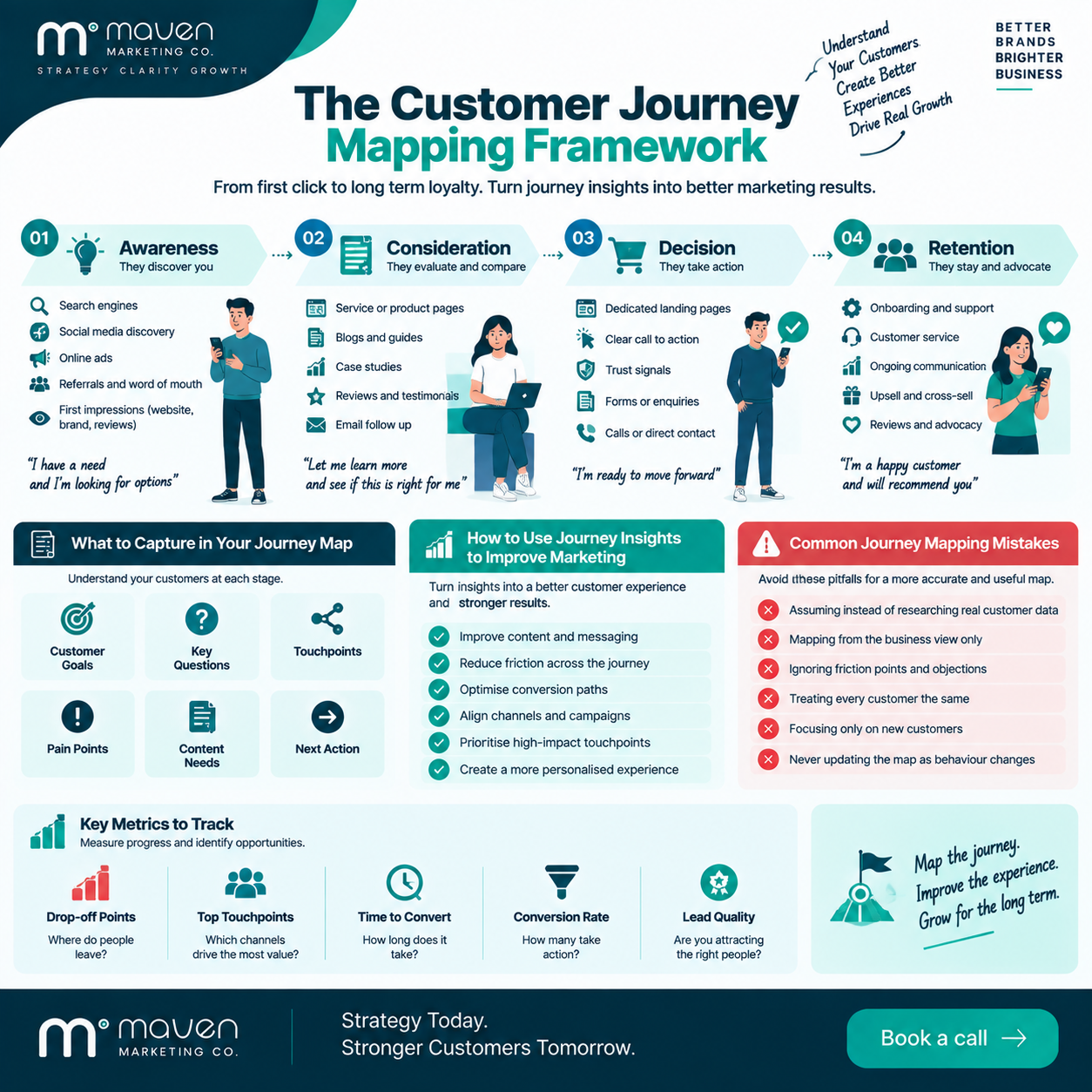
Next, define the main stages of the journey for that audience. For many businesses this will include awareness, consideration, decision and post-conversion experience. Then, under each stage, document what the customer is trying to achieve, what questions they are asking, which touchpoints they use, what barriers they face and what action you want them to take next.
A simple framework works well: customer goals, questions, touchpoints, pain points, content needs and next action. That structure keeps the map useful. It prevents it from becoming too abstract and makes it much easier to convert insight into specific marketing improvements.
Gather your input from multiple sources. Speak with sales and client-facing staff, review CRM notes, look at search data, analyse top entry pages, inspect conversion paths, review enquiry quality and, where possible, talk directly to customers. The strongest maps are built from evidence rather than guesswork.
Using Customer Journey Insights to Improve Marketing
The value of journey mapping becomes clear when you use it to improve decisions. If awareness-stage users are arriving but not progressing, you may need stronger educational content, better targeting or clearer positioning. If consideration-stage users are engaging but not converting, the problem may be message gaps, poor trust signals or weak calls to action.
Improving Content and Messaging
Journey mapping helps content become more intentional. Instead of producing generic assets, you can create content that directly answers the questions customers have at each stage. Awareness content may focus on problem definition and education, while consideration content can compare approaches, explain your process and show proof.
This is also where messaging improves. A good journey map shows what customers care about, what objections they have and what language they naturally use. Strong branding services help businesses turn these insights into consistent messaging, positioning and customer experiences across every channel. That can strengthen on-page copy, ad messaging, email nurture and sales enablement.
Optimising Conversion Paths
Conversion paths become clearer when you understand the journey leading into them. A conversion-focused website should guide users from their first interaction to the final action with clear messaging, strong user experience and simple navigation. Professional web development services help businesses create websites designed around customer behaviour and conversion goals.You can reduce friction by aligning landing pages with campaign intent, simplifying forms, using stronger proof, improving page speed and making next steps more obvious.
Google Analytics attribution and path reporting can support this process by showing which channels assist, initiate or close key events. Used well, that insight helps you understand not only what converted, but how users got there.
This kind of optimisation is often where journey mapping delivers commercial value. Better alignment between channels, pages and user expectations usually leads to stronger conversion rates, higher-quality leads and more efficient use of marketing spend.
Common Customer Journey Mapping Mistakes
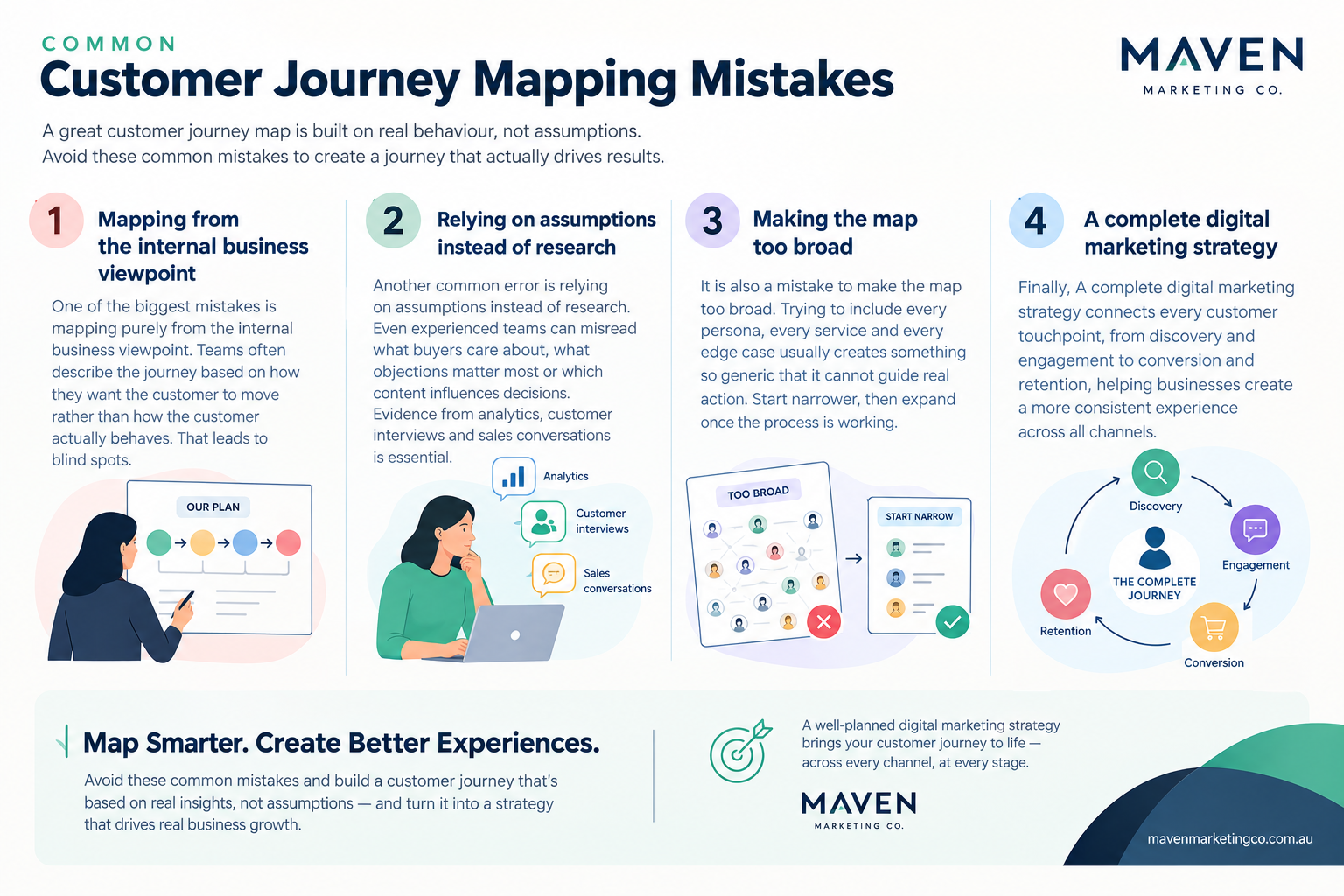
One of the biggest mistakes is mapping purely from the internal business viewpoint. Teams often describe the journey based on how they want the customer to move rather than how the customer actually behaves. That leads to blind spots.
Another common error is relying on assumptions instead of research. Even experienced teams can misread what buyers care about, what objections matter most or which content influences decisions. Evidence from analytics, customer interviews and sales conversations is essential.
It is also a mistake to make the map too broad. Trying to include every personal, every service and every edge case usually creates something so generic that it cannot guide real action. Start narrower, then expand once the process is working.
Finally, A complete digital marketing strategy connects every customer touchpoint, from discovery and engagement to conversion and retention, helping businesses create a more consistent experience across all channels.
Infographic: The Customer Journey Mapping Framework
FAQs
What is customer journey mapping?
Customer journey mapping is the process of documenting how a customer moves through key stages such as awareness, consideration, decision and post-conversion experience. It helps businesses understand touchpoints, questions, pain points and opportunities to improve marketing and customer experience.
Why is a customer journey map important?
A customer journey map is important because it helps you see the experience from the customer’s perspective. That makes it easier to improve messaging, align channels, reduce friction and build stronger conversion paths.
What are the stages of a customer journey?
The exact stages vary by business, but most journey maps include awareness, consideration and decision. Many businesses also include retention or advocacy where ongoing customer value matters.
How do I create a customer journey map?
Start with one audience segment, define the key stages, then document customer goals, questions, touchpoints, pain points, content needs and next actions at each stage. Use customer research, sales insight and analytics to make the map evidence-based.
How can customer journey mapping improve marketing results?
Journey mapping improves results by helping you create more relevant content, better messaging, clearer conversion paths and a more consistent customer experience across channels. That usually leads to better engagement, stronger conversion performance and higher-quality leads.
Build a customer journey map that improves strategy, not just documentation
The best customer journey maps do not sit in a slide deck and gather dust. They become practical planning tools that help your business make smarter decisions across SEO, paid media, content, website UX and conversion strategy.
Maven Marketing Co. helps businesses translate customer insight into practical digital marketing strategy. If you want to understand where customers are dropping off, how your touchpoints are working together and where the strongest opportunities for improvement sit, book a call with the team.

Table of contents
read more blogs

Why Your Google Ads Campaign Is Not Getting Results: Common Mistakes and Solutions
If your Google Ads campaign is getting impressions or clicks but not producing enough enquiries, sales, or qualified leads, the problem is usually not Google Ads itself. It is more often a strategy, tracking, or conversion issue somewhere in the system.That matters because paid search can look busy without being commercially effective. You can have traffic coming in, a reasonable click-through rate and money leaving the account every day, yet still have very little to show for it if your keywords are weak, your ad copy is misaligned, your landing pages do not convert or your tracking is incomplete.A strong campaign works as one connected chain. Search intent, keyword targeting, ad relevance, bidding, landing-page experience, and conversion tracking all need to support the same commercial outcome. If one link breaks, results usually suffer quickly.This guide explains the most common reasons a Google Ads campaign is not getting results, what those issues normally look like in practice and how to fix them without relying on guesswork. The focus is not on vanity metrics. It is on improving lead quality, conversion rate, and return on spend.

6 Ways Digital Marketing Can Boost B2B Lead Generation
B2B lead generation is not about filling a CRM with as many names as possible. The real objective is to attract businesses that fit your offer, give the right people a reason to engage and create enough confidence for a genuine sales conversation to start.That distinction matters because B2B buying is usually more targeted than consumer marketing and often involves several people influencing the decision. Current LinkedIn lead-generation guidance makes the same point: more leads do not automatically mean better results if only a small proportion are genuinely relevant or likely to progress.Digital marketing helps by creating multiple paths into the business. Search can capture active demand. Paid media can put an offer in front of a tightly defined audience. Content can build authority before a buyer is ready to talk. Social media can keep the brand visible across a long decision cycle. Your website turns interest into action, while email helps nurture that interest over time.The strongest B2B digital marketing strategies do not treat these as six separate activities. They use them as one connected system designed to generate quality B2B leads, support sales and build a more dependable pipeline

How to Build a Brand Positioning Strategy That Sets Your Business Apart
Most businesses can explain what they sell. Far fewer can explain, in a sentence or two, why the right customer should choose them instead of another credible option. That gap is where brand positioning matters.A strong brand positioning strategy gives your business a clear place in the market and a clear place in the customer's mind. It helps your team decide who you are speaking to, what you want to be known for, which benefits deserve the most attention and how your marketing should sound and look across every channel.It is not a slogan exercise and it is not something reserved for large consumer brands. For an Australian service business, e-commerce brand, professional firm, or growing B2B company, positioning can make everyday decisions easier, from website copy and campaign messaging to pricing, sales conversations, and brand identity. The goal is not to look different for the sake of it. The goal is to be meaningfully different in a way the right customers understand and value.


