
.svg)


%201.svg)
.avif)
Key Takeaways
- Quality Score directly determines CPC and ad position with scores of 8-10 reducing costs 30-50% below average whilst scores of 1-4 increase costs 50-400%, making relevance optimization more impactful than bidding strategy
- Three core factors determine Quality Score: expected click-through rate (40% weight), ad relevance (30% weight), and landing page experience (30% weight), each optimizable through systematic improvements
- Keyword-ad-landing page alignment creates relevance trinity ensuring search query, ad messaging, and landing page content demonstrate cohesive experience Google rewards with higher Quality Scores
- CTR improvement compounds Quality Score gains through historical performance influencing expected CTR calculations, making early optimization efforts more valuable than delayed improvements
- Account structure refinement through tightly themed ad groups (5-15 keywords per group) enables precise ad-keyword matching impossible in bloated groups containing 50+ disparate keywords
Your Google Ads campaign targets "accounting software Brisbane" with maximum CPC bid of $12. Your ad appears in position 3.4 on average, costing $9.80 per click. Your competitor bids only $8 maximum CPC yet appears in position 1.2, paying just $4.20 per click.
This isn't bidding wizardry or budget advantages—it's Quality Score differential. Your competitor's Quality Score of 9/10 reduces their actual CPC by 57% below market rate whilst improving position, making their $8 bid more competitive than your $12 bid hampered by Quality Score of 4/10 inflating costs.
The mathematics prove brutal: Quality Score determines ad rank (the metric actually determining position) through formula: Max CPC Bid × Quality Score = Ad Rank. Your campaign: $12 × 4 = 48 ad rank. Competitor: $8 × 9 = 72 ad rank. They dominate position whilst spending less through superior relevance.
Sydney e-commerce retailer The Iconic implemented systematic Quality Score optimization across their 2,400 active keywords, improving average score from 5.2 to 8.7 over six months. Average CPC declined from $6.40 to $2.80 (56% reduction) whilst average position improved from 2.8 to 1.4. These efficiency gains delivered $47,000 monthly savings redirected toward scaling volume, generating 340% more clicks within unchanged budget.
Google's Quality Score documentation confirms that Quality Score improvements reduce CPCs substantially, with the highest scores (8-10) earning discounts of 16-50% below average whilst poor scores (1-4) create cost penalties of 25-400% above average—meaning relevance optimization often delivers greater cost reduction than bidding strategy changes.
.avif)
Understanding Quality Score: The Relevance Metric Determining Costs
Quality Score represents Google's 1-10 assessment of how relevant and useful your ads and landing pages are to users searching your keywords, directly impacting both costs and ad position eligibility.
How Quality Score impacts advertising costs:
Quality Score functions as cost multiplier or divider in auction dynamics. Score of 10 enables approximately 50% CPC discount versus average relevance. Score of 8-9 provides 16-28% discount. Score of 6-7 performs near market average (±10%). Score of 4-5 creates 25-44% cost premium. Score of 1-3 inflates costs 100-400% above average—making advertising economically unviable.
Brisbane legal firm discovered this impact dramatically through Quality Score audit revealing their "employment law" campaign averaged 3.2 score paying $18.40 CPC for position 3.2, whilst "estate planning" campaign with 8.6 score paid $5.20 CPC for position 1.4. Identical bidding strategy, vastly different economics purely from relevance differential.
Ad Rank calculation determines actual ad position and cost:
Ad Rank = Max CPC Bid × Quality Score × Ad Extensions Impact. Advertisers rank by Ad Rank not bid amount. Actual CPC = (Ad Rank of advertiser below you ÷ Your Quality Score) + $0.01. This formula explains how lower bids with higher Quality Scores outperform higher bids with poor scores—relevance amplifies bidding power whilst irrelevance undermines it.
Quality Score components comprise three factors weighted unequally:
Expected click-through rate (40% weight) predicts likelihood users will click your ad based on keyword's historical CTR performance. Google compares your keyword's CTR to keywords in similar positions and contexts. Higher-than-expected CTR improves score, lower-than-expected CTR damages it. Melbourne retailer's analysis revealed expected CTR contributed most to their Quality Score problems, with 67% of keywords showing "below average" expected CTR dragging overall scores down.
Ad relevance (30% weight) measures how closely ad copy matches search intent implied by keyword. Keyword appearing in headline signals relevance. Ad text addressing user's likely question or need demonstrates relevance. Generic ads failing to incorporate keyword or address specific intent score poorly. Sydney software company improved ad relevance scores 73% through creating keyword-specific ad variations incorporating target keywords in headlines rather than using single generic ad across disparate keyword themes.
Landing page experience (30% weight) evaluates how relevant, useful, and navigable your landing page is for users clicking from that keyword. Keyword relevance to page content. Page load speed particularly on mobile. Mobile-friendliness and usability. Content uniqueness and substantiality. Navigation clarity enabling users to accomplish goals. Transparent business information building trust.
Where to find Quality Score:
In Google Ads, add Quality Score columns to keyword table: Columns → Modify Columns → Quality Score → Select "Quality Score," "Exp. CTR," "Ad Relevance," and "Landing Page Exp." These columns show historical Quality Score (not real-time) and component ratings (Above Average, Average, Below Average) identifying specific improvement opportunities.
.avif)
Keyword-Ad-Landing Page Alignment: The Relevance Trinity
Quality Score optimization begins with ensuring tight alignment between what users search (keyword), what ads promise (ad copy), and what landing pages deliver (content and experience).
Keyword research refinement establishes foundation for relevance:
Focus on specific rather than generic keywords. "Accounting software for small business Brisbane" enables more relevant ads and landing pages than broad "software." Group keywords by tight thematic similarity. "CRM software," "project management software," and "accounting software" belong in separate ad groups despite all being software, as each requires distinct messaging and landing pages. Remove irrelevant keyword variations bloating ad groups. Adelaide professional services firm consolidated 840 keywords into 160 focused keywords through eliminating poor-performing variants and low-relevance terms, improving average Quality Score from 4.8 to 7.2 through tighter thematic focus.
Ad group structure optimization enables precise ad-keyword matching:
Single Keyword Ad Groups (SKAGs) represent aggressive approach creating one ad group per keyword enabling perfectly matched ads. While effective for high-value keywords, SKAGs create management complexity for large accounts. Modified approach: Theme-based ad groups containing 5-15 closely related keywords enable relevant ads without excessive fragmentation. Perth retailer restructured from 12 ad groups (averaging 67 keywords each) to 52 tightly themed groups (averaging 11 keywords each), improving average Quality Score from 5.1 to 8.3 through enhanced ad-keyword alignment.
Ad copy keyword incorporation:
Include target keyword in Headline 1 whenever possible signaling immediate relevance. Use keyword variations and synonyms in Headline 2 and descriptions. Address search intent explicitly through benefit statements or question acknowledgment. Brisbane accounting software company testing found ads with exact keyword match in Headline 1 achieved 34% higher CTR and 2.1 points higher Quality Score than generic headline alternatives.
Landing page keyword relevance:
Keyword should appear in page headline (H1 tag) establishing topic immediately. Include keyword naturally throughout body content without stuffing. Use related terms and semantic variations Google recognizes as topically relevant. Ensure page specifically addresses keyword search intent—don't send "Brisbane accountant" searchers to generic homepage lacking geographic or accounting focus.
Message match continuity:
If ad promises "Free 30-Day Trial," landing page should prominently feature trial signup, not buried below generic product information. If ad highlights specific benefit ("Save 8 Hours Weekly"), landing page should elaborate on that benefit. Visual consistency through maintaining colour schemes, imagery style, and branding between ad and landing page builds coherence. Melbourne SaaS company achieved 2.3 point Quality Score improvement through ensuring every ad's primary promise appeared in landing page headline maintaining message continuity.
.avif)
CTR Optimization: Improving Expected Click-Through Rate
Expected CTR represents largest single Quality Score factor, making click-through rate improvement highest-leverage optimization opportunity.
Compelling headline formulation:
Include numbers and specifics ("Join 12,000+ Brisbane Businesses") outperforming vague claims ("Many Happy Customers"). Ask questions matching user intent ("Need Tax Help Fast?"). Use power words creating urgency or emotion ("Guaranteed," "Proven," "Discover"). Incorporate keyword for relevance signals. Test multiple headline variations systematically. Sydney retailer testing discovered headlines featuring specific customer counts outperformed generic social proof by 67% CTR, directly improving expected CTR component of Quality Score.
Ad copy testing framework:
Implement systematic testing rotating 3-4 ad variations per ad group. Test one variable at time (headline, then description, then display path). Allow minimum 100 clicks per variation before declaring winners. Pause losing variations, create new tests challenging current winner. Document learnings informing future tests. A/B testing best practices for PPC emphasize statistical rigor preventing premature optimization based on insufficient data.
Ad extensions deployment:
Sitelink extensions provide additional links expanding ad real estate and relevance. Callout extensions highlight key benefits and features. Structured snippets showcase product/service categories. Call extensions enable phone clicks for mobile users. Location extensions show business proximity for local searches. Price extensions display pricing transparency. Brisbane professional services firm implementing all relevant extensions improved CTR from 4.2% to 6.8% through expanded ad presence and additional relevance signals, contributing 1.8 point Quality Score improvement.
Negative keyword implementation:
Add negative keywords preventing ads from irrelevant searches dragging down CTR through impression waste. "Free" as negative for paid-only services. Job-seeking terms ("careers," "employment," "salary") for non-recruitment businesses. Geographic negatives for areas outside service coverage. Competitor names if bidding on them generates poor CTR. Adelaide software company added 340 negative keywords across campaigns improving CTR from 3.1% to 5.4% through filtering irrelevant impressions, boosting expected CTR ratings from "below average" to "average" on 67% of keywords.
Mobile optimization specificity:
Create mobile-preferred ads with shorter, punchier messaging suited to mobile scanning. Front-load value proposition in first 30 characters accounting for truncation. Use action-oriented CTAs ("Call Now," "Get Directions"). Emphasize mobile-relevant benefits (speed, convenience, immediate availability). Perth restaurant created mobile-specific ads emphasizing "Order for Pickup in 15 Minutes" achieving 8.9% mobile CTR versus 4.2% for desktop-oriented generic ads.
Dayparting for CTR protection:
Analyze performance by hour and day identifying low-CTR time periods. Pause campaigns or reduce bids during times generating impressions without clicks. Business-hours-only campaigns for B2B keywords avoid low-intent evening/weekend impressions. Melbourne B2B software company paused campaigns 6pm-8am weekdays and all weekend, eliminating 43% of impressions generating only 8% of clicks, improving overall CTR from 4.8% to 6.7% through avoiding low-intent impression inventory.
.avif)
Landing Page Experience Optimization
Landing page experience represents 30% of Quality Score, requiring technical performance and content relevance optimization ensuring positive user experience.
Page speed optimization:
Google's PageSpeed Insights measures load performance and provides specific recommendations. Compress images to appropriate file sizes—many pages use 2MB images where 200KB would suffice. Minimize HTTP requests through combining CSS/JavaScript files. Enable browser caching for repeat visitors. Use Content Delivery Network (CDN) for faster global delivery. Defer non-critical JavaScript preventing render blocking. Target under 3-second load time on 3G mobile connections.
Sydney e-commerce retailer reduced landing page load time from 8.2 seconds to 2.4 seconds through image compression (saved 4.1 seconds), JavaScript optimization (saved 1.2 seconds), and CDN implementation (saved 0.5 seconds). Quality Score improved average 2.7 points across affected keywords whilst conversion rate increased 34% from improved user experience.
Mobile-friendliness requirements:
Use responsive design adapting layouts to screen sizes. Ensure text readable without zooming—minimum 16px font size. Make buttons and links large enough for thumb tapping—minimum 48px touch targets. Avoid horizontal scrolling or pinch-to-zoom requirements. Test on actual mobile devices not just browser simulators. Brisbane professional services firm discovered mobile landing pages required viewport meta tag and CSS adjustments, improving mobile Quality Score ratings from "below average" to "above average" after fixes.
Content relevance and quality:
Headline (H1) should directly address keyword search intent. First paragraph should immediately confirm user found right page for their query. Include substantial unique content—minimum 300 words for service pages, 500+ for resource pages. Use clear subheadings organizing content scannability. Provide specific information not generic platitudes. Melbourne accounting firm rewrote landing pages from generic 150-word descriptions to comprehensive 600-word guides addressing specific services, improving landing page experience ratings from "average" to "above average" on 73% of pages.
Navigation and usability:
Clear call-to-action above the fold guiding users toward conversion. Prominent contact information including phone, email, and physical address. Logical navigation enabling users to find related information. Breadcrumb navigation showing site structure. Forms requesting only essential information—each additional field reduces conversion. Trust signals including security badges, testimonials, and credentials. Sydney software company simplified navigation reducing menu items from 42 to 12, highlighting primary conversion paths, improving bounce rate from 67% to 34% whilst Quality Score improved 1.8 points average.
Content uniqueness requirements:
Avoid duplicate content across multiple landing pages—each page should offer unique value. Don't use manufacturer descriptions verbatim—rewrite in your brand voice. Create comprehensive resource pages rather than thin affiliate-style content. Provide original insights, examples, or perspectives distinguishing from competitor pages. Adelaide e-commerce retailer discovered 34 product pages used identical manufacturer descriptions, creating duplicate content issues. Rewriting with unique descriptions improved landing page experience ratings whilst reducing intra-site competition.
Account Structure Refinement: Organization Enabling Relevance
Strategic account structure enables tight keyword-ad-landing page alignment impossible in poorly organized accounts, making structure optimization foundational to Quality Score improvement.
Campaign organization principles:
Separate campaigns by product/service line enabling budget allocation by business priority. Geographic campaigns for businesses with location-specific offerings or pricing. Brand versus non-brand separation preventing brand budget from funding generic terms. Device-type campaigns (mobile-only) when mobile experience differs substantially. Remarketing campaigns targeting previous visitors with tailored messaging. Brisbane multi-service business restructured from 2 campaigns ("Search" and "Display") to 8 campaigns (Plumbing, Electrical, HVAC, Landscaping, each with Brand/Non-Brand split), improving average Quality Score from 4.9 to 7.8 through enhanced specificity.
Ad group granularity balance:
Too broad (50+ keywords per ad group) prevents relevant ad copy for diverse terms. Too granular (1 keyword per ad group via SKAGs) creates management burden. Optimal: 5-15 tightly themed keywords per ad group enabling relevant ads without excessive complexity. Group by search intent not just topic—"buy accounting software" differs from "accounting software comparison" despite topic similarity. Perth retailer reduced ad groups from 18 (averaging 87 keywords each) to 64 (averaging 13 keywords each), improving Quality Score average from 5.3 to 8.1 through enabling precise ad-keyword matching.
Keyword match type strategy:
Understanding keyword match types enables controlling query relevance. Exact match [brackets] provides tightest control matching specific query. Phrase match "quotes" allows additional words before/after maintaining phrase order. Broad match modifier +words requires terms present in any order. Broad match (no modifier) allows extensive variation often generating irrelevant queries. Start with exact and phrase match for Quality Score optimization, expanding to broad match only after establishing strong relevance signals. Sydney professional services firm shifted from 70% broad match to 60% exact match/30% phrase match/10% broad match, improving average Quality Score from 5.6 to 7.9 through query relevance improvement.
Search term mining discipline:
Review search term reports weekly identifying irrelevant queries triggering ads. Add irrelevant terms as negative keywords. Add high-performing queries as exact/phrase match keywords. Remove keywords generating consistently poor Quality Scores (<5) after optimization attempts. Melbourne software company discovered 34% of impressions came from search terms they'd never reviewed, many completely irrelevant. Systematic search term review and negative keyword addition improved average CTR from 3.8% to 6.2%, directly improving expected CTR component of Quality Score.
Quality Score Monitoring and Iteration
.avif)
Quality Score optimization requires ongoing monitoring and iterative improvement rather than one-time fixes, as scores reflect cumulative historical performance.
Historical Quality Score tracking:
Quality Score shown in interface represents recent performance, not real-time. Changes take time materializing in visible scores—typically 1-2 weeks minimum. Track scores monthly documenting improvements. Use custom columns showing component ratings (expected CTR, ad relevance, landing page experience) identifying specific weaknesses. Brisbane agency maintains Quality Score dashboard tracking scores for top 100 keywords monthly, identifying trends and opportunities systematically.
Component-specific optimization prioritization:
If "Expected CTR" shows "Below Average," prioritize ad copy testing and negative keywords. If "Ad Relevance" shows "Below Average," incorporate keywords into ad copy and refine ad group structure. If "Landing Page Exp" shows "Below Average," focus on page speed, mobile optimization, and content relevance. Address weakest component first as it drags overall score down disproportionately. Sydney retailer prioritized expected CTR (their weakest area) through aggressive ad testing, improving component rating from "below average" to "average" on 67% of keywords over 90 days.
Keyword-level decision framework:
Keywords scoring 8-10: Maintain optimization, consider bid increases capturing more impression share. Keywords scoring 6-7: Test ad variations and landing page improvements seeking incremental gains. Keywords scoring 4-5: Aggressive optimization required—restructure ad groups, rewrite ads, improve landing pages. Keywords scoring 1-3: Pause unless strategically critical, as cost penalties make profitability nearly impossible. Melbourne professional services firm paused 23% of keywords (those scoring 1-4) redirecting budget to stronger performers, improving account-level efficiency 47% through concentrating spend on economically viable keywords.
New keyword Quality Score inheritance:
New keywords receive account-level average Quality Score initially before developing individual performance history. This means strong account health benefits new keyword launches whilst poor account health handicaps them. Adelaide software company with 8.2 average Quality Score sees new keywords start at 7-8, whilst competitor with 4.1 average sees new keywords inherit 4-5 scores, creating compounding advantage for historically well-optimized accounts.
Frequently Asked Questions
How long does it take to improve Quality Score after making changes?
Quality Score reflects historical performance over extended periods (weeks to months), making immediate improvements rare. Ad copy and negative keyword changes impacting CTR show Quality Score improvements typically within 2-4 weeks as new performance data accumulates. Landing page improvements may take 4-8 weeks reflecting in scores as Google recrawls pages and incorporates user behavior signals. Component ratings ("Expected CTR," "Ad Relevance," "Landing Page Exp") update more frequently than overall 1-10 score, providing early signals optimization is working. Brisbane retailer implementing comprehensive optimization saw component ratings improve within 3 weeks, overall Quality Scores improve meaningfully by week 6, and full optimization impact materializing by week 12. Patience is essential—premature abandonment of optimization efforts prevents realizing improvements that require time accumulating performance history.
Should I delete and recreate poorly performing keywords to reset Quality Score?
No, deleting and recreating keywords doesn't reset Quality Score history as Google associates performance with keyword text and account context, not specific keyword ID. Recreated keywords inherit similar Quality Scores to deleted versions, making recreation futile. Instead, address root causes: improve ad relevance through better copy incorporating keywords, enhance landing page experience through speed optimization and content improvements, add negative keywords improving CTR through filtering irrelevant queries, and refine match types controlling query relevance. If keyword fundamentally mismatches business offerings (poor landing page fit), replace with better-aligned keywords rather than recreating same terms expecting different results. Sydney agency tested deletion/recreation discovering scores returned to previous poor levels within 2-3 weeks, confirming approach futility whilst structured optimization achieved sustainable improvements.
Can I have high Quality Scores with low conversion rates?
Yes, Quality Score measures ad relevance and user experience (CTR, ad relevance, landing page experience) not business outcomes like conversion rates. You can achieve Quality Score 9-10 whilst converting poorly if ads accurately represent offerings that users find unappealing after clicking. However, high Quality Scores typically correlate with better conversion rates as relevance improvements benefiting Quality Score (message match, landing page clarity, speed) also improve conversion. Melbourne e-commerce retailer achieved 8.7 average Quality Score whilst converting 1.2%—good scores, poor conversions. Investigation revealed landing page speed and relevance were strong (supporting Quality Score) but checkout process was broken (harming conversions). The distinction: Quality Score measures pre-click relevance and landing page experience, conversion rate measures complete user journey through conversion. Optimize both simultaneously for best results.
Lower Costs While Improving Performance Through Relevance
Quality Score optimization represents highest-leverage Google Ads improvement opportunity available to Australian businesses, simultaneously reducing costs and improving ad positions through relevance enhancements that benefit both advertisers and users. Businesses mastering Quality Score optimization achieve 30-70% CPC reductions whilst improving average positions by 1-2 spots, creating compound advantages impossible through bidding strategy alone.
Yet most Australian SMEs ignore Quality Score completely, accepting inflated CPCs as unchangeable reality rather than recognizing relevance optimization opportunity cutting costs substantially whilst enhancing campaign performance across all metrics.
Maven Marketing Co specializes in Quality Score optimization for Australian businesses, providing comprehensive account audits identifying specific Quality Score weaknesses, keyword-ad-landing page alignment ensuring relevance trinity, CTR optimization through systematic ad testing and negative keyword implementation, landing page speed and mobile optimization improving user experience, and account structure refinement enabling tight thematic organization supporting relevance.
From initial Quality Score analysis through complete optimization implementation and ongoing monitoring, we transform poorly optimized accounts into high-performing efficient campaigns achieving superior positions at dramatically reduced costs.
Schedule your Quality Score optimization audit with Maven Marketing Co today and discover exactly how much your poor Quality Scores cost through inflated CPCs, which specific improvements will deliver greatest cost reduction, and how to systematically optimize toward 8-10 Quality Scores enabling maximum advertising efficiency.
Stop overpaying for poor ad positions. Start optimizing relevance for better results at lower costs.

Table of contents
read more blogs
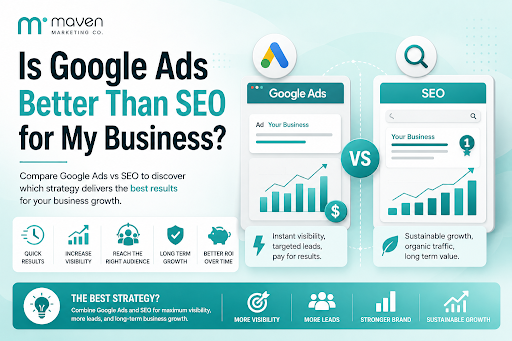
Is Google Ads Better Than SEO for My Business
One of the biggest questions business owners ask when they are planning online growth is whether they should invest in Google Ads or SEO. Both are strong marketing plays that help your company show up in Google search results, but they do things in separate lanes. Google Ads gives quicker visibility and can bring in leads fast, whereas SEO more or less focuses on slow, steady organic traffic that tends to grow the longer you keep building it. Picking the right direction depends on what you want to achieve, how much money you can spend, how crowded the market is, and how quickly you need results, like sooner rather than later. The good news is you don’t always have to choose one or the other; it’s not exactly a black-and-white situation. If you take time to understand the strongest points of both, you can put together a more sensible digital marketing plan that supports consistent expansion. In this guide, we’ll compare Google Ads vs SEO, explain the main differences, and help you figure out what option makes the most sense for your business.

When Should I Hire a Digital Marketing Agency
Growing a business today takes more than just having a website or throwing a post on social media; customers usually search around online, compare providers, skim reviews, and basically expect the brand to show up with a solid digital presence before they even think about buying. Many businesses try to run their marketing themselves, but there comes a point when “doing it all in-house” becomes clunky and hard to manage, all at once. Knowing when to hire a digital marketing agency can end up making a big, real difference for your growth. If you’re not getting enough leads, or your online visibility feels stuck, or sales are just not moving, the right agency can bring the know-how, plus a clear plan, to help you get noticeably better outcomes. In this guide, we’ll dig into what a digital marketing agency actually does, the usual signs it’s time to bring one on, and how picking the right marketing partner can help your business move forward at a faster pace.
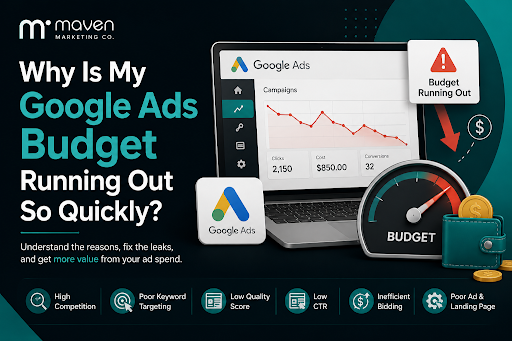
Why Is My Google Ads Budget Running Out So Quickly
Running a successful Google Ads budget isn’t only about throwing more money at it. It’s more like making every dollar, doing a bit extra. A lot of businesses start a Google Ads campaign with big hopes, then find out their daily budget is gone within a few hours, and that feels weird, right? After that, your ads stop showing effectively, new leads slip away, and your return on investment dips. So if your Google Ads budget is running out too fast, don’t stress. It’s a fairly common issue, and in most situations, it can be repaired with the right approach. There are multiple little things that can drain your advertising money quicker than you expected, from costly keywords to audience targeting that just doesn’t quite fit. In this guide, we’ll walk through why your budget disappears so quickly, how to cut wasteful spend, and the most reliable ways to boost your Google Ads ROI, even if your budget stays the same.


