.svg)


%201.svg)
Key Takeaways
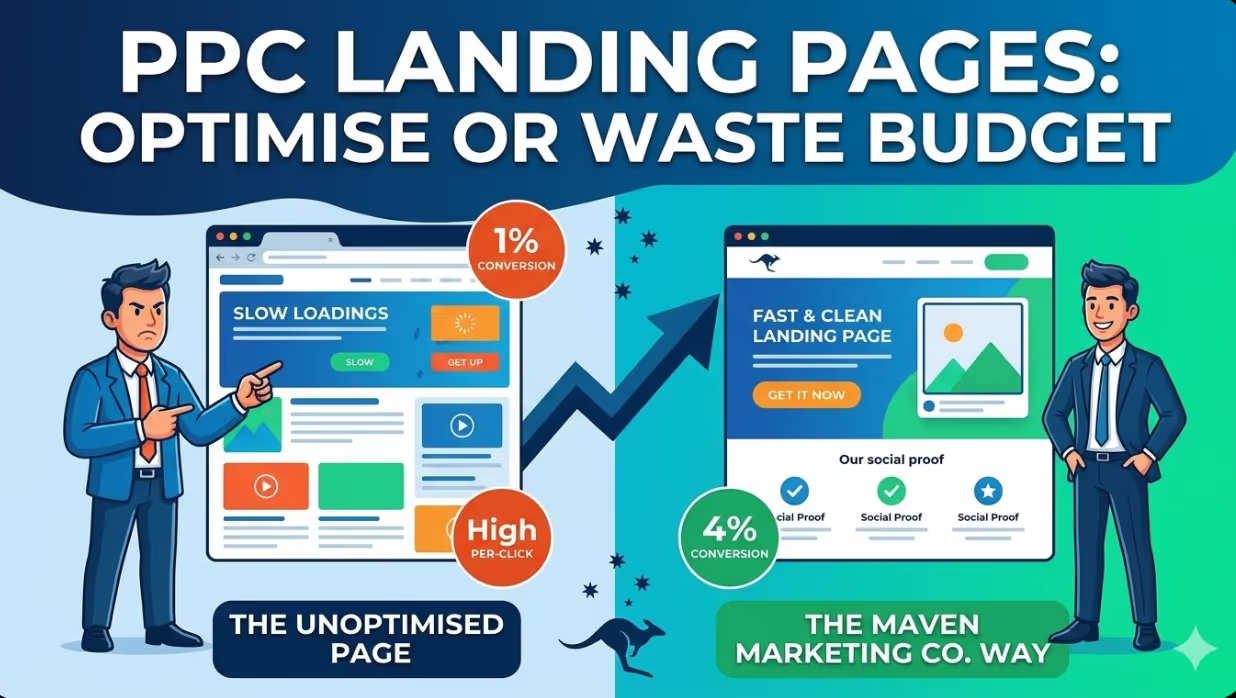
- A landing page designed to convert paid traffic is different from a standard website page. It is focused on a single conversion action, matches the specific promise made in the ad, and removes the navigation and distractions that encourage visitors to leave before converting.
- Page speed is a PPC landing page requirement, not a nice-to-have. Google's Quality Score assessment includes landing page experience, and a page that loads slowly both reduces ad performance and directly increases cost per click by lowering the Quality Score.
- The message match between the ad copy and the landing page headline is the first thing a visitor assesses on arrival. When the ad promises one thing and the landing page delivers a different or more generic message, a significant proportion of visitors leave immediately without giving the page a fair reading.
- Every paid traffic landing page must have a single, prominent conversion element that is visible without scrolling on the most common screen sizes receiving the campaign's traffic. Conversion elements buried below substantial content create an unnecessary distance between visitor intent and the opportunity to act on it.
- Social proof, including testimonials, review scores, case study references, and trust signals specific to the service or product being advertised, placed near the conversion element is one of the additions to a PPC landing page that produce the highest return landing page for Australian businesses.
- Form fields on PPC landing pages should be the minimum required to qualify and respond to the lead. Longer forms are appropriate for consultative B2B services where the prospect qualifying themselves is commercially important, but should still be justified field by field rather than inherited from a standard contact form.
- Conversion tracking must be implemented and validated before paid traffic is activated. Directing spend to a landing page without confirmed conversion tracking is operating blind: the campaign cannot be optimised because the performance data is not being captured.
Why Landing Page Quality Determines PPC Outcome
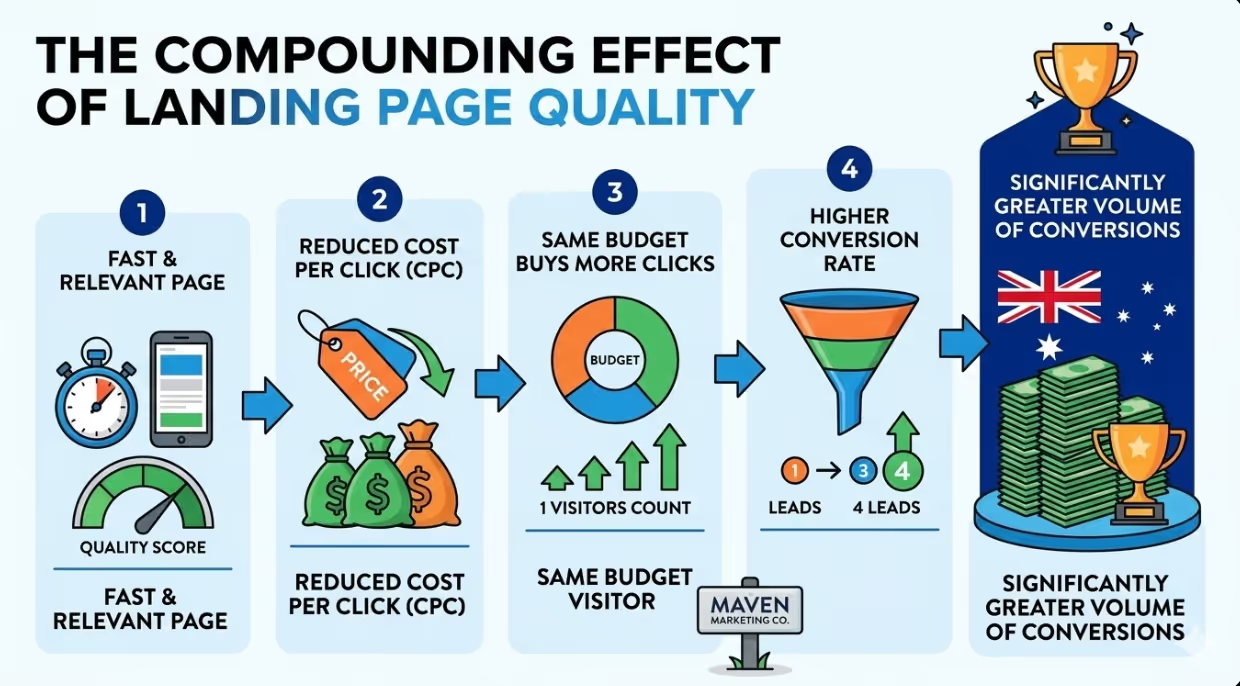
The relationship between landing page quality and PPC performance is direct and measurable in two ways. The first is through Google's Quality Score, a metric that affects the CPC the account pays in each auction. Quality Score is partially determined by landing page experience, which Google evaluates based on the relevance of the landing page content to the keyword and ad, the page load speed, and the usability of the page on mobile devices. A landing page with poor load speed or low relevance to the ad increases the CPC for the keywords sending traffic to it, meaning the account pays more for each click on the same keyword than a competitor whose page loads faster and is more relevant.
The second impact is conversion rate. A campaign that is well managed sending 100 visitors per day to a landing page that converts at one percent produces one lead per day. The same campaign, the same budget, the same keywords, directed to a landing page that converts at four percent produces four leads per day. The improvement does not require any change to the campaign. It requires a better landing page.
These two impacts compound. A better landing page improves Quality Score, which reduces CPC, which means the same budget buys more clicks. More clicks arriving at a page with a higher conversion rate produces a significantly greater volume of conversions from the same monthly budget. For Australian businesses investing in paid search, the landing page is not peripheral to campaign performance. It is central to it.
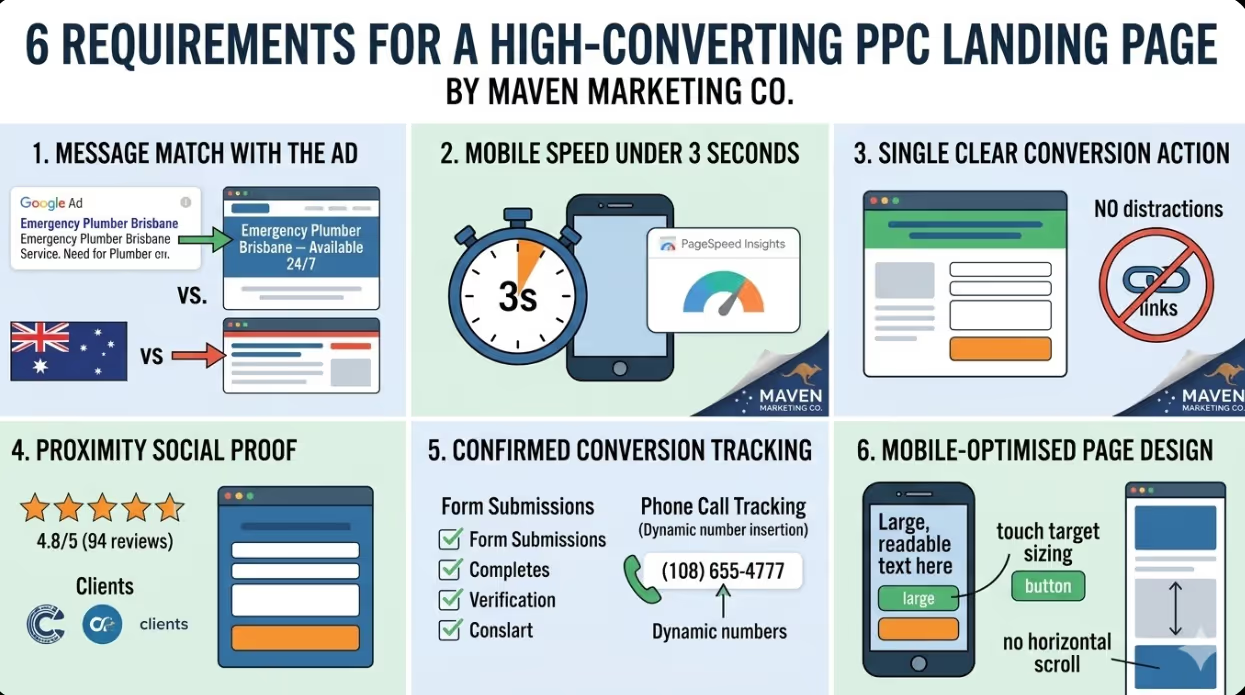
Requirement 1: Message Match With the Ad
When a visitor clicks a Google ad, they have formed an expectation based on the headline and description text they just read. The landing page headline is the first thing they evaluate against that expectation. When the expectation is confirmed, the visitor continues reading. When it is not, they leave.
Message match is the alignment between what the ad promised and what the landing page delivers. A Google Ad that says "Emergency Plumber Brisbane — Available 24/7" should land on a page whose headline references emergency plumbing in Brisbane, not on a general plumbing services page or the business's homepage. A Google Shopping ad for a specific product should land on that product's page, not the category page. A lead generation ad promising a free consultation should land on a page where the free consultation offer is the primary conversion element.
For clients bringing existing pages as PPC destinations, we assess message match by comparing the specific ad copy variants planned for each campaign against the headline, subheading, and first visible paragraph of the proposed landing page. Where the match is weak, we recommend either revising the landing page content or creating a page built specifically for the campaign rather than directing paid traffic to a page that will produce high bounce rates and low Quality Scores.
Requirement 2: Page Speed Under Three Seconds on Mobile
Google's own research establishes that the probability of a mobile user abandoning a page increases sharply as load time increases from one second to three seconds, and continues rising steeply beyond that. For PPC campaigns where the majority of clicks come from mobile devices, a landing page loading in six to eight seconds loses a significant fraction of the paid traffic before the page has finished rendering.
Page speed on mobile is not the same as page speed on a desktop connection. A page that loads in two seconds on a fast corporate WiFi connection may take eight seconds on a 4G connection with the page not optimised for mobile networks. We test landing pages using Google PageSpeed Insights at mobile settings and Google's web performance testing tools, and we require a Largest Contentful Paint of under three seconds and a Total Blocking Time under 300 milliseconds before directing paid traffic to a page.
Common causes of poor mobile load performance on Australian business websites include uncompressed images above the fold, JavaScript that blocks rendering and prevents the page from displaying until scripts have loaded, a hosting provider with slow server response times for Australian visitors, and the absence of a content delivery network for static assets.
If a client's existing pages do not meet the speed threshold, we provide specific technical recommendations for the development team and, where critical, work with the client to create a dedicated landing page with a simplified structure that meets the speed requirements without depending on a full website rebuild.
Requirement 3: A Single Clear Conversion Action
A PPC landing page should drive one conversion action. Not two, not three, not "whichever one the visitor feels like." One. The visitor should arrive, understand immediately what the page is asking them to do, and be able to do it without navigating to another page, without reading through lengthy content to find the form, and without being distracted by secondary offers, navigation links, or unrelated content.
The most common structural problem we encounter on existing pages proposed as PPC destinations is an excess of options. A page with a contact form, a phone number, a chat widget, a newsletter signup, links to case studies, links to other services, and social media icons in the footer is not a landing page. It is a website page that happens to have a form on it. For organic traffic, where the visitor is at various stages of their research journey, this range of options is appropriate. For paid traffic, where the visitor has expressed a specific intent through the search query they just performed, the variety of options dilutes the primary conversion action and reduces its completion rate.
For most Australian service businesses, the appropriate conversion action for a PPC landing page is either an enquiry form or a phone call, with the choice depending on the business's sales process and the nature of the service. An emergency service business benefits from a prominent phone number as the primary conversion action and a form as a secondary option. A B2B service involving a considered purchase benefits from a form as the primary action with a phone number available for visitors who prefer to call.
The conversion element must be visible without scrolling on the devices most commonly used by the campaign's audience. For Australian campaigns where mobile dominates, this means the form or phone number should be within the first 600 to 650 pixels of the page on a standard mobile screen.
Requirement 4: Social Proof Positioned Near the Conversion Element
The moment before a visitor decides to submit a form or call a phone number is the moment their hesitation is highest. Social proof placed at this moment, in the same visual section as the conversion element, directly addresses the hesitation by providing evidence that others have made the same decision and found it worthwhile.
For Australian PPC landing pages, the social proof elements that produce the most measurable impact on conversion rate are:
Google review score and count. A rating of 4.8 stars from 94 reviews, displayed with the star graphic, near the form provides independent validation of the business's quality. This single element, added to a landing page that previously had none, consistently improves conversion rates on our managed campaigns.
Short, specific testimonials. A one to two sentence testimonial from a named Australian client that references a specific outcome rather than generic praise. "We got a response within two hours and the job was done same day" is more persuasive than "very professional service." Specificity builds credibility.
Trust badges and certifications. Industry membership logos, professional certification marks, insurance confirmation, and relevant accreditations placed near the conversion element reduce the perceived risk of making contact with an unfamiliar business.
Client logos for B2B services. A row of recognisable organisation logos demonstrates that credible businesses have trusted the provider, which is particularly effective for B2B PPC campaigns targeting professional buyers.
Social proof does not need to be extensive to be effective. Three to five carefully chosen elements placed near the conversion action outperform a dedicated testimonials section elsewhere on the page.
Requirement 5: Confirmed Conversion Tracking
Conversion tracking must be implemented, tested, and confirmed before a campaign goes live. This is a requirement with no exceptions for every PPC engagement at Maven Marketing Co, and we will not activate paid traffic until we can confirm in the GA4 and Google Ads interfaces that conversion events are being recorded correctly.
The specific tracking requirements for a PPC landing page are:
Form submission tracking. The conversion event must fire on successful form submission, not on page view of the thank you page alone (which can be triggered without a form submission if the URL is visited directly) and not on the click of the submit button alone (which fires even if the form contains errors that prevent submission). The correct implementation fires the conversion event when the form backend confirms that the submission was received and processed.
Phone call tracking. For campaigns where phone calls are a primary conversion action, call tracking should be implemented using a dynamically replaced phone number that records calls originating from Google Ads traffic. Google Ads call tracking, Google Ads forwarding numbers, or a call tracking solution from a third party such as CallRail are all appropriate implementations depending on the client's setup.
Conversion value assignment. Where different lead types have different commercial values, assigning conversion values that reflect this difference allows the bidding algorithm to distinguish between an enquiry of high commercial value and a contact of lower value and optimise toward the more commercially important outcomes.
We verify conversion tracking by submitting a test form and making a test call to the tracking number before the campaign is activated, and by confirming that the conversions appear in both the Google Ads interface and the GA4 account before declaring the tracking implementation complete.
Requirement 6: Mobile-Optimised Page Design
Australian PPC campaigns typically receive between 55 and 70 percent of their clicks from mobile devices. A landing page that has been designed for desktop and then responsively scaled for mobile is not the same as a page designed with the mobile experience as the primary consideration. The differences are in text size and readability, touch target sizing for form fields and buttons, the positioning of the conversion element within the mobile viewport, and the overall information hierarchy when the page is viewed vertically on a small screen.
For clients using existing website pages as PPC destinations, we review each page on a physical mobile device rather than relying on browser emulation, and we assess specifically whether:
- The headline is readable at mobile text sizes without zooming
- The conversion form fields are large enough to tap accurately and do not trigger unexpected zoom behaviour on focus
- The primary conversion element is visible without scrolling on a standard iPhone or Android screen
- The page content does not overflow horizontally causing a scrollable viewport
- Images and media do not slow the mobile load time disproportionately to their contribution to the page's conversion argument
Where a page fails these checks on mobile, we document the specific issues with screenshots and provide them to the client's development team with prioritised recommendations for resolution before paid traffic is directed to the page.
FAQs
Can an existing website page be used as a PPC landing page, or is a dedicated landing page always required?Existing website pages can be effective PPC destinations when they meet the requirements described in this article: strong message match with the planned ad copy, adequate page speed, a clear and prominent conversion action, relevant social proof near the conversion element, and confirmed conversion tracking. In practice, most existing service pages on Australian business websites meet some but not all of these requirements and benefit from targeted improvements before being used as paid traffic destinations. A landing page built specifically for the campaign is most valuable when the existing website infrastructure makes meeting the speed and design requirements difficult without a rebuild, when the client is testing a new service or audience where the existing site has no relevant page, or when the competitive landscape of the keyword set is strong enough that a highly focused landing page is needed to achieve the conversion rate required to make the campaign commercially viable.
How many landing pages does a Google Ads campaign typically require?The number of landing pages depends on the campaign structure and the diversity of the intent being targeted. A brand awareness campaign targeting a single service in a single city can direct all traffic to a single thoroughly optimised page. A campaign covering multiple service lines, multiple geographic markets, or multiple audience segments typically benefits from separate landing pages for each significant variation, because the message match between ad and page degrades as the page tries to serve multiple different audiences simultaneously. For Australian service businesses with a clear primary service and a defined geographic market, a single optimised landing page for the primary campaign combined with tailored pages for any secondary campaigns or geographic variants is a practical starting point. For ecommerce businesses with campaigns tied to specific products, each product or product category should have its own landing page that corresponds to the specific Shopping or Search ad driving traffic to it.
What is the fastest way for an Australian business to build a compliant PPC landing page if the existing website cannot be modified quickly?Landing page builders including Unbounce, Instapage, and Leadpages allow PPC landing pages to be created specifically for the campaign, independently of the main website and without requiring access to or changes to the primary website codebase. These tools produce pages that load quickly and adapt to mobile, with conversion tracking integrations included that can be connected to Google Ads and GA4. The landing page can be hosted on a subdomain of the client's primary domain (for example, offers.business.com.au) to maintain brand consistency while operating independently of the main site. For Australian businesses in competitive PPC categories where the existing website pages do not meet the conversion requirements, a dedicated landing page built in one of these tools is often the fastest path to a campaign that can generate results at an acceptable cost per lead from the first week of activation.
The Campaign Is Only as Good as the Page It Points To
PPC management expertise, keyword research precision, and bidding strategy sophistication all reach their limit at the landing page. An optimally managed campaign cannot extract conversion performance from a page that is not built to convert. For Australian businesses investing in paid search, the landing page is the commercial return on the media investment, and treating it as an afterthought produces a predictable outcome: high spend, low conversion, and a conclusion that PPC does not work, when the accurate conclusion is that the page was not ready for the traffic.
Maven Marketing Co conducts landing page assessments for all new PPC clients, provides specific improvement recommendations, and supports the development team in implementing the changes required before paid traffic is activated.
Talk to the team at Maven Marketing Co →

Table of contents
read more blogs
Is Google Ads Better Than SEO for My Business
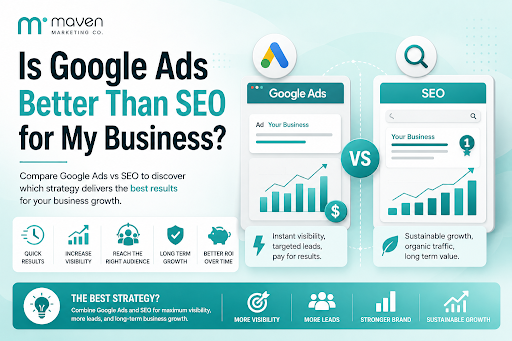
One of the biggest questions business owners ask when they are planning online growth is whether they should invest in Google Ads or SEO. Both are strong marketing plays that help your company show up in Google search results, but they do things in separate lanes. Google Ads gives quicker visibility and can bring in leads fast, whereas SEO more or less focuses on slow, steady organic traffic that tends to grow the longer you keep building it. Picking the right direction depends on what you want to achieve, how much money you can spend, how crowded the market is, and how quickly you need results, like sooner rather than later. The good news is you don’t always have to choose one or the other; it’s not exactly a black-and-white situation. If you take time to understand the strongest points of both, you can put together a more sensible digital marketing plan that supports consistent expansion. In this guide, we’ll compare Google Ads vs SEO, explain the main differences, and help you figure out what option makes the most sense for your business.

When Should I Hire a Digital Marketing Agency
Growing a business today takes more than just having a website or throwing a post on social media; customers usually search around online, compare providers, skim reviews, and basically expect the brand to show up with a solid digital presence before they even think about buying. Many businesses try to run their marketing themselves, but there comes a point when “doing it all in-house” becomes clunky and hard to manage, all at once. Knowing when to hire a digital marketing agency can end up making a big, real difference for your growth. If you’re not getting enough leads, or your online visibility feels stuck, or sales are just not moving, the right agency can bring the know-how, plus a clear plan, to help you get noticeably better outcomes. In this guide, we’ll dig into what a digital marketing agency actually does, the usual signs it’s time to bring one on, and how picking the right marketing partner can help your business move forward at a faster pace.
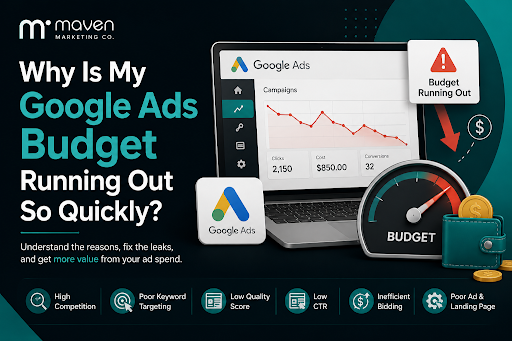
Why Is My Google Ads Budget Running Out So Quickly
Running a successful Google Ads budget isn’t only about throwing more money at it. It’s more like making every dollar, doing a bit extra. A lot of businesses start a Google Ads campaign with big hopes, then find out their daily budget is gone within a few hours, and that feels weird, right? After that, your ads stop showing effectively, new leads slip away, and your return on investment dips. So if your Google Ads budget is running out too fast, don’t stress. It’s a fairly common issue, and in most situations, it can be repaired with the right approach. There are multiple little things that can drain your advertising money quicker than you expected, from costly keywords to audience targeting that just doesn’t quite fit. In this guide, we’ll walk through why your budget disappears so quickly, how to cut wasteful spend, and the most reliable ways to boost your Google Ads ROI, even if your budget stays the same.