.svg)


%201.svg)
Key Takeaways
- Bidding on a competitor's brand name as a keyword is generally permitted under Google's advertising policies and Australian law, provided the competitor's trademark is not used in the ad copy itself in a way that creates consumer confusion or constitutes misleading conduct.
- The conversion rate from competitor conquest campaigns is typically lower than from branded or generic category campaigns, because the searcher was looking for the competitor specifically rather than for an alternative. The conquest strategy is most effective when paired with a compelling reason to switch or consider an alternative.
- Quality Score for competitor keyword terms is typically lower than for own-brand or category terms because the landing page content and ad copy cannot reference the competitor's name, reducing the relevance signal that Google uses to calculate the score.
- The most effective conquest ad copy leads with a genuine competitive advantage, not a generic alternative message. Searchers evaluating a specific competitor are looking for a specific reason to consider something different, and vague positioning produces low engagement.
- Competitor conquest campaigns work best in categories where switching costs are low, the product or service is comparable across providers, and the competitor's searcher base overlaps significantly with the advertiser's target audience.
- Negative keyword management is critical in conquest campaigns. The brand terms being targeted should be applied with modified match to capture the right queries without the campaign matching against unrelated queries that happen to include the competitor's name.
- Conquest campaigns should be monitored with greater frequency than standard campaigns because Quality Score dynamics, competitor responses (including bidding on the advertiser's own brand in retaliation), and ad policy compliance issues can shift quickly in an active competitive landscape.
The Legal Framework for Competitor Bidding in Australia
Before configuring any competitor conquest campaign, understanding the legal framework specific to Australia is essential. The rules differ meaningfully from the UK and USA, and advice derived from those markets may not apply correctly to the Australian context.
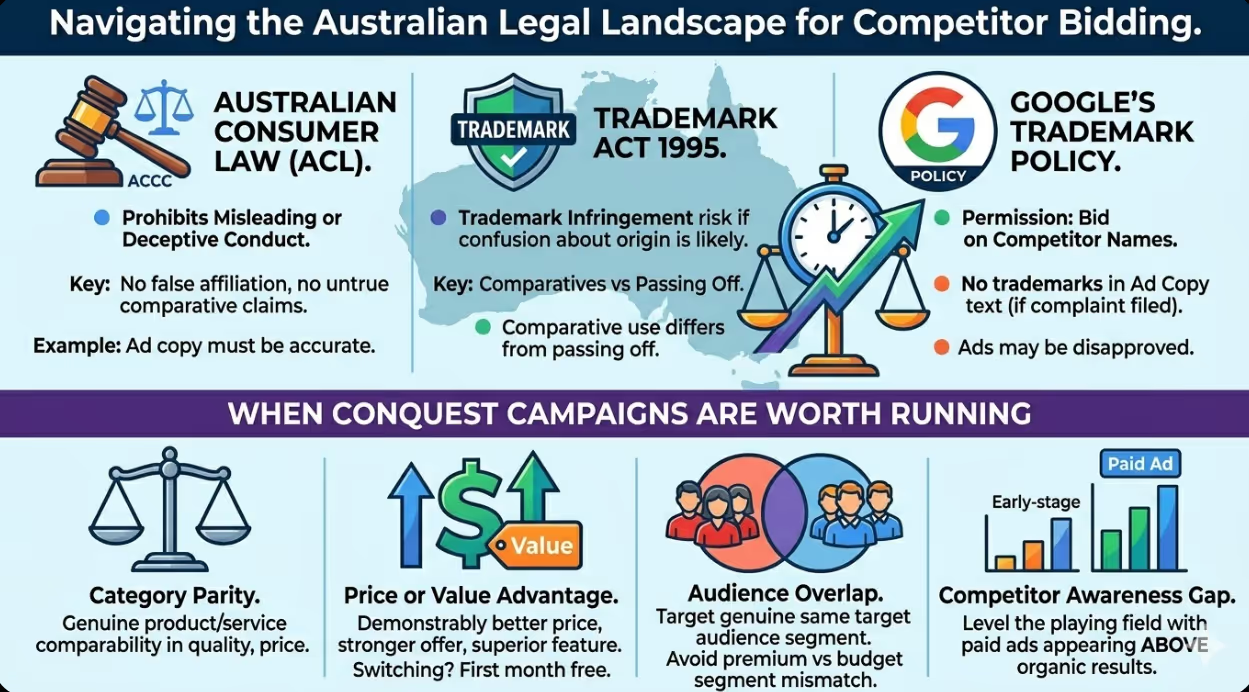
Google's policies. Google permits advertisers to bid on keywords that include a competitor's brand name. The ads will appear in search results for those queries. However, Google's trademark policy prohibits the use of a trademark belonging to a third party in the ad text itself if the trademark owner has filed a trademark complaint with Google. Many Australian businesses with registered trademarks have done so, meaning that using a competitor's brand name in the headline or description of the ad may result in the ad being disapproved.
Australian Consumer Law. Misleading and deceptive conduct is prohibited under Australian Consumer Law, administered by the Australian Competition and Consumer Commission. A conquest ad that implies false affiliation with the competitor, that falsely claims to offer the competitor's product, or that makes untrue comparative claims about the competitor's product could constitute misleading conduct regardless of whether it would violate Google's trademark policy. The ad copy must be accurate in every comparative claim it makes and must not create a false impression about the relationship between the advertiser and the competitor.
Australian trademark law. Using a registered trademark in advertising in a way that is likely to create confusion about the origin of the goods or services can constitute trademark infringement under the Trade Marks Act 1995. The specific circumstances matter: using a competitor's trademark to indicate that your product is compatible with theirs (comparative use) is treated differently from using it to pass off your product as theirs. Australian businesses considering conquest campaigns should seek legal advice on their specific situation if any uncertainty exists about whether the planned campaign approach falls within permissible comparative advertising.
The practical implication of this framework is that most Australian conquest campaigns are configured with the competitor's brand name as a keyword but without any reference to the competitor in the ad copy itself. The ad simply presents the advertiser's own proposition strongly, and the placement in the results for the competitor's query does the work of positioning it as an alternative.
When Competitor Conquest Campaigns Are Worth Running
Not every competitive situation justifies a conquest campaign. The commercial calculus requires assessing whether the expected conversion rate and conversion value from competitor queries justifies the typically higher CPC and lower Quality Score that comes with bidding on brand terms the advertiser does not own.
Favourable conditions for conquest campaigns:
Category parity. When the advertiser's product or service is genuinely comparable to the competitor's in quality, capability, and price range, a searcher who finds both options in the same search is capable of evaluating them on their merits. A conquest campaign in a category with clear parity gives the advertiser a chance to make their case to an audience that is already engaged.
Price or value advantage. If the advertiser can offer a demonstrably better price, a stronger offer, a superior feature, or a more appropriate fit for a specific segment of the competitor's audience, the conquest message has a concrete reason to resonate. "Comparing alternatives to [competitor]? See our pricing" or "Switching from [competitor]? First month free" are examples of conquest angles that work because they offer a specific reason to consider the alternative, not just a generic presence.
Competitor's audience overlap. The conquest campaign is most commercially efficient when the competitor's audience is genuinely the same audience the advertiser wants to reach. A conquest campaign targeting a premium competitor's brand terms for an advertiser in a different price segment wastes budget on searchers who are unlikely to convert regardless of the message.
Competitor brand awareness gap. For newer Australian businesses competing against established brands with high organic search presence, conquest campaigns level the visibility playing field at the moment of highest competitor intent. An established competitor with strong funding may dominate the organic results for their own brand name, but paid results appear above organic results, and a conquest ad can appear above the competitor's own website for their own brand query.
Unfavourable conditions for conquest campaigns:
The strategy is difficult to justify when switching costs are high and the product is complex, because the conversion path from a competitor search to an actual customer acquisition is too long to produce an efficient CPA. It is also difficult to justify in markets where the competitor's audience and the advertiser's target audience have minimal overlap. And it is rarely appropriate for businesses where the legal risk of comparative advertising is high due to the nature of the claims that would be needed to differentiate effectively.
Campaign Configuration
Keyword Selection and Match Types
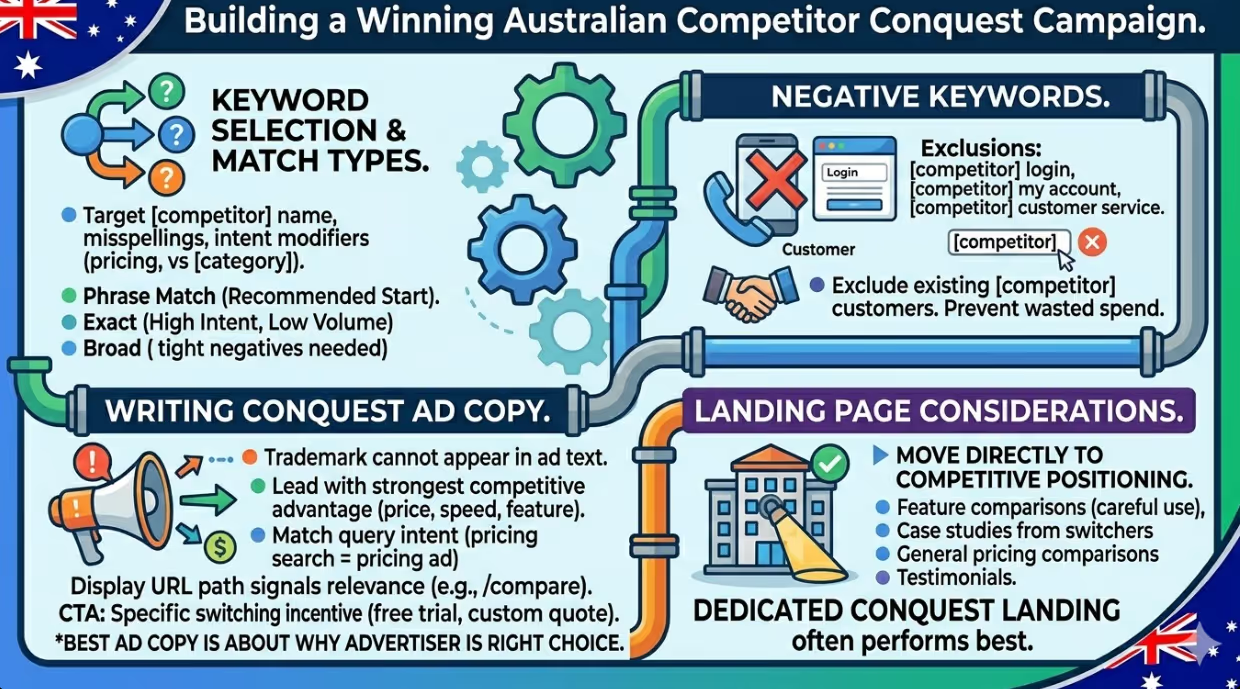
The keywords for a conquest campaign are the competitor's brand name, common misspellings of the brand name, and the brand name combined with modifiers that signal strong intent ("alternative to [competitor]," "[competitor] pricing," "[competitor] vs [category]," "[competitor] reviews").
Phrase match is the recommended starting match type for conquest campaigns. It provides enough query control to keep the campaign matching against queries that genuinely reflect competitor evaluation intent, while capturing the natural query variations that searchers use.
Exact match on the pure brand name is appropriate when the advertiser wants to limit spend to only the purest brand queries. It produces the highest-intent audience but the smallest volume.
Broad match on competitor terms is generally not recommended without very tight negative keyword management, because broad match on a competitor brand name will match against a wide range of unrelated queries that happen to share words with the competitor's name.
Negative keywords should include terms associated with the competitor's current customer service, support, and account management queries ("my [competitor] account," "[competitor] login," "[competitor] customer service"), because these searchers are existing customers of the competitor who are not in an evaluation mode and whose clicks represent wasted spend.
Campaign Structure
Conquest campaigns should be in their own separate campaign rather than included with generic category keywords or the advertiser's own brand campaigns. This separation provides independent budget control, independent bid management, and clean performance data for the conquest campaign specifically.
A conquest campaign structure for a business competing against three primary competitors might look like:
- Campaign: Competitor Conquest
- Ad Group: Competitor A Brand Terms
- Ad Group: Competitor B Brand Terms
- Ad Group: Competitor C Brand Terms
Each ad group contains the relevant brand terms and its own ad copy tailored to the specific competitive situation. An ad group targeting Competitor A's terms can reference the specific advantages the advertiser has relative to Competitor A's known weaknesses, without those messages appearing in the ad group for Competitor B where they may not apply.
Writing Conquest Ad Copy
The constraint that the competitor's trademark cannot appear in the ad copy requires the conquest campaign to work harder on the advertiser's own proposition rather than relying on the comparative hook. This is actually a positive constraint: the best conquest ads are not about the competitor at all. They are about why the advertiser is the right choice for someone who is actively evaluating their options.
Lead with the strongest competitive advantage. If the advertiser has a price advantage, lead with price. If the advantage is speed of service, lead with speed. If the advantage is a specific feature or capability the competitor lacks, lead with that. Generic headlines like "Looking for an Alternative?" perform far below specific headlines that articulate a concrete reason to consider switching.
Match the intent of the query. Searchers who typed "[competitor name] pricing" are interested in pricing. An ad targeted to this query should reference pricing in its copy. Searchers who typed "[competitor name] reviews" are in evaluation mode. An ad targeted to this query should reference review scores, testimonials, or social proof that addresses the evaluation concern.
Use the display URL to signal relevance. While the competitor's name cannot appear in the ad copy headline or description, the display URL path (the custom text that appears after the domain in the ad) can include relevant terms that signal the ad's relevance to someone evaluating a competitor without using the competitor's trademark. For example, a display URL path of "compare" or "alternatives" or "pricing" signals the intent of the ad to the searcher without trademark risk.
Include a specific call to action with a switching incentive where possible. "Start a free trial," "Get a custom quote today," "Compare our pricing," and "See why 500 Australian businesses chose us" are all calls to action that work in the conquest context because they offer a specific next step that is appropriate for someone in the evaluation stage.
Landing Page Considerations
The landing page that conquest campaign traffic is directed to should be designed for a visitor who is familiar with the competitor's product and is actively evaluating alternatives, not a visitor who is discovering the advertiser for the first time.
This means the landing page for conquest traffic can move directly to competitive positioning without the educational foundation that a landing page designed for first-time visitors would require. Feature comparisons (without using the competitor's trademark in a way that could constitute misleading conduct), case studies from customers who switched from the competitor's category, pricing comparisons against the general category, and testimonials that reference the switching decision are all appropriate landing page elements for conquest traffic.
A dedicated conquest landing page that is separate from the main website's service or product pages typically outperforms sending conquest traffic to a generic landing page, because the message can be specifically calibrated to the evaluation state of a visitor who is actively researching an alternative.
FAQs
Will a competitor see that an Australian business is bidding on their brand terms and take action?Competitors can see that another brand is bidding on their terms if they search for their own brand and see a competitor's ad above their organic result. Many sophisticated Australian businesses monitor this regularly. The most common response is a retaliatory conquest campaign: the competitor begins bidding on the original advertiser's brand terms. This escalation can increase CPCs for both parties without producing incremental conversion value for either. Some Australian businesses deliberately avoid conquest campaigns for this reason, particularly in markets where both parties are large enough to sustain a prolonged bidding war that drives up costs for everyone. The decision to run a conquest campaign should account for the likelihood and cost of competitive retaliation.
What bid strategy should an Australian business use for conquest campaigns?Manual CPC or enhanced CPC is the appropriate starting strategy for conquest campaigns because the Quality Score for competitor brand keywords is typically lower than for category or own-brand keywords, and smart bidding strategies set to optimise for conversion may underspend or overbid in unpredictable ways when they encounter the Quality Score dynamics specific to conquest terms. As conversion data accumulates and the campaign's typical CPA becomes established, transitioning to a Target CPA strategy can be appropriate. Maximise conversions without a target is an intermediate option for campaigns with enough volume to benefit from automation but insufficient history for a reliable CPA target. The key structural difference from standard campaigns is that conquest campaign CPCs are typically higher relative to conversion rate, requiring a realistic assessment of the maximum acceptable cost per conquest conversion before the campaign is launched.
How can Australian businesses measure whether their conquest campaign is generating genuinely new customers or simply reattributing conversions that would have occurred anyway?The challenge with conquest campaign attribution is that a proportion of the conversions it records may be from searchers who would have discovered the advertiser through other channels without the conquest campaign's presence. The cleanest measurement approach is to run an incrementality test: pause the conquest campaign for a defined period (two to four weeks) and observe whether the total conversion volume from the audience of searchers who searched for the competitor changes materially. If pausing the campaign produces no measurable change in total conversions, the campaign is reattributing existing conversions rather than generating new ones and its budget would be more efficiently deployed elsewhere. Google's Campaign Experiments feature allows A/B testing of this kind against a control group, which is a more statistically rigorous measurement approach than a simple simple pause test comparing before and after, though it requires more careful setup and interpretation.
Conquest Is a Tactic, Not a Strategy
A competitor conquest campaign is one tactic within a PPC programme, not a complete strategy in its own right. It is most effective when it operates alongside strong brand campaigns that protect the advertiser's own search presence, category campaigns that capture demand at the non-branded level, and a landing page that is genuinely built to convert visitors who are in the evaluation stage. The conquest campaign directs searchers with strong intent toward the advertiser at a commercially valuable moment. What the business does with that attention, how compelling the offer is, how well the landing page is built for the evaluation context, and how well the sales or conversion process converts a searcher who is evaluating alternatives into an actual customer, determines whether the conquest tactic produces a return.
Maven Marketing Co designs and manages PPC competitor conquest strategies for Australian businesses, including keyword selection, ad copy development, landing page strategy, and ongoing competitive monitoring.
Talk to the team at Maven Marketing Co →

Table of contents
read more blogs
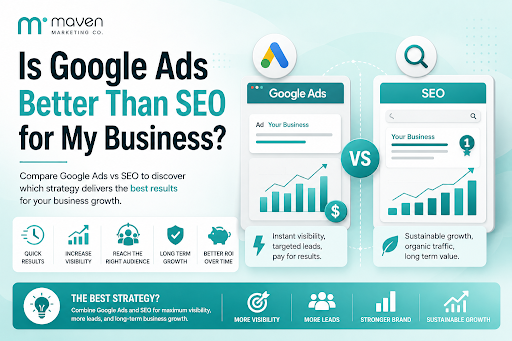
Is Google Ads Better Than SEO for My Business
One of the biggest questions business owners ask when they are planning online growth is whether they should invest in Google Ads or SEO. Both are strong marketing plays that help your company show up in Google search results, but they do things in separate lanes. Google Ads gives quicker visibility and can bring in leads fast, whereas SEO more or less focuses on slow, steady organic traffic that tends to grow the longer you keep building it. Picking the right direction depends on what you want to achieve, how much money you can spend, how crowded the market is, and how quickly you need results, like sooner rather than later. The good news is you don’t always have to choose one or the other; it’s not exactly a black-and-white situation. If you take time to understand the strongest points of both, you can put together a more sensible digital marketing plan that supports consistent expansion. In this guide, we’ll compare Google Ads vs SEO, explain the main differences, and help you figure out what option makes the most sense for your business.

When Should I Hire a Digital Marketing Agency
Growing a business today takes more than just having a website or throwing a post on social media; customers usually search around online, compare providers, skim reviews, and basically expect the brand to show up with a solid digital presence before they even think about buying. Many businesses try to run their marketing themselves, but there comes a point when “doing it all in-house” becomes clunky and hard to manage, all at once. Knowing when to hire a digital marketing agency can end up making a big, real difference for your growth. If you’re not getting enough leads, or your online visibility feels stuck, or sales are just not moving, the right agency can bring the know-how, plus a clear plan, to help you get noticeably better outcomes. In this guide, we’ll dig into what a digital marketing agency actually does, the usual signs it’s time to bring one on, and how picking the right marketing partner can help your business move forward at a faster pace.
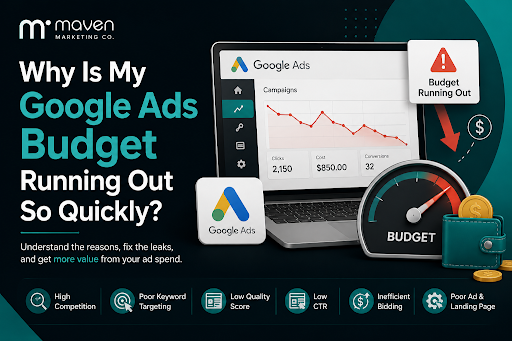
Why Is My Google Ads Budget Running Out So Quickly
Running a successful Google Ads budget isn’t only about throwing more money at it. It’s more like making every dollar, doing a bit extra. A lot of businesses start a Google Ads campaign with big hopes, then find out their daily budget is gone within a few hours, and that feels weird, right? After that, your ads stop showing effectively, new leads slip away, and your return on investment dips. So if your Google Ads budget is running out too fast, don’t stress. It’s a fairly common issue, and in most situations, it can be repaired with the right approach. There are multiple little things that can drain your advertising money quicker than you expected, from costly keywords to audience targeting that just doesn’t quite fit. In this guide, we’ll walk through why your budget disappears so quickly, how to cut wasteful spend, and the most reliable ways to boost your Google Ads ROI, even if your budget stays the same.