.svg)


%201.svg)

Key Takeaways
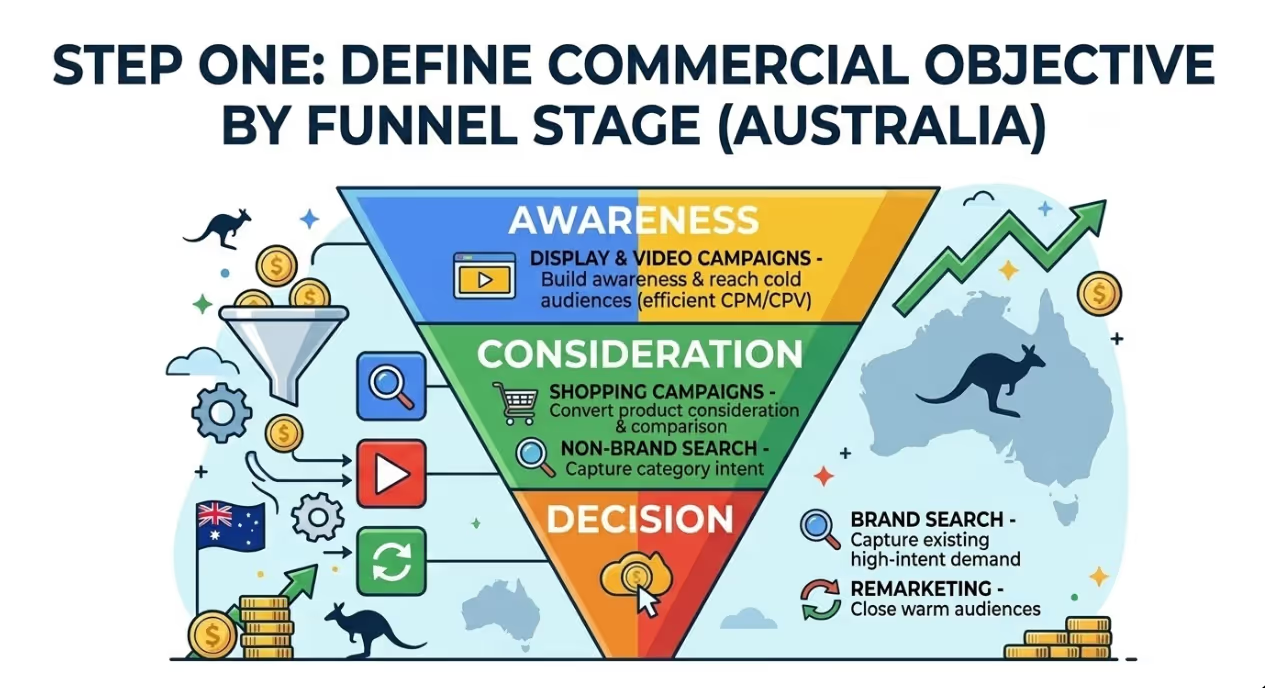
- Budget allocation across campaign types should be anchored to the commercial funnel stage each type addresses most effectively: Search captures existing demand, Shopping converts product consideration, Display and video build awareness, and remarketing closes warm audiences.
- Brand Search campaigns, those targeting the brand's own name and related terms, typically deliver the highest return on investment of any campaign type and should receive a protected budget allocation that is not subject to reallocation when other campaigns underperform.
- Performance Max campaigns require a minimum budget threshold to function effectively. An Performance Max campaign that spans the whole account allocated less than $50 to $80 per day in the Australian market will not generate sufficient auction participation to allow the machine learning optimisation to function, producing misleading performance data and wasting the allocated spend.
- The allocation between Search and Shopping campaigns for Australian ecommerce businesses depends on the brand awareness level and the nature of the product category. Categories with strong brand awareness and considered purchase behaviour benefit from a allocation weighted toward Search. Categories where product discovery drives purchase behaviour benefit from a allocation weighted toward Shopping.
- Remarketing campaigns should receive a budget allocation proportional to the size of the warm audience available, not a fixed percentage of the total budget. Accounts with small remarketing audiences, those with fewer than 1,000 monthly website visitors, should not allocate meaningful budget to remarketing until audience size makes it statistically viable.
- The correct budget allocation at account launch is different from the correct allocation at six months and different again at twelve months, because the algorithm's ability to optimise, the quality of conversion data accumulated, and the understanding of which campaign types perform best for the specific business all improve over time.
- No budget allocation framework survives contact with data unchanged. The framework provides the starting point and the review logic. The data from the running account provides the evidence that drives reallocation decisions every four to six weeks.
The Allocation Problem in Practice
Most Australian businesses that manage PPC in house or through an agency arrive at their campaign budget split through one of three methods, none of which is explicitly wrong but all of which produce suboptimal results in the absence of a structured framework.
The first method is equal distribution: dividing the total budget evenly across all active campaign types and adjusting based on which campaigns generate the most obvious results. The problem with equal distribution is that different campaign types have fundamentally different budget requirements for efficient operation. A Display campaign and a Brand Search campaign do not need the same budget to generate useful performance data, and allocating equal amounts to both either overfunds the Brand Search campaign or underfunds the Display campaign to the point where it cannot function effectively.
The second method is historical precedent: allocating the same proportions as the previous period, adjusted marginally for budget increases or decreases. Historical allocation perpetuates whatever imbalances existed in the original setup and fails to adapt to changes in the business's funnel dynamics, competitive landscape, or the algorithm capabilities of the campaigns being run.
The third method is allocation driven by recommendations: implementing the budget splits suggested by a Google account manager, an agency, or an automated recommendation. These recommendations are not necessarily wrong, but they are generated without access to the full commercial context of the business, and they should be treated as one input into a structured allocation decision rather than as the allocation itself.
A structured framework replaces all three of these approaches with a logic that anchors allocation decisions to the funnel stage, conversion intent, and minimum viable budget of each campaign type.
Step One: Define the Commercial Objective by Campaign Type
Before any specific allocation is made, the commercial objective of each campaign type in the account must be defined. The objectives are not the same for every business, but the framework for defining them follows a consistent logic.
Brand Search. The objective of Brand Search is to capture demand that already exists for the brand by name: users who have already been exposed to the brand and are searching for it directly. Brand Search also protects the brand's organic search presence from competitors bidding on the brand name. The return on investment from Brand Search is typically very high because the searcher has already expressed a direct intent to engage with the brand. The objective is conversion at minimal cost.
Non-Brand Search. The objective of Non-Brand Search is to capture demand that exists for the product or service category without specifically intending to engage with the brand. This is the primary demand capture campaign for most Australian service businesses and for ecommerce businesses in categories where product discovery begins with a descriptive search rather than a brand name. The objective is conversion from category queries where purchase intent is strong.
Shopping. The objective of Shopping campaigns is to capture product intent from searchers who are actively comparing options in a product category. Shopping results appear with images, prices, and product names, which means the searcher is significantly closer to a purchase decision than a typical visitor who arrived through a search not involving the brand name. The objective is conversion from product searchers with strong purchase intent at a target cost per acquisition.
Performance Max. The objective of Performance Max is to capture conversion opportunities across all of Google's inventory, including Search, Shopping, Display, YouTube, Discover, and Gmail, from a single campaign. Performance Max is a broad channel that uses machine learning to find audiences that are likely to convert across all placements. The objective varies by account setup but is typically either sales volume at a target cost per acquisition or leads at a target cost per lead.
Display and video. The objective of Display and video campaigns is primarily awareness and consideration: reaching audiences who have not yet searched for the product or brand and introducing them to it. The return on investment is harder to attribute directly because the conversion path is longer. The objective is reach and consideration at an efficient cost per thousand impressions or cost per view.
Remarketing. The objective of remarketing campaigns is to convert or reengage audiences who have previously visited the brand's website or interacted with its content. Remarketing audiences are warmer than cold audience campaigns and typically convert at higher rates and lower costs. The objective is conversion or reengagement of warm audiences at a target cost per outcome.
Step Two: Establish Minimum Viable Budgets
Each campaign type has a minimum budget threshold below which it cannot gather enough data to operate effectively. Allocating less than the minimum viable budget to a campaign produces an account that generates misleading performance signals and accumulates conversion data too slowly to support meaningful optimisation decisions.
The minimum viable daily budgets for each campaign type in the Australian market in 2026 are approximate and vary significantly by industry, keyword competition level, and geographic targeting, but the following benchmarks provide a practical starting framework.
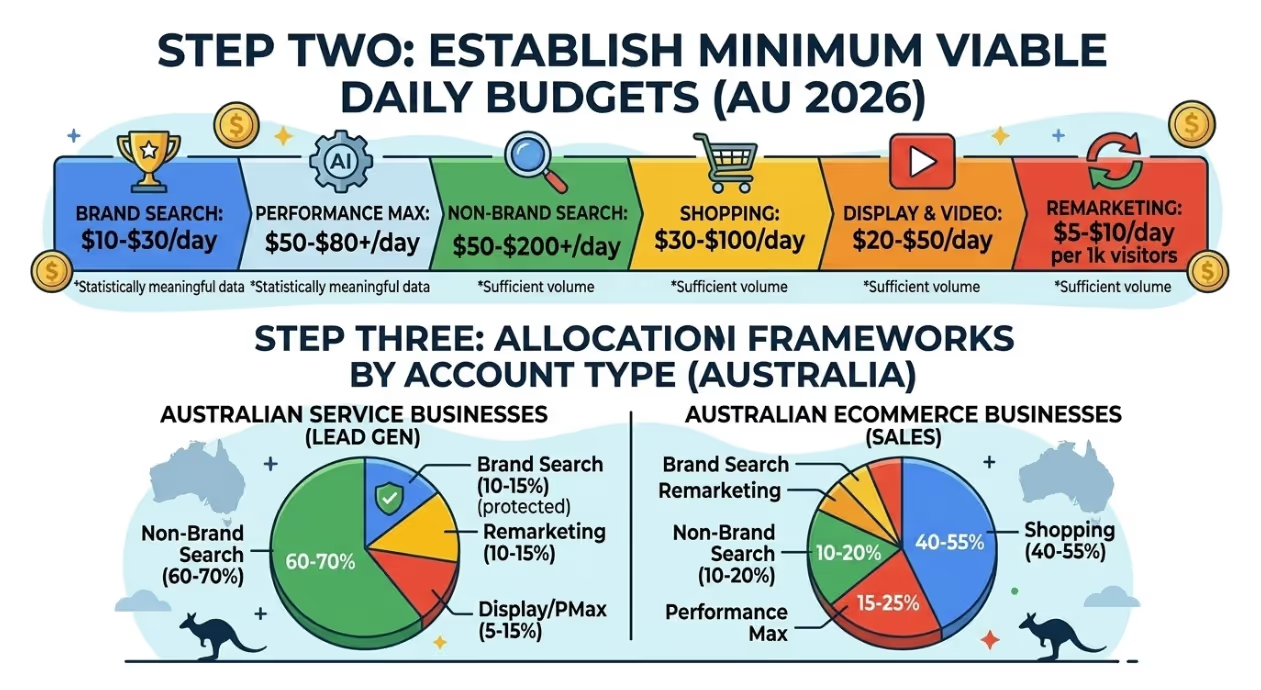
Brand Search: $10 to $30 per day in most Australian markets. Brand keyword CPCs are typically low, and the conversion intent is high, meaning even a modest budget captures the majority of available brand search volume.
Non-Brand Search: $50 to $200 per day to gather statistically meaningful conversion data within a optimisation window of four to six weeks. Highly competitive categories such as legal, financial services, insurance, and real estate may require substantially higher minimums to generate sufficient click volume for optimisation driven by data.
Shopping: $30 to $100 per day for Australian ecommerce businesses, with the appropriate minimum scaling with the size of the product catalogue and the breadth of the category being targeted.
Performance Max: $50 to $80 per day as an absolute minimum. Below this threshold, the machine learning optimisation that Performance Max depends on does not have sufficient auction participation to function reliably. Most Australian accounts would benefit from a minimum of $100 to $150 per day to allow Performance Max to operate effectively.
Display and video: $20 to $50 per day for ongoing awareness campaigns. Display requires relatively less budget to gather meaningful impression data than Search campaigns, but requires a clear audience definition and compelling creative to deliver useful awareness outcomes.
Remarketing: Budget should be proportional to remarketing audience size. A good starting heuristic is $5 to $10 per day per 1,000 monthly website visitors in the remarketing pool. Accounts with fewer than 1,000 monthly visitors should not activate remarketing campaigns until audience size is sufficient.
Step Three: The Allocation Framework by Account Type
With commercial objectives defined and minimum viable budgets established, the allocation framework differs depending on the primary commercial model of the business.
Australian Service Businesses (Lead Generation)
For Australian service businesses running Google Ads primarily to generate enquiries and leads, the recommended starting allocation is:
Brand Search receives 10 to 15 percent of the total budget. This is a protected allocation that ensures brand search volume is captured regardless of the performance of other campaigns.
Non-Brand Search receives 60 to 70 percent of the total budget. This is the primary demand capture channel for most service businesses, and it requires the largest allocation to generate sufficient lead volume and conversion data.
Remarketing receives 10 to 15 percent of the total budget, scaled to audience size. For service businesses with low website traffic, this allocation should be reduced and redirected to Non-Brand Search until remarketing audience size justifies the investment.
Display or Performance Max receives the remaining 5 to 15 percent as an awareness and prospecting supplement, applied when the Non-Brand Search and remarketing campaigns are generating efficient results and additional budget is available for activity higher in the funnel.
Australian Ecommerce Businesses
For Australian ecommerce businesses running Google Ads primarily to drive product sales, the recommended starting allocation is:
Brand Search receives 5 to 10 percent of the total budget. Ecommerce brands with strong existing brand recognition may need a slightly higher allocation to protect search share from competitor brand bidding.
Shopping campaigns receive 40 to 55 percent of the total budget. Shopping is typically the highest volume and most commercially efficient conversion channel for ecommerce accounts with a thoroughly optimised product feed, and it should receive the largest single allocation.
Performance Max receives 15 to 25 percent of the total budget. For ecommerce accounts, Performance Max is used primarily to extend Shopping reach across additional inventory and to capture prospecting audiences that Search and Shopping do not reach. It should not receive a larger allocation than Shopping until its performance data demonstrates it deserves one.
Non-Brand Search receives 10 to 20 percent for category and intent queries where Shopping coverage is incomplete.
Remarketing receives 5 to 10 percent, scaled to audience size and the volume of cart abandonment traffic available for dynamic remarketing.
Step Four: Review Triggers and Reallocation Logic
The starting allocation is a hypothesis based on the framework, not a permanent structure. The account data that accumulates over the first four to six weeks of operation provides the evidence to test that hypothesis and adjust the allocation accordingly.
The reallocation triggers that should prompt a formal review of the budget distribution are:
A campaign type is consistently hitting its daily budget limit. A campaign hitting its budget cap every day is generating strong return and is being artificially constrained. Increasing its allocation at the expense of campaigns that are not hitting their caps is the appropriate response.
A campaign type is generating spend but no conversions over a window of four weeks. This signals either a targeting problem, a quality problem, or insufficient budget to gather conversion data. The remediation depends on which of these is the cause, but the allocation should not be increased until the root cause is diagnosed.
A significant change in business seasonality, product mix, or competitive intensity. These changes alter the relative value of each campaign type and should trigger an allocation review even when the performance data does not show a specific problem.
The algorithm in a Performance Max or Smart Bidding campaign has accumulated sufficient conversion data to shift to a more aggressive bidding strategy. This often corresponds to a point in the account's development where Performance Max deserves a higher allocation because it now has the data to optimise effectively.
FAQs
How should an Australian business decide between running Performance Max alongside standard Search and Shopping campaigns versus replacing them?
Performance Max and standard Search and Shopping campaigns can be run simultaneously, but they require careful structural management to prevent cannibalisation. When both are active in the same account, Performance Max will compete for the same auction inventory as Search and Shopping campaigns, and without proper campaign priority settings and exclusions, it will absorb budget from the more transparent and controllable standard campaigns. The recommended approach for Australian businesses is to run standard Search and Shopping campaigns as the primary channels, with Performance Max as a supplementary channel receiving a minority allocation. Only move toward a structure where Performance Max is dominant once sufficient conversion data exists to evaluate whether it is genuinely generating incremental conversions rather than just reattributing conversions that would have been generated by the standard campaigns. This evaluation typically requires a structured test with clearly separated budget and attribution windows, which is difficult to execute without specialist support.
What is the right total PPC budget for an Australian business starting from zero?
The minimum total budget to generate meaningful results from a Google Ads account in Australia depends heavily on the industry, the geographic targeting, and the average CPC in the category. For a local service business targeting a single Australian city, a starting budget of $2,000 to $3,000 per month is typically the minimum required to generate enough click volume for decisions driven by data across Brand Search and Non-Brand Search. For businesses in competitive categories such as legal, finance, and insurance, meaningful starting budgets are typically $5,000 per month or higher. For national ecommerce businesses, the starting budget should be sufficient to cover the minimum viable budget across Brand Search, Shopping, and Performance Max simultaneously, which in most product categories requires at least $3,000 to $5,000 per month. Below these thresholds, the account does not accumulate data fast enough to support the optimisation decisions that make PPC compounding rather than merely expensive.
How does seasonality affect PPC budget allocation across campaign types for Australian businesses?
Seasonality affects PPC allocation at two levels. At the total budget level, increasing total spend during peak commercial periods, such as the retail window before Christmas, the EOFY period for B2B businesses, and January for businesses in lifestyle and fitness categories, captures the increased search demand that occurs at those times. At the campaign type level, seasonality can shift the relative value of different channels: during peak purchase periods, the allocation toward Shopping and Non-Brand Search should increase at the expense of channels oriented toward awareness, because the audience is in a purchase mode where intent is high and capturing that intent is more valuable than building awareness that will convert later. During quieter commercial periods, shifting allocation toward Display and Performance Max prospecting can build the audience pools that improve remarketing performance during the next peak period. The allocation framework should include a seasonal adjustment layer that anticipates these shifts and changes the campaign budgets proactively rather than reactively.
The Framework Gives the Data Something to Test Against
A budget allocation made without a framework is just a number. A budget allocation made within a framework is a hypothesis about how the account should perform and what it should learn from the first few weeks of operation. The framework provides the structure. The data from the running account provides the evidence that refines the allocation over time until the distribution of spend across campaign types reflects the actual performance characteristics of each channel for the specific business rather than a generic starting assumption. For Australian businesses managing PPC investment, that refinement process is where the compounding returns are built.
Maven Marketing Co manages PPC campaigns for Australian businesses across all campaign types, including initial budget framework development, ongoing allocation management, and rebalancing driven by performance data.
Talk to the team at Maven Marketing Co →

Table of contents
read more blogs
Is Google Ads Better Than SEO for My Business
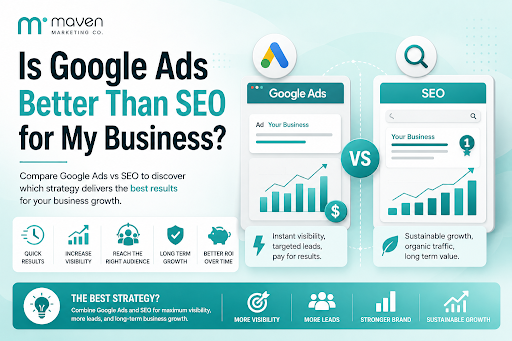
One of the biggest questions business owners ask when they are planning online growth is whether they should invest in Google Ads or SEO. Both are strong marketing plays that help your company show up in Google search results, but they do things in separate lanes. Google Ads gives quicker visibility and can bring in leads fast, whereas SEO more or less focuses on slow, steady organic traffic that tends to grow the longer you keep building it. Picking the right direction depends on what you want to achieve, how much money you can spend, how crowded the market is, and how quickly you need results, like sooner rather than later. The good news is you don’t always have to choose one or the other; it’s not exactly a black-and-white situation. If you take time to understand the strongest points of both, you can put together a more sensible digital marketing plan that supports consistent expansion. In this guide, we’ll compare Google Ads vs SEO, explain the main differences, and help you figure out what option makes the most sense for your business.

When Should I Hire a Digital Marketing Agency
Growing a business today takes more than just having a website or throwing a post on social media; customers usually search around online, compare providers, skim reviews, and basically expect the brand to show up with a solid digital presence before they even think about buying. Many businesses try to run their marketing themselves, but there comes a point when “doing it all in-house” becomes clunky and hard to manage, all at once. Knowing when to hire a digital marketing agency can end up making a big, real difference for your growth. If you’re not getting enough leads, or your online visibility feels stuck, or sales are just not moving, the right agency can bring the know-how, plus a clear plan, to help you get noticeably better outcomes. In this guide, we’ll dig into what a digital marketing agency actually does, the usual signs it’s time to bring one on, and how picking the right marketing partner can help your business move forward at a faster pace.
Why Is My Google Ads Budget Running Out So Quickly
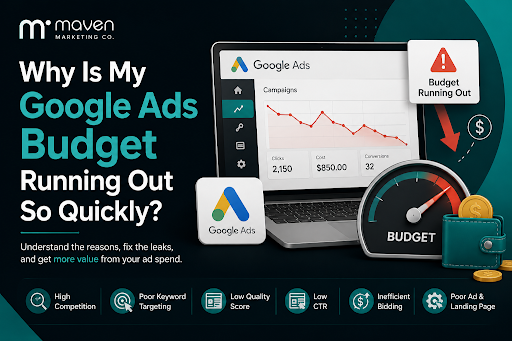
Running a successful Google Ads budget isn’t only about throwing more money at it. It’s more like making every dollar, doing a bit extra. A lot of businesses start a Google Ads campaign with big hopes, then find out their daily budget is gone within a few hours, and that feels weird, right? After that, your ads stop showing effectively, new leads slip away, and your return on investment dips. So if your Google Ads budget is running out too fast, don’t stress. It’s a fairly common issue, and in most situations, it can be repaired with the right approach. There are multiple little things that can drain your advertising money quicker than you expected, from costly keywords to audience targeting that just doesn’t quite fit. In this guide, we’ll walk through why your budget disappears so quickly, how to cut wasteful spend, and the most reliable ways to boost your Google Ads ROI, even if your budget stays the same.