.svg)


%201.svg)

Key Takeaways
- In-market audiences survived cookie deprecation through signal aggregation: Modern in-market targeting uses aggregated behavioural patterns across millions of users rather than individual tracking, maintaining effectiveness whilst protecting privacy through statistical modelling instead of persistent identifiers
- Machine learning replaced deterministic tracking: Google's algorithms analyse search queries, video views, content engagement, and browsing patterns at aggregate level, predicting purchase intent without requiring individual user identification or cross-site tracking
- Signal quality matters more than signal volume: Privacy-first targeting prioritises high-quality signals like active search behaviour and engaged content consumption over passive tracking, improving relevance whilst reducing privacy concerns through focus on intentional user actions
- First-party data integration enhances targeting precision: Combining Google's in-market signals with your first-party customer data through Customer Match and enhanced conversions creates more accurate targeting than either signal source alone
- Contextual signals complement behavioural targeting: Content context where ads appear provides additional relevance signals supplementing behavioural predictions, with algorithms considering both what users search for and where they consume content
- Transparency and user control increased significantly: Users can now view and manage their ad personalisation settings more easily, opting out of personalised ads whilst advertisers maintain targeting effectiveness through aggregate modelling compensating for individual opt-outs
- Performance metrics focus on incrementality: Privacy changes shifted measurement emphasis from last-click attribution to incremental impact measurement through conversion lift studies, brand lift surveys, and holdout testing quantifying true advertising value
- Category granularity balances precision with scale: Highly specific in-market categories offer better relevance but smaller audiences, whilst broader categories provide scale with less precision, requiring strategic category selection matching campaign objectives
A home renovation company spent $22,000 monthly on Google Ads targeting homeowners planning kitchen and bathroom remodels. Pre-2024 third-party cookie-based targeting delivered consistent performance with clear attribution and predictable costs. As cookie deprecation rolled out through 2024-2025, they worried their targeting precision and campaign performance would collapse without persistent user tracking.
Contrary to fears, their 2026 in-market audience performance actually improved compared to cookie-based targeting. Google's privacy-safe machine learning analysed aggregated patterns including searches for renovation contractors, YouTube views of remodelling videos, engagement with design content, and contextual signals from home improvement site visits without tracking individual users across sites. The algorithms identified purchase-ready homeowners through intent signals rather than identity tracking.
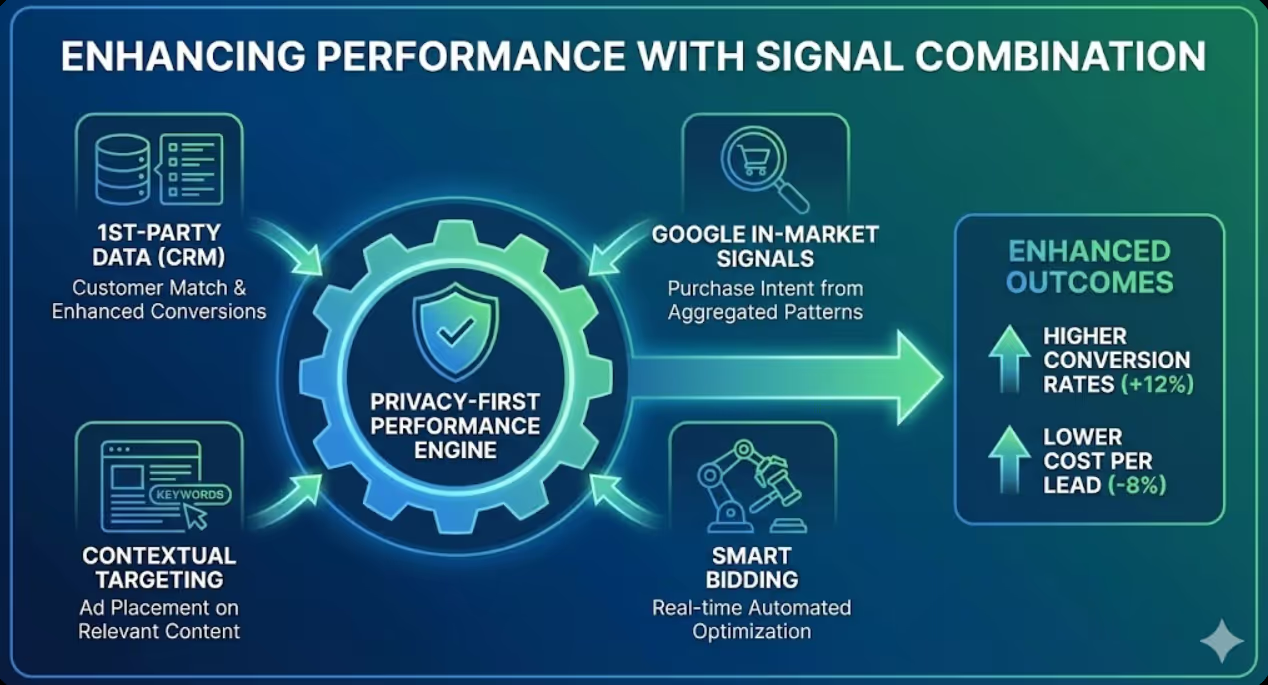
They enhanced performance by layering first-party data through Customer Match, combining Google's in-market signals with their CRM segments showing which customer characteristics predict renovation projects. Enhanced conversions sent privacy-safe conversion data back to Google improving audience quality predictions. Strategic bid adjustments for high-confidence in-market segments plus contextual targeting on relevant content created multi-signal approach compensating for any individual signal weaknesses.
Results showed 12% improvement in conversion rates whilst cost per lead decreased 8% compared to cookie-based campaigns. The privacy-first approach delivered better performance through higher-quality signals focused on active intent rather than passive tracking. User privacy complaints dropped to zero whilst campaign effectiveness improved, proving privacy and performance compatible rather than opposing forces.
Understanding Privacy-First In-Market Audiences
In-market audiences in 2026 function fundamentally differently from cookie-based predecessors, leveraging aggregate signals and machine learning whilst protecting individual privacy.
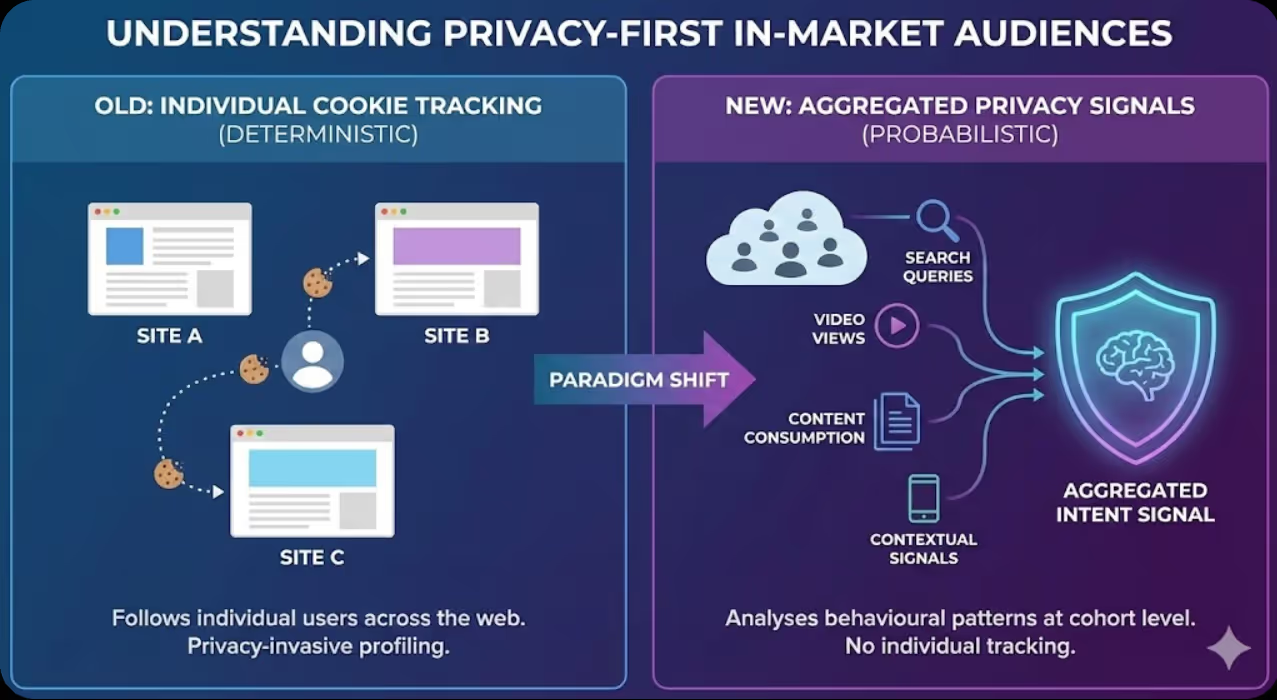
The evolution from cookies to signals represents paradigm shift from deterministic tracking following individual users across websites to probabilistic modelling identifying purchase intent patterns across aggregated user populations. According to Google's 2025 Privacy Sandbox documentation, modern targeting analyses behavioural patterns at cohort level rather than individual level, maintaining advertising effectiveness whilst preventing cross-site user tracking that enables privacy-invasive profiling.
Machine learning architecture powers modern in-market predictions through neural networks analysing billions of anonymised signals, pattern recognition identifying correlations between behaviours and purchase likelihood, continuous learning adapting to changing user patterns, and privacy-preserving aggregation ensuring individual user behaviour remains unidentifiable within aggregate data. These algorithms predict purchase intent with accuracy matching or exceeding cookie-based approaches despite lacking persistent individual tracking.
Signal sources feeding in-market models include search query analysis showing active research behaviour indicating purchase consideration, video engagement patterns reflecting product education and comparison, content consumption across Google properties revealing topic interests, device and browser signals (privacy-safe contextual data without cross-site tracking), and temporal patterns showing research intensity and decision-making timeframes. These diverse signals combine creating comprehensive purchase intent picture without requiring individual user following across the web.
Category taxonomy organisation groups products and services into hierarchical categories from broad sectors to specific offerings. Users demonstrating relevant signal patterns get assigned to appropriate in-market categories. Category membership remains dynamic with users entering categories as purchase intent emerges and exiting as intent diminishes or purchases complete. The 2026 taxonomy includes over 1,000 categories spanning consumer products, services, automotive, real estate, financial services, travel, and B2B solutions.
Privacy protections embedded throughout include differential privacy adding statistical noise preventing individual re-identification, k-anonymity requirements ensuring sufficient group sizes before creating targetable segments, consent frameworks respecting user advertising preferences, and transparency tools enabling users to understand and control their ad personalisation settings. These protections operate automatically without requiring advertiser intervention whilst maintaining targeting utility.
Cross-device understanding occurs through privacy-safe signals rather than deterministic linking. Users signing into Google services provide first-party signals enabling cross-device understanding whilst users not signed in contribute to aggregate patterns without individual tracking. This approach balances multi-device journey understanding with privacy protection.
Implementing In-Market Audience Strategies
Strategic in-market audience implementation requires understanding category selection, layering approaches, bidding strategies, and integration with other targeting methods.
Category selection strategy begins with identifying relevant categories matching your products or services. Browse Google's in-market taxonomy, research category definitions understanding included behaviours, analyse category sizes balancing precision with scale, and test multiple categories identifying highest-performing options. Selecting appropriate categories represents foundational decision determining campaign relevance and performance potential.
Layering multiple targeting signals creates more precise audience definitions through combining in-market audiences with demographic targeting, geographic restrictions, device preferences, and dayparting. According to Think with Google research on audience layering, campaigns using multiple targeting dimensions typically achieve 20-40% better conversion rates than single-dimension targeting through compounded relevance from multiple filters.
Observation versus targeting mode distinction determines whether in-market audiences actively restrict delivery or passively provide reporting insights. Observation mode serves ads to all users whilst reporting performance by in-market category membership, enabling performance analysis without delivery restriction. Targeting mode restricts delivery exclusively to in-market audience members, focusing budget on highest-intent users. Most campaigns benefit from targeting mode after observation period validates performance differences.
Bid adjustment strategies allocate budget proportional to audience intent strength with strong purchase intent categories receiving 30-100% bid increases, moderate intent categories maintaining baseline bids, and weak intent categories reducing bids 20-40% or exclusion entirely. These adjustments ensure impression share and position advantages for highest-intent audiences maximising conversion probability.
Exclusion strategies prevent waste through excluding recently converted users who completed purchases, excluding brand loyalty audiences unlikely to switch, and excluding low-performing categories after testing reveals poor fit. Strategic exclusions preserve budget for genuine prospects rather than unlikely converters or saturated audiences.
Campaign structure decisions determine whether to segment campaigns by in-market category enabling category-specific messaging, maintain unified campaigns with audience layering, or create separate prospecting campaigns for in-market audiences versus other targeting approaches. Structure choices impact optimisation flexibility and reporting granularity.
Testing frameworks systematically evaluate category performance through controlled tests comparing conversion rates, cost per acquisition, and return on ad spend across categories. Continuous testing identifies which categories deliver best performance for your specific business, with results potentially differing from generic assumptions about relevant categories.
Enhancing Performance with Signal Combination
Modern privacy-first advertising succeeds through combining multiple signal sources creating comprehensive targeting exceeding any single signal's capabilities.
First-party data integration layers your customer data with Google's in-market signals through Customer Match uploading customer lists, enhanced conversions sending privacy-safe conversion data, and offline conversion imports connecting digital campaigns to in-store purchases. This integration enables Google's algorithms to better identify users resembling your best customers within in-market populations.
Contextual targeting renaissance occurred as privacy regulations limited behavioural tracking, making content context increasingly valuable signal. Combining in-market behavioural signals with contextual placement targeting ensures ads appear both to right people and in right environments, compounding relevance through dual signal validation.
Affinity audience layering combines long-term interests with short-term purchase intent through pairing in-market audiences indicating active shopping with affinity audiences showing sustained interest in related topics. Someone in-market for home gym equipment showing fitness affinity represents stronger prospect than in-market membership alone.
Custom intent audiences supplement standard in-market categories with your specific keyword and URL targeting. Create custom audiences from keywords relevant to your niche, URLs of competitor sites or review platforms, and apps related to your category. These custom signals complement standard in-market categories with business-specific intent indicators.
Life events targeting identifies users experiencing significant life changes often triggering purchase decisions. Moving, marriage, graduation, and other milestones correlate with increased purchase intent across multiple categories. Layering life events with in-market audiences identifies users whose circumstances amplify existing shopping intent.
Remarketing integration combines past site visitors with in-market status creating highly qualified audiences. Users who visited your site previously and currently show in-market signals represent warm prospects with established brand awareness and active purchase consideration. This combination typically delivers conversion rates 2-4x higher than either signal alone.
Smart Bidding integration enables automated bid optimisation leveraging all available signals simultaneously. Google's machine learning analyses in-market signals, demographics, device, location, time, and auction dynamics optimising bids in real-time for maximum performance. Smart Bidding handles signal complexity better than manual bid adjustments across multiple dimensions.
Measuring Performance in Privacy-First Environment
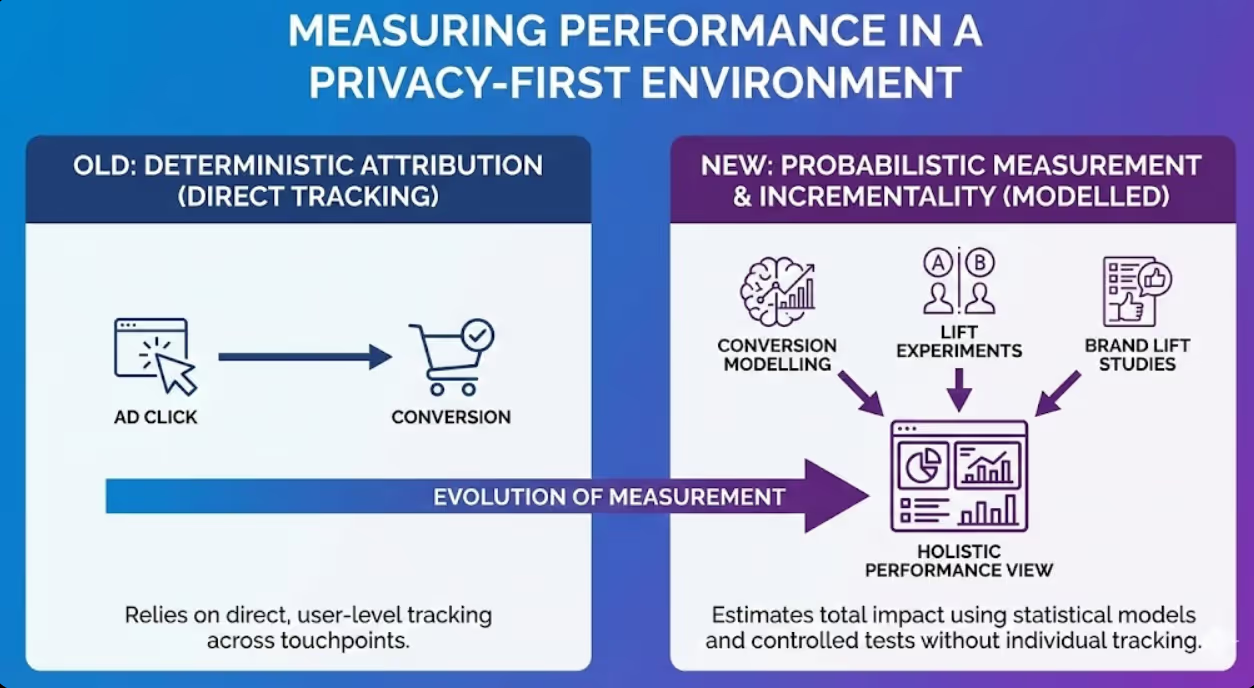
Privacy changes necessitated measurement approach evolution from deterministic attribution to probabilistic impact assessment and incrementality focus.
Conversion modelling addresses reduced visibility into individual conversions through statistical modelling estimating total conversions based on observable subset. Google's conversion modelling fills gaps where privacy protections prevent complete conversion tracking, providing more complete performance picture whilst respecting user privacy.
Incrementality testing measures true advertising impact through geographic holdout tests withholding ads from random markets comparing conversion rates against active markets, user-based holdouts splitting audiences into test and control groups, and time-based holdouts comparing performance during active versus paused periods. These tests quantify incremental value beyond organic baseline separating advertising impact from conversions that would have occurred anyway.
Brand lift studies measure awareness, consideration, and preference changes among exposed versus unexposed users. Brand surveys shown to random samples assess whether in-market audience campaigns improve brand metrics beyond direct response conversions. Brand lift particularly valuable for upper-funnel campaigns where immediate conversions don't fully capture value.
Conversion lift experiments randomly withhold ads from subset of target audience comparing conversion rates between exposed and control groups quantifying incremental conversions attributable to advertising. According to Google's testing frameworks, conversion lift studies represent gold standard for measuring true campaign incrementality in privacy-first era.
Multi-touch attribution modelling distributes conversion credit across touchpoints acknowledging modern customer journeys involve multiple interactions. Data-driven attribution uses machine learning analysing successful conversion paths comparing against unsuccessful paths identifying touchpoint contributions. Privacy-safe attribution operates on aggregate paths without individual user tracking.
Cross-channel measurement integrates performance across search, display, video, and social campaigns providing holistic view of marketing effectiveness. Privacy-first measurement platforms aggregate data at campaign level rather than user level, quantifying overall impact whilst protecting individual privacy.
Proxy metrics and leading indicators supplement direct conversion measurement through engagement metrics, assisted conversion rates, time to conversion changes, and search query quality improvements. These indicators signal campaign health even when privacy limitations reduce conversion tracking completeness.
Navigating Privacy Regulations and User Consent
Compliance with evolving privacy regulations whilst maintaining advertising effectiveness requires understanding requirements and implementing proper consent and transparency mechanisms.
GDPR implications for European users mandate explicit consent for personalised advertising, transparency about data usage and processing, user access and deletion rights, and documentation of lawful processing basis. Businesses targeting European users must comply regardless of business location, with in-market audience usage requiring proper consent frameworks.
California Consumer Privacy Act (CCPA) and subsequent regulations require disclosure of data collection and usage, opt-out mechanisms for data selling or sharing, consumer access to collected data, and equal service guarantees for users exercising privacy rights. In-market audience usage must respect California residents' privacy preferences.
Australian Privacy Act compliance requires collecting only necessary data, using data only for disclosed purposes, implementing reasonable security measures, and enabling access and correction. Whilst Australian regulations currently less stringent than GDPR, privacy expectations increasing with potential regulatory strengthening anticipated.
Consent management platforms (CMPs) operationalise privacy compliance through consent collection interfaces, preference storage and propagation, vendor management for advertising partners, and audit trails documenting compliance. Proper CMP implementation ensures in-market audience usage respects user preferences automatically.
Transparency initiatives provide users understanding and control over ad personalisation through Google's "My Ad Center" enabling users to view in-market categories, adjust topic preferences, disable personalisation entirely, and understand why specific ads appear. Increased transparency builds trust whilst giving users control meeting privacy expectations.
Privacy-safe activation methods ensure compliant in-market audience usage through aggregate signal processing preventing individual identification, contextual targeting supplementing behavioural signals, first-party data reliance with proper consent, and differential privacy protecting individual data within aggregate models. These methods maintain targeting effectiveness whilst exceeding compliance requirements.
Audit and documentation procedures demonstrate good-faith privacy practices through privacy policy reviews ensuring accurate disclosure, consent mechanism testing verifying proper functionality, vendor assessment confirming partner compliance, and incident response planning for potential breaches. Documentation proves compliance efforts during regulatory reviews.
Optimising for Signal Quality and Relevance
Privacy-first targeting prioritises signal quality over quantity, requiring strategic approach to maximising high-value signals whilst respecting privacy boundaries.
Search signal amplification occurs through search campaigns providing strongest intent signals. Search query patterns directly indicate active research and purchase consideration. Campaigns targeting in-market audiences on search often outperform display or video given search's explicit intent expression. Allocating appropriate budget to search campaigns maximises high-quality signal capture.
Video engagement strategies leverage YouTube's role in product research and consideration. Users watching comparison videos, product reviews, and how-to content demonstrate strong purchase signals. YouTube campaigns targeting in-market audiences reach users during active research phases with engaging video content addressing consideration-stage questions.
Content quality emphasis ensures ads appear in brand-safe, high-quality environments improving campaign perception and performance. Contextual targeting combined with in-market audiences ensures ads reach right people in right contexts, compounding relevance through dual validation of audience and environment.
Landing page relevance directly impacts conversion rates for in-market audiences. Users demonstrating purchase intent expect relevant landing experiences. Personalised landing pages addressing specific in-market categories convert significantly better than generic pages treating all traffic identically. Post-click experience quality determines whether strong in-market signals translate into actual conversions.
Negative audience exclusion prevents budget waste on unlikely prospects through excluding recently converted users, brand-loyal competitor customers, and low-performing audience segments. Strategic exclusions ensure budget focuses on genuine prospects rather than saturated or impossible-to-convert audiences.
Seasonal and temporal optimisation adjusts strategies for changing purchase patterns. Some in-market signals strengthen during specific seasons whilst others weaken. Understanding temporal patterns in your category enables strategic budget allocation and messaging adjustments matching seasonal intent fluctuations.
Cross-device consistency acknowledges users research on mobile and convert on desktop or vice versa. In-market signals capture cross-device journeys through privacy-safe methods. Ensuring campaigns and landing pages work excellently across devices prevents conversion loss from device-specific friction.
Future of Behavioural Targeting
Understanding trajectory of privacy-first targeting enables proactive strategy adaptation rather than reactive compliance as regulations and technologies continue evolving.
Privacy Sandbox maturation introduces new targeting mechanisms including Topics API replacing third-party cookies with broad interest categories, FLEDGE enabling remarketing through on-device auctions, and Attribution Reporting API measuring conversions with aggregated reporting. These Privacy Sandbox technologies represent Google's vision for privacy-first web advertising maintaining functionality whilst preventing individual tracking.
Machine learning advancement continues improving prediction accuracy despite reduced signal availability. Models become more sophisticated at extracting meaningful patterns from limited privacy-safe signals. Expect accuracy improvements even as available signals decrease through regulatory restrictions.
First-party data emphasis accelerates as businesses recognise owned data value in privacy-first landscape. Companies investing in first-party data collection through customer accounts, newsletters, loyalty programs, and direct relationships gain competitive advantages in privacy-constrained targeting environment. First-party data combined with privacy-safe third-party signals represents optimal strategy.
Contextual targeting sophistication improves through AI analysing content meaning beyond simple keywords. Natural language processing enables semantic understanding matching ads to content themes rather than requiring exact keyword matches. Advanced contextual targeting provides meaningful relevance without requiring behavioural tracking.
Privacy-enhancing technologies enable new approaches to measurement and targeting through federated learning training models on distributed data without centralising sensitive information, secure multi-party computation enabling collaborative analytics without data sharing, and homomorphic encryption allowing computation on encrypted data without decryption. These cryptographic approaches enable previously impossible privacy-utility combinations.
Regulatory harmonisation efforts attempt creating consistent global privacy frameworks reducing compliance complexity for international advertisers. Whilst complete harmonisation remains unlikely, increased international cooperation on privacy principles creates more predictable regulatory environment.
Consumer privacy expectations continue increasing regardless of regulatory requirements. Users demand transparency, control, and privacy respect from advertisers. Companies meeting these expectations voluntarily build trust competitive advantages whilst laggards face consumer backlash. Privacy excellence becomes brand differentiator rather than mere compliance burden.
Ready to Master Privacy-First Audience Targeting?
In-market audiences in 2026 prove privacy and performance compatibility rather than opposition. Privacy-safe signals, machine learning, first-party data integration, and multi-signal strategies maintain or improve targeting effectiveness whilst respecting user privacy and regulatory requirements.
For advertisers adapting to privacy-first landscape, in-market audiences represent proven targeting approach delivering results without requiring invasive tracking. Success requires understanding modern signal mechanisms, strategic implementation, measurement adaptation, and ongoing optimisation matching evolving best practices.
Need expert guidance implementing privacy-first in-market audience strategies and navigating post-cookie advertising landscape? Maven Marketing Co. specialises in modern audience targeting combining privacy compliance with performance optimisation. Our team stays current with privacy regulations, Google's evolving targeting capabilities, and measurement approaches ensuring your campaigns remain effective whilst respecting user privacy and meeting all compliance requirements.
We don't just adjust targeting settings. We develop comprehensive privacy-first advertising strategies integrating in-market audiences with first-party data, implementing multi-signal approaches, establishing privacy-compliant measurement frameworks, and future-proofing campaigns against continued privacy evolution.
Contact Maven Marketing Co. today for a privacy-first advertising strategy consultation. We'll audit your current targeting approaches, identify opportunities for privacy-safe optimisation, develop compliant implementation strategies, and create roadmap ensuring continued campaign effectiveness throughout ongoing privacy transformation. Let's prove privacy and performance complement rather than contradict each other.
Frequently Asked Questions
Q: How do in-market audiences work without third-party cookies, and is targeting effectiveness maintained?
Modern in-market audiences analyse aggregated behavioural patterns across millions of users using machine learning rather than tracking individuals through cookies. Google's algorithms examine search queries, video engagement, content consumption, and contextual signals identifying patterns correlating with purchase intent without requiring persistent user identifiers. This aggregate modelling maintains targeting effectiveness whilst protecting privacy through statistical methods preventing individual re-identification. Multiple studies show privacy-safe in-market targeting achieving similar or better performance compared to cookie-based predecessors, with improvements coming from higher-quality signals focused on active intent rather than passive tracking. First-party data integration and multi-signal strategies further enhance accuracy beyond what cookies alone provided.
Q: What's the difference between in-market audiences and affinity audiences in 2026's privacy-first environment?
In-market audiences identify users actively researching and planning purchases in near-term through recent behavioural signals indicating current shopping intent, whilst affinity audiences represent sustained interests and lifestyle characteristics shown over longer periods without immediate purchase intent. In-market members demonstrate active product comparison, price research, and purchase preparation behaviors whilst affinity members show ongoing interest without current buying activity. Both audience types survived cookie deprecation through aggregate modelling, but serve different funnel stages with in-market targeting bottom-funnel conversion campaigns and affinity supporting upper-funnel awareness campaigns. Layering both creates full-funnel strategies reaching users throughout consideration journey from initial awareness through active shopping to final purchase.
Q: Can we still measure in-market audience performance accurately with privacy changes limiting conversion tracking?
Yes, through adapted measurement approaches emphasising incrementality over deterministic attribution. Conversion modelling estimates total conversions using statistical methods filling gaps where privacy prevents complete tracking. Conversion lift studies measure true incremental impact through holdout testing comparing exposed versus unexposed audience performance. Multi-touch attribution operates on aggregate conversion paths rather than individual user tracking. Brand lift surveys quantify awareness and consideration changes supplementing direct response metrics. These privacy-safe measurement methods provide accurate performance assessment whilst respecting user privacy, often revealing more honest campaign value than last-click attribution ever provided by acknowledging full customer journey complexity and isolating genuine advertising incrementality from baseline organic conversions.

Table of contents
read more blogs

The Role of Digital PR in Long Term SEO Growth
Building a solid online presence is basically more than just posting content now and then or sprinkling keywords across your website. Search engines such as Google tend to point users toward businesses that feel trustworthy, useful, and backed up by others online, even if it’s not always obvious at first. When a company puts together a well-thought-out digital PR strategy, it can bring in solid media mentions, earning high-quality backlinks and stronger brand awareness, all of which feed long-term SEO progress. Rather than obsessing solely over rankings, digital PR helps you build credibility plus authority, so your site looks more appealing to search engines and also to real people who might become customers. In this guide, we’ll walk through how digital PR supports SEO, what makes it such a key part of modern marketing, and the most effective approaches for sustainable growth in search results.

Is Google Ads Better Than SEO for My Business
One of the biggest questions business owners ask when they are planning online growth is whether they should invest in Google Ads or SEO. Both are strong marketing plays that help your company show up in Google search results, but they do things in separate lanes. Google Ads gives quicker visibility and can bring in leads fast, whereas SEO more or less focuses on slow, steady organic traffic that tends to grow the longer you keep building it. Picking the right direction depends on what you want to achieve, how much money you can spend, how crowded the market is, and how quickly you need results, like sooner rather than later. The good news is you don’t always have to choose one or the other; it’s not exactly a black-and-white situation. If you take time to understand the strongest points of both, you can put together a more sensible digital marketing plan that supports consistent expansion. In this guide, we’ll compare Google Ads vs SEO, explain the main differences, and help you figure out what option makes the most sense for your business.

When Should I Hire a Digital Marketing Agency
Growing a business today takes more than just having a website or throwing a post on social media; customers usually search around online, compare providers, skim reviews, and basically expect the brand to show up with a solid digital presence before they even think about buying. Many businesses try to run their marketing themselves, but there comes a point when “doing it all in-house” becomes clunky and hard to manage, all at once. Knowing when to hire a digital marketing agency can end up making a big, real difference for your growth. If you’re not getting enough leads, or your online visibility feels stuck, or sales are just not moving, the right agency can bring the know-how, plus a clear plan, to help you get noticeably better outcomes. In this guide, we’ll dig into what a digital marketing agency actually does, the usual signs it’s time to bring one on, and how picking the right marketing partner can help your business move forward at a faster pace.