



More website traffic does not automatically mean more business. A site can attract thousands of visits and still generate very few useful enquiries if the path from first click to next action is unclear, generic or too difficult to complete.
The commercial goal is not simply to increase traffic. It is to attract relevant people, help them understand why your business is a good fit, make the next step easy and capture enough information to identify genuine opportunities. That is the difference between website traffic and qualified lead generation.
A conversion path is the sequence of steps a visitor moves through before completing an action that matters to the business. It might begin with a Google search, paid ad, social post or referral, continue through a service page or article, and end with an enquiry form, phone call, booking or another meaningful lead action. The quality of that path has a major influence on whether traffic turns into leads and whether those leads are worth following up.
This guide explains how to build stronger conversion paths, improve website lead generation and measure whether your site is producing qualified opportunities rather than just activity. A complete digital marketing strategy connects traffic generation, website experience, conversion optimisation and lead nurturing to support sustainable business growth. The focus is on practical improvements to messaging, landing pages, forms, trust, user experience and follow-up.
Key takeaways
· Website traffic becomes commercially useful when the visitor, message, page and next action are aligned.
· A qualified lead is not simply someone who submits a form. The lead should have a reasonable fit, genuine intent and enough commercial potential to justify follow-up.
· Clear calls to action, relevant landing pages, simple forms and visible trust signals reduce friction across the conversion path.
· Content should support different buyer stages instead of asking every visitor to make the same decision immediately.
· Measure both website conversions and downstream lead quality so optimisation is based on business outcomes rather than form volume alone.
Why Website Traffic Does Not Always Generate Leads
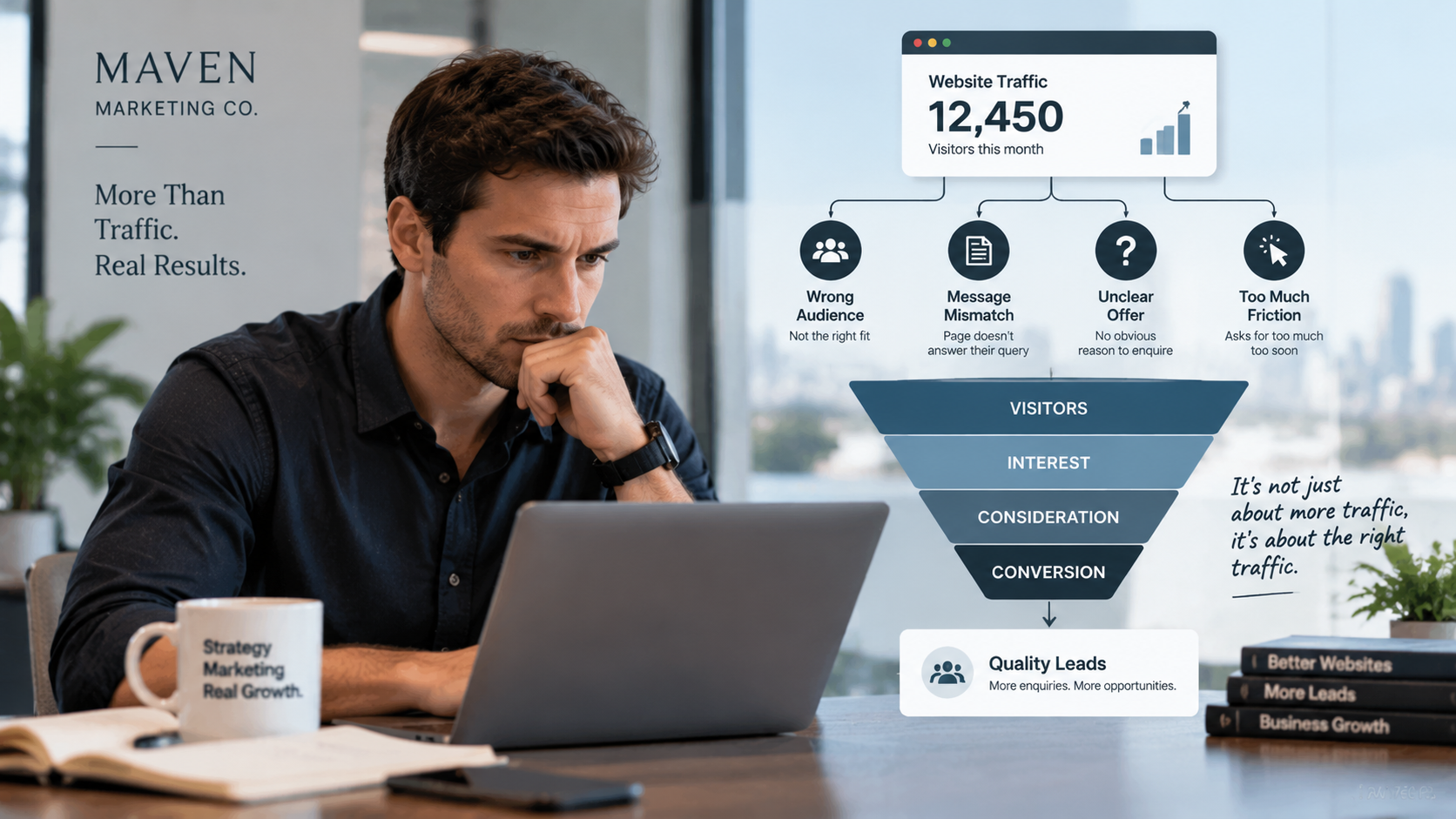
Traffic can fail to generate leads for several reasons, and most of them come down to relevance or friction. The visitor may be the wrong fit, the page may not answer the question that brought them there, the offer may be unclear, or the next step may ask for too much commitment too early.
This is especially common when businesses treat all traffic as equal. A visitor arriving from a high-intent Google search behaves differently from someone who has just discovered the brand through social media. A returning prospect who has already read a case study is at a different stage again. Sending all of those people to the same generic page with the same generic call to action usually leaves conversion opportunity on the table.
Message match is another major issue. Google Ads specifically recommends aligning landing-page content with the ad and keywords that brought the visitor there. A well-structured website built through professional web development services helps businesses create clear conversion paths, improve user experience and turn relevant visitors into enquiries. That principle applies beyond paid media as well. If a search result, ad or social post promises one thing and the page feels broader or different, trust drops and the visitor has to work harder to find what they expected.
The first diagnostic question should therefore be simple: is the website attracting the right visitors and giving them a clear, relevant path to the next step? If the answer is uncertain, more traffic alone is unlikely to fix the problem.
What Makes a Website Visitor a Qualified Lead?
A qualified website lead is a visitor who has taken a meaningful action and appears to have a reasonable fit with the business. Understanding lead quality is especially important for businesses using a B2B lead generation strategy, where enquiry volume needs to be balanced with commercial opportunity. The exact definition will vary by company, but it usually combines intent with practical suitability.
For a service business, qualification might include the type of service required, location, project size, timeframe, budget range or whether the person is a genuine decision maker. For a B2B business, it may also include company size, industry, role, urgency and commercial need. The point is not to create unnecessary barriers. It is to distinguish useful opportunities from low-fit enquiries.
This is why form submissions should not be treated as the final measure of lead generation success. A campaign that generates 30 enquiries with only a handful of genuine opportunities may be less valuable than one that generates 15 enquiries with a much stronger fit. Lead quality needs to be considered alongside lead volume.
A useful qualification framework asks four questions: does the visitor have a real need, can your business genuinely help, is there reasonable intent to act, and is there enough commercial value to justify the sales effort? Those criteria can then guide the content, form fields and reporting used across the website.
How to Build Better Conversion Paths
A strong conversion path makes the next step feel natural. The visitor should understand where they are, why the content is relevant and what action makes sense next. That does not mean every page needs a hard sales push. It means every important page should help the visitor progress.
For a typical service business, the path might look like this: relevant traffic arrives through search or advertising, the page confirms the visitor is in the right place, useful content answers key questions, trust signals reduce uncertainty and a clear call to action captures the lead. Effective SEO services help attract the right visitors by improving visibility for relevant searches and customer needs. the page confirms the visitor is in the right place, useful content answers key questions, trust signals reduce uncertainty, a clear call to action invites the next step, and a simple form or phone option captures the lead. Follow-up then continues the journey rather than leaving the enquiry sitting in an inbox.
The best conversion paths are also specific. High-intent service searches should usually lead to relevant service or landing pages, not a broad homepage. Informational visitors may need educational content before they are ready to enquire. Returning visitors may need stronger proof, comparison information or a direct booking option.
Clear Calls to Action
Calls to action should tell visitors what happens next. Vague buttons such as 'Learn More' can work in some contexts, but lead-generation pages often benefit from more specific wording such as 'Book a Strategy Call', 'Request a Quote', 'Talk to the Team' or 'Get a Project Estimate'. The wording should match the level of commitment the visitor is ready to make.
Placement matters too. A primary call to action should normally be visible early on high-intent pages, then repeated at natural decision points after the visitor has seen enough information to move forward. Secondary actions can support people who are not ready for the main conversion, such as viewing a case study, downloading useful information or contacting the business another way.
The key is consistency. The CTA on the ad or search result, the headline on the landing page and the action on the page should feel like parts of the same conversation. Professional Google Ads management services help businesses align targeting, messaging and landing pages to generate higher-quality leads from paid traffic. Google Ads describes this alignment as important to landing-page relevance and user expectations.
Relevant Landing Pages and Forms
Landing pages should be built around the intent that brought the visitor there. A page for a specific service should make that service obvious, explain who it suits, address common questions and provide proof close to the point of conversion. Generic pages force the visitor to search for relevance instead of seeing it immediately.
Forms should also be proportionate to the decision. Ask for the information needed to qualify and respond effectively, but avoid turning the first interaction into an application process. The W3C's current forms guidance recommends keeping forms simple, asking only for information required for the process, and using clear labels and instructions so people understand what to enter.
For many service businesses, a name, contact method, service requirement and a short project or enquiry field may be enough to begin. Additional qualification questions can be useful where they genuinely improve sales efficiency, but every field should have a reason to exist.
Matching Content to Different Buyer Stages
Not every visitor is ready to enquire immediately. One of the most effective ways to improve conversion paths is to match content and calls to action to the stage of the buying journey.
Early-stage visitors often need clarity. They may be trying to understand a problem, compare approaches or work out what a service actually involves. Useful articles, guides, FAQs and clear service explanations help build relevance without demanding an immediate sales conversation.
Consideration-stage visitors usually need evidence and differentiation. Case studies, reviews, project examples, process information, pricing context where appropriate, and clear explanations of what makes the business different can help reduce uncertainty. These visitors are closer to conversion but still need enough confidence to act.
Decision-stage visitors need a low-friction route to contact. That may mean a well-structured landing page, visible phone number, booking option or short form with a clear explanation of what happens after submission. Matching content to these stages helps the website support progression instead of treating every visitor the same.
Using Trust Signals to Increase Conversions
Trust becomes more important as the visitor gets closer to sharing details, booking a call or making a purchase decision. At that point, the website needs to answer a quiet but important question: why should I trust this business enough to take the next step?
Useful trust signals include genuine client reviews, case studies, recognisable customers where permission exists, accreditations, awards, team experience, clear contact details and transparent process information. The strongest proof is specific and credible rather than decorative. A vague statement that a business is 'trusted' carries far less weight than evidence showing who has trusted it and what outcome was achieved.
Trust should also sit close to the conversion point. If a visitor has to leave the page to find reviews, proof or contact information, unnecessary friction has been added. Relevant proof near forms, calls to action and key decision sections can help reassure visitors at the moment they are deciding whether to proceed.
Accuracy matters as well. Outdated testimonials, inconsistent contact details, unsupported claims or broken links can have the opposite effect. Trust is built through a consistent experience, not a single badge or testimonial block.
How to Reduce Friction in the Lead Generation Process
Conversion friction is anything that makes a reasonable next step harder than it needs to be. It can be obvious, such as a long form, or subtle, such as unclear button wording, poor mobile layout, slow loading, distracting navigation or uncertainty about what happens after an enquiry.
Start with mobile. A form that is easy to complete on desktop may still be awkward on a phone if fields are cramped, labels disappear, buttons are hard to tap or content loads slowly. Google recommends good Core Web Vitals because loading performance, responsiveness and visual stability contribute to user experience, and those same qualities matter when someone is trying to complete a conversion.
Next, remove unnecessary choices. High-intent landing pages do not need to send visitors in six directions. Keep the primary action clear, support it with relevant secondary options and make the page hierarchy obvious. This does not require stripping every navigation element from every page; it requires making the intended next step easy to recognise.
Finally, set expectations. Tell visitors what happens after they submit the form, when they can expect a response and what information will be useful. A simple confirmation such as 'We'll review your enquiry and contact you within one business day' can reduce uncertainty and make the process feel more professional. The exact response commitment should, of course, match what the business can consistently deliver.
Measuring and Improving Conversion Paths
Conversion optimisation works best when measurement follows the full path rather than stopping at page views or form submissions. Google Analytics allows important actions to be marked as key events, while Path Exploration can be used to examine how users move through pages and events before or after those actions.
For lead-generation websites, useful measurements normally include landing-page conversion rate, form completions, call or booking actions, qualified lead rate, cost per qualified lead, sales opportunities and revenue where the data can be connected reliably. The exact set should reflect the business model rather than a generic dashboard.
Pay particular attention to the difference between a conversion and a qualified lead. If form completions rise but lead quality falls, the website may be making it too easy for the wrong audience to convert or the marketing may be attracting poor-fit traffic. If traffic is relevant but conversions remain weak, the problem is more likely to sit in messaging, trust, UX or the offer itself.
Use testing carefully. Change one meaningful element at a time where possible, such as the headline, CTA wording, form length, trust placement or landing-page structure, then evaluate the result against enough data to make a sensible decision. The aim is not constant random change. It is a steady process of identifying friction, testing improvements and keeping what genuinely performs better.
The final step is connecting marketing data with sales feedback. The website can tell you who converted; sales and CRM data can tell you whether those people became genuine opportunities. That connection is what turns conversion-rate optimisation into qualified lead optimisation.
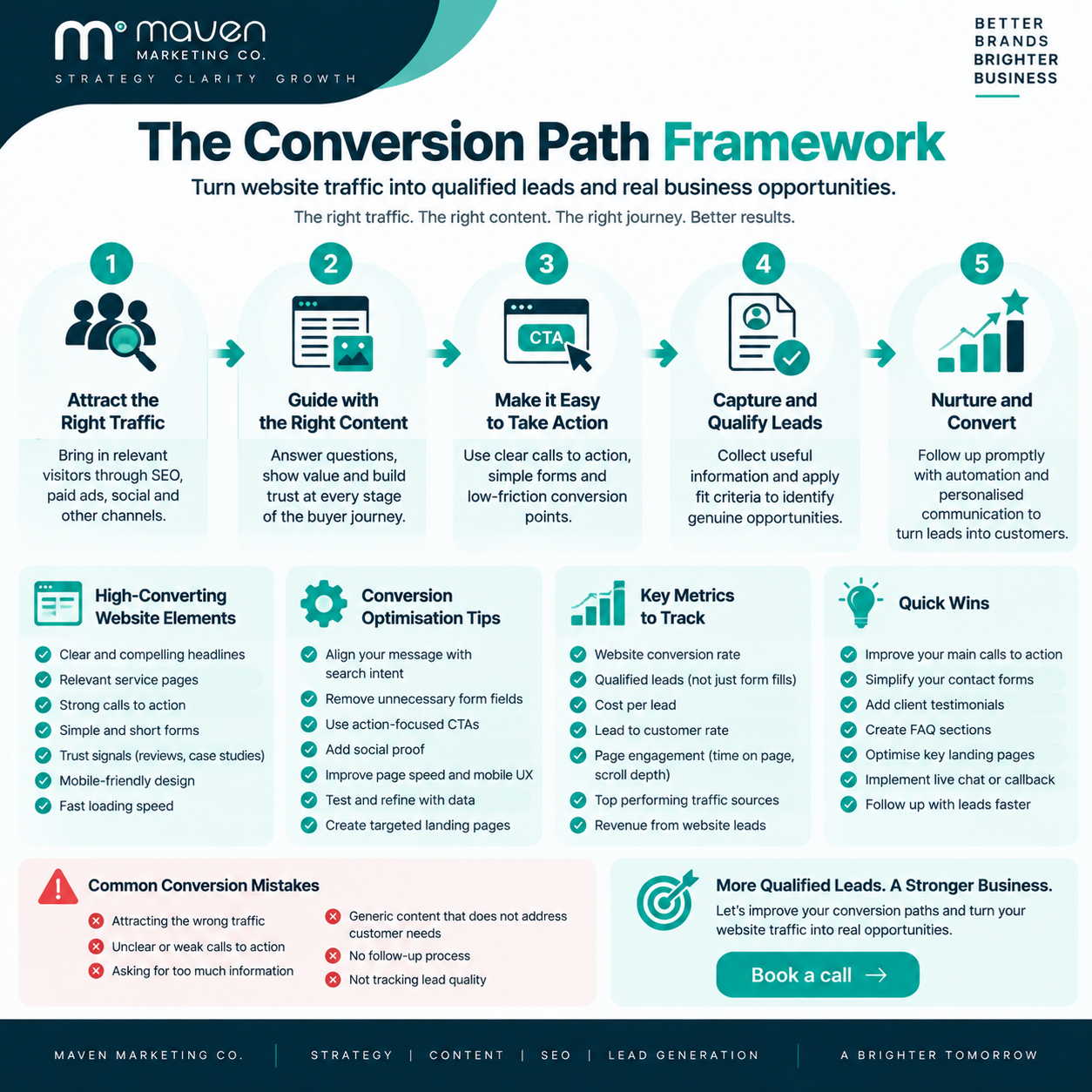
Infographic: The Conversion Path Framework
FAQs
How can I turn website traffic into leads?
Start by making sure you are attracting relevant visitors, then create a clear path from their original intent to a useful landing page, strong message, trust signals and an obvious next action. Keep forms simple and make follow-up fast and consistent.
What is a qualified website lead?
A qualified website lead is someone who has taken a meaningful action and appears to be a reasonable fit for the business based on factors such as need, service fit, location, budget, timeframe or buying intent. The exact criteria should reflect your sales process.
What are conversion paths on a website?
A conversion path is the sequence of pages, content, calls to action and interactions a visitor moves through before completing a valuable action such as an enquiry, booking or phone call. Strong conversion paths reduce friction and keep the next step clear.
How can I improve my website conversion rate?
Improve relevance first. Match pages to visitor intent, strengthen headlines and value propositions, use clear CTAs, simplify forms, improve mobile usability and page speed, add credible proof and measure the steps where visitors drop out.
What makes a website effective for lead generation?
An effective lead-generation website attracts the right audience, explains the offer clearly, builds trust, makes action easy and measures both conversion volume and lead quality. It should support the customer journey rather than simply present information.
Turn more of the right traffic into real opportunities
A website does not need more traffic at any cost. It needs the right traffic moving through a clear, relevant conversion path. When messaging, landing pages, trust, forms and follow-up work together, the site becomes a much stronger commercial asset.
Maven Marketing Co. helps businesses improve the connection between traffic, website experience and qualified lead generation. If you want to identify where your conversion paths are losing opportunities and what should be improved first, book a call with the team.

Table of contents
read more blogs

How to Measure Marketing ROI Across SEO, PPC and Social Media
Marketing reporting can become very busy without becoming very useful. A dashboard might show thousands of impressions, rising traffic, cheaper clicks and strong engagement, yet still leave the most important question unanswered: is marketing creating enough commercial value for the business?That is the purpose of marketing ROI. It moves the conversation away from activity alone and towards the return generated from the money, time and resources invested in marketing. For some businesses that return is direct revenue. For others it is qualified pipeline, customer acquisition, repeat business or a combination of outcomes that eventually translate into profit.Measuring digital marketing ROI is not as simple as forcing SEO, PPC and social media into one identical formula. A connected digital marketing strategy helps businesses evaluate each channel based on its role, contribution and impact on overall growth. Paid search often produces clearer campaign-level cost and conversion data. SEO may compound over a longer period. Social media can create awareness, assist later conversions and support customer relationships as well as generate direct leads. The measurement framework needs to respect those differences while still connecting every channel to commercial outcomes.This guide explains how to measure marketing ROI across SEO, PPC and social media, which metrics matter, how attribution changes the picture and how to build a reporting process that helps you make better budget and strategy decisions.

How to Build a Strong Online Presence for Your Business
A strong online presence is no longer just about having a website and a few social media accounts. It is the combined experience people have when they search for your business, visit your website, see your content, read reviews, encounter your advertising and interact with your brand across digital channels.For most businesses, that experience shapes trust before a conversation ever happens. Potential customers can compare providers, read reviews, visit service pages, check social activity and form an opinion about your credibility long before they enquire. If those signals are weak, inconsistent or hard to find, the business can lose opportunities without ever knowing they were there.Building a strong online presence is therefore less about being everywhere and more about being easy to find, easy to understand and easy to trust. A complete digital marketing strategy helps businesses connect their website, search visibility, content, advertising and customer engagement into one consistent growth system. Your website, search visibility, content, social presence, paid activity, brand and customer engagement all need to reinforce the same commercial story.This guide explains how to build a stronger business online presence step by step. The focus is practical: improving visibility, creating useful content, strengthening brand consistency, reducing friction and measuring whether your digital presence is actually helping the business attract and convert better opportunities.

The Ultimate Guide to E-commerce Product Page Optimisation
A strong e-commerce product page has to do several jobs at once. It needs to be discoverable in search, easy to understand, persuasive enough to build confidence and simple enough for a customer to buy without unnecessary friction. That combination is what makes product page optimisation such an important part of both ecommerce SEO and conversion strategy.The difficulty is that product pages are often built from one reusable template across hundreds or thousands of products. If the template is weak, the problem scales. Thin descriptions, poor imagery, unclear variants, buried shipping information or an awkward mobile experience can affect a large part of the store at the same time.Current product-page UX research from Baymard continues to show how often shoppers abandon otherwise suitable products because of avoidable usability issues. At the same time, Google provides dedicated guidance for e-commerce sites, product structured data, product variants and image optimisation because product information needs to be clear and machine-readable as well as useful to people.The goal is not to stuff every product page with more text or technical markup. A complete digital marketing strategy combines SEO, user experience, content and conversion improvements to help ecommerce businesses attract and convert the right customers. It is to give shoppers the information they need, in the right order, while helping search engines understand what the product is, whether it is available and how the page relates to the wider store. This guide covers the practical elements that make that happen.


