.svg)


%201.svg)
.avif)
Key Takeaways
- B2B content marketing succeeds by serving decision-maker information needs rather than promoting products, building genuine trust through valuable insights that earn attention in crowded executive inboxes and feeds
- Australian decision-makers research extensively before engaging sales teams, with 70% of the buying journey completed independently—content must address every stage from awareness through evaluation and decision
- Effective B2B content formats include thought leadership articles, industry research reports, case studies with measurable outcomes, webinars, and ROI calculators that address specific business problems decision-makers face
- Distribution strategy targeting Australian executives requires LinkedIn-first approach, direct email outreach, industry publication placements, conference presence, and peer network activation rather than broad social media tactics
- Measuring B2B content marketing success requires tracking pipeline influence, sales cycle acceleration, deal size impact, and revenue attribution rather than vanity metrics like traffic and social engagement alone
A Brisbane industrial equipment supplier invested heavily in product-focused content—detailed specifications, feature comparisons, and promotional case studies emphasising their equipment's capabilities. Content reached some procurement managers but rarely influenced senior decision-makers authorising major capital expenditure. Sales cycles remained long. Win rates were mediocre.
They repositioned content strategy entirely, focusing on decision-maker priorities rather than product features. Published original research on operational efficiency benchmarks across Australian manufacturing sectors. Created ROI calculators enabling CFOs to model equipment investment returns. Developed regulatory compliance guides helping operations managers navigate Australian workplace safety requirements. Produced industry trend analysis relevant to CEO strategic planning.
Decision-makers began engaging with content voluntarily. CFOs shared ROI calculators with procurement teams. Operations managers forwarded compliance guides to colleagues. CEOs referenced industry research in internal strategy documents. Sales conversations shifted from product education to business outcome discussion. Average deal size increased 40%. Sales cycle shortened by three months. The transformation resulted entirely from content strategy repositioning—from product promotion to genuine decision-maker value creation.
According to research from LinkedIn's B2B Institute, 95% of B2B buyers are not in-market at any given time, making long-term thought leadership content that builds brand preference during the 95% of time buyers aren't actively purchasing critical to eventual sales success.
.avif)
Understanding Australian B2B Decision-Makers
Effective B2B content requires deep understanding of how Australian decision-makers think, research, and make purchasing decisions within their organisational contexts.
Decision-maker psychology differs fundamentally from consumer purchasing. B2B decisions involve career risk (wrong decisions damage professional reputation), organisational accountability (defending choices to boards and colleagues), collective consensus (multiple stakeholders must align), and extended evaluation (thorough due diligence before commitment). Content must acknowledge these psychological pressures, reducing perceived risk through evidence, social proof, and demonstrated expertise rather than simply promoting product benefits.
Research behaviour patterns reveal how Australian executives gather information before engaging vendors. Research from Gartner shows B2B buyers spend only 17% of their total buying time meeting with potential suppliers—the majority of research happens independently through industry publications, peer networks, online searches, and content consumption. By the time decision-makers contact sales teams, they've already formed significant opinions based on content encountered during independent research.
Information hierarchy determines what content earns executive attention. Senior decision-makers prioritise strategic implications (how does this affect our competitive position?), financial outcomes (what measurable return will this deliver?), implementation risk (what could go wrong and how is it mitigated?), and peer validation (what are comparable organisations doing?). Content addressing these priorities earns engagement; content focused on product features or vendor credentials gets filtered out.
Buying committee complexity characterises most significant Australian B2B purchases. Typical enterprise decisions involve economic buyers (CFOs, financial directors authorising expenditure), technical buyers (IT managers, operations directors evaluating specifications), end users (staff who will use products or services), and influencers (consultants, industry advisors shaping recommendations). Content strategy must address each stakeholder's distinct priorities rather than targeting single decision-maker.
Australian market characteristics influence B2B content strategy specifically. Australia's relatively small market means decision-makers often know each other through industry associations and professional networks, creating strong peer influence dynamics. Geographic concentration in Sydney, Melbourne, and Brisbane creates networking density influencing word-of-mouth and reference sharing. Australian executives tend to value directness, practical application over theory, and local relevance over international case studies.
Industry-specific content preferences vary significantly across Australian sectors. Mining and resources executives prioritise operational safety, regulatory compliance, and productivity metrics. Financial services decision-makers focus on regulatory adherence, risk management, and technology transformation. Healthcare administrators emphasise patient outcomes, clinical evidence, and operational efficiency. Construction and infrastructure leaders value project delivery, compliance frameworks, and subcontractor management. Understanding sector-specific priorities enables content relevance that generic B2B content can't achieve.
Digital research habits reveal where Australian decision-makers consume information. LinkedIn dominates professional content consumption for most industries. Industry-specific publications and associations maintain significant influence. Peer recommendations through professional networks carry substantial weight. Conference presentations and industry events remain important in relationship-oriented Australian business culture. Email remains primary communication channel for business content distribution.
.avif)
Building B2B Content Strategy Around Buyer Journey Stages
Effective B2B content strategy maps content to distinct buying journey stages, ensuring decision-makers encounter relevant information throughout extended purchasing processes.
Awareness stage content addresses decision-makers before active purchasing consideration. Content objectives include identifying and framing business problems, establishing category relevance and urgency, building initial brand awareness and credibility, and positioning your organisation as knowledgeable industry participant. Formats include thought leadership articles examining industry trends, research reports revealing benchmark data, educational guides explaining emerging challenges, and opinion pieces addressing strategic business questions. Awareness content should never mention products or services—focus exclusively on decision-maker education.
Consideration stage content serves decision-makers actively researching solutions. Objectives include demonstrating understanding of specific challenges, differentiating your approach from alternatives, building confidence in your methodology, and nurturing relationships toward sales readiness. Formats include detailed case studies showing solution implementation, comparison frameworks helping buyers evaluate options, webinars demonstrating expertise and enabling questions, and diagnostic tools helping prospects assess their current situation. Consideration content addresses solution categories while establishing your approach's advantages.
Decision stage content supports final vendor selection. Objectives include reducing perceived implementation risk, enabling internal business case development, facilitating stakeholder consensus building, and providing justification for selection decisions. Formats include detailed implementation guides reducing uncertainty, ROI calculators enabling financial justification, reference programmes connecting prospects with existing clients, and proposal support materials helping champions advocate internally. Decision content directly addresses purchase justification requirements.
Post-purchase content retains clients and generates referrals. Objectives include ensuring successful implementation, maximising product/service value realisation, building advocacy for referrals and case studies, and identifying expansion opportunities. Formats include onboarding guides and training resources, best practice documentation, customer success stories featuring clients prominently, and advanced usage guides for experienced users. Post-purchase content protects revenue through retention whilst generating marketing assets from satisfied clients.
Content gap analysis identifies missing journey stage coverage. Map existing content against buyer journey stages, identify stages lacking adequate content support, prioritise content creation filling critical gaps, and ensure seamless progression from awareness through decision. Most Australian B2B marketers have reasonable awareness content but insufficient decision-stage material helping buyers justify and execute purchases.
High-Impact B2B Content Formats
Certain content formats perform significantly better in B2B contexts given decision-maker information needs, evaluation criteria, and consumption preferences.
Original research and industry reports represent highest-value B2B content investment. Proprietary data, benchmark studies, and industry surveys create content assets competitors cannot replicate, establish genuine thought leadership through unique insights, generate substantial media coverage and backlinks from publications citing your data, and provide sales teams with conversation-starting assets. Annual research programmes build cumulative authority as organisations become known for data-driven industry perspective. According to research from Demand Gen Report, 76% of B2B buyers rely on research reports and data when evaluating purchases, making original research particularly influential.
Executive thought leadership builds personal and organisational authority simultaneously. CEO and senior leader bylines in industry publications demonstrate executive expertise, LinkedIn articles from company leaders reach professional networks authentically, keynote presentations at industry conferences establish peer credibility, and podcast appearances build intimate audience relationships through extended conversation format. Australian B2B buyers frequently research company leadership before engaging vendors—executive content shapes favourable impressions during independent research phases.
Case studies with measurable outcomes provide social proof serving multiple decision-maker priorities. Structure case studies around specific challenges, solution implementation, and quantified outcomes (percentage improvements, dollar savings, time reductions). Include client testimonials from named executives adding authenticity. Feature clients in comparable industries and company sizes enabling prospect identification. Australian decision-makers respond particularly well to local case studies featuring recognisable Australian businesses rather than international examples requiring contextual translation.
ROI calculators and business case tools directly address financial decision-maker requirements. Interactive calculators enabling prospects to input their specific parameters and calculate potential returns give CFOs and economic buyers tools for internal justification. Business case templates providing financial modelling frameworks reduce implementation friction. Payback period calculators making investment timelines concrete address common executive concerns about capital commitment duration. Practical financial tools often become most-shared B2B content as champions distribute them internally during evaluation.
Webinars and virtual events combine content distribution with lead generation and relationship building. Educational webinars addressing genuine decision-maker challenges attract self-qualified prospects willing to invest an hour. Panel discussions featuring respected industry voices leverage peer influence dynamics. Workshop formats providing practical application attract implementation-focused buyers. Australian B2B audiences respond particularly well to locally-relevant webinars featuring Australian speakers addressing Australian market conditions rather than adapted international content.
Regulatory and compliance guides serve Australian B2B buyers navigating complex legal environments. Privacy Act compliance guides for businesses handling customer data, workplace health and safety frameworks for operations managers, financial services regulatory updates for compliance professionals, and environmental regulations for resource sector businesses all address genuine information needs. Compliance content demonstrates regulatory expertise whilst attracting buyers whose roles centre on managing compliance risk.
Video content increasingly influences B2B decisions across Australian industries. Executive interview series building leader profiles, customer testimonial videos adding authentic voice to case studies, product demonstration videos reducing evaluation friction, and thought leadership videos making insights accessible to visual learners all serve different decision-maker needs. Video consumption habits among Australian professionals have accelerated significantly, making video an increasingly essential B2B content format rather than optional enhancement.
.avif)
LinkedIn Strategy for Australian B2B Decision-Makers
LinkedIn dominates Australian professional content consumption, requiring dedicated strategy maximising platform-specific opportunity.
Company page optimisation establishes professional credibility foundation. Complete company description positioning expertise clearly, consistent content publishing demonstrating active presence, employee advocacy programmes amplifying reach through individual networks, and showcase pages for specific products or audience segments create comprehensive LinkedIn presence. Company pages serve as digital business cards—decision-makers evaluating vendors frequently review company LinkedIn profiles.
Executive personal branding leverages individual authenticity LinkedIn's algorithm rewards. Senior leaders publishing personal perspectives generate substantially higher engagement than company page content, authentic voice differentiating from corporate polish resonates with peer decision-makers, and regular insightful posting builds recognition within Australian industry networks. Encourage and support executive LinkedIn activity through content assistance, publishing calendars, and engagement coaching rather than leaving personal branding to individual initiative.
LinkedIn article publishing reaches professional audiences through platform's native content format. Long-form articles examining industry topics, sharing original research findings, or analysing strategic business questions perform well in LinkedIn's algorithm whilst demonstrating thought leadership. Articles appear in followers' feeds, search results, and Google's index extending reach beyond LinkedIn audience. Native LinkedIn articles receive substantially more algorithm distribution than posts linking to external websites.
Sponsored content targeting reaches Australian decision-makers precisely through LinkedIn's unmatched professional targeting. Job title targeting (CFO, Operations Director, IT Manager), industry filtering (mining, financial services, healthcare), company size selection (enterprise, mid-market), and seniority level targeting enable precise audience definition unavailable on other advertising platforms. Australian LinkedIn advertising enables targeting specific roles within specific industries in specific Australian cities—precision justifying higher CPM than broader digital advertising.
LinkedIn outreach sequences nurture connections toward content engagement. Connection request with personalised note referencing shared context, follow-up sharing relevant content piece, engagement with prospect's content building reciprocal relationship, and gradual progression toward direct conversation create systematic relationship development. Avoid immediately pitching products following connection—provide value through content before requesting meetings.
LinkedIn groups and communities enable participation in existing decision-maker conversations. Join industry-specific Australian LinkedIn groups, contribute genuinely valuable insights rather than promotional content, share original content as natural part of discussions, and build recognition as knowledgeable community participant. Group participation builds relationships and awareness organically rather than through paid promotion.
.avif)
Content Distribution Beyond LinkedIn
Comprehensive B2B distribution extends beyond LinkedIn through multiple channels reaching Australian decision-makers across their professional information consumption touchpoints.
Industry publication partnerships place content in publications decision-makers already trust and consume. Identify key Australian industry publications for your target sectors, pitch byline articles offering genuine insights rather than promotional content, build relationships with editors enabling ongoing contribution, and leverage publication credibility enhancing content authority. Industry publication placement reaches audiences who would never encounter your owned channels whilst benefiting from publication trust transfer.
Email marketing to decision-makers reaches executives directly without algorithm dependency. Build email lists through content downloads, webinar registrations, event attendance, and direct relationship cultivation. Segment lists by industry, role, and buying journey stage enabling relevant content delivery. Create executive-appropriate email content—brief, insight-dense, immediately valuable, respecting time constraints. Avoid newsletter formats burying insights in lengthy emails poorly suited to executive consumption.
Industry association engagement builds authority within professional communities. Sponsor industry association publications and events, participate in association research and reports, present at association conferences, and contribute expertise to working groups or committees. Australian industry associations maintain strong member trust—association-endorsed content carries credibility beyond self-published material.
Conference and event presence remains particularly important in Australia's relationship-oriented B2B culture. Speaking engagements establish peer-level credibility unavailable through digital content alone, booth presence creates physical engagement opportunities, sponsored events associate brand with industry gatherings, and networking provides direct decision-maker relationship development. Australian business culture values face-to-face relationships supporting digital content engagement.
Podcast development and guest appearances build authority through long-form audio. Create branded podcast series addressing industry challenges reaching commuting Australian executives, or pursue guest appearances on established Australian industry podcasts reaching existing audiences. Podcast audiences develop strong presenter affinity through extended listening, creating meaningful authority and trust.
Sales team content enablement ensures content reaches decision-makers through relationship channels. Equip sales teams with relevant content for different prospect situations, train teams on content sharing as value-adding rather than promotional behaviour, create content sharing tools and templates reducing friction, and track content influence on sales conversations. Sales-distributed content often reaches decision-makers more effectively than digital channels due to personal relationship context.
.avif)
Measuring B2B Content Marketing Effectiveness
B2B content marketing measurement requires sophisticated attribution connecting content engagement to business outcomes rather than tracking vanity metrics disconnected from revenue.
Pipeline influence tracking connects content engagement to sales opportunities. Identify content pieces consumed by contacts within active opportunities, measure percentage of closed deals involving content engagement, calculate average deal values for content-influenced versus uninfluenced opportunities, and attribute content contribution to pipeline development. Pipeline influence demonstrates content's commercial contribution beyond traffic metrics.
Sales cycle impact measurement reveals content's efficiency contribution. Compare average sales cycle length for prospects engaging with significant content versus minimal content engagement, identify content pieces consumed immediately before sales conversations, and measure progression speed between buying stages. Content reducing sales cycle length delivers measurable efficiency value translating directly to revenue timing.
Content-attributed revenue provides ultimate ROI demonstration. Implement multi-touch attribution tracking content touchpoints throughout buying journeys, calculate revenue influenced by specific content pieces, compare content production costs against attributed revenue, and calculate content programme ROI. Revenue attribution justifies ongoing B2B content investment to financially-focused leadership.
Engagement quality metrics assess decision-maker content resonance. Track time spent with content pieces (longer indicates deeper engagement), scroll depth on written content, video completion rates, return visits to content, and content download rates. Quality engagement from target decision-makers indicates content relevance—high traffic from non-target audiences provides vanity without commercial value.
Lead quality scoring differentiates content-generated leads. Score leads based on content consumed (research reports indicate higher intent than awareness articles), job title and company fit, engagement depth and frequency, and buying journey stage signals. Content-generated lead scoring enables sales prioritisation and marketing programme evaluation beyond raw lead volume.
Brand authority indicators measure thought leadership programme impact. Track share of voice in Australian industry conversations, media mention frequency and quality, speaking invitation increases, industry award recognition, and analyst or consultant references. Brand authority improvements may not immediately translate to revenue but build competitive advantages compounding over time.
Frequently Asked Questions
How should Australian B2B businesses balance thought leadership content that builds long-term authority with more direct lead generation content producing immediate results?
Effective B2B content programmes balance both objectives rather than choosing between them—typically allocating 60-70% of content effort toward thought leadership and 30-40% toward direct lead generation. Thought leadership builds the awareness and trust enabling lead generation content to convert—audiences responding to gated content, webinar registrations, or consultation offers are often already familiar with your brand through prior thought leadership exposure. Separate KPIs measure each content type: thought leadership tracks brand awareness, share of voice, and media mentions, whilst lead generation content tracks form completions, qualified leads, and pipeline contribution. Avoid abandoning thought leadership for short-term lead generation focus—organisations prioritising immediate leads sacrifice the compounding authority advantages making future lead generation progressively more efficient.
What content formats work best for reaching C-suite executives versus operational decision-makers within Australian B2B organisations?
C-suite executives (CEOs, CFOs, COOs) typically respond to strategic content addressing competitive positioning, financial outcomes, market trends, and organisational transformation rather than operational detail. Preferred formats include executive briefings (concise, insight-dense summaries), original industry research (data informing strategic decisions), peer-authored thought leadership (content from respected industry leaders), and financial modelling tools (ROI calculators, business case frameworks). Operational decision-makers (IT directors, operations managers, procurement leads) engage more deeply with technical content addressing implementation challenges, process improvements, and tactical execution. Preferred formats include detailed case studies, technical white papers, comparison frameworks, and process guides. Most significant Australian B2B purchases require engaging both levels simultaneously—strategic content winning C-suite preference whilst technical content satisfying operational evaluation requirements.
How can Australian B2B companies with limited marketing budgets compete against larger competitors with substantial content marketing resources?
Budget-constrained B2B marketers can compete effectively through specialisation and authenticity unavailable to larger competitors. Narrow focus on specific Australian industry verticals or buyer personas rather than attempting broad market coverage enables deeper relevance than generalist competitors achieve. Original research using affordable survey tools (SurveyMonkey, Typeform) with existing client and industry contacts generates unique data without expensive research firm engagements. Executive authenticity through genuine CEO and senior leader perspectives offers differentiation that large corporate communications teams producing polished but impersonal content cannot match. Strategic publication partnerships placing quality content in established industry publications reach decision-makers without paid distribution budgets. Prioritise 3-4 high-quality pieces monthly over high-volume mediocre content production—quality concentration delivers superior results to volume strategies requiring unsustainable resources.
How should Australian B2B businesses approach content personalisation for different industries when resources don't allow creating entirely separate content programmes?
Tiered personalisation balances relevance against resource constraints through strategic adaptation rather than complete recreation. Foundation content addressing universal B2B challenges provides base layer applicable across industries. Industry-specific versions adapt examples, statistics, and case studies for primary sectors without recreating strategic frameworks. Segment-specific distribution ensures industry-relevant content reaches appropriate audiences through targeted email segmentation, LinkedIn audience targeting, and industry publication partnerships. Sales team personalisation provides final customisation layer—equip teams with industry-specific talking points and examples enabling them to contextualise content for individual prospects. This layered approach delivers substantial personalisation benefits at fraction of cost required for entirely separate content programmes per industry.
What are the most common content marketing mistakes Australian B2B organisations make when attempting to engage decision-makers, and how should they be avoided?
Most common mistakes include product-centric content that fails to address decision-maker priorities beyond vendor evaluation. Decision-makers aren't interested in your product features until they've decided a solution category is worth pursuing—lead with business problems and industry insights rather than product capabilities. Inconsistent publishing undermining authority building is equally damaging—sporadic content provides insufficient touchpoints to build recognition and trust. Develop realistic publishing cadences you can sustain rather than ambitious programmes that collapse. Neglecting distribution investment whilst focusing entirely on creation means excellent content reaching nobody—allocate at least equal resources to distribution as creation. Measuring only vanity metrics (traffic, social followers) rather than pipeline impact creates false performance impressions, potentially defunding programmes genuinely influencing revenue whilst appearing unproductive by wrong measures.
How long should Australian B2B organisations expect before content marketing delivers measurable pipeline and revenue impact, and what early indicators suggest a programme is on track?
Realistic timelines for measurable pipeline impact range 9-18 months for most Australian B2B programmes, reflecting the extended buying cycles typical in enterprise markets. Early indicators suggesting programmes are on track appear sooner—typically 3-6 months. Positive early indicators include decision-makers engaging with content pieces (LinkedIn article views from target job titles, gated content downloads from target companies), sales teams reporting prospects referencing content during conversations, industry peers commenting on and sharing thought leadership content, inbound connection requests from decision-makers following content publication, and media mentions or speaking invitations reflecting growing authority. Organisations expecting immediate revenue impact misunderstand B2B content marketing's mechanism—content builds the trust and familiarity that accelerates eventual sales conversations rather than generating immediate transactions.
How should Australian B2B companies integrate content marketing with account-based marketing (ABM) programmes targeting specific high-value organisations?
ABM and content marketing integration creates powerful personalisation at scale through coordinated targeting of specific accounts with strategically relevant content. Identify named target accounts and research their specific challenges, strategic priorities, and key decision-makers. Create or adapt existing content addressing those specific challenges—industry-specific research relevant to target account sector, case studies from comparable organisations, and thought leadership addressing strategic questions their executive team faces publicly. Distribute through channels target account decision-makers use—LinkedIn targeting specific company employees, personalised email outreach, and direct sales team distribution. Track target account engagement with content as ABM progression metric. The combination of broad thought leadership building category authority with targeted ABM content addressing specific account priorities creates comprehensive engagement across both aware and unaware decision-makers within priority accounts.
B2B Content Marketing Builds Sustainable Australian Business Growth
Effective B2B content marketing transforms Australian organisations from vendors competing on price and features into trusted advisors whose expertise decision-makers actively seek. This positioning shift changes sales conversations, shortens buying cycles, increases deal sizes, and builds sustainable competitive advantages that product-focused marketing cannot replicate.
The strategies outlined in this guide—deep decision-maker understanding, buyer journey alignment, high-impact format selection, LinkedIn-led distribution, and revenue-focused measurement—provide comprehensive framework for B2B content programmes engaging Australian industry decision-makers throughout extended purchasing journeys.
Australian B2B organisations committed to genuine decision-maker value creation through content marketing consistently outperform competitors relying on traditional interruption-based approaches as buying behaviour continues shifting toward independent research and peer validation.
Ready to develop B2B content marketing strategy engaging Australian industry decision-makers? Maven Marketing Co. provides comprehensive B2B content strategy, creation, and distribution services tailored to Australian industry sectors and decision-maker audiences. Let's build content programmes that establish your authority and drive measurable pipeline results.

Table of contents
read more blogs
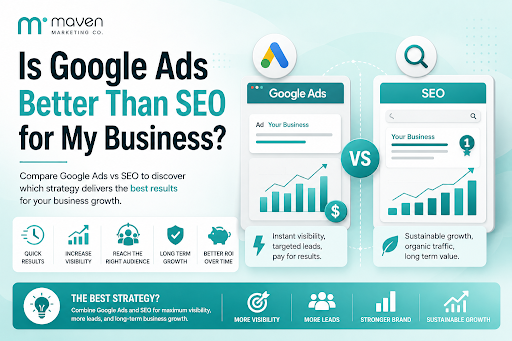
Is Google Ads Better Than SEO for My Business
One of the biggest questions business owners ask when they are planning online growth is whether they should invest in Google Ads or SEO. Both are strong marketing plays that help your company show up in Google search results, but they do things in separate lanes. Google Ads gives quicker visibility and can bring in leads fast, whereas SEO more or less focuses on slow, steady organic traffic that tends to grow the longer you keep building it. Picking the right direction depends on what you want to achieve, how much money you can spend, how crowded the market is, and how quickly you need results, like sooner rather than later. The good news is you don’t always have to choose one or the other; it’s not exactly a black-and-white situation. If you take time to understand the strongest points of both, you can put together a more sensible digital marketing plan that supports consistent expansion. In this guide, we’ll compare Google Ads vs SEO, explain the main differences, and help you figure out what option makes the most sense for your business.

When Should I Hire a Digital Marketing Agency
Growing a business today takes more than just having a website or throwing a post on social media; customers usually search around online, compare providers, skim reviews, and basically expect the brand to show up with a solid digital presence before they even think about buying. Many businesses try to run their marketing themselves, but there comes a point when “doing it all in-house” becomes clunky and hard to manage, all at once. Knowing when to hire a digital marketing agency can end up making a big, real difference for your growth. If you’re not getting enough leads, or your online visibility feels stuck, or sales are just not moving, the right agency can bring the know-how, plus a clear plan, to help you get noticeably better outcomes. In this guide, we’ll dig into what a digital marketing agency actually does, the usual signs it’s time to bring one on, and how picking the right marketing partner can help your business move forward at a faster pace.
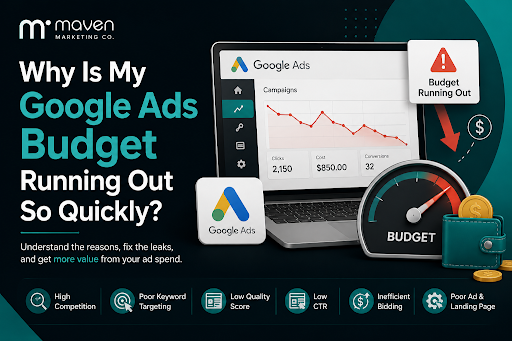
Why Is My Google Ads Budget Running Out So Quickly
Running a successful Google Ads budget isn’t only about throwing more money at it. It’s more like making every dollar, doing a bit extra. A lot of businesses start a Google Ads campaign with big hopes, then find out their daily budget is gone within a few hours, and that feels weird, right? After that, your ads stop showing effectively, new leads slip away, and your return on investment dips. So if your Google Ads budget is running out too fast, don’t stress. It’s a fairly common issue, and in most situations, it can be repaired with the right approach. There are multiple little things that can drain your advertising money quicker than you expected, from costly keywords to audience targeting that just doesn’t quite fit. In this guide, we’ll walk through why your budget disappears so quickly, how to cut wasteful spend, and the most reliable ways to boost your Google Ads ROI, even if your budget stays the same.