


A strong online presence is no longer just about having a website and a few social media accounts. It is the combined experience people have when they search for your business, visit your website, see your content, read reviews, encounter your advertising and interact with your brand across digital channels.
For most businesses, that experience shapes trust before a conversation ever happens. Potential customers can compare providers, read reviews, visit service pages, check social activity and form an opinion about your credibility long before they enquire. If those signals are weak, inconsistent or hard to find, the business can lose opportunities without ever knowing they were there.
Building a strong online presence is therefore less about being everywhere and more about being easy to find, easy to understand and easy to trust. A complete digital marketing strategy helps businesses connect their website, search visibility, content, advertising and customer engagement into one consistent growth system. Your website, search visibility, content, social presence, paid activity, brand and customer engagement all need to reinforce the same commercial story.
This guide explains how to build a stronger business online presence step by step. The focus is practical: improving visibility, creating useful content, strengthening brand consistency, reducing friction and measuring whether your digital presence is actually helping the business attract and convert better opportunities.
Key takeaways
· A strong online presence combines website quality, search visibility, useful content, social activity, digital advertising, brand consistency and audience engagement.
· Your website should act as the central credibility and conversion point rather than simply an online brochure.
· SEO and content help people discover and understand your business, while paid advertising can support immediate demand and targeted reach.
· Consistency across channels improves recognition and trust, but every channel still needs a clear role rather than repeating the same message everywhere.
· Measure online presence using qualified traffic, branded search, engagement, enquiry quality, conversion rate and repeat visits rather than vanity metrics alone.
What Is an Online Presence?
An online presence is the overall footprint your business creates across digital channels. It includes the assets you control, such as your website, landing pages, social profiles and email activity, as well as the wider signals people encounter through search engines, reviews, directories, advertising and third-party mentions.
It is useful to think of digital presence as a connected system rather than a collection of separate profiles. A customer may first find a business through Google, then visit the website, check social media, read reviews and return later through a branded search or paid ad. Each touchpoint contributes to the impression they form.
That means online presence is partly about visibility and partly about credibility. Being found matters, but so does what people see when they find you. A strong presence should make the business easy to recognise, understand and evaluate, while giving potential customers clear next steps when they are ready to act.
Why a Strong Online Presence Matters for Your Business
A strong online presence matters because buying decisions increasingly involve digital research, even when the final conversion happens offline. People compare options, check reviews, assess expertise and look for reassurance before they make contact. If your business is difficult to find or looks inconsistent across channels, that uncertainty can work against you.
Good digital presence also improves efficiency. When your website explains the offer clearly, your search visibility attracts relevant visitors and your brand is consistent across channels, prospects arrive with more context. That can improve enquiry quality and reduce the amount of basic explanation required once sales conversations begin.
It also creates resilience. A business that relies on one source of visibility is exposed if that channel becomes more expensive, more competitive or less effective. A stronger presence spreads visibility across search, content, social, paid activity, referrals and repeat engagement so the business is not dependent on one platform alone.
1. Create a Professional and User-Friendly Website
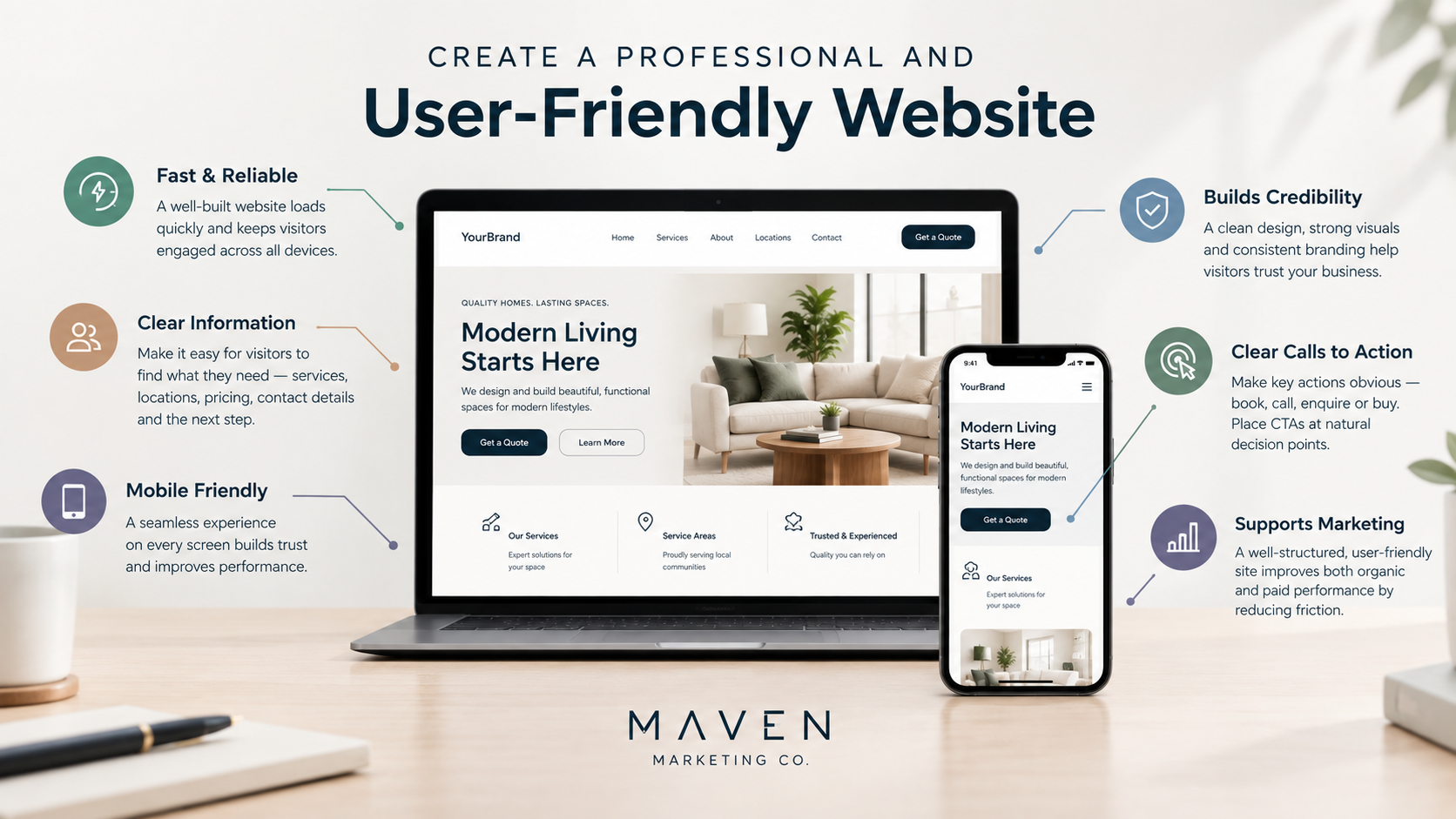
Your website is usually the central asset in your online presence because it is the place where you control the message, experience and conversion path. Professional web development services help businesses create websites that are fast, user-friendly and designed to support conversions. It should quickly communicate what the business does, who it is for, why it is credible and what the visitor should do next.
Professional does not mean over-designed. It means clear structure, useful information, strong visual hierarchy, consistent branding and a user experience that works well on desktop and mobile. Visitors should not need to search for basic information such as services, locations, pricing context, contact details or the next step.
Good website UX also supports marketing performance. Google’s guidance for search and advertising consistently emphasises useful, relevant information and a good page experience. A site that is slow, confusing or difficult to use can weaken both organic and paid performance because it creates friction after the visitor arrives.
From a conversion perspective, make key actions obvious. Depending on the business, that might be booking a consultation, calling, requesting a quote, submitting an enquiry or making a purchase. The right CTA should appear at natural decision points rather than only at the bottom of the page.
2. Improve Your Search Engine Visibility
Search visibility is one of the most important foundations of a strong online presence because it connects your business with people who are actively looking for information, products or services. Professional SEO services help businesses improve rankings, attract relevant visitors and create long-term organic visibility. Good SEO is not about manipulating rankings. It is about helping search engines understand your content and helping the right people find useful pages that match what they are looking for.
Optimise Your Website for Relevant Searches
Start with relevance. Build clear pages around the services, products, audiences and locations that genuinely matter to the business. Use language customers naturally use when describing their needs, and make sure page titles, H1s, body copy, internal links and image alt text all support the topic without becoming repetitive.
Google’s Search Essentials recommends creating helpful, reliable content, using the words people use to look for your content in prominent places, and making links crawlable so search engines can discover other important pages. Those basics remain more useful than chasing artificial keyword-density targets.
For local businesses, Google Business Profile also forms part of online visibility. Google advises keeping business information complete and accurate, responding to reviews and using relevant photos or videos. Local results are influenced by relevance, distance and prominence, so accurate business information and genuine customer proof matter.
Create Useful and Consistent Content
Content helps expand your online presence beyond commercial service pages. A strong content marketing strategy helps businesses answer customer questions, demonstrate expertise and create valuable touchpoints throughout the buying journey. Useful articles, guides, case studies, FAQs, video and other resources can answer the questions customers ask before they are ready to contact you. That gives the brand more opportunities to be discovered and helps people evaluate your expertise.
Google’s current people-first and generative-search guidance strongly favours useful, original content with real depth and a clear point of view. For a business, that means publishing material based on genuine knowledge, customer questions and practical experience rather than producing generic articles simply to target keywords.
Consistency matters, but frequency should not come at the expense of quality. A smaller library of useful, accurate content is generally more valuable than a large volume of thin material that repeats what is already available elsewhere.
3. Build a Strong Social Media Presence
Social media can strengthen an online presence by making the brand more visible, familiar and accessible. Through professional social media marketing services, businesses can build audience relationships, share valuable content and maintain consistent brand visibility. It gives businesses a place to share expertise, customer stories, behind-the-scenes content, news, visual work and opinions in a format that feels more immediate than a traditional website page.
The right social platform depends on the audience. A B2B business may rely more heavily on LinkedIn, while visually led consumer brands may benefit more from Instagram, Facebook, TikTok or video platforms. The point is not to be active everywhere. It is to be consistently useful where your target audience actually spends time.
Social presence should also reinforce the brand rather than operate as a separate personality. Tone, visual identity, positioning and core messages should feel recognisable across website and social channels, even though the format and style of individual posts change.
Measure the quality of interaction as well as follower counts. Useful indicators include profile visits, website traffic from social, content saves and shares, qualified enquiries, remarketing audience growth and whether social activity contributes to branded search or repeat visits.
4. Use Online Advertising to Reach Your Target Audience
Online advertising can help businesses reach relevant audiences more quickly than organic channels alone. Effective Google Ads management services help businesses target high-intent customers, improve campaign performance and generate measurable results from paid traffic. Search advertising can capture active demand, while social and display platforms can support awareness, retargeting and audience-based campaigns.
The effectiveness of paid activity depends heavily on message match. If an ad promises one thing and the landing page delivers something broader or different, conversion performance usually suffers. Google Ads describes landing-page experience in terms of usefulness, relevance, ease of navigation and alignment with what the user expected after clicking.
Paid activity works best when it supports the wider online presence rather than trying to compensate for weak foundations. Strong ads cannot fully rescue a confusing website, poor brand credibility or a lack of useful information. Advertising should accelerate a clear proposition and conversion path that already make sense.
5. Strengthen Your Brand Across Digital Channels
Digital branding is the connective tissue that makes your online presence feel like one business rather than a set of unrelated accounts. Professional branding services help businesses develop consistent messaging, visual identity and stronger recognition across digital channels. Consistent brand expression helps people recognise you more quickly and gives the overall experience a sense of professionalism and intent.
Consistency starts with positioning. The same core idea about who you help, what value you provide and why you are different should carry through your website, social profiles, advertising, content and sales communication. The wording does not need to be identical, but the strategic message should remain coherent.
Visual consistency matters too. Logos, colour, typography, imagery and presentation style should be recognisable across key touchpoints. This does not mean every post or page needs to look the same. It means the brand should feel clearly connected wherever people encounter it.
A strong digital brand also makes it easier to build branded search demand over time. As people become familiar with the business, they are more likely to search for the brand directly, return to the website or recognise future advertising. That familiarity can improve trust before a direct sales conversation happens.
6. Engage With Your Audience Online
An online presence becomes stronger when it feels active and responsive. Engagement gives people evidence that there is a real business behind the website and profiles. That includes answering enquiries promptly, responding to reviews, engaging with useful comments and acknowledging customer feedback.
For local businesses, review responses are especially valuable. Google’s Business Profile guidance specifically encourages businesses to respond to reviews because it shows customers that feedback is valued. More broadly, thoughtful responses can strengthen reputation and help future prospects see how the business communicates.
Engagement also provides insight. Questions, comments, objections and recurring customer feedback are useful raw material for better content, service pages, FAQs and campaign messaging. A strong online presence is not only about broadcasting. It should help the business learn what customers actually care about.
The same principle applies after conversion. Sharing customer success, requesting reviews where appropriate and continuing to provide useful updates can help turn one-off customers into repeat customers and advocates.
How to Measure and Improve Your Online Presence
Online presence is broad, so no single metric can tell you whether it is strong. The best measurement framework combines visibility, engagement, conversion and customer-quality signals. That helps you understand not only whether more people are finding the business, but whether the right people are moving towards useful outcomes.
Useful metrics may include qualified organic traffic, branded search growth, engagement rate, time on key pages, enquiry quality, conversion rate, repeat visits and revenue or pipeline contribution where available. For local businesses, Business Profile views, calls, directions and review activity can also add context.
Google Analytics Path Exploration can help show how users move through your site before or after important pages and events. That can reveal where people get stuck, which pages support conversion and what common journeys look like across the website.
Review performance by channel and by customer journey rather than only looking at top-line traffic. A social post may create familiarity, organic search may bring the person back later, and a landing page may ultimately convert them. Strong online presence often works as a connected system, so measurement should reflect that reality.
The improvement process should be ongoing. Update outdated content, strengthen weak service pages, refresh proof and reviews, test conversion paths, improve mobile performance and keep business information accurate across channels. A strong digital presence is built through consistent maintenance, not one large launch.
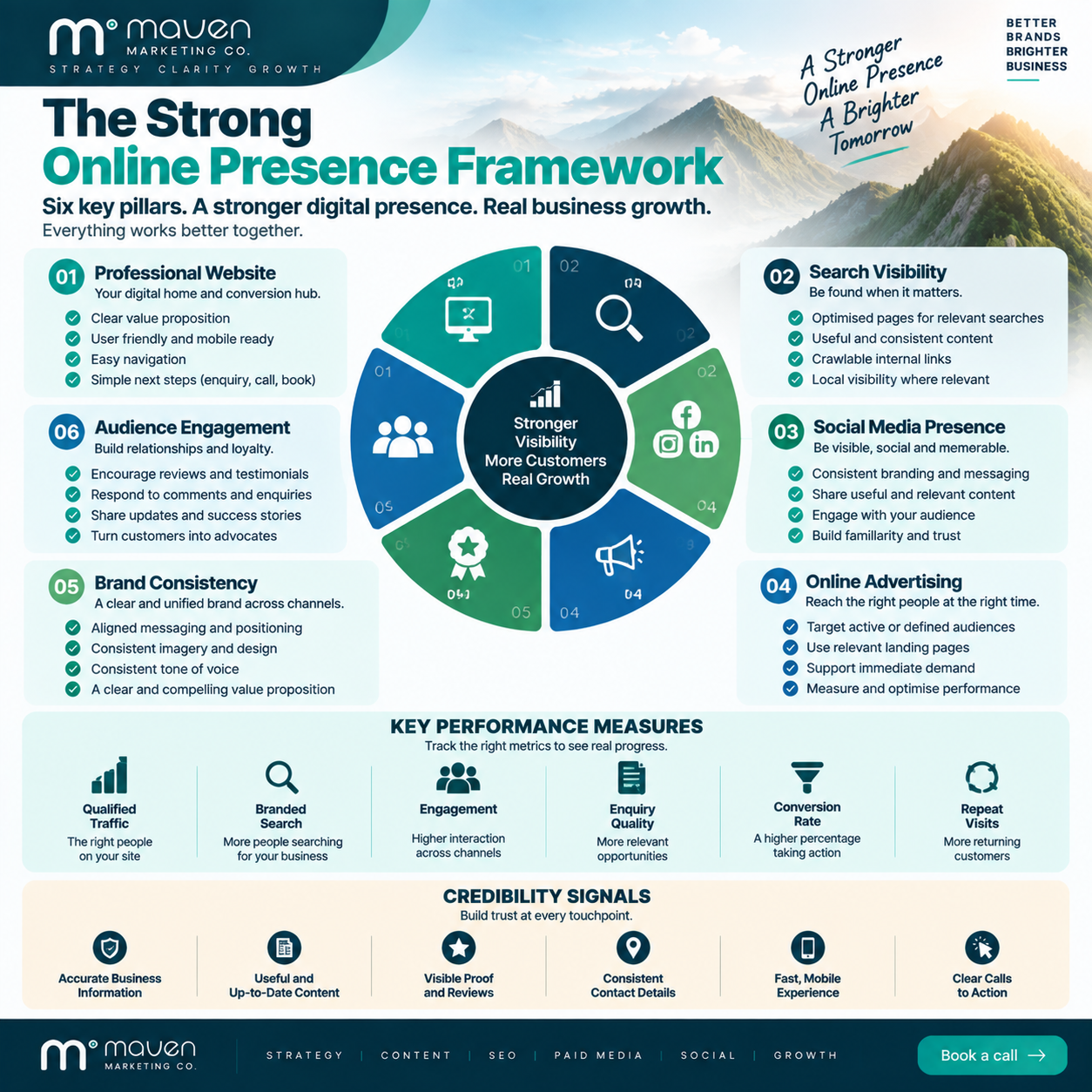
Infographic: The Strong Online Presence Framework
FAQs
What is an online presence for a business?
A business online presence is the combined digital footprint people encounter when they search for, research or interact with the business. It includes the website, search visibility, social media, reviews, content, advertising, directories and other digital touchpoints.
Why is having a strong online presence important?
A strong online presence helps people find the business, understand what it offers and build enough trust to take the next step. It can improve visibility, brand recognition, enquiry quality and the efficiency of marketing across multiple channels.
How can I improve my business's online presence?
Start with a professional website, stronger search visibility, useful content, consistent social activity, relevant advertising, clear branding and active audience engagement. Then measure which touchpoints are contributing to qualified traffic and conversions.
How does SEO help build an online presence?
SEO helps search engines understand your website and makes it easier for relevant customers to discover your pages. Strong SEO combines clear site structure, useful content, natural search language, internal links, technical accessibility and ongoing improvement.
Which digital marketing channels should a business use?
The right mix depends on the audience, buyer intent, business goals, budget and internal capability. Most businesses benefit from a combination of website, search, content and one or more supporting channels such as paid advertising, social media or email rather than trying to use every platform at once.
Build a digital presence that works together
A strong online presence is not created by one campaign, one platform or one website redesign. It comes from making every major digital touchpoint clearer, more useful and more consistent for the people you want to reach.
Maven Marketing Co. helps businesses bring website, SEO, content, paid media, social and brand together into one practical digital strategy. If you want to understand where your current online presence is strong, where it is fragmented and where the best opportunities sit, book a call with the team.

Table of contents
read more blogs

The Ultimate Guide to E-commerce Product Page Optimisation
A strong e-commerce product page has to do several jobs at once. It needs to be discoverable in search, easy to understand, persuasive enough to build confidence and simple enough for a customer to buy without unnecessary friction. That combination is what makes product page optimisation such an important part of both ecommerce SEO and conversion strategy.The difficulty is that product pages are often built from one reusable template across hundreds or thousands of products. If the template is weak, the problem scales. Thin descriptions, poor imagery, unclear variants, buried shipping information or an awkward mobile experience can affect a large part of the store at the same time.Current product-page UX research from Baymard continues to show how often shoppers abandon otherwise suitable products because of avoidable usability issues. At the same time, Google provides dedicated guidance for e-commerce sites, product structured data, product variants and image optimisation because product information needs to be clear and machine-readable as well as useful to people.The goal is not to stuff every product page with more text or technical markup. A complete digital marketing strategy combines SEO, user experience, content and conversion improvements to help ecommerce businesses attract and convert the right customers. It is to give shoppers the information they need, in the right order, while helping search engines understand what the product is, whether it is available and how the page relates to the wider store. This guide covers the practical elements that make that happen.

How to Choose the Right Digital Marketing Channels for Your Business
Choosing digital marketing channels is one of the easiest places for businesses to lose clarity. There are more options than ever, every platform promises reach and results, and it is easy to assume that the best strategy is simply to be everywhere. In reality, most businesses do better when they choose channels with intention rather than spreading budget and effort too thinly.The right channel mix depends on where your audience spends time, how they search or discover solutions, what your business is trying to achieve and how much resource you actually have to support execution properly. A channel is only useful if it helps move the right people towards a commercial outcome that matters to the business.This is why strong digital marketing strategy is not really about finding one perfect platform. It is about understanding the role each channel can play across awareness, demand capture, conversion and retention. SEO might build long-term visibility, Google Ads might capture active intent, social media might support familiarity and reach, while email may help nurture prospects and strengthen customer value over time.This guide explains what digital marketing channels are, how to assess them properly and how to build a balanced channel mix for your business. The focus is practical. Rather than chasing every new platform, the goal is to help you choose the channels that fit your audience, goals, budget and internal capability.

How to Build a Customer Journey Map for Your Digital Marketing Strategy
A strong digital marketing strategy is not just about channels, creative or traffic. It is about understanding how real people move from first awareness through to enquiry, purchase and ongoing loyalty. That is exactly why customer journey mapping matters.Without a clear view of the journey, businesses often optimise in fragments. They improve the website without thinking about the ad that drove the visit, produce content without considering where the audience is in the decision process, or judge conversion performance without understanding the friction points that sit earlier in the experience.A customer journey map helps you step back and see the bigger picture. It shows the stages people move through, the touchpoints they interact with, the questions they ask, the barriers they face and the moments where your marketing can either help or lose them.This guide explains how to build a practical customer journey map for your digital marketing strategy, what information to include, how to use the map to improve performance and which common mistakes to avoid. The goal is not to create a pretty workshop artefact that gets forgotten. It is to build a working tool that improves messaging, user experience, channel decisions and conversion outcomes.


