



Choosing digital marketing channels is one of the easiest places for businesses to lose clarity. There are more options than ever, every platform promises reach and results, and it is easy to assume that the best strategy is simply to be everywhere. In reality, most businesses do better when they choose channels with intention rather than spreading budget and effort too thinly.
The right channel mix depends on where your audience spends time, how they search or discover solutions, what your business is trying to achieve and how much resource you actually have to support execution properly. A channel is only useful if it helps move the right people towards a commercial outcome that matters to the business.
This is why strong digital marketing strategy is not really about finding one perfect platform. It is about understanding the role each channel can play across awareness, demand capture, conversion and retention. SEO might build long-term visibility, Google Ads might capture active intent, social media might support familiarity and reach, while email may help nurture prospects and strengthen customer value over time.
This guide explains what digital marketing channels are, how to assess them properly and how to build a balanced channel mix for your business. The focus is practical. Rather than chasing every new platform, the goal is to help you choose the channels that fit your audience, goals, budget and internal capability.
Key takeaways
· The best digital marketing channels depend on audience behaviour, business goals, buyer intent, available budget and internal capability.
· No single channel is best for every business. Different channels play different roles across discovery, demand capture, conversion and retention.
· SEO, paid search, social media, email and content all work best when they are matched to a clear business objective rather than used in isolation.
· A balanced digital marketing strategy usually performs better than an overreliance on one channel.
· Channel performance should be measured using meaningful commercial outcomes such as lead quality, conversion rate, cost per acquisition and pipeline or revenue contribution.
What Are Digital Marketing Channels?
Digital marketing channels are the online platforms, mediums and pathways businesses use to reach, influence and convert potential customers. They include search, paid advertising, social media, email, content, websites, landing pages and other digital touchpoints that help people discover and engage with your brand.
The important point is that channels are not just traffic sources. They each serve a role in the customer journey. Some channels create visibility and familiarity. Others capture demand when buyers are actively searching. Some help nurture people over time, while others support loyalty, repeat purchase or re-engagement.
Thinking about channels this way makes strategy more useful. Instead of asking which channel is fashionable or which one competitors are using, you start asking where the audience is, what they are trying to do and which digital channel is best suited to that part of the journey.
Why Choosing the Right Marketing Channels Matters
Choosing the right channels matters because every channel requires investment. That investment might be budget, team capacity, creative effort, technical setup or time. If the channel does not suit the audience or objective, the business ends up spending effort without enough commercial return.
This decision also affects efficiency. A business that invests in channels aligned to customer intent usually sees stronger lead quality, more relevant traffic and a clearer path to conversion. A business that chooses channels based on assumption or trend alone often ends up with inconsistent activity that is difficult to measure or scale.
Channel choice also shapes the wider experience. If the channels are not aligned, messaging becomes fragmented and the website may fail to guide users toward action. Professional web development services help businesses create websites that support marketing goals, user experience and conversions. A considered channel mix creates better continuity between what people see, what they click and what happens next.
Key Digital Marketing Channels to Consider
Most businesses do not need every possible channel, but they do need to understand the strengths of the main ones. Each channel performs best when it is used for the role it naturally suits rather than being forced to achieve every marketing goal on its own.
SEO and Content Marketing
SEO and content marketing are strong long-term channels for building visibility, authority and search demand capture. Professional SEO services help businesses improve organic visibility, attract relevant audiences and build sustainable traffic through content and search optimisation. They are especially useful when potential customers research their options, compare providers or ask questions before making contact. Google’s guidance on people-first content reinforces the value of publishing genuinely useful material that helps readers rather than simply chasing rankings.
This channel is often best for businesses that want to improve discoverability, build credibility and reduce dependence on paid traffic over time. It usually requires consistency and patience, but the compounding value can be significant when the content and site structure are aligned to real search intent.
PPC and Paid Advertising
PPC and paid advertising can accelerate visibility and demand capture much more quickly than organic channels alone. With effective Google Ads management services, businesses can reach high-intent customers, test campaigns quickly and optimise advertising spend based on measurable outcomes. Google Ads is particularly effective when people are actively searching for a service, solution or product and you want to place a relevant offer in front of them at the moment of intent.
Paid channels are also useful for testing offers, generating leads in competitive markets and supporting campaigns where time matters. Google Ads’ own guidance makes it clear that bidding strategy should align with the business goal, whether that is conversions, conversion value, clicks or awareness. The strongest results usually come when targeting, messaging, landing pages and measurement all work together.
Social Media and Email Marketing
Social media and email play different but complementary roles. Through professional social media marketing services, businesses can build brand awareness, engage audiences and create valuable touchpoints throughout the customer journey. Social media is often strongest for attention, familiarity, creative storytelling, audience building and remarketing support. Depending on the business, it can help shape brand perception and keep the business visible between higher-intent moments.
Email is usually more powerful once a relationship already exists. It supports lead nurturing, follow-up, repeat business and retention. For many businesses, email is not a discovery channel at all. It is a conversion and relationship channel. That distinction matters because it helps set the right expectation around what success should look like.
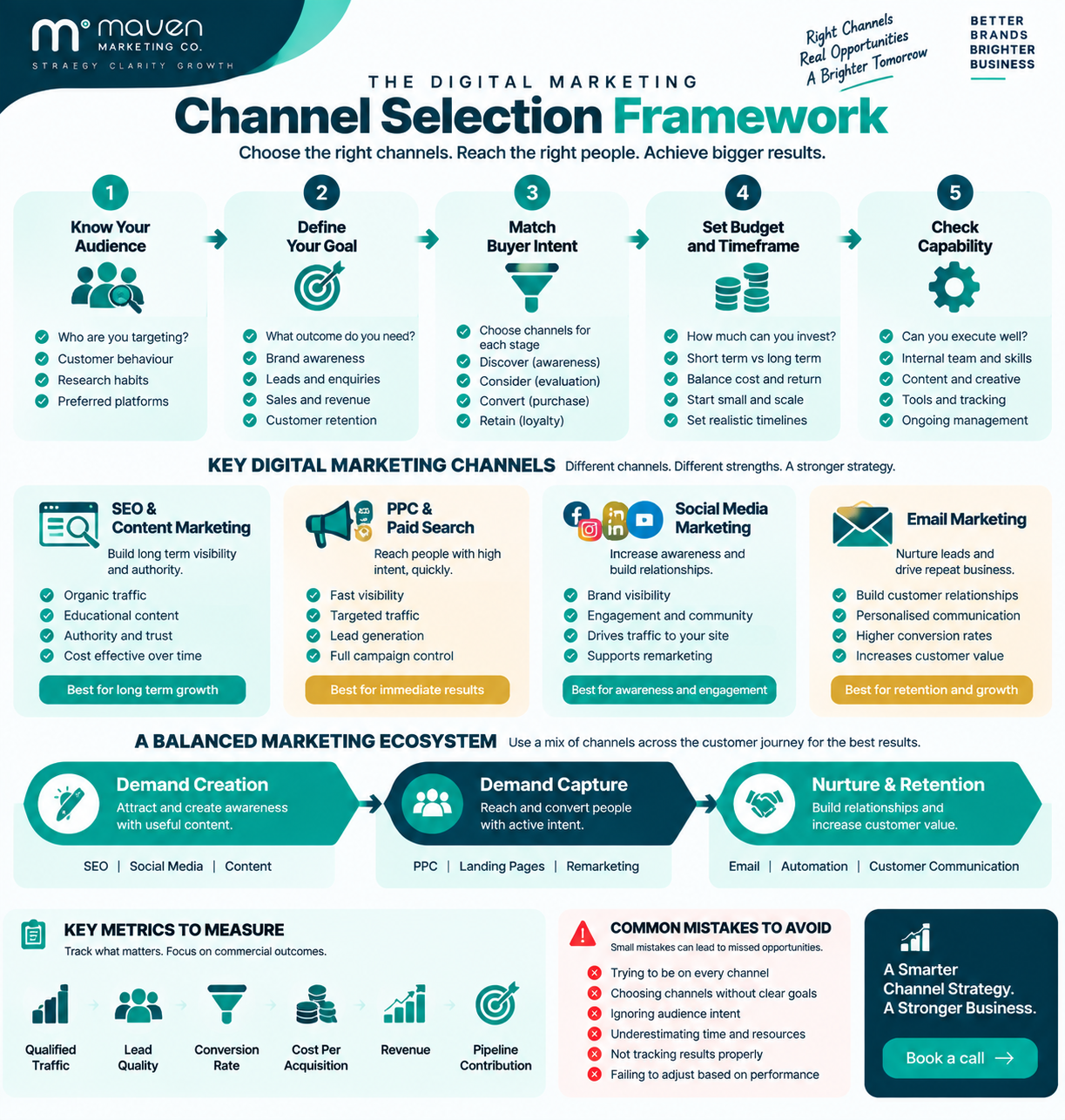
Infographic: The Digital Marketing Channel Selection Framework
How to Choose the Right Channels for Your Business
The best way to choose channels is to start with strategy, not platform preference. That means looking at audience behaviour, buyer intent, commercial goals, timeframe, internal resourcing and budget before deciding where to invest.
One useful approach is to evaluate each channel against five questions. Is your audience there? Does the channel support a real business goal? Can you resource it properly? Can you measure success in a meaningful way? And what role will it play alongside your existing channels? If a channel cannot answer those questions well, it may not be the right priority yet.
This is where many businesses improve simply by becoming more realistic. A channel may be theoretically useful, but if there is no capacity to manage creative, optimise landing pages, respond to leads or maintain content quality, the practical outcome is often disappointing. Channel strategy should always reflect execution reality.
Match Marketing Channels to Your Target Audience
Audience fit is one of the most important channel decisions you can make. Different audiences use digital channels differently. Some search actively on Google when they have a need. Some discover businesses through social content or peer recommendations. Some require repeated exposure before they are ready to engage. Others convert quickly once they find a credible provider.
Start by mapping where your best-fit customers research, compare and act. If they use search heavily, SEO and paid search may deserve stronger emphasis. If visual storytelling or community engagement influences the category, social may play a bigger role. If your sales process involves longer consideration, email nurturing and retargeting may become more important.
This is also where customer journey thinking helps. A channel does not need to do everything. It may only need to perform one valuable role in the journey. The mistake is often expecting an awareness channel to convert like a high-intent search channel, or undervaluing a nurturing channel because it does not create direct first-touch demand.
A consistent brand presence across different channels also plays an important role in building trust. Strong branding services help businesses create clear messaging, visual consistency and a recognisable identity across every customer interaction.
Consider Your Marketing Goals and Budget
Channel decisions should also reflect what the business is actually trying to achieve. Awareness, qualified lead generation, e-commerce sales, bookings, retention and brand growth are not the same objective, so they should not automatically lead to the same channel mix.
Budget matters here too, but not only in the obvious sense. It is not just about how much media spend you can afford. It is also about how much you can invest in content production, creative testing, landing-page development, reporting, optimisation and follow-up. A channel with low media cost can still be expensive if it demands heavy internal effort to do well.
That is why short-term and long-term balance matters. Paid search may generate demand capture faster, while SEO and content build equity more gradually. Social might help create ongoing visibility, while email can improve yield from leads or customers you already have. A sensible strategy usually blends immediate opportunities with channels that build strength over time.
How to Build a Balanced Digital Marketing Strategy
A balanced strategy does not mean equal investment across every channel. It means choosing a mix that reflects the different jobs marketing needs to do. For many businesses, that includes some form of demand creation, demand capture and nurture or retention.
For example, brand awareness and educational content can help create demand. SEO, paid search and landing pages can help capture it. Email, remarketing and customer communication can help nurture and retain it. When those roles are understood clearly, the overall strategy becomes easier to manage and measure.
This is also where integration matters. The strongest digital strategies make channels work together rather than compete for credit. A prospect might first discover the business through social content, later search for the brand or solution on Google, convert through a landing page and then be nurtured through email. Google Analytics reports such as Attribution Paths and Path Exploration can help show how those channel interactions contribute across the journey.
A balanced channel mix is usually more resilient as well. If one platform becomes more expensive, more competitive or less effective for a period, the business is not left depending on a single source of opportunity.
Measuring Digital Marketing Channel Performance
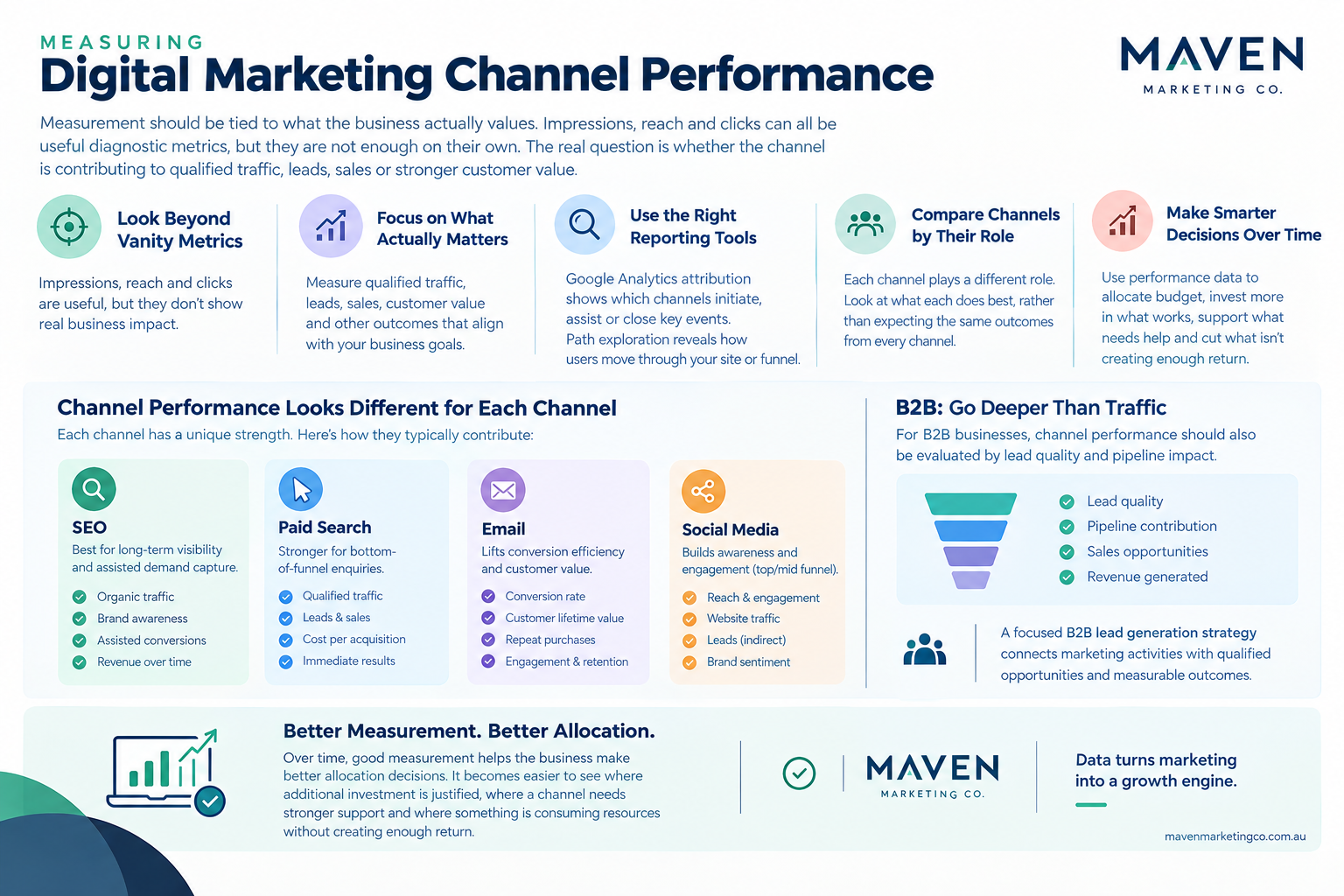
Measurement should be tied to what the business actually values. Impressions, reach and clicks can all be useful diagnostic metrics, but they are not enough on their own. The more important question is whether the channel is contributing to qualified traffic, leads, sales or stronger customer value.
This usually means looking at conversion rate, lead quality, cost per acquisition, assisted conversions, pipeline contribution or revenue, depending on the business model. Attribution reporting in Google Analytics can help show which channels initiate, assist or close key events, while path exploration can reveal how users move through the site or funnel.
The most useful performance reviews compare channels by role rather than expecting identical outcomes from each one. SEO might excel in long-term visibility and assisted demand capture. Paid search may be stronger for bottom-of-funnel enquiries. Email may lift conversion efficiency and customer value. Judging them all by the same narrow metric can lead to poor decisions.For B2B businesses, channel performance should also be evaluated by lead quality and pipeline impact. A focused B2B lead generation strategy helps connect marketing activities with qualified opportunities and measurable business outcomes.
Over time, good measurement helps the business make better allocation decisions. It becomes easier to see where additional investment is justified, where a channel needs stronger support and where something is consuming resources without creating enough return.
FAQs
What are the main digital marketing channels?
The main digital marketing channels usually include SEO, content marketing, Google Ads and other paid media, social media, email marketing, websites and landing pages. The best mix depends on the business, audience and goals.
How do I choose the right digital marketing channels for my business?
Start with your audience, goals, buyer intent, budget and internal capability. Choose channels that match where customers research and act, and that your business can manage and measure properly.
Which digital marketing channel is most effective?
There is no single best channel for every business. Search may be most effective where demand already exists, while social may be stronger for awareness and email may perform best for nurturing and retention. Effectiveness depends on the role the channel is meant to play.
How many digital marketing channels should a business use?
Most businesses should use enough channels to support awareness, demand capture and follow-up, but not so many that execution becomes diluted. A smaller, well-managed mix usually performs better than trying to be active everywhere.
How can I measure the performance of different marketing channels?
Measure channels using metrics linked to business outcomes such as qualified traffic, conversion rate, cost per acquisition, lead quality, assisted conversions and revenue contribution. Use analytics tools to understand both direct and supporting channel impact.
Choose channels with purpose, not pressure
The best digital marketing channels are the ones that fit your audience, business objective and capacity to execute well. Strong channel strategy is not about copying what everyone else is doing. It is about selecting the channels that genuinely help the business create demand, capture intent and convert opportunities more effectively.
Maven Marketing Co. helps businesses choose, align and optimise the digital channels that will have the most practical impact. If you want a clearer strategy around where to invest and how your channels should work together, book a call with the team.

Table of contents
read more blogs

How to Build a Customer Journey Map for Your Digital Marketing Strategy
A strong digital marketing strategy is not just about channels, creative or traffic. It is about understanding how real people move from first awareness through to enquiry, purchase and ongoing loyalty. That is exactly why customer journey mapping matters.Without a clear view of the journey, businesses often optimise in fragments. They improve the website without thinking about the ad that drove the visit, produce content without considering where the audience is in the decision process, or judge conversion performance without understanding the friction points that sit earlier in the experience.A customer journey map helps you step back and see the bigger picture. It shows the stages people move through, the touchpoints they interact with, the questions they ask, the barriers they face and the moments where your marketing can either help or lose them.This guide explains how to build a practical customer journey map for your digital marketing strategy, what information to include, how to use the map to improve performance and which common mistakes to avoid. The goal is not to create a pretty workshop artefact that gets forgotten. It is to build a working tool that improves messaging, user experience, channel decisions and conversion outcomes.

Why Your Google Ads Campaign Is Not Getting Results: Common Mistakes and Solutions
If your Google Ads campaign is getting impressions or clicks but not producing enough enquiries, sales, or qualified leads, the problem is usually not Google Ads itself. It is more often a strategy, tracking, or conversion issue somewhere in the system.That matters because paid search can look busy without being commercially effective. You can have traffic coming in, a reasonable click-through rate and money leaving the account every day, yet still have very little to show for it if your keywords are weak, your ad copy is misaligned, your landing pages do not convert or your tracking is incomplete.A strong campaign works as one connected chain. Search intent, keyword targeting, ad relevance, bidding, landing-page experience, and conversion tracking all need to support the same commercial outcome. If one link breaks, results usually suffer quickly.This guide explains the most common reasons a Google Ads campaign is not getting results, what those issues normally look like in practice and how to fix them without relying on guesswork. The focus is not on vanity metrics. It is on improving lead quality, conversion rate, and return on spend.

6 Ways Digital Marketing Can Boost B2B Lead Generation
B2B lead generation is not about filling a CRM with as many names as possible. The real objective is to attract businesses that fit your offer, give the right people a reason to engage and create enough confidence for a genuine sales conversation to start.That distinction matters because B2B buying is usually more targeted than consumer marketing and often involves several people influencing the decision. Current LinkedIn lead-generation guidance makes the same point: more leads do not automatically mean better results if only a small proportion are genuinely relevant or likely to progress.Digital marketing helps by creating multiple paths into the business. Search can capture active demand. Paid media can put an offer in front of a tightly defined audience. Content can build authority before a buyer is ready to talk. Social media can keep the brand visible across a long decision cycle. Your website turns interest into action, while email helps nurture that interest over time.The strongest B2B digital marketing strategies do not treat these as six separate activities. They use them as one connected system designed to generate quality B2B leads, support sales and build a more dependable pipeline


