



A strong e-commerce product page has to do several jobs at once. It needs to be discoverable in search, easy to understand, persuasive enough to build confidence and simple enough for a customer to buy without unnecessary friction. That combination is what makes product page optimisation such an important part of both ecommerce SEO and conversion strategy.
The difficulty is that product pages are often built from one reusable template across hundreds or thousands of products. If the template is weak, the problem scales. Thin descriptions, poor imagery, unclear variants, buried shipping information or an awkward mobile experience can affect a large part of the store at the same time.
Current product-page UX research from Baymard continues to show how often shoppers abandon otherwise suitable products because of avoidable usability issues. At the same time, Google provides dedicated guidance for e-commerce sites, product structured data, product variants and image optimisation because product information needs to be clear and machine-readable as well as useful to people.
The goal is not to stuff every product page with more text or technical markup. A complete digital marketing strategy combines SEO, user experience, content and conversion improvements to help ecommerce businesses attract and convert the right customers. It is to give shoppers the information they need, in the right order, while helping search engines understand what the product is, whether it is available and how the page relates to the wider store. This guide covers the practical elements that make that happen.
Key takeaways
· Optimised product pages combine search visibility, useful product information, strong user experience and a clear path to purchase.
· Unique, specific product titles and descriptions are more useful than generic supplier copy or keyword-heavy text.
· High-quality images, descriptive alt text, clear variants, price and availability all help customers make decisions with less friction.
· Product structured data can help Google understand product details and can support richer product appearances, but it does not replace useful visible content.
· Mobile usability, trust signals, reviews and transparent shipping or returns information can materially affect ecommerce conversions.
· Measure product-page performance using commercial metrics such as add-to-cart rate, conversion rate and revenue per visitor rather than rankings alone.
What Is E-commerce Product Page Optimisation?
E-commerce product page optimisation is the process of improving an individual product page so it is easier for customers and search engines to understand, easier to use and more effective at converting visitors into buyers. It brings together ecommerce SEO, product information, UX, conversion design, performance and trust.
That means a well-optimised page is not just a product title, price and Add to cart button. It should answer the questions a shopper needs resolved before buying: what exactly is this product, who is it for, what are the important features or specifications, which variant should I choose, what does delivery look like, can I return it, and why should I trust the store?
From a search perspective, the page also needs enough clarity for Google to understand the product, its relationship to the category and, where applicable, its price, availability, variants and other structured information. Google’s e-commerce guidance recommends sharing product data through page content, structured data and Merchant Center where relevant.
Why Product Page Optimisation Matters
Product page optimisation also improves the performance of paid campaigns because visitors are more likely to convert when landing pages provide clear information, trust signals and a smooth buying experience. Google Ads management services can help businesses drive targeted traffic while product pages are optimised for better results.
Baymard’s current Product Page UX research has documented a large number of recurring usability issues across major e-commerce sites, including problems with product information, imagery, variants, reviews and layout. The lesson is useful for stores of every size: small friction points can interrupt a purchase even when the customer is interested in the product.
Optimisation also matters commercially because improvements can compound across a catalogue. A better image gallery, clearer shipping message or stronger mobile layout can lift the experience on many product pages at once. That is why product page work often deserves priority over producing large volumes of low-value content around the store.
Key Elements of an Optimised Product Page
The best product pages are usually clear before they are clever. Customers should be able to understand the product, compare options, see the price, assess trust and take the next step without hunting through the page. The exact layout varies by category, but the core information remains remarkably consistent.
Product Titles and Descriptions
The product title should identify the item accurately and use the language customers naturally recognise. It normally needs the product name and the most useful differentiating detail, such as model, size, material, capacity or product type, where that information genuinely helps shoppers and search engines understand the page.
Avoid writing titles as a chain of repeated keywords. The objective is clarity, not density. If every product title becomes long, mechanical and difficult to scan, the SEO tactic starts working against the user experience.
Product descriptions should do more than repeat manufacturer specifications. Explain the product in useful terms: what it does, why a feature matters, who it suits, what is included, how it is used and any practical buying information that may influence the decision. Technical specifications can sit alongside benefit-led copy rather than replacing it.
Where possible, avoid publishing identical supplier descriptions across large parts of the catalogue. Unique copy is most valuable on commercially important products and where the store can add genuine expertise, fit guidance, product knowledge or comparison information that customers will not find everywhere else.
Product Images and Alt Text
Images are part of the product information, not decoration. Customers need to see enough of the product to evaluate it confidently. Depending on the category, that can include front and rear views, detail shots, scale or context images, packaging, colour options and real-world use.
Google’s image SEO guidance recommends high-quality, relevant images that load efficiently and sit near useful supporting text. It also recommends descriptive filenames and meaningful alt text. Alt text should describe the image in context, not repeat a keyword list. For example, 'black leather weekender bag showing zip and side pocket' is more useful than a string of ecommerce search terms.
Image optimisation should also consider performance. Large, uncompressed product images can slow the page considerably. The aim is to preserve useful detail while serving appropriately sized, responsive files so shoppers are not forced to choose between image quality and page speed.
How to Optimise Product Pages for SEO
E-commerce product page SEO starts with relevance and site structure. The page should target the product itself, not try to rank for every possible category phrase. Professional SEO services help ecommerce businesses improve search visibility, optimise site structure and attract customers searching for relevant products. Category pages usually serve broader commercial searches, while individual product pages should focus on the specific product, model or variant people are looking for.
Use the product name and relevant attributes naturally in the title tag, H1, product copy and supporting details. Build internal links from category pages, related products, buying guides and other useful sections of the site. This helps customers move around the store and makes the relationship between categories and products easier for search engines to interpret.
Structured data is another important layer. Google supports Product structured data for product pages and merchant listing experiences. Depending on the page and implementation, this can include product name, image, offers, price, availability, ratings, shipping and returns information. For stores with meaningful variants such as size or colour, Google also supports ProductGroup and related variant properties.
The key principle is consistency. Structured data should match what users can actually see on the page. Do not mark up prices, reviews, availability or claims that are missing, outdated or misleading. Google also recommends sharing product data through Merchant Center where relevant, particularly for shopping surfaces.
Search optimisation should stay connected to the customer experience. A technically perfect product page with thin information will still be weak. Google’s broader e-commerce guidance is built around making product data easy to find and parse, but usefulness and clarity still need to be present in the visible page itself.
How to Improve Product Page User Experience
Product page UX is about reducing uncertainty. The customer should not need to work out what the next step is, whether the item is in stock, which option they have selected or where to find essential delivery and returns information. Professional web development services help ecommerce businesses create fast, user-friendly websites that support better shopping experiences and conversions.
A practical product page usually gives the most important decision information priority near the top: product name, imagery, price, availability, options or variants, review summary where available, and the primary purchase action. Supporting detail can then follow in a logical order rather than competing for attention.
Variant selection deserves particular care. Size, colour, finish, pack quantity or configuration should be labelled clearly, and the selected state should be obvious. If the price, image or stock status changes by variant, the page should update in a way that does not create ambiguity.
Shipping, returns and payment information also need to be findable before checkout. Hiding basic purchase conditions creates unnecessary anxiety. If the store has genuine delivery thresholds, returns policies, warranties or secure payment options, present them at the point where they help the decision rather than expecting customers to search the footer.
Optimising Product Pages for Higher Conversions
Conversion optimisation is not about adding more urgency messages or oversized buttons. It is about making the product easier to evaluate and the purchase action easier to complete. A structured conversion optimisation strategy helps ecommerce brands identify friction points, improve user experience and increase completed purchases.Strong pages remove doubt, answer objections and make the next step obvious.
Clear Calls to Action
The main CTA should be visually clear, specific and positioned close to the information needed to make the purchase decision. For most retail product pages that means Add to cart or Buy now, depending on the buying flow. The button should not compete with several equally prominent secondary actions.
Make sure required choices are obvious before the CTA. If a customer must select a size or colour first, the page should communicate that clearly. Error messages should help people fix the problem rather than simply tell them something went wrong.
Reviews and Trust Signals
Reviews can reduce uncertainty because they show how other customers experienced the product. A useful review section gives enough context to interpret the rating, includes genuine comments and makes it easy to understand how many reviews sit behind the score.
For Australian businesses, review practices also need to be genuine and transparent. The ACCC states that businesses must not create fake or misleading reviews or arrange for others to do so. If reviews are incentivised, the context and relationship should be handled transparently rather than manufacturing trust.
Trust signals extend beyond reviews. Clear returns information, secure payment options, realistic delivery messaging, contact details and genuine product guarantees can all reduce hesitation. Use real proof and policies rather than decorative badges that do not tell the customer anything useful.
Infographic: The E-commerce Product Page Optimisation Framework
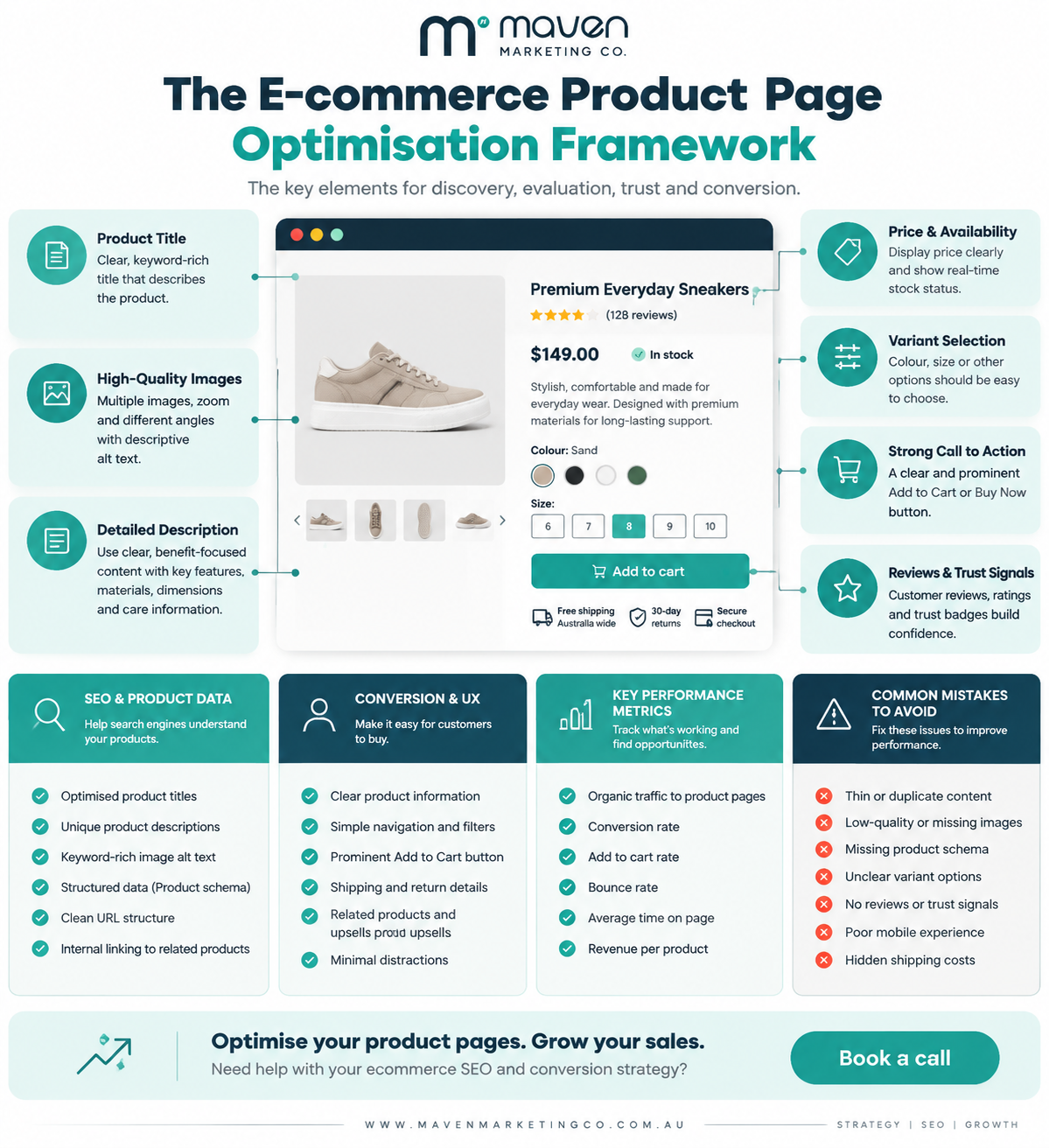
Mobile Optimisation for E-commerce Product Pages
Mobile product pages need more than a responsive layout. They need a deliberate mobile experience. The screen is smaller, the customer may be on a slower connection and important content can easily end up buried underneath oversized galleries, promotional banners or navigation.
Prioritise fast-loading product imagery, readable type, clear variant controls and a purchase action that is easy to find and tap. Avoid making shoppers open several accordions before they can find basic information. The most important content should remain accessible without turning the page into a wall of text.
Baymard’s current product-page research continues to highlight mobile product page UX as a weak area for many leading stores. That reinforces a simple point: test the complete buying experience on real mobile devices rather than assuming a responsive desktop template is enough.
How to Measure Product Page Performance
Product page ranking is only one part of performance. A page can rank and still fail commercially if shoppers do not engage or buy. Measurement therefore needs to cover visibility, behaviour and revenue outcomes.
Useful metrics include organic impressions and clicks for product queries, product-page engagement, add-to-cart rate, conversion rate, revenue per visitor, product-level return rate and exit behaviour. Search Console can show search visibility, while analytics and ecommerce platforms can show whether that visibility translates into buying behaviour.
Look for patterns rather than judging a single page in isolation. If a group of products has strong traffic but low add-to-cart rates, the issue may be pricing, imagery, information quality or fit. If add-to-cart is strong but conversion is poor, the problem may sit later in checkout, delivery or payment.
Testing is most useful when tied to a clear hypothesis. For example, test whether clearer size guidance reduces abandonment, whether more useful imagery improves add-to-cart rate or whether bringing shipping information closer to the CTA reduces hesitation. Optimisation works best as an ongoing cycle rather than a one-off redesign.
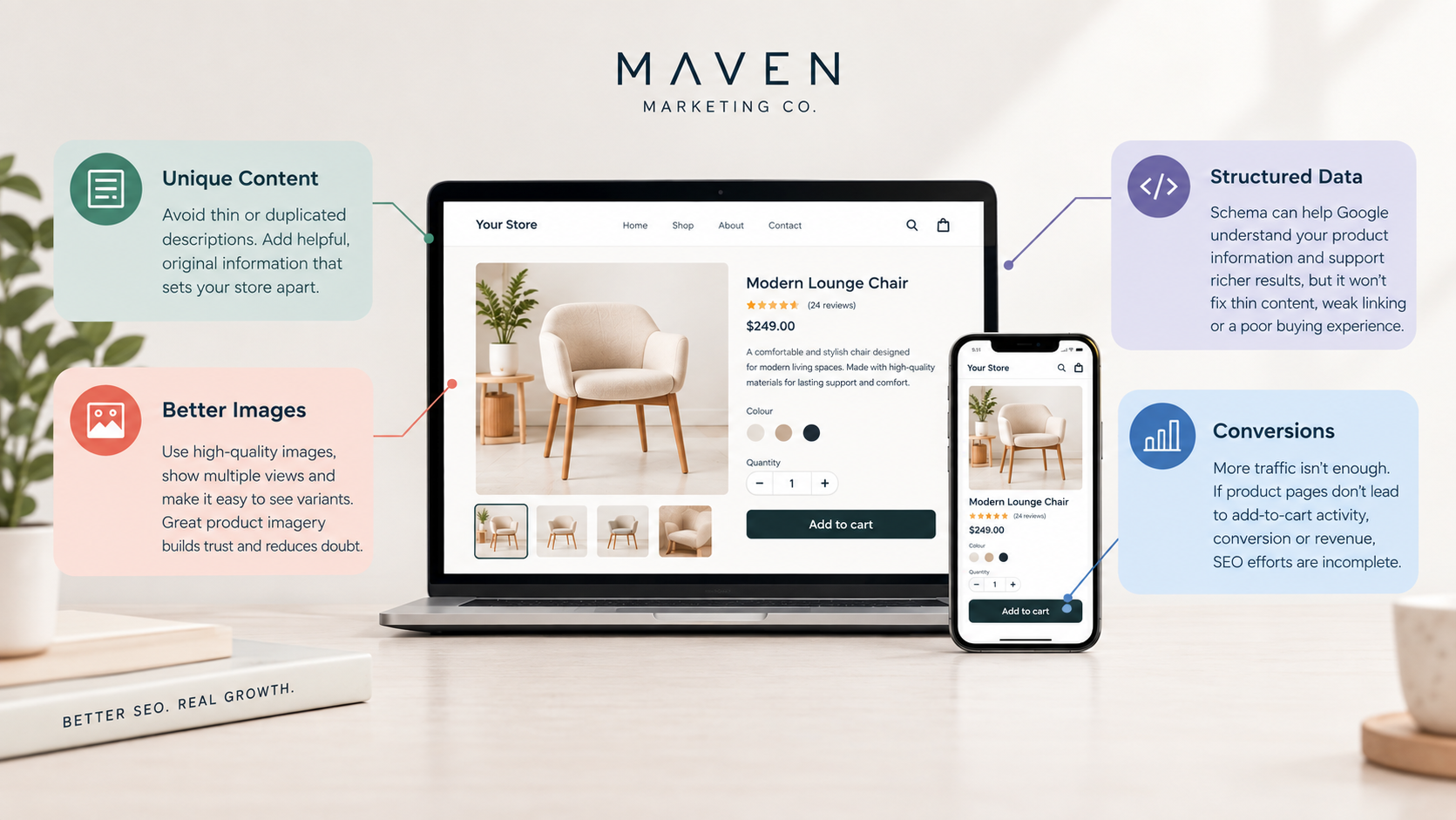
Common Product Page Optimisation Mistakes to Avoid
One common mistake is relying on thin or duplicated descriptions across large sections of the store. Supplier copy may be accurate, but it rarely gives your store a distinctive or helpful perspective. Prioritise unique information where it can make a real difference.
Another is treating product imagery as an afterthought. Low-resolution images, too few views or galleries that are difficult to use can undermine confidence quickly. The same applies to unclear variants, hidden shipping information and weak mobile presentation.
Stores also sometimes over-rely on structured data as if schema alone will fix poor product-page SEO. Structured data can help Google understand product information and support richer appearances, but it does not compensate for thin content, weak internal linking or a poor buying experience.
Finally, avoid optimising solely for traffic. If product pages attract more visitors but do not increase add-to-cart activity, conversion or revenue, the optimisation is incomplete. Search visibility and customer experience need to move together.
FAQs
What is e-commerce product page optimisation?
E-commerce product page optimisation is the process of improving product pages for search visibility, usability and conversion. It covers product titles and descriptions, images, structured data, variants, page speed, mobile UX, trust signals and the path to purchase.
How do I optimise an e-commerce product page for SEO?
Use a clear product-focused title and H1, write useful unique product copy, optimise images and alt text, build relevant internal links, keep product information current and use appropriate Product structured data. Where relevant, keep Merchant Center product data aligned with the site.
What should an optimised product page include?
An optimised product page should normally include a clear title, useful description, high-quality images, price and availability, obvious variants, a strong Add to cart action, delivery and returns information, genuine reviews or trust signals and a fast mobile experience.
How can product page optimisation improve conversions?
Optimisation can improve conversions by reducing uncertainty and friction. When customers can understand the product, choose the right option, trust the store and complete the next step easily, they are more likely to add the item to cart and buy.
How can I improve the user experience on product pages?
Start with clarity. Make important information easy to find, use strong product imagery, explain variants clearly, show price and availability, keep the CTA obvious, surface delivery and returns information and test the full experience on mobile.
Build product pages that are easier to find and easier to buy from
The best e-commerce product pages make SEO, product information and user experience work together. They help search engines understand the product, help customers evaluate it with confidence and reduce friction at the point where someone is ready to buy.
Maven Marketing Co. helps e-commerce businesses improve the marketing, search visibility and conversion experience behind their online stores. If you want to identify where product pages are losing visibility or sales and prioritise the changes with the strongest commercial upside, book a call with the team.

Table of contents
read more blogs

How to Choose the Right Digital Marketing Channels for Your Business
Choosing digital marketing channels is one of the easiest places for businesses to lose clarity. There are more options than ever, every platform promises reach and results, and it is easy to assume that the best strategy is simply to be everywhere. In reality, most businesses do better when they choose channels with intention rather than spreading budget and effort too thinly.The right channel mix depends on where your audience spends time, how they search or discover solutions, what your business is trying to achieve and how much resource you actually have to support execution properly. A channel is only useful if it helps move the right people towards a commercial outcome that matters to the business.This is why strong digital marketing strategy is not really about finding one perfect platform. It is about understanding the role each channel can play across awareness, demand capture, conversion and retention. SEO might build long-term visibility, Google Ads might capture active intent, social media might support familiarity and reach, while email may help nurture prospects and strengthen customer value over time.This guide explains what digital marketing channels are, how to assess them properly and how to build a balanced channel mix for your business. The focus is practical. Rather than chasing every new platform, the goal is to help you choose the channels that fit your audience, goals, budget and internal capability.

How to Build a Customer Journey Map for Your Digital Marketing Strategy
A strong digital marketing strategy is not just about channels, creative or traffic. It is about understanding how real people move from first awareness through to enquiry, purchase and ongoing loyalty. That is exactly why customer journey mapping matters.Without a clear view of the journey, businesses often optimise in fragments. They improve the website without thinking about the ad that drove the visit, produce content without considering where the audience is in the decision process, or judge conversion performance without understanding the friction points that sit earlier in the experience.A customer journey map helps you step back and see the bigger picture. It shows the stages people move through, the touchpoints they interact with, the questions they ask, the barriers they face and the moments where your marketing can either help or lose them.This guide explains how to build a practical customer journey map for your digital marketing strategy, what information to include, how to use the map to improve performance and which common mistakes to avoid. The goal is not to create a pretty workshop artefact that gets forgotten. It is to build a working tool that improves messaging, user experience, channel decisions and conversion outcomes.

Why Your Google Ads Campaign Is Not Getting Results: Common Mistakes and Solutions
If your Google Ads campaign is getting impressions or clicks but not producing enough enquiries, sales, or qualified leads, the problem is usually not Google Ads itself. It is more often a strategy, tracking, or conversion issue somewhere in the system.That matters because paid search can look busy without being commercially effective. You can have traffic coming in, a reasonable click-through rate and money leaving the account every day, yet still have very little to show for it if your keywords are weak, your ad copy is misaligned, your landing pages do not convert or your tracking is incomplete.A strong campaign works as one connected chain. Search intent, keyword targeting, ad relevance, bidding, landing-page experience, and conversion tracking all need to support the same commercial outcome. If one link breaks, results usually suffer quickly.This guide explains the most common reasons a Google Ads campaign is not getting results, what those issues normally look like in practice and how to fix them without relying on guesswork. The focus is not on vanity metrics. It is on improving lead quality, conversion rate, and return on spend.


