



Marketing reporting can become very busy without becoming very useful. A dashboard might show thousands of impressions, rising traffic, cheaper clicks and strong engagement, yet still leave the most important question unanswered: is marketing creating enough commercial value for the business?
That is the purpose of marketing ROI. It moves the conversation away from activity alone and towards the return generated from the money, time and resources invested in marketing. For some businesses that return is direct revenue. For others it is qualified pipeline, customer acquisition, repeat business or a combination of outcomes that eventually translate into profit.
Measuring digital marketing ROI is not as simple as forcing SEO, PPC and social media into one identical formula. A connected digital marketing strategy helps businesses evaluate each channel based on its role, contribution and impact on overall growth. Paid search often produces clearer campaign-level cost and conversion data. SEO may compound over a longer period. Social media can create awareness, assist later conversions and support customer relationships as well as generate direct leads. The measurement framework needs to respect those differences while still connecting every channel to commercial outcomes.
This guide explains how to measure marketing ROI across SEO, PPC and social media, which metrics matter, how attribution changes the picture and how to build a reporting process that helps you make better budget and strategy decisions.
Key takeaways
· Marketing ROI should connect spend and effort to commercial outcomes, not just impressions, clicks or engagement.
· ROI and ROAS are different: ROAS compares conversion value with ad spend, while ROI should account for the broader cost required to generate the return.
· SEO ROI needs a longer view because organic visibility and content can keep producing value after the initial work is completed.
· PPC ROI depends heavily on accurate conversion tracking, conversion values and the quality of the leads or sales being generated.
· Social media ROI may include direct conversions, assisted conversions, pipeline influence and customer value depending on the role of the channel.
· Attribution matters because customers often interact with more than one channel before they convert.
What Is Marketing ROI?
Marketing ROI is a way of comparing the return generated by marketing with the cost of producing that return. At its simplest, the calculation is: marketing ROI = (return generated - marketing cost) / marketing cost x 100.
The important part is defining 'return' and 'cost' properly. If you use revenue as the return but ignore cost of goods, sales effort, agency fees, media, software and production, the percentage can look much healthier than the real commercial result. Where the data is available, profit or contribution margin usually gives a more honest view than revenue alone.
For lead-generation businesses, the return may not be visible at the first conversion. A form enquiry has no confirmed financial value until the lead is qualified and progresses. In that case, you can track stages such as lead, sales-accepted lead, opportunity, won customer and customer value, then connect those stages back to the original marketing source.
ROAS, or return on ad spend, is useful but narrower. It is commonly calculated as conversion value or revenue divided by ad spend. Google Ads uses conversion values to help advertisers understand and optimise around the business value generated by campaigns. ROAS is useful for paid media, but it should not be treated as a complete business-profit measure.

Why Measuring Marketing ROI Matters
Measuring ROI matters because marketing budgets are allocation decisions. Every dollar and every hour invested in one activity is unavailable for something else. A clear ROI view helps you decide where to increase investment, where to improve execution and where an activity may no longer justify the resources it consumes.
It also creates better conversations between marketing, sales and leadership. Marketing can move beyond reporting activity. Sales can provide feedback on lead quality and revenue outcomes. Leadership can see which channels are contributing to pipeline and customer acquisition rather than only which dashboards look busy.
Strong marketing performance measurement also helps prevent short-term decision-making. Some channels create demand, some capture it, and some help prospects convert later. If you judge every channel only by immediate last-click revenue, you can cut activity that is contributing earlier in the journey. The opposite problem is just as common: keeping a channel because it produces reach or engagement without evidence that the activity is commercially useful.
The aim is not to make every channel look good. It is to create enough visibility to make better decisions.
Key Metrics for Measuring Marketing Performance
The right marketing metrics should form a chain from attention through to commercial outcome. The exact mix varies by business model, but the principle is consistent: use early-stage metrics to diagnose performance, and use later-stage metrics to judge business value.
Traffic, Leads, and Conversions
Traffic shows whether marketing is bringing people to the website, but quality matters more than volume. For SEO, Google Search Console can show impressions, clicks, queries and pages performing in Google Search. In analytics, you can then look at what those users do after they arrive.
Leads and conversions take the measurement closer to the business outcome. For a service business, that might include enquiry forms, calls, bookings or demo requests. For ecommerce it may include add-to-cart, checkout and purchase. The key is to define the actions that genuinely indicate progress rather than treating every minor event as equally valuable.
Conversion rate is useful because it shows how efficiently traffic turns into action. But it still needs context. A high conversion rate is not impressive if the leads are poor quality, and a lower conversion rate can be commercially stronger if the customers have higher value.
A strong B2B lead generation strategy connects marketing channels with sales outcomes and pipeline growth.
Cost Per Lead and Customer Acquisition Cost
Cost per lead is the amount spent to generate a lead. It is easy to calculate for paid media and can also be estimated across broader marketing programs by dividing channel or campaign investment by the number of relevant leads generated.
Customer acquisition cost goes further. It looks at the cost required to acquire an actual customer, which is usually more useful than cost per lead for strategic decisions. Depending on the reporting maturity of the business, CAC can include media spend, agency or internal marketing costs, creative and technology costs, and sometimes the sales cost associated with closing the customer.
Lead quality should sit beside both metrics. A campaign with a higher cost per lead can still be the better investment if those leads progress more often, have higher average value or require less sales effort to close.
How to Measure SEO ROI
SEO ROI needs a different mindset from paid media because the investment and the return often occur at different times. Professional SEO services help businesses improve organic visibility, attract qualified traffic and measure the long-term impact of search optimisation efforts. Content, technical improvements and authority-building work may take time to increase visibility, but successful pages can continue generating qualified traffic and leads long after the initial work was completed.
Start by defining SEO investment. That may include strategy, technical work, content production, optimisation, digital PR or authority activity, software and the internal time required to support the program. Then connect organic search activity to measurable outcomes such as leads, sales, pipeline or estimated customer value.
Search Console is useful for the top of the SEO measurement chain because it shows how often pages appear in Google Search, which queries drive clicks and how click-through behaviour changes over time. Analytics and CRM data then help connect those visits with key events and commercial outcomes.
For ecommerce, SEO ROI can often be tied more directly to organic revenue. For lead generation, you may need to connect organic enquiries to CRM stages and eventual revenue. Where exact revenue attribution is not available, use a clearly documented estimated value based on lead-to-customer conversion rates and average customer value rather than pretending the number is more precise than it is.
A useful SEO reporting view includes organic visibility, qualified organic traffic, conversions, lead quality, assisted conversions, revenue or pipeline where available, and total SEO investment. Review the trend over a sensible period rather than making decisions on short-term movement alone.
How to Measure PPC ROI
PPC is generally easier to measure because media spend is explicit and campaign platforms provide conversion data. Effective Google Ads management services help businesses optimise campaigns, improve conversion tracking and understand the true commercial value generated from paid advertising. That does not mean the ROI is automatically accurate. The quality of the answer still depends on conversion tracking, value assignment and whether the campaign is creating the kind of customer the business actually wants.
Google Ads recommends measuring conversions and assigning values where appropriate so the business can understand the value generated, not only the number of conversions. For ecommerce, that may be transaction revenue. For lead generation, values can be based on qualified lead stages or imported offline outcomes where the tracking setup supports it.
ROAS is particularly useful for comparing revenue or conversion value with ad spend. If a campaign generated $20,000 in tracked conversion value from $5,000 in ad spend, the ROAS would be 4.0, or 400%. That is not the same as a 400% profit return because the calculation has not yet included other business costs.
For a stronger PPC ROI view, look at ad spend, conversion value, qualified leads or sales, cost per acquisition, lead-to-sale rate, profit contribution and any agency or creative costs required to run the program. The deeper the data connection between the advertising platform, analytics and CRM, the more useful the result becomes.
The mistake is optimising to the cheapest conversion without checking commercial quality. A campaign can produce a low cost per lead while sending poor-fit enquiries to sales. If another campaign costs more per lead but closes at a much stronger rate, it may be the better investment.
How to Measure Social Media ROI
Social media ROI is often misunderstood because social can play several roles at once. Professional social media marketing services help businesses measure audience engagement, lead generation, brand visibility and the wider impact of social activity on customer relationships.Paid social may generate leads or sales directly. Organic social may build familiarity and distribute expertise. Retargeting may assist people who first discovered the business through another channel. Customer content and engagement can also support retention and advocacy.
Start by being clear about the role of the social activity. If the objective is lead generation, measure qualified leads, cost per lead, conversion rate, sales acceptance and revenue or pipeline contribution. If the objective is awareness, engagement metrics can be useful, but they should be tied to stronger signals such as qualified site traffic, branded search, remarketing audience growth or later conversions.
Platform reporting can help, but it should not be the only view. Social platforms use their own attribution settings and may include click-through, view-through or modelled conversions. LinkedIn, for example, reports click and view conversions and supports different attribution views in Campaign Manager. That means platform conversion counts may not exactly match Google Analytics or the CRM.
Use consistent UTM tagging for campaign links so analytics can identify the source, medium and campaign clearly. Google Analytics specifically recommends a standardised UTM strategy because inconsistent naming fragments reporting and makes channel comparisons harder.
For many businesses, the most useful social ROI view combines platform performance with analytics and CRM outcomes: qualified traffic, leads, assisted conversions, cost per result, pipeline or revenue contribution, and customer engagement where that is relevant to the objective.
Understanding Attribution Across Multiple Channels
Attribution is the process of assigning credit to the marketing touchpoints that contributed to a conversion. It matters because real customer journeys often involve multiple interactions. Someone might first discover a business through organic search, later see social content, return through a paid search ad and eventually convert through a direct visit or email.
If you only look at the final click, the channel that closed the conversion can receive all the apparent credit while earlier touchpoints disappear from the story. If you give every touchpoint equal credit without evidence, you can create a different distortion. Attribution is not about finding one perfect model. It is about understanding the limitations of each view and using multiple signals to make a sensible commercial decision.
Google Analytics provides key-event attribution reports that show the paths users take before important actions and which channels initiate, assist and close those events. GA4 also supports data-driven attribution, which uses account data to assess the contribution of touchpoints, alongside last-click views for comparison.
Attribution becomes more useful when combined with sales and customer data. Analytics can show a form submission, but the CRM can show whether that enquiry became a qualified opportunity or customer. Connecting those systems helps prevent the business from giving too much weight to channels that generate large numbers of weak leads.
For reporting, it is helpful to show both direct contribution and assisted influence where the data is reliable. That keeps the business from treating the customer journey as a single-click event while still avoiding vague claims that every channel influenced everything.
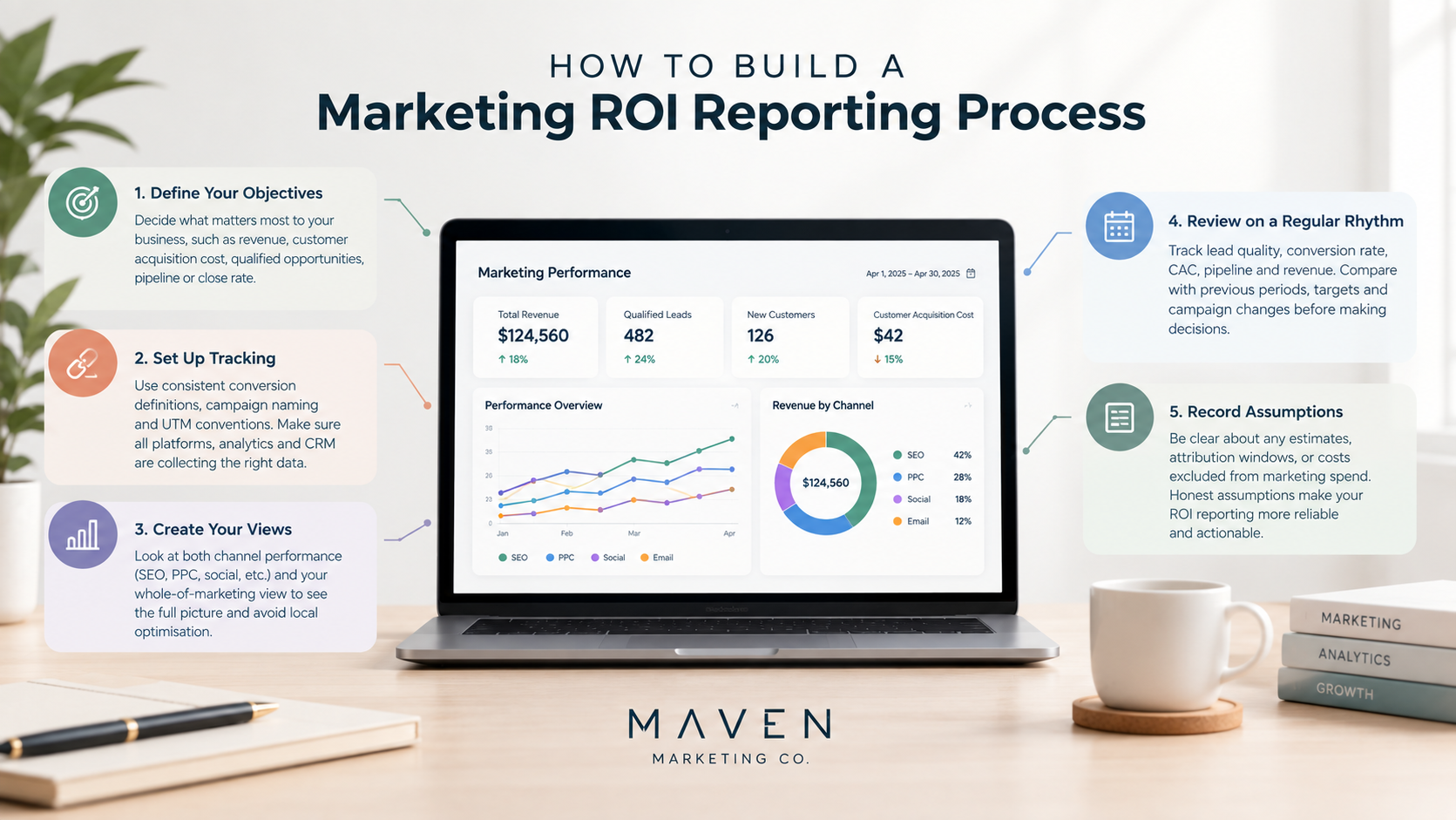
How to Build a Marketing ROI Reporting Process
A strong ROI reporting process should be consistent enough to compare performance over time and simple enough that people actually use it. Accurate marketing analytics and reporting help businesses connect campaign activity with qualified leads, revenue and overall growth performance. The aim is not to build the biggest dashboard. It is to create a repeatable decision framework.
Start by defining the business outcomes that matter. For one business that might be revenue and customer acquisition cost. For another it may be qualified opportunities, pipeline value and close rate. Then define the key events and channel metrics that connect marketing activity to those outcomes.
Next, standardise tracking. Use consistent conversion definitions, campaign naming and UTM conventions. Confirm that advertising platforms, analytics and CRM systems are collecting the right data. If tracking is unreliable, fix that before making aggressive budget decisions based on the numbers.
Create a channel view and a whole-of-marketing view. The channel view helps diagnose SEO, PPC and social performance in detail. The whole-of-marketing view shows the combined investment, total qualified outcomes, pipeline or revenue contribution and customer acquisition efficiency. This prevents local optimisation from damaging the bigger picture.
Then review performance on a regular rhythm. Look for changes in lead quality, conversion rate, CAC, pipeline and revenue rather than reacting to one unusual week. Compare performance with prior periods, business targets and known changes in campaign mix. When the evidence is strong enough, reallocate budget or effort based on commercial impact.
Finally, record assumptions. If SEO revenue is estimated from average deal value, say so. If social-assisted conversions use a specific attribution window, document it. If internal labour has been excluded from marketing cost, make that visible. Honest assumptions make ROI reporting more useful because decision-makers understand what the numbers can and cannot prove.
FAQs
What is marketing ROI?
Marketing ROI measures the return generated from marketing relative to the cost of producing that return. A common formula is (return generated - marketing cost) divided by marketing cost, expressed as a percentage. The most useful version uses profit or contribution where available rather than revenue alone.
How do you calculate digital marketing ROI?
Define the return generated by the marketing activity, subtract the relevant marketing cost, then divide by that cost. For lead-generation businesses, you may need to connect leads to CRM outcomes and customer value before the return can be calculated properly.
How can I measure SEO ROI?
Measure the total SEO investment against the commercial value generated from organic search. Track Search Console visibility and clicks, then use analytics and CRM data to connect organic visits with conversions, qualified leads, sales, pipeline or revenue over time.
How do I measure PPC performance?
Track ad spend, conversions, conversion value, cost per acquisition, lead quality, sales outcomes and ROAS where relevant. For a fuller ROI view, include the other costs required to run the campaigns and assess profit contribution rather than relying only on platform conversion counts.
What is the best way to track marketing ROI across channels?
Use consistent conversion definitions and UTM naming, connect platform data with analytics and CRM outcomes, and review attribution paths rather than relying only on last click. Report each channel according to its role while also maintaining a whole-of-marketing view of cost, pipeline, revenue and customer acquisition.
Measure marketing by the value it creates, not the noise it produces
Good marketing reporting should make decisions easier. If a dashboard cannot show whether activity is creating stronger leads, sales, customers or long-term value, it is probably measuring too much of the wrong thing.
Maven Marketing Co. helps businesses connect SEO, paid media, social and website performance to clearer commercial outcomes. If you want to understand where your marketing return is really coming from and where the strongest improvement opportunities sit, book a call with the team.
Infographic: The Marketing ROI Measurement Framework
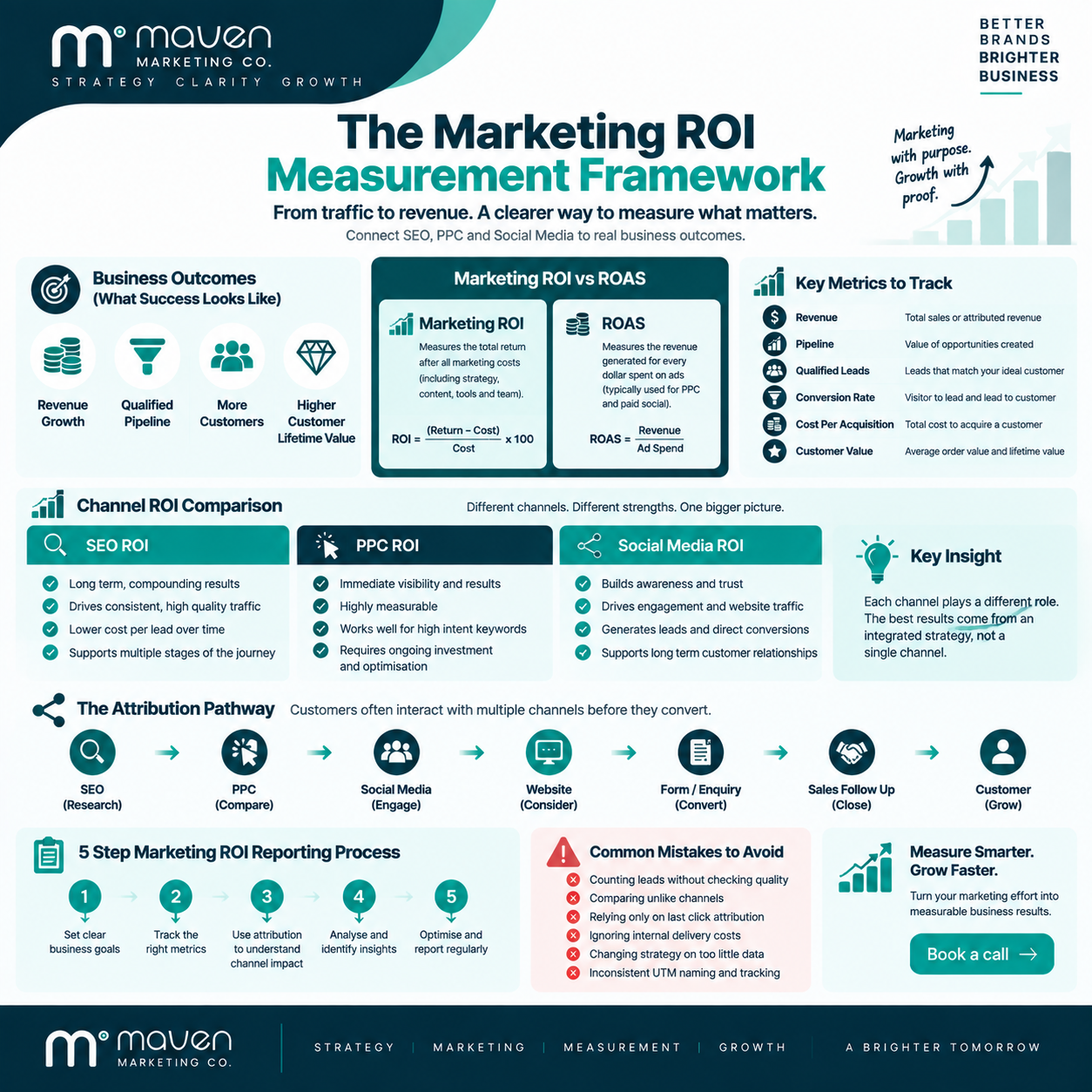

Table of contents
read more blogs

How to Build a Strong Online Presence for Your Business
A strong online presence is no longer just about having a website and a few social media accounts. It is the combined experience people have when they search for your business, visit your website, see your content, read reviews, encounter your advertising and interact with your brand across digital channels.For most businesses, that experience shapes trust before a conversation ever happens. Potential customers can compare providers, read reviews, visit service pages, check social activity and form an opinion about your credibility long before they enquire. If those signals are weak, inconsistent or hard to find, the business can lose opportunities without ever knowing they were there.Building a strong online presence is therefore less about being everywhere and more about being easy to find, easy to understand and easy to trust. A complete digital marketing strategy helps businesses connect their website, search visibility, content, advertising and customer engagement into one consistent growth system. Your website, search visibility, content, social presence, paid activity, brand and customer engagement all need to reinforce the same commercial story.This guide explains how to build a stronger business online presence step by step. The focus is practical: improving visibility, creating useful content, strengthening brand consistency, reducing friction and measuring whether your digital presence is actually helping the business attract and convert better opportunities.

The Ultimate Guide to E-commerce Product Page Optimisation
A strong e-commerce product page has to do several jobs at once. It needs to be discoverable in search, easy to understand, persuasive enough to build confidence and simple enough for a customer to buy without unnecessary friction. That combination is what makes product page optimisation such an important part of both ecommerce SEO and conversion strategy.The difficulty is that product pages are often built from one reusable template across hundreds or thousands of products. If the template is weak, the problem scales. Thin descriptions, poor imagery, unclear variants, buried shipping information or an awkward mobile experience can affect a large part of the store at the same time.Current product-page UX research from Baymard continues to show how often shoppers abandon otherwise suitable products because of avoidable usability issues. At the same time, Google provides dedicated guidance for e-commerce sites, product structured data, product variants and image optimisation because product information needs to be clear and machine-readable as well as useful to people.The goal is not to stuff every product page with more text or technical markup. A complete digital marketing strategy combines SEO, user experience, content and conversion improvements to help ecommerce businesses attract and convert the right customers. It is to give shoppers the information they need, in the right order, while helping search engines understand what the product is, whether it is available and how the page relates to the wider store. This guide covers the practical elements that make that happen.

How to Choose the Right Digital Marketing Channels for Your Business
Choosing digital marketing channels is one of the easiest places for businesses to lose clarity. There are more options than ever, every platform promises reach and results, and it is easy to assume that the best strategy is simply to be everywhere. In reality, most businesses do better when they choose channels with intention rather than spreading budget and effort too thinly.The right channel mix depends on where your audience spends time, how they search or discover solutions, what your business is trying to achieve and how much resource you actually have to support execution properly. A channel is only useful if it helps move the right people towards a commercial outcome that matters to the business.This is why strong digital marketing strategy is not really about finding one perfect platform. It is about understanding the role each channel can play across awareness, demand capture, conversion and retention. SEO might build long-term visibility, Google Ads might capture active intent, social media might support familiarity and reach, while email may help nurture prospects and strengthen customer value over time.This guide explains what digital marketing channels are, how to assess them properly and how to build a balanced channel mix for your business. The focus is practical. Rather than chasing every new platform, the goal is to help you choose the channels that fit your audience, goals, budget and internal capability.


