.svg)


%201.svg)
Key Takeaways
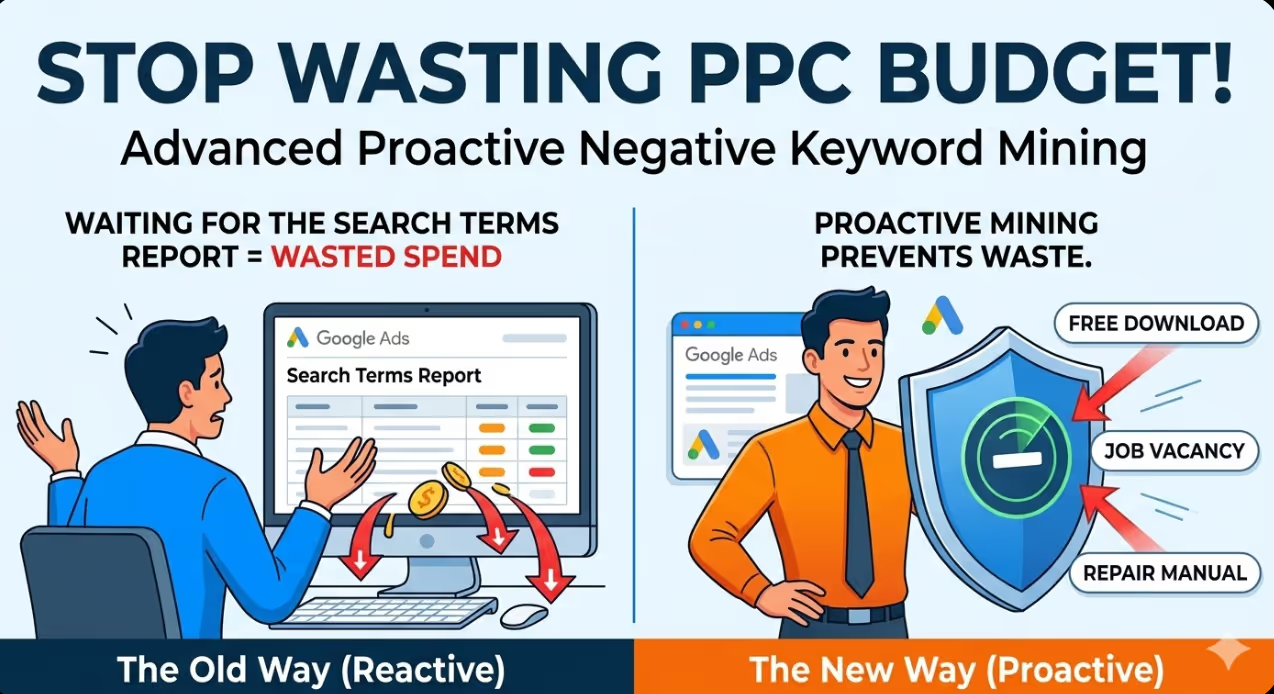
- The Search Terms Report shows wasted spend that has already occurred. Advanced negative keyword mining prevents spend waste before it happens by identifying irrelevant query patterns through research rather than waiting for them to appear in the report.
- Broad match and Performance Max campaigns generate the widest range of irrelevant search term matches and require the most rigorous proactive negative keyword work. Exact match campaigns require less proactive mining but still benefit from a structured negative keyword framework.
- Competitor keyword analysis reveals which search queries in the brand's category are associated with informational, price comparison, or competitor brand intent that the account should exclude, rather than discovering this only after paying for those clicks.
- Industry terminology research identifies the full vocabulary of the product or service space, including trade terms, acronyms, and related concepts that share keywords with the target queries but represent entirely different searcher intents.
- Negative keyword lists at the account level, applied across all campaigns simultaneously, provide structural protection that individual campaign negatives cannot and reduce the maintenance overhead of managing negatives on a campaign by campaign basis.
- The match type applied to negative keywords is as strategically important as the match type applied to positive keywords. Using the wrong negative match type either fails to block the intended query pattern or blocks legitimate traffic as collateral damage.
- A quarterly negative keyword audit, reviewing both the Search Terms Report and the proactive mining sources, is the maintenance cadence that keeps a mature Google Ads account operating at peak efficiency.
Why the Search Terms Report Is Not Enough
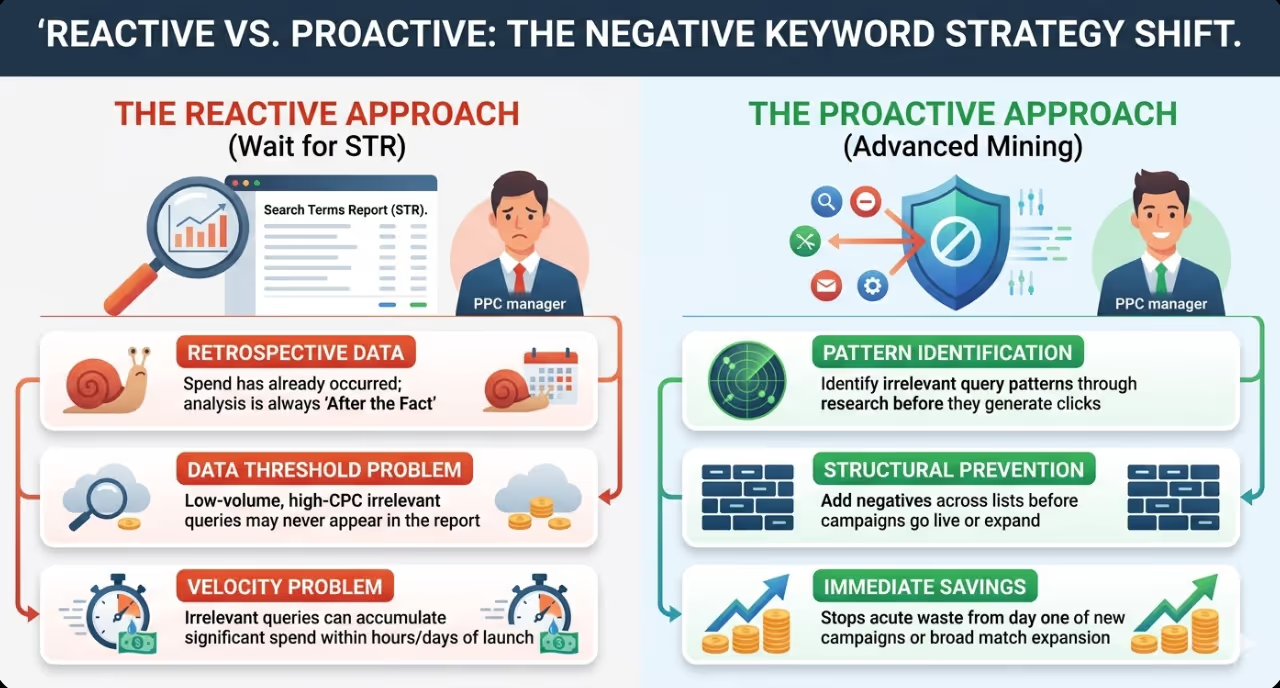
The Search Terms Report in Google Ads shows the actual queries that triggered impressions and clicks in the account over a selected date range. It is valuable, widely used and genuinely important for identifying specific irrelevant queries that have generated spend. It is also fundamentally retrospective: by the time a query appears in the Search Terms Report with enough data to warrant adding it as a negative, the account has already paid for those clicks.
There are three structural limitations of a purely reactive approach to negative keyword management.
The first is the data threshold problem. Google Ads does not show all search terms in the report, only those that have reached a minimum volume threshold. Queries that generate a small number of clicks at high CPCs may never appear in the report individually even though they collectively represent meaningful wasted spend. Proactive mining identifies the query patterns that would produce these terms before they accumulate, rather than waiting for individual terms to surface.
The second is the velocity problem. For campaigns running significant daily budgets, irrelevant queries can accumulate substantial spend within a single day or week of a new campaign launch or a match type expansion before the Search Terms Report provides enough data for a manager to identify and respond to the problem. Proactive negative keyword frameworks, added to the account before campaigns go live or when campaigns are expanded, prevent this acute waste.
The third is the campaign structure problem. Performance Max campaigns, which now manage a significant portion of spend in most Australian Google Ads accounts, do not provide the same level of search term transparency as standard Search campaigns. The limited insight into what queries Performance Max is matching against makes proactive negative keyword management even more important, since the reactive approach has fewer data signals to work from.
Technique 1: Intent Landscape Mapping
Intent landscape mapping is a proactive technique that identifies the full range of search intents that exist around the account's core keyword set, including the intents that represent irrelevant or commercially misaligned audiences, before a single query appears in the Search Terms Report.
The process starts with each core keyword or keyword theme in the account and expands outward to map the full set of queries a user might perform that contain or relate to those terms. This expansion uses a combination of Google Suggest, related searches at the bottom of the results page, the People Also Ask questions on the results page, and keyword research tools such as Semrush or Ahrefs to identify the adjacent query landscape.
Within this expanded query set, the relevant queries are those representing the searcher intents the account is designed to capture: commercial intent, purchase intent, and the specific informational intents that represent the early stages of the target audience's decision journey. The irrelevant queries are those representing intents the account should not be paying to reach: academic research, employment seeking, competitor brand navigation, DIY alternatives to purchasing, trade or industry audiences rather than consumer audiences, geographic markets outside the targeting, and any other intent segment that does not match the commercial objective.
Each identified irrelevant intent cluster becomes a source of negative keywords. For example, an Australian ecommerce business selling premium coffee equipment that identifies a significant cluster of "how to fix" and "repair" queries in the intent landscape around its core terms should add negative keywords covering the repair and troubleshooting intent before those queries appear in the account, not after.
Technique 2: Competitor and Branded Query Analysis
A significant proportion of wasted spend in Google Ads accounts operating in competitive Australian markets comes from queries that include competitor brand names, alternative product brand names, or informational queries about competitive comparisons. In some cases the account owner has deliberately included competitor terms. In many cases, broad match keywords are triggering these queries without the account owner intending to target them.
For Australian accounts using broad match extensively, a deliberate competitor negative keyword strategy is essential. The process involves researching the primary competitor brands in the category, the product names and model numbers they sell, and the common informational queries searchers use when comparing options in the category, such as "[competitor name] review", "[competitor name] vs [brand name]", and "[competitor name] alternative".
Whether the account should target competitor terms intentionally is a separate strategic decision. What the negative keyword mining process establishes is that the account is not unintentionally paying for competitor queries through broad match expansion when it has not deliberately chosen to compete on those terms. The distinction matters because competitor terms typically convert at much lower rates than commercial queries that do not involve branded terms for most Australian businesses, and unintentional competitor spend erodes return on investment without the account owner being aware.
Technique 3: Industry Vocabulary and Terminology Research
Every product and service category contains vocabulary that creates false matching opportunities for broad match campaigns. A word that is central to the target query landscape may also appear in search queries from entirely different audiences with no commercial relevance to the account.
A healthcare business advertising physiotherapy services in Brisbane must account for the fact that broad match keywords related to physical therapy and rehabilitation will also trigger queries from job seekers researching physiotherapy careers, from students researching physiotherapy courses, from academics researching clinical methodology, and from people seeking information about specific conditions that would be treated by a GP rather than a private physio practice.
Each of these query populations shares vocabulary with the target keyword set but represents an entirely different searcher intent. A systematic review of the industry terminology, conducted through keyword research tools and augmented by knowledge of the specific category, identifies the vocabulary clusters associated with each adjacent intent and generates the negative keywords needed to block them structurally before they enter the account.
This technique is particularly valuable when launching campaigns in a new category or expanding existing campaigns into broader match types. The terminology research that takes a few hours before launch prevents weeks of accumulated spend waste that would otherwise require the Search Terms Report to reveal.
Technique 4: Geographic and Demographic Exclusion Mining
For Australian businesses with specific geographic service areas, negative keyword mining should extend to identifying the query patterns tied to specific locations that fall outside the service area. Google Ads geographic targeting settings do not always prevent impressions for queries that include geographic terms outside the targeted area, particularly when the searcher's physical location is within the target but the query explicitly references a different location.
A service business based in Brisbane that operates only within the Brisbane metropolitan area may receive clicks from queries such as "plumber Sydney", "plumber Melbourne", or "plumber near me" from users physically in Brisbane who are researching for a friend or relative in another city. Geographic negative keywords covering the major Australian cities and states outside the service area, combined with the appropriate geographic targeting settings, provide more complete geographic exclusion than either approach delivers alone.
For Australian businesses with age or products designed for a specific audience, demographic intent signals in the query itself can be used to build negative keyword lists that prevent impressions for queries indicating a demographic mismatch. A business selling products exclusively to adults that identifies query patterns including terms such as "for kids", "for children", "for school", or "for teenagers" in the intent landscape should add these modifiers as negative keywords to prevent spend on that demographic intent.
Technique 5: Seasonal and Topical Query Pattern Mining
Some irrelevant query patterns are predictable in advance because they are associated with specific seasonal events, news cycles, or cultural moments that generate search volume around terms that overlap with the account's keywords.
An Australian financial services business running campaigns around the term "tax" will see search volume spikes around the end of the financial year from queries associated with news coverage, policy announcements, and general awareness building that does not represent commercial intent. An Australian retailer running campaigns for "Christmas gifts" in November and December will see irrelevant query patterns emerge as news coverage, charity appeals, and Christmas content with no commercial intent generates search volume around similar terms.
Anticipating these seasonal query patterns and adding the relevant negatives in advance of the period when they spike prevents the account from absorbing spend from a searcher population that is not commercially relevant, without requiring the Search Terms Report to reveal the problem after spend has already been committed.
Technique 6: Negative Keyword List Architecture
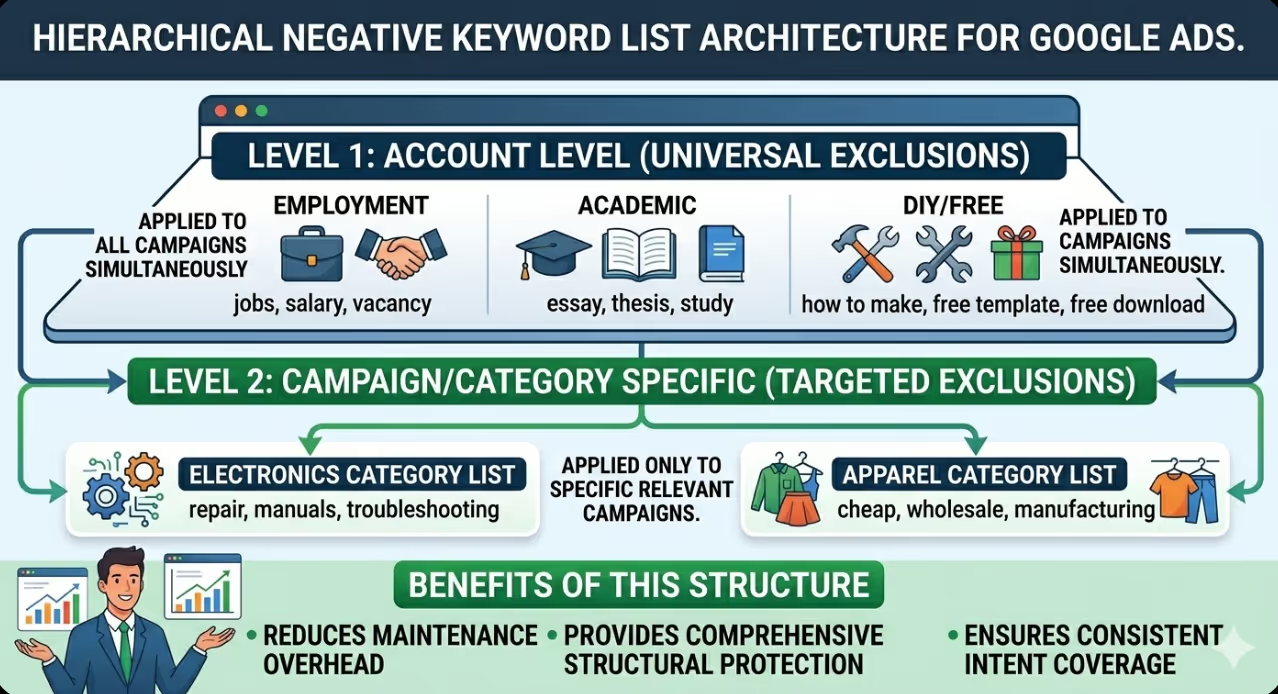
The structural organisation of negative keywords within the account is an advanced technique in itself. The difference between maintaining negative keywords as a flat list at the campaign level and building a structured hierarchy of shared negative keyword lists applied at the account level is the difference between a maintenance task that scales poorly and one that compounds in value as the account grows.
Google Ads allows the creation of shared negative keyword lists that can be applied to multiple campaigns simultaneously. This capability is underused in most Australian PPC accounts but represents one of the most efficient structural improvements available.
A a negative keyword list architecture that is well structured for an Australian Google Ads account typically includes several categories of shared lists.
A universal exclusion list. This list contains negative keywords that should never trigger any campaign in the account regardless of the keyword: terms associated with employment intent (jobs, careers, salary, vacancy), academic intent (essay, assignment, thesis, study), DIY research that signals intent to not purchase (how to make, free template, free download), and any other intent category that is universally irrelevant to the account's commercial objectives. This list is applied to every campaign in the account.
Exclusion lists by category. These lists contain negative keywords specific to particular product or service categories within the account, applied only to the campaigns covering those categories. A retailer with both an electronics and an apparel offering needs different exclusion lists specific to each category for each product area.
Geographic exclusion lists. For businesses with defined geographic service areas, a list of location terms outside the service area applied across the whole account ensures consistent geographic exclusion without requiring manual maintenance on each individual campaign.
Competitor exclusion lists. For accounts that have deliberately decided not to compete on competitor brand terms, a shared competitor exclusion list prevents broad match expansion from unintentionally targeting competitor queries across all campaigns.
Negative Match Types: Choosing Correctly
The match type applied to a negative keyword determines the scope of its exclusion, and using the wrong match type either leaves the intended query uncovered or blocks legitimate traffic.
Negative broad match (the default when a negative is added without brackets or quotation marks) excludes queries that contain all the words in the negative keyword in any order. A negative broad match of "free consultation" excludes "free legal consultation", "consultation free", and "get a free consultation". It does not exclude "free" alone or "consultation" alone.
Negative phrase match (added in quotation marks) excludes queries that contain the exact phrase in that order. Negative phrase match "free consultation" excludes "free consultation Sydney" and "get a free consultation" but not "consultation free" because the word order differs.
Negative exact match (added in square brackets) excludes only queries that exactly match the keyword with no additional words. Negative exact match [free consultation] excludes only the precise query "free consultation" with nothing before or after it.
For most exclusions based on searcher intent, negative phrase match provides the right balance: it blocks the specific intent pattern across its natural variations without inadvertently blocking queries that happen to contain one of the words in a different context.
FAQs
How often should Australian PPC managers review and update their negative keyword lists?
Negative keyword maintenance operates on two different cycles. The reactive review of the Search Terms Report should happen at least weekly for active campaigns with significant daily budgets, and at least fortnightly for campaigns with smaller daily spends. The proactive mining review, which reassesses the intent landscape, competitor vocabulary, and seasonal query patterns, should happen quarterly as part of a broader account audit. At each quarterly review, the account's negative keyword lists should be assessed for both gaps (query patterns that have emerged and are generating spend but are not yet blocked) and blocking of legitimate traffic (negatives that were added correctly at the time but are now blocking legitimate traffic due to changes in the campaign's keyword set or match type configuration). Negative keyword management is not a task done once but an ongoing account discipline that improves in precision the longer it is maintained.
What is the risk of adding too many negative keywords to a Google Ads account?
Adding too many negatives is a genuine and often underappreciated risk in Google Ads account management. Aggressive negative keyword addition can reduce an account's reach below the threshold needed to gather sufficient data for smart bidding algorithms to function effectively, block legitimate traffic that shares vocabulary with the excluded intents, and prevent Performance Max and broad match campaigns from finding the audiences likely to convert that the campaigns would have discovered if the intent space had not been constrained too tightly. The risk of adding excess negatives is highest when negatives are added at the exact match level across entire campaigns without assessing the potential for legitimate traffic overlap, and when negatives are applied across the whole account that should be applied only to specific campaigns. A structured negative keyword audit that reviews the impact of existing negatives on impression share and search term coverage, conducted alongside the proactive mining process, prevents the account from drifting into an state where too many negatives have been applied.
How should Australian PPC managers handle negative keywords in Performance Max campaigns?
Performance Max campaigns accept negative keywords through shared negative keyword lists and, in some configurations, at the campaign level via specific exclusion settings. The limited search term transparency that Performance Max provides makes proactive negative keyword management especially important for these campaigns: since the account manager cannot see the full range of queries being matched against, the structural protection provided by shared lists applied at the account level and exclusions at the campaign level must be in place before the campaign runs rather than added reactively after spend has accumulated. For Australian accounts running Performance Max alongside standard Search and Shopping campaigns, the universal exclusion list and any lists specific to the relevant categories applied to the standard campaigns should also be applied to the Performance Max campaign to ensure consistent intent coverage across all campaigns in the account.
Proactive Mining Is Where Account Efficiency Is Built
The Search Terms Report is a valuable tool and reactive negative keyword management is better than no negative keyword management. But the accounts that achieve consistently high efficiency in the Australian PPC market are those where the negative keyword architecture was built before the campaigns went live and is maintained through proactive mining rather than waiting for irrelevant spend to surface in the data. The investment in proactive mining pays for itself quickly and compounds with every additional week of cleaner conversion signals flowing into the account's smart bidding system.
Maven Marketing Co conducts Google Ads account audits and implements proactive negative keyword frameworks for Australian businesses, reducing wasted spend and improving campaign efficiency from the first weeks of implementation.
Talk to the team at Maven Marketing Co →

Table of contents
read more blogs

Is Google Ads Better Than SEO for My Business
One of the biggest questions business owners ask when they are planning online growth is whether they should invest in Google Ads or SEO. Both are strong marketing plays that help your company show up in Google search results, but they do things in separate lanes. Google Ads gives quicker visibility and can bring in leads fast, whereas SEO more or less focuses on slow, steady organic traffic that tends to grow the longer you keep building it. Picking the right direction depends on what you want to achieve, how much money you can spend, how crowded the market is, and how quickly you need results, like sooner rather than later. The good news is you don’t always have to choose one or the other; it’s not exactly a black-and-white situation. If you take time to understand the strongest points of both, you can put together a more sensible digital marketing plan that supports consistent expansion. In this guide, we’ll compare Google Ads vs SEO, explain the main differences, and help you figure out what option makes the most sense for your business.

When Should I Hire a Digital Marketing Agency
Growing a business today takes more than just having a website or throwing a post on social media; customers usually search around online, compare providers, skim reviews, and basically expect the brand to show up with a solid digital presence before they even think about buying. Many businesses try to run their marketing themselves, but there comes a point when “doing it all in-house” becomes clunky and hard to manage, all at once. Knowing when to hire a digital marketing agency can end up making a big, real difference for your growth. If you’re not getting enough leads, or your online visibility feels stuck, or sales are just not moving, the right agency can bring the know-how, plus a clear plan, to help you get noticeably better outcomes. In this guide, we’ll dig into what a digital marketing agency actually does, the usual signs it’s time to bring one on, and how picking the right marketing partner can help your business move forward at a faster pace.
Why Is My Google Ads Budget Running Out So Quickly
Running a successful Google Ads budget isn’t only about throwing more money at it. It’s more like making every dollar, doing a bit extra. A lot of businesses start a Google Ads campaign with big hopes, then find out their daily budget is gone within a few hours, and that feels weird, right? After that, your ads stop showing effectively, new leads slip away, and your return on investment dips. So if your Google Ads budget is running out too fast, don’t stress. It’s a fairly common issue, and in most situations, it can be repaired with the right approach. There are multiple little things that can drain your advertising money quicker than you expected, from costly keywords to audience targeting that just doesn’t quite fit. In this guide, we’ll walk through why your budget disappears so quickly, how to cut wasteful spend, and the most reliable ways to boost your Google Ads ROI, even if your budget stays the same.