.svg)


%201.svg)
Key Takeaways
- Extensions are now called assets in Google Ads but the term extensions remains widely used. Both terms refer to the same feature: additional information attached to a search ad that can appear below the main headline and description.
- Not all extensions are eligible to serve on every impression. Google shows extensions when it predicts they will improve performance, and the combination of extensions shown varies by query, device, position, and other contextual signals.
- Extensions are free to add. There is no additional cost for configuring extensions, and each extension type that serves adds to the ad's real estate in search results and typically improves the rate of clicks through.
- The most impactful extensions for most Australian service businesses are sitelinks, callouts, call extensions, structured snippets, and location extensions. Each of these directly addresses a common searcher need at the moment of decision.
- Extensions can be applied at the account level, campaign level, or ad group level. Applications at a lower level override those at a higher level for the same extension type, allowing specific campaigns or ad groups to show more targeted extension content.
- Some extension types require eligibility criteria or verification: call extensions require a verified phone number, location extensions require a linked Google Business Profile, and affiliate location extensions are available only to brands whose products are sold through retail chains that are third parties.
- The Google Ads platform automatically suggests and creates some extensions based on the content of the website and existing ads. These automated extensions should be reviewed for accuracy and appropriateness before they begin serving.
Extension Type 1: Sitelink Extensions
Sitelinks are the most widely used and most impactful extension type. They appear as additional links beneath the main ad, each with its own title and optional description lines, directing searchers to specific pages on the website beyond the main landing page.
A sitelink set that is well configured for an Australian service business typically includes links to the primary service categories, a testimonials or reviews page, an About page, a pricing or quote page, and the contact page. For ecommerce businesses, sitelinks often link to the top product categories, current promotions, new arrivals, and the bestsellers section.
Configuration best practice: Each sitelink needs a distinct, specific title (not a generic "Learn More") and ideally two lines of description text (35 characters each) that explain what the searcher will find when they click. A sitelink with description lines occupies significantly more vertical space in the ad and provides more context to encourage a more qualified click.
Account vs campaign level: Sitelinks added at the account level serve across all campaigns unless overridden by sitelinks set at the campaign level. For businesses with multiple distinct service areas or product lines, sitelinks at the campaign level that are specific to each campaign's theme produce better results than generic links set at the account level.
Extension Type 2: Callout Extensions
Callout extensions are short text phrases (up to 25 characters each) that appear beneath the ad to highlight specific features, benefits, or attributes of the business. They cannot be clicked and serve purely as supplementary persuasion text.
Effective callouts for Australian businesses typically highlight points of difference: "Australian Owned," "Same-Day Service," "No Call-Out Fee," "Licensed and Insured," "Free Consultation," "Over 500 Reviews," "10-Year Warranty," "24/7 Emergency Line."
Configuration best practice: Add a minimum of eight to ten callouts so Google has enough variation to test different combinations. Avoid repeating information already in the headline or description. Make each callout as specific as possible rather than generic claims like "Quality Service" that every competitor can also say.
Extension Type 3: Structured Snippet Extensions
Structured snippets display a predefined header followed by a list of values. The header must be chosen from Google's list of approved header types, which include: Services, Products, Brands, Models, Styles, Destinations, Courses, Degree programmes, Featured Hotels, Insurance Coverage, Neighbourhoods, and Service Catalogue.
For an Australian plumbing business, a structured snippet with the header "Services" and values "Emergency Repairs, Hot Water Systems, Drain Clearing, Bathroom Renovations, Gas Fitting, Water Leak Detection" gives searchers an immediate sense of the full scope of services before clicking.
Configuration best practice: Use the header type that best matches the most important category of content for the campaign. Add at least four to eight values per snippet for adequate variety. Values should be specific and informative rather than generic.
Extension Type 4: Call Extensions
Call extensions add a phone number to the ad, allowing mobile users to call the business directly from the search results page without visiting the website. On desktop, the number is displayed as a clickable call link.
For Australian service businesses in categories with high intent (emergency services, healthcare, legal, trades), call extensions are among the most commercially important extensions available. A searcher looking for an emergency plumber who sees a phone number in the ad can call immediately rather than clicking through, waiting for the page to load, and finding the number.
Configuration best practice: Use a tracked number (either Google's call forwarding number or a call tracking number from a third party) so that calls from the extension are attributed correctly in reporting. Set a call schedule aligned with business hours so the extension is not shown when nobody is available to answer. Configure a minimum call duration for conversion tracking so that brief, unqualified calls are not counted as conversions.
Extension Type 5: Location Extensions
Location extensions connect the ad to the business's Google Business Profile, displaying the business address, distance from the searcher, and a link to the Google Maps listing. They are particularly valuable for businesses with physical premises that customers visit.
For Australian retail businesses, service businesses with a showroom, and any business where the physical location is commercially relevant, location extensions provide a proximity signal that is especially impactful for local search queries.
Eligibility requirement: Location extensions require a verified Google Business Profile linked to the Google Ads account. The Business Profile must be in good standing and verified before the location extension can be activated.
Configuration best practice: For businesses with multiple Australian locations, link all locations through the Business Profile account. Set bid adjustments for users in close proximity to the physical location, as searchers near a store or office typically convert at a higher rate than distant searchers.
Extension Type 6: Affiliate Location Extensions
Affiliate location extensions are designed for manufacturers and brands whose products are sold through national retail chains. They show searchers the nearby retail locations where the advertised brand's products can be purchased.
For Australian brands distributed through major retailers (Bunnings, Harvey Norman, JB Hi-Fi, Officeworks, Woolworths), affiliate location extensions allow the brand's Google Ads campaigns to drive searchers to the nearest retail location rather than only to the brand's own website.
Eligibility requirement: Affiliate location extensions are available only for brands whose retail partners participate in Google's affiliate location network. Availability depends on which Australian retail chains have connected with Google's system.
Extension Type 7: Price Extensions
Price extensions display a set of product or service cards beneath the ad, each showing a name, a brief description, and a price (or price range), with individual links to the relevant pages for each item.
For Australian businesses in categories where price is a key decision factor, price extensions allow searchers to evaluate whether the price suits them before clicking: a user who sees that the service starts at $150 and is comfortable with that price is a more commercially qualified click than a user who clicks without any price context and leaves immediately when they see the cost.
Configuration best practice: Include a minimum of three to eight price items for good coverage. Use price ranges ("From $150") where fixed prices are not appropriate. Keep item names and descriptions specific and focused on the benefit to the searcher. Ensure the links for each item go directly to the most relevant page for that item rather than to the homepage.
Extension Type 8: Promotion Extensions
Promotion extensions highlight a specific promotional offer in the ad, including the offer type (monetary discount, percentage discount, "up to" discount), the offer detail, a promotional code where applicable, and optional start and end dates.
For Australian ecommerce businesses running seasonal promotions (end of financial year sales, Christmas offers, clearance events), promotion extensions surface the offer directly in the search results, increasing the rate of clicks among searchers who are motivated by price at that moment.
Configuration best practice: Use promotion extensions only when there is a genuine, active promotion. An expired or inaccurate promotion extension reduces the quality of the click and the credibility of the brand. Set start and end dates in the extension configuration so it serves only during the active promotional period. Review automatically generated promotions (which Google sometimes creates from website content) to ensure accuracy.
Extension Type 9: Lead Form Extensions
Lead form extensions allow the searcher to submit a basic enquiry form directly within the Google Ads interface, without visiting the advertiser's website. The form collects the searcher's name, email, phone number, and optionally a brief additional message in their own words.
For Australian businesses where the primary conversion goal is generating enquiry leads and where landing page friction is a barrier to conversion (particularly on mobile), lead form extensions can capture leads from searchers who would otherwise bounce from the landing page without converting.
Configuration best practice: Lead form extensions require a confirmed business category and compliance with Google's lead form policies. The form headline and business name must be accurate. A webhook or CRM integration (or at minimum a CSV download process) is required to retrieve the leads, as they are not automatically delivered by email. Response time to leads submitted through the extension is commercially important: a lead form submission is a strong intent signal and should receive a response within a few hours at most.
Extension Type 10: Image Extensions
Image extensions add a square image to text ads on eligible placements. The image appears to the right of the text ad on desktop search results. Approved images must meet Google's image policy requirements and must be directly relevant to the ad's subject matter.
Image extensions are particularly effective for businesses in categories where visuals drive decisions: home renovation, landscaping, food and beverage, accommodation, and retail. A completed kitchen renovation image next to a kitchen renovation services ad provides visual credibility that text alone cannot.
Eligibility requirement: Image extensions are available to advertisers who meet Google's eligibility criteria, which include account history and policy compliance requirements. Not all Australian accounts are automatically eligible.
Configuration best practice: Use professionally photographed and of high quality images rather than stock photos. The image should directly represent the specific product or service advertised in the campaign or ad group to which it is applied. Images approved for one campaign should be reviewed before applying them to a different campaign with a different theme.
Extension Type 11: Seller Ratings Extensions
Seller ratings extensions display a star rating and review count beneath the ad, automatically populated from verified review sources including Google Customer Reviews, Trustpilot, and other approved review aggregators.
Seller ratings extensions are not manually added: they appear automatically when the account meets Google's eligibility threshold, which requires a minimum number of verified reviews (typically 100 or more) above a minimum average rating (typically 3.5 stars or higher) from an approved review source.
For Australian businesses with strong review profiles, seller ratings extensions provide powerful social proof at the most commercially critical moment: when a searcher is comparing multiple competing ads. An ad displaying 4.8 stars from 215 reviews next to a competitor's ad with no rating has a measurable advantage in the rate of clicks.
Building eligibility: The fastest path to seller ratings eligibility is implementing Google Customer Reviews on the website (available through Google Merchant Center) and actively encouraging verified review submissions from verified purchasers.
Extension Type 12: App Extensions
App extensions add a link to download a mobile application alongside the text ad, providing both a standard landing page destination and an app store download option. They are relevant only to businesses with a mobile application that the ad is promoting.
For Australian businesses running campaigns to drive app downloads, app extensions allow the campaign to capture both web and app install conversions from the same ad. The app store link is shown to mobile users and the web link is shown to desktop users.
Extension Type 13: Dynamic Sitelink, Callout, and Structured Snippet Extensions
Google automatically generates dynamic versions of sitelink, callout, and structured snippet extensions based on the website's content. These automated extensions serve when Google predicts they will outperform the manually configured versions.
Automated extensions can provide useful supplementary coverage, particularly for new accounts or campaigns that have not yet had time to configure a comprehensive manual extension set. However, they should be monitored for accuracy: automatically generated callouts and sitelinks occasionally produce inaccurate or inconsistent with the intended brand message.
Management approach: Review the automated extension report in Google Ads to see which automated extensions are serving and what they contain. Extensions that are inaccurate, irrelevant, or inconsistent with the brand's current positioning can be excluded from serving through the automated extension settings.
Prioritising Extensions by Business Type
Not all thirteen extensions are appropriate for every Australian business. The prioritisation framework for the most commercially important extension types by business category is:
Australian service businesses (trades, professional services, healthcare, legal): Sitelinks, callouts, call extensions, structured snippets, location extensions, and lead form extensions should all be active. Price extensions are appropriate where transparent pricing is a differentiator. Promotion extensions apply when a genuine offer is active.
Australian ecommerce businesses: Sitelinks, callouts, structured snippets, price extensions, promotion extensions, seller ratings, and image extensions are the highest priority. Call extensions may be appropriate for products involving a more considered purchase where phone support adds value. Dynamic extensions should be reviewed and appropriately managed.
Australian B2B businesses: Sitelinks, callouts, structured snippets, and lead form extensions are the primary focus. Call extensions for sales enquiries, price extensions for service pricing, and image extensions where applicable add incremental value. Seller ratings require specific B2B review sources.
FAQs
How many sitelinks should an Australian Google Ads account have to maximise extension coverage?
Google recommends a minimum of four sitelinks to provide enough variety for the system to optimise which combination to show in any given auction. In practice, six to eight sitelinks that are well written and include description text gives the algorithm a useful range to test and optimise from, and is sufficient for most Australian service and ecommerce campaigns. Adding more than twelve sitelinks set at the campaign level provides diminishing returns, as the additional links are rarely shown and the effort of maintaining them can distract from more impactful optimisation. For sitelinks set at the account level, four to six general sitelinks covering the main sections of the site is typically adequate, supplemented by sitelinks at the campaign level that are specific to each campaign's theme.
Do Google Ads extensions improve Quality Score?
Extensions do not directly contribute to the Quality Score calculation at the keyword level, which is based on the expected rate of clicks through, ad relevance, and landing page experience. However, extensions influence the Quality Score component based on expected click rate because ads with relevant extensions that are well configured tend to achieve higher rates of clicking through than ads without them. Additionally, the overall ad rank calculation in Google's auction system incorporates the predicted impact of extensions, meaning that an extension set that is well configured can effectively improve ad position without requiring a higher bid. Australian advertisers who neglect extension configuration are paying a small but real competitive disadvantage in every auction where their ads with few extensions compete against ads with a more extensive extension set.
Can extensions be used to show different information to mobile versus desktop users in Australia?
Extensions do not have separate desktop and mobile configuration options, but some extension types behave differently across devices by design. Call extensions show a button to call directly on mobile and a static number on desktop, which is the most significant device differentiation available. Image extensions are currently available on desktop only. Location extensions are displayed differently on mobile, where they are more prominent and include a feature that opens navigation directions. For bid adjustments at the campaign level that are specific to the device, the bid adjustment for mobile devices is a separate setting from the extension configuration itself, and it affects the overall likelihood that the ad and its extensions appear in mobile results. Australian businesses that want to emphasise phone calls from mobile traffic should ensure call extensions are active, have appropriate business hours scheduling, and have a positive bid adjustment applied for mobile devices.
Extensions Are the Easiest Incremental Improvement Available
Unlike landing page improvements, keyword restructuring, or creative development, adding and optimising ad extensions requires no changes to the website, no development work, and no additional media spend. Every extension that is correctly configured, eligible, and serving is adding information to the ad at no incremental cost per impression, making it one of the optimisation activities with the highest return available in a Google Ads account. Australian businesses that have not fully configured all thirteen extension types are leaving measurable performance on the table in every auction where their ads are eligible to show.
Maven Marketing Co audits and configures Google Ads extension sets for Australian businesses, ensuring all relevant extension types are active, accurately populated, and properly scheduled across every campaign.
Talk to the team at Maven Marketing Co →

Table of contents
read more blogs
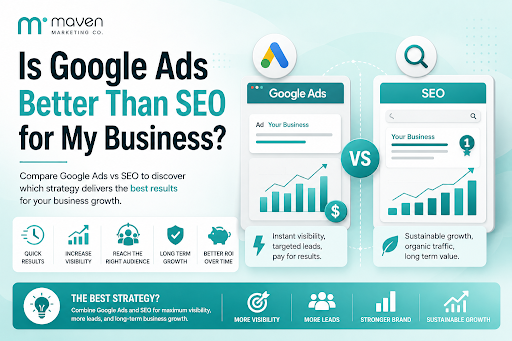
Is Google Ads Better Than SEO for My Business
One of the biggest questions business owners ask when they are planning online growth is whether they should invest in Google Ads or SEO. Both are strong marketing plays that help your company show up in Google search results, but they do things in separate lanes. Google Ads gives quicker visibility and can bring in leads fast, whereas SEO more or less focuses on slow, steady organic traffic that tends to grow the longer you keep building it. Picking the right direction depends on what you want to achieve, how much money you can spend, how crowded the market is, and how quickly you need results, like sooner rather than later. The good news is you don’t always have to choose one or the other; it’s not exactly a black-and-white situation. If you take time to understand the strongest points of both, you can put together a more sensible digital marketing plan that supports consistent expansion. In this guide, we’ll compare Google Ads vs SEO, explain the main differences, and help you figure out what option makes the most sense for your business.

When Should I Hire a Digital Marketing Agency
Growing a business today takes more than just having a website or throwing a post on social media; customers usually search around online, compare providers, skim reviews, and basically expect the brand to show up with a solid digital presence before they even think about buying. Many businesses try to run their marketing themselves, but there comes a point when “doing it all in-house” becomes clunky and hard to manage, all at once. Knowing when to hire a digital marketing agency can end up making a big, real difference for your growth. If you’re not getting enough leads, or your online visibility feels stuck, or sales are just not moving, the right agency can bring the know-how, plus a clear plan, to help you get noticeably better outcomes. In this guide, we’ll dig into what a digital marketing agency actually does, the usual signs it’s time to bring one on, and how picking the right marketing partner can help your business move forward at a faster pace.
Why Is My Google Ads Budget Running Out So Quickly
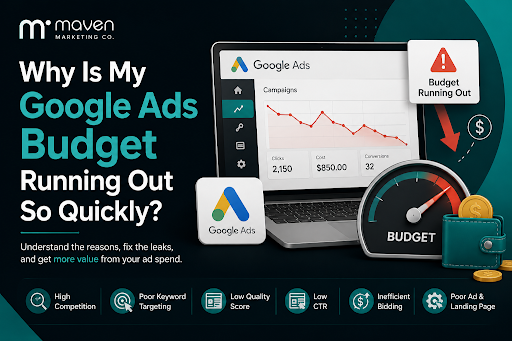
Running a successful Google Ads budget isn’t only about throwing more money at it. It’s more like making every dollar, doing a bit extra. A lot of businesses start a Google Ads campaign with big hopes, then find out their daily budget is gone within a few hours, and that feels weird, right? After that, your ads stop showing effectively, new leads slip away, and your return on investment dips. So if your Google Ads budget is running out too fast, don’t stress. It’s a fairly common issue, and in most situations, it can be repaired with the right approach. There are multiple little things that can drain your advertising money quicker than you expected, from costly keywords to audience targeting that just doesn’t quite fit. In this guide, we’ll walk through why your budget disappears so quickly, how to cut wasteful spend, and the most reliable ways to boost your Google Ads ROI, even if your budget stays the same.