.svg)


%201.svg)
Quick Answers
Q: Should Australian businesses use Smart Bidding or manual bidding in 2026?
The optimal choice depends on conversion volume, business maturity, and strategic goals rather than a universal best practice. Smart Bidding strategies like Target CPA and Target ROAS excel when accounts generate 30+ conversions monthly, providing machine learning sufficient data for optimization. They outperform manual bidding by 20-35% in mature accounts with stable conversion patterns, complex auction dynamics, and adequate historical data. Manual bidding remains superior for new accounts building conversion history, businesses with highly seasonal patterns requiring rapid strategic pivots, budgets under $3,000 monthly where Smart Bidding lacks optimization data, niche Australian markets with limited auction data, and situations requiring granular control over specific keywords or audiences. Most successful Australian businesses in 2026 use hybrid approaches—Smart Bidding for stable campaigns with conversion volume, manual bidding for new initiatives or low-volume campaigns, and Enhanced CPC bridging the gap. Start with manual bidding to understand your account dynamics, transition to Smart Bidding once you've accumulated 30+ conversions monthly, and maintain manual control for strategic campaigns requiring precise bid management.
Q: What's the best Google Ads bidding strategy for small Australian businesses?
Small Australian businesses should select bidding strategies based on monthly conversion volume and primary goals rather than budget size alone. For businesses generating fewer than 30 monthly conversions, start with Maximize Clicks to build traffic and conversion data, then transition to Enhanced CPC once conversion tracking is reliable. This provides some automated optimization while maintaining control during the learning phase. Once reaching 30+ monthly conversions, transition to Target CPA if lead generation is your goal (service businesses, B2B, local businesses) or Target ROAS if transaction values vary significantly (e-commerce, varied service packages). For brand awareness campaigns or very limited budgets, Maximize Clicks remains effective as it prioritizes traffic generation. Australian businesses spending $2,000-5,000 monthly typically see best results with Enhanced CPC initially, graduating to Target CPA after 2-3 months of consistent conversion data. Those spending $5,000+ monthly can implement Smart Bidding more aggressively, often seeing 25-40% efficiency improvements within 30-60 days. The key is matching bidding strategy to your data maturity—premature Smart Bidding adoption without sufficient conversion history often underperforms manual approaches by 15-30%.
.avif)
The Bidding Landscape: How We Got Here
Google Ads bidding has undergone radical transformation since the platform's inception. Understanding this evolution provides context for strategic decision-making in 2026.
2000-2010: The Manual Era
Advertisers manually set maximum CPC bids for every keyword, adjusted daily based on performance data, and spent countless hours optimizing bid strategies. Control was absolute, but scaling was grueling.
2011-2015: Early Automation
Google introduced basic automated bidding options like Enhanced CPC, which adjusted manual bids based on conversion likelihood. The automation was rudimentary, often underperforming experienced manual bidders.
2016-2019: Smart Bidding Emergence
Machine learning-powered Smart Bidding strategies launched—Target CPA, Target ROAS, Maximize Conversions. Early adopters saw mixed results as algorithms required substantial data to optimize effectively.
2020-2023: Algorithm Maturation
Smart Bidding algorithms became dramatically more sophisticated, incorporating signals invisible to manual bidders—device type, location, time of day, audience characteristics, and hundreds of contextual factors. Performance advantages became undeniable for accounts with sufficient data.
2024-2026: Strategic Integration
The current landscape isn't about choosing Smart Bidding or manual—it's about strategic deployment based on campaign objectives, data availability, and business maturity. According to Google's latest data, advertisers using Smart Bidding strategies see 20% more conversions on average compared to manual bidding, but this varies dramatically based on implementation context.
Understanding Smart Bidding: How Machine Learning Works
Smart Bidding leverages machine learning to optimize bids in real-time based on conversion likelihood. The sophistication exceeds what any human bidder can manually accomplish.
The Data Advantage
Smart Bidding algorithms analyze millions of auction-time signals:
- Device type, model, and operating system
- Physical location down to suburb level for Australian users
- Time of day, day of week, and seasonal patterns
- User's search history and previous site interactions
- Browser type and language settings
- Remarketing list membership
- Ad creative performance patterns
- Landing page historical conversion rates
This contextual analysis occurs in milliseconds for every auction, adjusting bids based on real-time conversion probability calculations.
The Learning Process
Smart Bidding requires a learning period—typically 7-14 days—during which performance may fluctuate as algorithms establish baseline patterns. During this phase:
- Conversion tracking must be accurate and consistent
- Budget should remain stable to enable effective learning
- Campaign changes should be minimized to avoid resetting learning
- Performance evaluation should focus on trends, not daily fluctuations
Australian businesses often abandon Smart Bidding prematurely during the learning period, reverting to manual bidding before algorithms optimize. Patience during this phase is critical for long-term success.
Conversion Value Signals
For e-commerce and businesses with varying transaction values, passing accurate conversion values to Google is essential. Smart Bidding uses this data to optimize for revenue, not just conversion volume. Many Australian businesses fail to implement conversion value tracking properly, limiting Smart Bidding effectiveness.
.avif)
The Complete Bidding Strategy Breakdown
Smart Bidding Strategies
Target CPA (Cost Per Acquisition)
How It Works: You set a target cost per conversion, and Google automatically adjusts bids to achieve that average CPA across your campaign.
Best For:
- Lead generation businesses (lawyers, accountants, medical practices)
- Service businesses with consistent lead values
- Businesses focused on volume at specific cost thresholds
- Accounts generating 30+ conversions monthly
Australian Example: A Melbourne legal firm targets $150 CPA for personal injury leads. Target CPA bidding achieved 124 conversions at $148 average CPA, compared to 98 conversions at $167 CPA with manual bidding—27% more leads at 11% lower cost.
Limitations:
- Requires substantial conversion volume for optimization
- May sacrifice impression share to maintain CPA targets
- Less effective for highly seasonal businesses
- Provides limited control over individual keyword bids
Optimization Tips:
- Start with Target CPA 20-30% above historical CPA to allow algorithm flexibility
- Allow 2-3 weeks for learning before evaluating performance
- Monitor search impression share to ensure you're not excessively limiting reach
- Adjust target CPA gradually in 10-15% increments monthly based on business needs
Target ROAS (Return On Ad Spend)
How It Works: You set a target return on ad spend (e.g., 400% ROAS = $4 revenue per $1 ad spend), and Google optimizes bids to achieve that average across your campaign.
Best For:
- E-commerce businesses with varying product values
- Businesses with transaction value data accurately passed to Google
- Campaigns where profit margins vary by product
- Focus on revenue rather than lead volume
Australian Example: A Sydney e-commerce retailer selling outdoor equipment targets 500% ROAS. Target ROAS bidding generated $142,000 revenue from $28,400 ad spend (500% ROAS) compared to $118,000 revenue from $29,600 spend (399% ROAS) with manual bidding—20% more revenue at target efficiency.
Limitations:
- Requires accurate conversion value tracking implementation
- Needs 50+ conversions monthly for effective optimization
- May limit volume excessively when ROAS targets are too aggressive
- Less suitable for lead generation where all leads have similar value
Optimization Tips:
- Set initial Target ROAS at 80-90% of historical ROAS to ensure adequate volume
- Ensure conversion values accurately reflect actual business revenue
- Monitor total conversion value trends alongside ROAS percentage
- Consider separate campaigns for different product categories with distinct ROAS goals

Maximize Conversions
How It Works: Google automatically sets bids to generate maximum conversions within your daily budget, without a specific CPA or ROAS target.
Best For:
- Building conversion history in new campaigns
- Businesses prioritizing volume over efficiency
- Seasonal campaigns requiring rapid scaling
- Accounts with less than 30 monthly conversions
Australian Example: A Brisbane education provider launching a new course used Maximize Conversions to rapidly generate enrollment inquiries, achieving 87 conversions in the first month compared to projected 52 with manual bidding—68% increase enabling faster campaign optimization.
Limitations:
- No cost efficiency control—CPA can vary dramatically
- May exhaust budget quickly on expensive clicks
- Requires careful budget management to avoid overspending
- Less predictable cost per acquisition
Optimization Tips:
- Use when testing new campaigns or building conversion data
- Set daily budgets conservatively to control overall spend
- Monitor CPA trends closely and transition to Target CPA once data accumulates
- Consider tighter budget controls during high-traffic periods
Maximize Conversion Value
How It Works: Similar to Maximize Conversions but optimizes for total conversion value rather than conversion volume, within your budget.
Best For:
- E-commerce focusing on revenue maximization
- Variable transaction values where higher-value conversions are prioritized
- Building conversion value data before implementing Target ROAS
- Campaigns without specific ROAS requirements
Australian Example: A Perth automotive parts retailer used Maximize Conversion Value to prioritize higher-value transactions, generating $94,000 in conversion value compared to $76,000 with volume-focused bidding at similar spend levels—24% revenue increase.
Limitations:
- Requires accurate conversion value tracking
- No control over efficiency—may achieve high revenue at low ROAS
- Can result in unpredictable daily costs
- Budget can exhaust quickly if high-value conversions are expensive
Optimization Tips:
- Transition to Target ROAS once you've established baseline conversion value patterns
- Monitor both conversion volume and average order value
- Ensure all conversion values are accurately tracked
- Use budget controls to prevent excessive daily spending
Manual and Semi-Automated Strategies
Manual CPC
How It Works: You set maximum CPC bids manually for each keyword or ad group, maintaining complete control over auction participation.
Best For:
- New accounts without conversion history
- Highly competitive Australian niches requiring strategic bid management
- Campaigns requiring precise control (brand terms, competitor terms)
- Low-volume, high-value conversions
- Experienced advertisers who can dedicate time to optimization
Australian Example: A specialist Sydney orthodontist uses manual CPC for high-intent keywords like "Invisalign Sydney," adjusting bids based on appointment booking patterns and competitor activity, achieving $124 CPA compared to $189 CPA in previous Smart Bidding attempts that lacked sufficient conversion data.
Limitations:
- Time-intensive requiring regular monitoring and adjustment
- Cannot leverage real-time signals Smart Bidding analyzes
- Scaling is challenging as keyword volume increases
- Human bias can limit optimization potential
Optimization Tips:
- Adjust bids based on performance data at least weekly
- Use bid adjustments for device, location, and time of day
- Focus manual efforts on highest-volume, highest-value keywords
- Consider graduating to Enhanced CPC once conversion tracking is reliable
Enhanced CPC (ECPC)
How It Works: You set manual bids, but Google adjusts them up or down (typically ±30%) based on conversion likelihood, blending manual control with automated optimization.
Best For:
- Transitioning from manual to Smart Bidding
- Accounts with 15-30 monthly conversions (not quite enough for full Smart Bidding)
- Businesses wanting some automation while maintaining control
- Testing automated bidding before committing to full Smart Bidding
Australian Example: A Melbourne plumbing service used ECPC to automate bid adjustments while maintaining strategic control over keyword bids, achieving 34% more conversions at similar CPA compared to pure manual bidding—capturing automation benefits while retaining control.
Limitations:
- Less sophisticated than full Smart Bidding strategies
- Still requires manual bid management effort
- Bid adjustments may not align with your strategic priorities
- Performance improvement typically less dramatic than Target CPA or Target ROAS
Optimization Tips:
- Use ECPC as stepping stone to Smart Bidding, not permanent strategy
- Continue manual bid optimization while letting ECPC handle real-time adjustments
- Monitor CPA trends to determine when to graduate to Target CPA
- Consider as hybrid approach for campaigns with some but insufficient conversion data
Maximize Clicks
How It Works: Google automatically sets bids to generate maximum clicks within your daily budget, prioritizing traffic over conversions.
Best For:
- Brand awareness campaigns
- Building initial traffic and conversion data
- Very limited budgets requiring traffic efficiency
- Display and video campaigns focused on reach
Australian Example: A Canberra tourism operator launching a new attraction used Maximize Clicks to build awareness and initial website traffic, generating 2,847 clicks at $0.73 average CPC compared to 1,923 clicks at $1.08 with manual bidding—48% more traffic at lower cost.
Limitations:
- No conversion optimization—clicks don't guarantee conversions
- Can attract low-quality traffic if not properly targeted
- May exhaust budget on cheap, low-intent clicks
- Not suitable for direct response campaigns
Optimization Tips:
- Use primarily for awareness campaigns or initial data gathering
- Transition to conversion-focused bidding once tracking is established
- Monitor bounce rates and engagement metrics alongside click volume
- Set maximum CPC limits to prevent excessive spending on expensive clicks
Target Impression Share
How It Works: You set a target percentage of impressions you want to achieve (absolute top, top of page, or anywhere on page), and Google bids to reach that goal.
Best For:
- Brand protection campaigns defending against competitors
- Businesses requiring consistent top-of-page presence
- Highly competitive Australian markets where visibility is critical
- Awareness campaigns prioritizing reach over efficiency
Australian Example: A Brisbane law firm uses Target Impression Share at 90% for their brand terms, ensuring they dominate search results when potential clients search their firm name, preventing competitor ads from appearing above them.
Limitations:
- Can be expensive in competitive auctions
- No consideration for conversion efficiency
- May win impressions at prohibitive costs
- Not suitable for performance-focused campaigns
Optimization Tips:
- Use primarily for brand terms requiring protective bidding
- Set maximum CPC bid limits to control costs
- Monitor cost per click trends to ensure sustainable spending
- Consider lower impression share targets (60-80%) to balance visibility and cost
.avif)
The Decision Framework: Choosing Your Bidding Strategy
Selecting optimal bidding strategies requires systematic evaluation of multiple factors specific to your Australian business context.
Factor 1: Monthly Conversion Volume
Less than 15 conversions/month:
- Manual CPC with careful keyword selection
- Maximize Clicks to build traffic data
- Focus on conversion tracking implementation
- Avoid Smart Bidding—insufficient data for optimization
15-30 conversions/month:
- Enhanced CPC as bridge to automation
- Maximize Conversions if prioritizing volume
- Begin preparing for Smart Bidding transition
- Monitor conversion consistency
30-50 conversions/month:
- Target CPA for lead generation
- Target ROAS for e-commerce (if conversion values vary)
- Smart Bidding becomes viable option
- Expect 2-3 week learning period
50+ conversions/month:
- Full Smart Bidding implementation recommended
- Choose strategy based on business goals
- Expect optimal algorithm performance
- Consider portfolio bidding for multiple campaigns
Factor 2: Business Goals
Lead Generation (Service Businesses):Primary: Target CPA
Secondary: Enhanced CPC (low volume) or Maximize Conversions (building data)
E-Commerce (Variable Transaction Values):Primary: Target ROAS
Secondary: Maximize Conversion Value (building data) or Target CPA (consistent values)
Brand Awareness: Primary: Maximize Clicks or Target Impression Share
Secondary: Manual CPC with broad match keywords
Competitive Defense: Primary: Target Impression Share for brand terms
Secondary: Manual CPC with aggressive bidding on competitor terms
Factor 3: Budget Considerations
Under $3,000/month:
- Limited conversion volume typically requires manual bidding
- Enhanced CPC once conversion tracking is reliable
- Focus on high-intent keywords with manual control
- Smart Bidding likely underperforms due to data constraints
$3,000-$10,000/month:
- Transition zone where Smart Bidding becomes viable
- Start with Enhanced CPC or Maximize Conversions
- Graduate to Target CPA/ROAS as conversion volume builds
- Monitor performance closely during transition
$10,000+/month:
- Smart Bidding typically optimal
- Sufficient budget for algorithm learning and optimization
- Consider portfolio bidding across multiple campaigns
- Maintain manual bidding only for strategic campaigns requiring control
Factor 4: Market Competitiveness
Highly Competitive Australian Markets (legal, insurance, finance):
- Smart Bidding helps compete with large advertisers' sophisticated optimization
- Target ROAS prevents overpaying in expensive auctions
- Consider manual bidding for specific high-value terms requiring strategic control
- Monitor auction insights to understand competitive dynamics
Moderate Competition (local services, retail):
- Flexible approach—Smart Bidding or manual both viable
- Decision based more on conversion volume and goals
- Enhanced CPC provides good balance
- Adjust strategy based on performance data
Low Competition (Niche Markets):
- Manual CPC often performs well due to limited auction complexity
- Smart Bidding may be overkill for simple auction dynamics
- Maximize Clicks cost-effective for traffic generation
- Focus on audience targeting over sophisticated bidding
Factor 5: Seasonality Patterns
Highly Seasonal Businesses (retail, tourism, tax services):
- Manual bidding provides faster response to demand shifts
- Smart Bidding requires time to adapt to pattern changes
- Consider hybrid approach—Smart Bidding during stable periods, manual during transitions
- Use seasonality adjustments in Google Ads to inform Smart Bidding
Stable, Year-Round Demand:
- Smart Bidding optimal—algorithms excel with consistent patterns
- Set and monitor strategy, adjusting targets quarterly
- Minimal manual intervention required
- Excellent candidate for portfolio bidding
Implementation Best Practices For Australian Businesses
Starting With Smart Bidding
Week 1-2: Preparation
- Audit conversion tracking accuracy—test conversions to ensure proper recording
- Review historical CPA or ROAS to set realistic targets
- Ensure sufficient conversion history (30+ conversions in past 30 days)
- Stabilize campaign structure—avoid major changes during learning period
Week 3: Implementation
- Enable Smart Bidding strategy with conservative targets (20-30% above historical performance)
- Maintain existing daily budgets to ensure adequate learning data
- Document baseline performance metrics for comparison
- Set calendar reminder for 2-week evaluation
Week 4-5: Learning Period
- Resist urge to make changes during algorithm learning
- Monitor trends rather than daily performance
- Expect CPA/ROAS fluctuations during optimization
- Document any data anomalies or tracking issues
Week 6+: Optimization
- Evaluate performance against baseline after learning period completes
- Adjust targets gradually (10-15% changes) based on business needs
- Identify campaigns or ad groups underperforming for potential manual intervention
- Consider expanding Smart Bidding to additional campaigns if results are positive
Optimizing Manual Bidding
If maintaining manual bidding, systematic optimization is essential:
Weekly Tasks:
- Review keyword performance—adjust bids for top performers
- Analyze search terms report—add negatives, adjust match types
- Monitor position metrics and adjust bids for visibility goals
- Check budget pacing to ensure daily budgets align with monthly goals
Monthly Tasks:
- Comprehensive performance analysis by campaign, ad group, and keyword
- Evaluate bid adjustment effectiveness (device, location, time)
- Review competition metrics and adjust strategy accordingly
- Test new keywords and match types for expansion
Quarterly Tasks:
- Strategic review of overall account performance and goals
- Evaluate whether conversion volume supports Smart Bidding transition
- Competitive analysis using auction insights
- Budget reallocation based on performance across campaigns
Hybrid Approaches: Getting Best Of Both
Many successful Australian advertisers use hybrid strategies:
Scenario 1: Campaign Segmentation
- Smart Bidding for high-volume, stable campaigns (70% of budget)
- Manual bidding for low-volume or strategic campaigns (20% of budget)
- Testing campaigns with Maximize Conversions (10% of budget)
Scenario 2: Funnel-Based Strategy
- Target Impression Share for top-of-funnel awareness keywords
- Target CPA for mid-funnel consideration keywords
- Manual CPC for bottom-funnel, high-intent terms requiring control
Scenario 3: Product-Based Strategy (E-Commerce)
- Target ROAS for bestselling product categories with stable demand
- Manual CPC for new products without conversion history
- Maximize Conversion Value for clearance/promotional campaigns
Common Mistakes Australian Businesses Make

Mistake 1: Implementing Smart Bidding Too Early
The Problem: Enabling Target CPA or Target ROAS before accumulating sufficient conversion data results in poor algorithm performance, wasted budget, and premature abandonment of potentially effective strategies.
The Solution: Wait until you have at least 30 conversions in the past 30 days before implementing Smart Bidding. Use Enhanced CPC or Maximize Conversions as bridge strategies while building data.
Mistake 2: Evaluating Performance Too Quickly
The Problem: Judging Smart Bidding results after 3-5 days, before the learning period completes, leads to incorrect conclusions about strategy effectiveness.
The Solution: Allow minimum 2 weeks for learning period completion. Evaluate performance based on trends after learning period, not daily fluctuations during it.
Mistake 3: Making Constant Changes
The Problem: Frequently adjusting targets, budgets, or campaign settings resets Smart Bidding learning, preventing algorithms from optimizing effectively.
The Solution: Make changes gradually and infrequently. Allow 7-10 days between target adjustments. Batch minor changes rather than implementing one change daily.
Mistake 4: Inaccurate Conversion Tracking
The Problem: Tracking conversions incorrectly (duplicate conversions, wrong values, missing conversions) feeds bad data to Smart Bidding algorithms, resulting in poor optimization decisions.
The Solution: Rigorously test conversion tracking before enabling Smart Bidding. Regularly audit conversion data accuracy. Ensure conversion values match actual business revenue for ROAS strategies.
Mistake 5: Setting Unrealistic Targets
The Problem: Setting Target CPA 50% lower than historical performance or Target ROAS 200% higher than achievable forces algorithms to severely limit impression share, resulting in minimal traffic and conversions.
The Solution: Set initial targets based on historical performance (within 20-30%). Gradually adjust targets monthly in 10-15% increments as performance improves.
Mistake 6: Ignoring Search Impression Share
The Problem: Focusing solely on CPA or ROAS without monitoring impression share can result in strategies that meet efficiency targets but limit growth by restricting auction participation.
The Solution: Monitor search impression share alongside efficiency metrics. Balance efficiency goals with growth objectives. Consider incrementally less aggressive targets if missing significant impression opportunities.
Advanced Strategies For 2026
Portfolio Bidding
Portfolio bid strategies apply targets across multiple campaigns, allowing algorithms to optimize holistically rather than in isolated campaigns.
Benefits:
- Enables Smart Bidding for campaigns individually lacking conversion volume
- Allows flexibility—some campaigns may exceed target while others fall below, averaging to goal
- Simplifies management of multiple campaigns with similar goals
- Improves algorithm learning by aggregating data
Best For:
- Accounts with multiple campaigns targeting similar audiences or goals
- Geographic or product segmentation requiring separate campaigns
- Seasonal campaigns that can share learnings
Implementation: Create portfolio strategy in Google Ads shared library, apply to relevant campaigns, monitor aggregate performance.
Seasonality Adjustments
Smart Bidding can be informed of expected conversion rate changes during specific periods, helping algorithms adapt faster to predictable fluctuations.
Use Cases:
- Sales events or promotional periods
- Seasonal demand shifts (tax season for accountants, summer for tourism)
- Major events affecting conversion patterns (sporting events, holidays)
Implementation: Add seasonality adjustments in Google Ads at least 1 week before expected pattern change, specifying expected conversion rate change percentage and date range.
Conversion Value Rules
Dynamic conversion values can be assigned based on specific conditions, enabling more sophisticated ROAS optimization.
Use Cases:
- Australian businesses with different values for weekday vs weekend leads
- Services with varying profit margins by service type
- Lead quality differences by traffic source or device
Implementation: Set up conversion value rules in Google Ads, specifying conditions and corresponding value adjustments.
Measuring Success: Beyond CPA And ROAS
Effective bidding strategy evaluation requires comprehensive metrics:
Efficiency Metrics:
- Cost per acquisition
- Return on ad spend
- Conversion rate
- Cost per click
Volume Metrics:
- Total conversions
- Conversion value
- Click volume
- Impression volume
Competitive Metrics:
- Search impression share
- Top of page rate
- Absolute top impression share
- Overlap rate with key competitors
Quality Metrics:
- Quality Score trends
- Landing page experience
- Ad relevance
- Expected CTR
Monitor all metrics holistically rather than optimizing for CPA or ROAS in isolation. A 10% CPA increase might be acceptable if total conversion volume increases 40%, improving overall business outcomes despite reduced efficiency.
The Future: Where Bidding Is Heading
Google continues advancing Smart Bidding capabilities with increasingly sophisticated machine learning:
Predicted Trends:
- Greater integration of first-party customer data in bid optimization
- Enhanced cross-channel optimization incorporating YouTube, Display, and Search
- More granular control options within Smart Bidding strategies
- Improved transparency into algorithm decision-making
- Faster learning periods through transfer learning across accounts
Australian businesses should expect Smart Bidding to become increasingly dominant, with manual bidding relegated to specific strategic scenarios requiring precise control. The advertisers succeeding in 2026 and beyond are those who understand when to leverage automation and when manual control remains superior.
Your Bidding Strategy Action Plan
Stop treating bidding strategy selection as one-time decision. It's ongoing process requiring regular evaluation and adjustment based on business performance, market changes, and data accumulation.
Immediate Actions:
- Audit your current bidding strategies—are they aligned with conversion volume and business goals?
- Evaluate conversion tracking accuracy—is data reliable enough for Smart Bidding?
- Calculate your actual CPA or ROAS across campaigns for baseline establishment
- Determine monthly conversion volume by campaign to identify Smart Bidding candidates
- Create testing roadmap for transitioning appropriate campaigns to Smart Bidding
30-Day Actions:
- Implement Enhanced CPC on campaigns currently using manual bidding with reliable conversion tracking
- Enable Smart Bidding (Target CPA or Target ROAS) on campaigns with 30+ monthly conversions
- Set realistic targets based on historical performance
- Document baseline metrics for future comparison
- Schedule 2-week evaluation after learning period completion
90-Day Actions:
- Evaluate Smart Bidding performance after sufficient optimization time
- Adjust targets based on performance and business goals
- Expand Smart Bidding to additional campaigns if results are positive
- Identify campaigns requiring manual control and adjust strategy accordingly
- Implement advanced features like portfolio bidding or seasonality adjustments
The Australian businesses dominating Google Ads in 2026 aren't necessarily those with largest budgets—they're those implementing appropriate bidding strategies for their specific context, data maturity, and goals.
Ready To Optimize Your Google Ads Bidding?
Maven Marketing Co. specializes in Google Ads optimization for Australian businesses seeking maximum return from paid search investment. Our team combines deep platform expertise with strategic thinking, implementing bidding strategies that align with your business goals and data reality.
We've helped Australian businesses across industries optimize bidding strategies, achieving 25-45% efficiency improvements while maintaining or increasing conversion volume.
Stop guessing at bidding strategies or accepting underperformance. Visit mavenmarketingco.com.au today for a complimentary Google Ads audit. We'll analyze your current bidding strategies, identify optimization opportunities, and provide a clear roadmap to improved performance.
Book your Google Ads consultation now and join the Australian businesses leveraging optimal bidding strategies for competitive advantage.

Table of contents
read more blogs
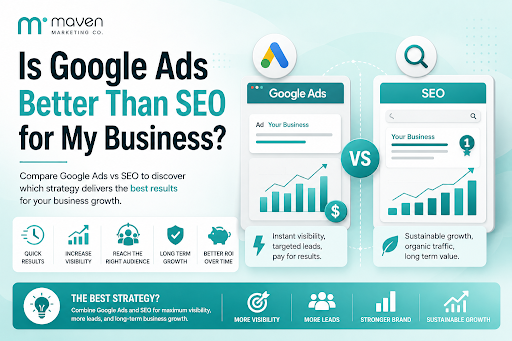
Is Google Ads Better Than SEO for My Business
One of the biggest questions business owners ask when they are planning online growth is whether they should invest in Google Ads or SEO. Both are strong marketing plays that help your company show up in Google search results, but they do things in separate lanes. Google Ads gives quicker visibility and can bring in leads fast, whereas SEO more or less focuses on slow, steady organic traffic that tends to grow the longer you keep building it. Picking the right direction depends on what you want to achieve, how much money you can spend, how crowded the market is, and how quickly you need results, like sooner rather than later. The good news is you don’t always have to choose one or the other; it’s not exactly a black-and-white situation. If you take time to understand the strongest points of both, you can put together a more sensible digital marketing plan that supports consistent expansion. In this guide, we’ll compare Google Ads vs SEO, explain the main differences, and help you figure out what option makes the most sense for your business.

When Should I Hire a Digital Marketing Agency
Growing a business today takes more than just having a website or throwing a post on social media; customers usually search around online, compare providers, skim reviews, and basically expect the brand to show up with a solid digital presence before they even think about buying. Many businesses try to run their marketing themselves, but there comes a point when “doing it all in-house” becomes clunky and hard to manage, all at once. Knowing when to hire a digital marketing agency can end up making a big, real difference for your growth. If you’re not getting enough leads, or your online visibility feels stuck, or sales are just not moving, the right agency can bring the know-how, plus a clear plan, to help you get noticeably better outcomes. In this guide, we’ll dig into what a digital marketing agency actually does, the usual signs it’s time to bring one on, and how picking the right marketing partner can help your business move forward at a faster pace.
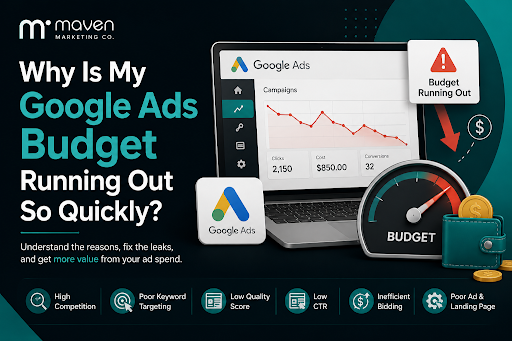
Why Is My Google Ads Budget Running Out So Quickly
Running a successful Google Ads budget isn’t only about throwing more money at it. It’s more like making every dollar, doing a bit extra. A lot of businesses start a Google Ads campaign with big hopes, then find out their daily budget is gone within a few hours, and that feels weird, right? After that, your ads stop showing effectively, new leads slip away, and your return on investment dips. So if your Google Ads budget is running out too fast, don’t stress. It’s a fairly common issue, and in most situations, it can be repaired with the right approach. There are multiple little things that can drain your advertising money quicker than you expected, from costly keywords to audience targeting that just doesn’t quite fit. In this guide, we’ll walk through why your budget disappears so quickly, how to cut wasteful spend, and the most reliable ways to boost your Google Ads ROI, even if your budget stays the same.