.svg)


%201.svg)
Key Takeaways
- Bid strategy selection should be determined by three variables in sequence: the campaign's commercial goal, the volume of conversion data available to support the strategy, and the campaign's current maturity relative to the algorithm's learning requirements.
- Smart bidding strategies including target ROAS, target CPA, and maximise conversion value require a minimum conversion data threshold to function effectively. Applying them below this threshold produces worse results than a simpler strategy on lower data volume.
- Manual CPC bidding is not obsolete. For new campaigns, keyword sets with low volume, and accounts where control over individual bid levels is commercially important, manual bidding remains a valid and sometimes superior choice over automated strategies applied prematurely.
- Target ROAS is the appropriate strategy for ecommerce campaigns where different products carry different revenue values and the goal is to maximise return on ad spend rather than conversion volume. It requires Google to have conversion value data, not just conversion count data.
- Target CPA is the appropriate strategy for lead generation campaigns where conversions are broadly equivalent in value and the goal is to generate the maximum number of leads at or below a defined cost per lead.
- Maximise conversion value is a useful transitional strategy between manual bidding on low data volume and target ROAS on accounts with rich conversion data: it optimises for revenue value without requiring a specific ROAS target the account may not yet have the data to achieve reliably.
- Bid strategy changes on active campaigns trigger a learning period during which performance will be temporarily more variable than at steady state. The timing and staging of bid strategy changes should be planned to minimise disruption to commercial outcomes.
Why Bid Strategy Mismatches Are So Common
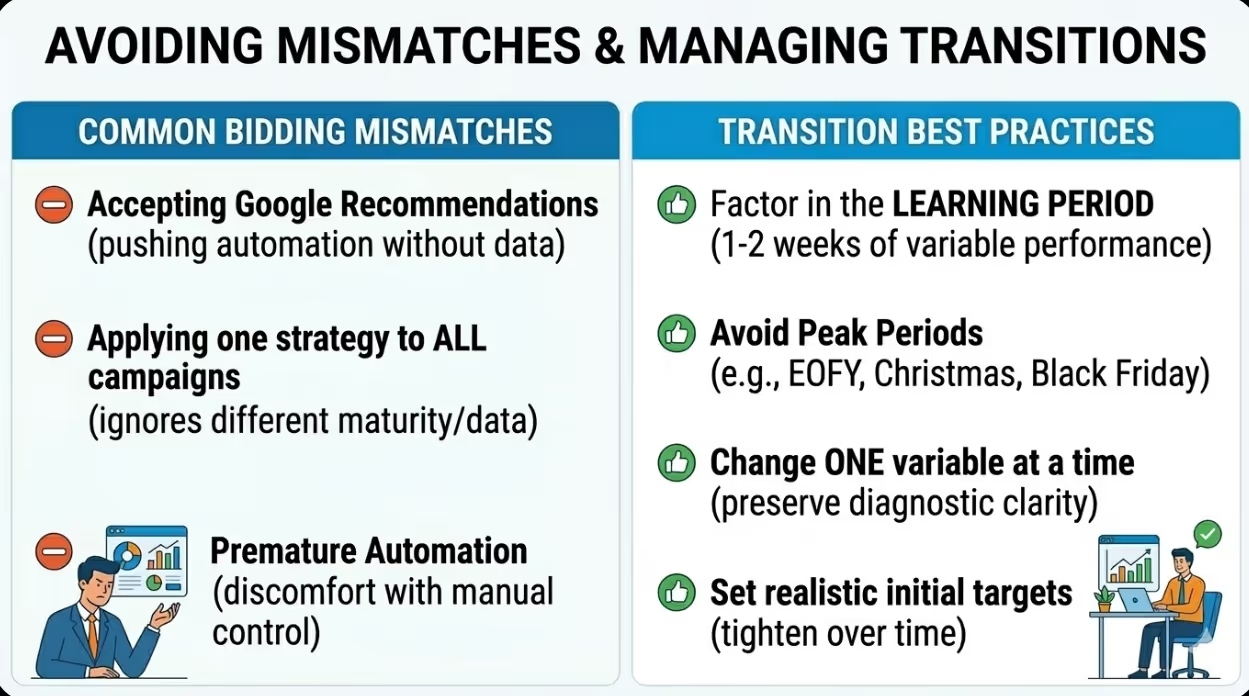
Google's platform presents bid strategy selection as a series of accessible options with brief descriptions, and the recommendations it generates within the account often push toward the highest automation level available regardless of whether the account has the data to support it. An account manager following Google's recommendations generated within the platform without evaluating whether the campaign meets the data requirements for the recommended strategy will regularly apply strategies that are technically available but practically premature.
The second driver of mismatch is the tendency to apply the same bid strategy to all campaigns in an account. Different campaigns within the same account often have fundamentally different conversion data volumes, different commercial goals, and different maturity levels. A brand new campaign and a campaign that has been running for twelve months should not automatically use the same bid strategy.
The third driver is discomfort with uncertainty. Manual bidding requires active management and produces results that the manager is directly responsible for. Automated bidding produces results that are partly delegated to an algorithm, which can feel either like freedom or like loss of control depending on the manager's experience and the account's behaviour. This discomfort sometimes drives managers toward automation prematurely or toward manual control longer than the data justifies.
Understanding What Each Strategy Actually Optimises For
Before selecting a strategy, it is important to understand precisely what the algorithm is maximising or minimising, because the stated label and the actual optimisation objective are not always as aligned as they sound.
Manual CPC. The manager sets a maximum bid for each keyword or ad group and the algorithm bids up to that maximum in each auction. No automated adjustment occurs. The manager retains full control over bid levels but bears full responsibility for the quality of bid decisions across potentially thousands of keywords.
Enhanced CPC. The manager sets manual CPC bids and the algorithm adjusts them upward or downward in individual auctions based on signals that suggest higher or lower conversion probability. This is the lightest form of automation and the appropriate transitional strategy between pure manual bidding and full smart bidding.
Maximise clicks. The algorithm sets bids to generate the maximum number of clicks within the campaign budget. It optimises for click volume, not for conversion volume or value. This strategy is appropriate for campaigns where the immediate goal is traffic volume or where conversion tracking is not yet in place, but it should be replaced with a strategy focused on conversion once tracking is established.
Maximise conversions. The algorithm sets bids to generate the maximum number of conversions within the campaign budget. It treats all conversion events as equivalent regardless of their value. This strategy is appropriate for lead generation campaigns where conversions genuinely are broadly equivalent in value, and for ecommerce campaigns where the goal is volume rather than efficient return.
Maximise conversion value. The algorithm sets bids to maximise the total conversion value generated within the campaign budget, without a specific ROAS target. This strategy requires conversion value data (a revenue figure assigned to each conversion event) and is the appropriate choice for ecommerce campaigns that have sufficient conversion volume to benefit from value optimisation but insufficient history to set a reliable ROAS target.
Target CPA. The algorithm sets bids to generate conversions at or below a specified cost per conversion. This strategy is appropriate for lead generation campaigns with a clear maximum acceptable cost per lead, and for ecommerce campaigns where all products have broadly similar margins and a cost per sale target is a useful proxy for profitability. It requires a minimum of 30 to 50 conversions per month for reliable optimisation, though Google's published guidance suggests 30 conversions over 30 days as the minimum.
Target ROAS. The algorithm sets bids to achieve a specified return on ad spend, calculated as conversion value divided by ad spend. This strategy is appropriate for ecommerce campaigns where different products carry different revenue values and the goal is efficient revenue generation rather than raw conversion volume. It requires not only sufficient conversion volume but sufficient conversion value data, meaning the account must be tracking revenue values accurately, not just counting conversions. Google's guidance suggests a minimum of 50 conversions per month for reliable target ROAS performance, though catalogues with higher individual conversion values but lower volume may require longer periods to accumulate equivalent signal quality.
Target impression share. The algorithm sets bids to achieve a specified percentage of available impressions at a specified position. This strategy is appropriate for brand campaigns where visibility is the primary objective and conversion efficiency is secondary, and for campaigns targeting specific competitors' brand terms where impression share rather than conversion cost is the relevant metric.
The Selection Framework: Three Questions
Bid strategy selection should be determined by answering three questions in sequence.
Question One: What Is the Campaign's Commercial Goal?
The commercial goal determines which metric the bid strategy should optimise toward. The principal commercial goal categories and their corresponding strategy alignment are:
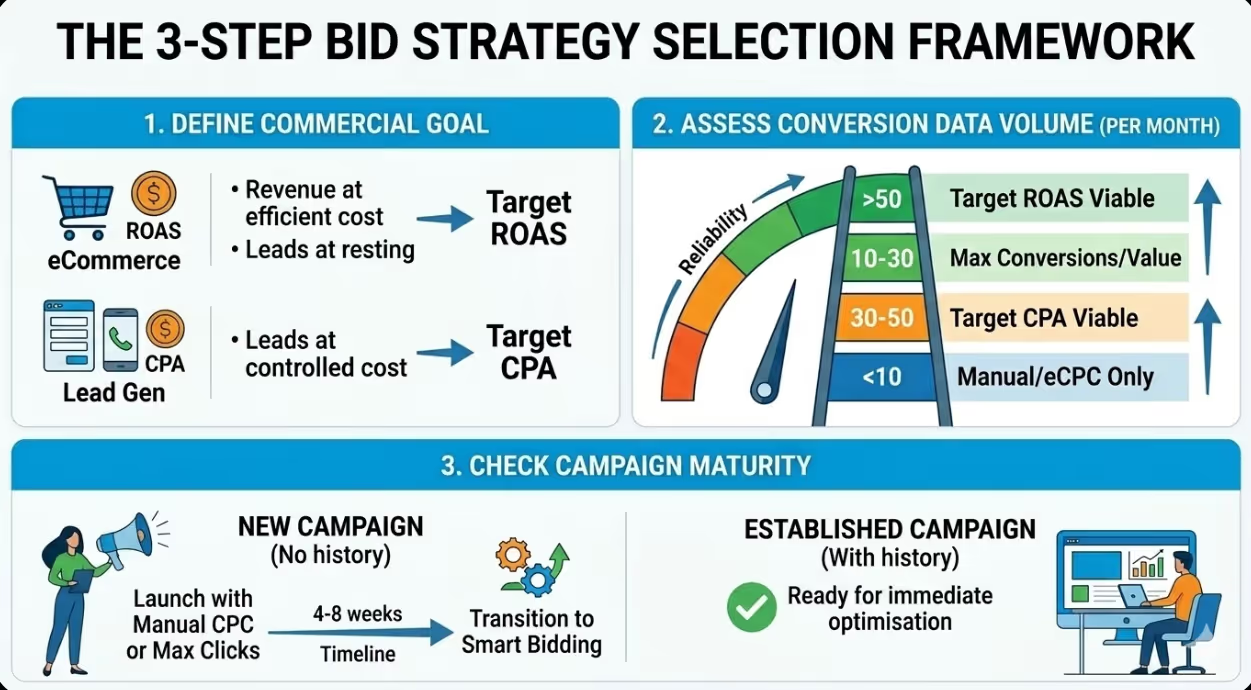
Revenue at efficient cost: Target ROAS. The campaign should generate revenue from product sales and the efficiency of that revenue generation, measured as the ratio of revenue to ad spend, is the primary commercial metric.
Leads at controlled cost: Target CPA. The campaign should generate enquiries, form completions, phone calls, or other lead events at or below a defined maximum cost per lead.
Revenue volume without a specific efficiency target: Maximise conversion value. The campaign should generate as much revenue as the budget allows, without a specific ROAS floor that might suppress impression share in ways that reduce total revenue.
Conversion volume without a specific cost target: Maximise conversions. The campaign should generate as many conversion events as the budget allows, without a specific CPA floor.
Traffic volume: Maximise clicks. The campaign should generate as many website visits as the budget allows, regardless of what happens after the click.
Brand visibility: Target impression share. The campaign should appear in a defined proportion of available auctions, regardless of the conversion or click outcome.
Question Two: Does the Campaign Have Sufficient Conversion Data?
The conversion data question determines whether the chosen strategy is practical given the account's current state. The following thresholds provide a practical decision framework for Australian accounts:
Fewer than 10 conversions per month: Manual CPC or enhanced CPC only. Smart bidding strategies cannot function reliably at this data volume and will typically produce erratic performance as the algorithm makes bid adjustments that are poorly informed.
10 to 30 conversions per month: Maximise conversions or maximise conversion value (without a specific target). These strategies can begin to learn from the available data without requiring the model accuracy that target CPA and target ROAS need.
30 to 50 conversions per month: Target CPA becomes viable. The algorithm has sufficient conversion data to build a moderately reliable prediction model. ROAS targets remain risky at the lower end of this range unless the account has a long history that provides additional signal.
More than 50 conversions per month: Target ROAS is viable for ecommerce campaigns with accurate conversion value tracking. Both target ROAS and target CPA operate with reasonable reliability at this data volume.
Question Three: What Is the Campaign's Current Maturity?
A brand new campaign entering an account has no historical data, no audience signals, and no established quality scores. Applying a smart bidding strategy from day one of a new campaign means the algorithm is starting with no prior knowledge of which queries, audiences, or device types convert for this specific campaign. The learning period will be longer and more expensive than for a campaign with established history.
For new campaigns, the recommended approach is to launch with maximise clicks or manual CPC to build initial data, then transition to a strategy focused on conversion once the minimum conversion threshold is reached. This transition can typically happen within four to eight weeks for campaigns generating meaningful click volume, sooner for campaigns in categories with high conversion volume.
Bid Strategy Transitions: Managing the Learning Period
Every bid strategy change on an active campaign triggers a learning period during which the algorithm is recalibrating its bid model. During this period, performance metrics including CPC, CPA, ROAS, and conversion volume will typically be more variable than at steady state. The learning period typically lasts one to two weeks but can extend to four weeks for campaigns with limited data or significant bid strategy changes.
Managing the timing and circumstances of bid strategy changes reduces the commercial impact of the learning period.
Avoid bid strategy changes during peak commercial periods. Changing a bid strategy in the two weeks before Christmas or EOFY means the learning period coincides with the period of highest commercial importance. Transitions should be planned during quieter periods where learning period variability is commercially acceptable.
Change one variable at a time. Changing the bid strategy and the daily budget and the campaign structure simultaneously makes it impossible to attribute performance changes to the specific variable that caused them. Staged changes with sufficient time between each to observe the impact preserve diagnostic clarity.
Set realistic initial targets when transitioning to target CPA or target ROAS. Setting a target that is significantly more aggressive than the account's recent performance requires the algorithm to find conversion efficiency it has not previously demonstrated, which extends the learning period and increases the risk that the campaign underspends while pursuing an unachievable target. Starting with a target close to the account's current average CPA or ROAS and tightening toward the commercial goal over time produces more stable transitions than immediately setting the aspirational target.
FAQs
Should Australian businesses use portfolio bid strategies or individual campaign bid strategies?
Portfolio bid strategies allow a single bid strategy to be applied across multiple campaigns simultaneously, with the algorithm pooling conversion data from all campaigns in the portfolio to make bid decisions. This is advantageous when individual campaigns have insufficient conversion volume to support smart bidding independently, but when combined their data meets the threshold. For example, three brand campaigns each generating 12 conversions per month individually are below the threshold for reliable target CPA, but combined in a portfolio with 36 conversions per month they cross it. The trade off is that portfolio strategies blur the optimisation signals between campaigns that may have different commercial objectives, different conversion values, or different competitive dynamics. Portfolio strategies are most appropriate when the campaigns being combined are genuinely similar in their goal and audience, and when the primary reason for combining them is data volume rather than any other structural convenience.
What should an Australian business do when a smart bidding strategy enters an extended learning period and performance declines significantly?
An extended learning period, defined as more than four weeks without a return to the pre-change performance baseline, usually indicates one of three problems. The target set is too aggressive relative to the campaign's historical performance, meaning the algorithm is suppressing impression share while searching for conversion efficiency it cannot find. The campaign has experienced a structural change alongside the strategy change, such as a significant keyword list change, a landing page change, or a budget change, that is confusing the algorithm's model. Or the campaign's conversion tracking has a problem, such as a broken conversion tag or a duplicated conversion action, that is producing noisy or inaccurate data the algorithm is trying to optimise toward. Diagnosing the specific cause before reverting to the previous bid strategy is important, because reverting without addressing the underlying problem simply postpones the issue rather than resolving it.
How does Performance Max bid strategy selection differ from standard Search and Shopping campaign strategy selection?
Performance Max campaigns are limited to two bid strategy options: maximise conversion value (with an optional target ROAS) and maximise conversions (with an optional target CPA). The selection between them follows the same logic as for standard campaigns: ecommerce objectives focused on revenue should use maximise conversion value with a target ROAS once sufficient data exists, and lead generation objectives should use maximise conversions with a target CPA. The additional complexity with Performance Max is that its conversion data is pooled across all of Google's inventory, meaning the data threshold requirements apply to the Performance Max campaign's own conversion history rather than to the broader account. A Performance Max campaign that has been running for less than six weeks should generally be evaluated without a target, allowing it to accumulate conversion history before a specific ROAS or CPA target is introduced.
The Algorithm Is Only as Good as the Goal It Is Given
Google's smart bidding algorithms are genuinely powerful optimisation tools. They process more auction signals with greater speed and precision than any human manager can replicate across a large keyword set. But the quality of their output is entirely dependent on the quality of the objective they have been given: a campaign optimising toward the wrong metric with insufficient data to model it accurately will produce performance numbers that look confident pointing in the wrong direction. The discipline of matching bid strategy to commercial goal, data availability, and campaign maturity is what ensures the algorithm's power is directed toward outcomes that actually matter to the business.
Maven Marketing Co manages Google Ads bid strategy frameworks for Australian businesses, including strategy selection, data readiness assessment, and managed transitions that minimise learning period disruption.
Talk to the team at Maven Marketing Co →

Table of contents
read more blogs
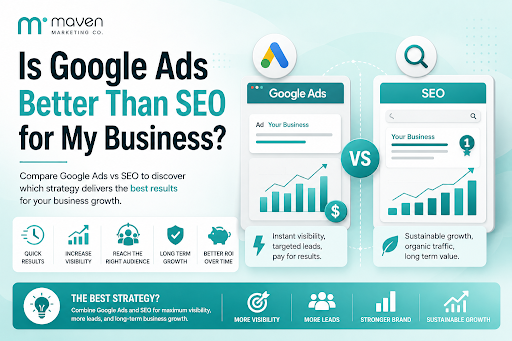
Is Google Ads Better Than SEO for My Business
One of the biggest questions business owners ask when they are planning online growth is whether they should invest in Google Ads or SEO. Both are strong marketing plays that help your company show up in Google search results, but they do things in separate lanes. Google Ads gives quicker visibility and can bring in leads fast, whereas SEO more or less focuses on slow, steady organic traffic that tends to grow the longer you keep building it. Picking the right direction depends on what you want to achieve, how much money you can spend, how crowded the market is, and how quickly you need results, like sooner rather than later. The good news is you don’t always have to choose one or the other; it’s not exactly a black-and-white situation. If you take time to understand the strongest points of both, you can put together a more sensible digital marketing plan that supports consistent expansion. In this guide, we’ll compare Google Ads vs SEO, explain the main differences, and help you figure out what option makes the most sense for your business.

When Should I Hire a Digital Marketing Agency
Growing a business today takes more than just having a website or throwing a post on social media; customers usually search around online, compare providers, skim reviews, and basically expect the brand to show up with a solid digital presence before they even think about buying. Many businesses try to run their marketing themselves, but there comes a point when “doing it all in-house” becomes clunky and hard to manage, all at once. Knowing when to hire a digital marketing agency can end up making a big, real difference for your growth. If you’re not getting enough leads, or your online visibility feels stuck, or sales are just not moving, the right agency can bring the know-how, plus a clear plan, to help you get noticeably better outcomes. In this guide, we’ll dig into what a digital marketing agency actually does, the usual signs it’s time to bring one on, and how picking the right marketing partner can help your business move forward at a faster pace.
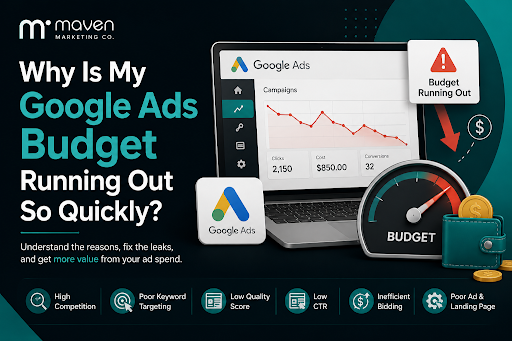
Why Is My Google Ads Budget Running Out So Quickly
Running a successful Google Ads budget isn’t only about throwing more money at it. It’s more like making every dollar, doing a bit extra. A lot of businesses start a Google Ads campaign with big hopes, then find out their daily budget is gone within a few hours, and that feels weird, right? After that, your ads stop showing effectively, new leads slip away, and your return on investment dips. So if your Google Ads budget is running out too fast, don’t stress. It’s a fairly common issue, and in most situations, it can be repaired with the right approach. There are multiple little things that can drain your advertising money quicker than you expected, from costly keywords to audience targeting that just doesn’t quite fit. In this guide, we’ll walk through why your budget disappears so quickly, how to cut wasteful spend, and the most reliable ways to boost your Google Ads ROI, even if your budget stays the same.