.svg)


%201.svg)

Key Takeaways
- Account structure determines data quality. An account where campaigns are segmented by intent, product category, and audience type produces cleaner conversion signals that the bidding algorithm can use more effectively than one where campaigns with mixed intent compete for budget and attribution.
- The single most common structural error in Australian Google Ads accounts is keyword dilution: placing too many keywords with different intents, margins, or conversion rates into the same ad group or campaign, making it impossible to manage bids, budgets, or messaging at the level of granularity that performance differences require.
- Brand Search campaigns should always be separated from Non-Brand Search campaigns in a distinct campaign, because the conversion rates, CPCs, and bidding strategies appropriate for each are fundamentally different and cannot be managed optimally when combined.
- For Australian ecommerce businesses, the Shopping campaign structure should mirror the product catalogue hierarchy to the extent that budget and performance differences between product categories justify separate campaigns. A flat shopping structure is a starting point, not an optimal state.
- Performance Max campaigns function best when they are given a clear, focused objective and a clearly defined asset group rather than being set up as a campaign that covers all products and services every product or service the business offers simultaneously.
- The number of campaigns in an account should be the minimum needed to achieve the segmentation required for budget control, bid management, and performance reporting, not the maximum that the number of products or services might suggest. Excessive campaign fragmentation produces data too thin in any single campaign for smart bidding to function effectively.
- Account structure should be reviewed and potentially restructured when a business model changes significantly, when new campaign types are introduced, or when the volume of conversion data has grown to the point where previously appropriate structural choices are now less optimal relative to what the algorithm could achieve with different segmentation.
The Structural Principles That Apply Across All Business Models
Before examining the architecture recommendations specific to each business model type, three structural principles apply universally to Google Ads account management for Australian businesses and should govern every structural decision regardless of the business type.
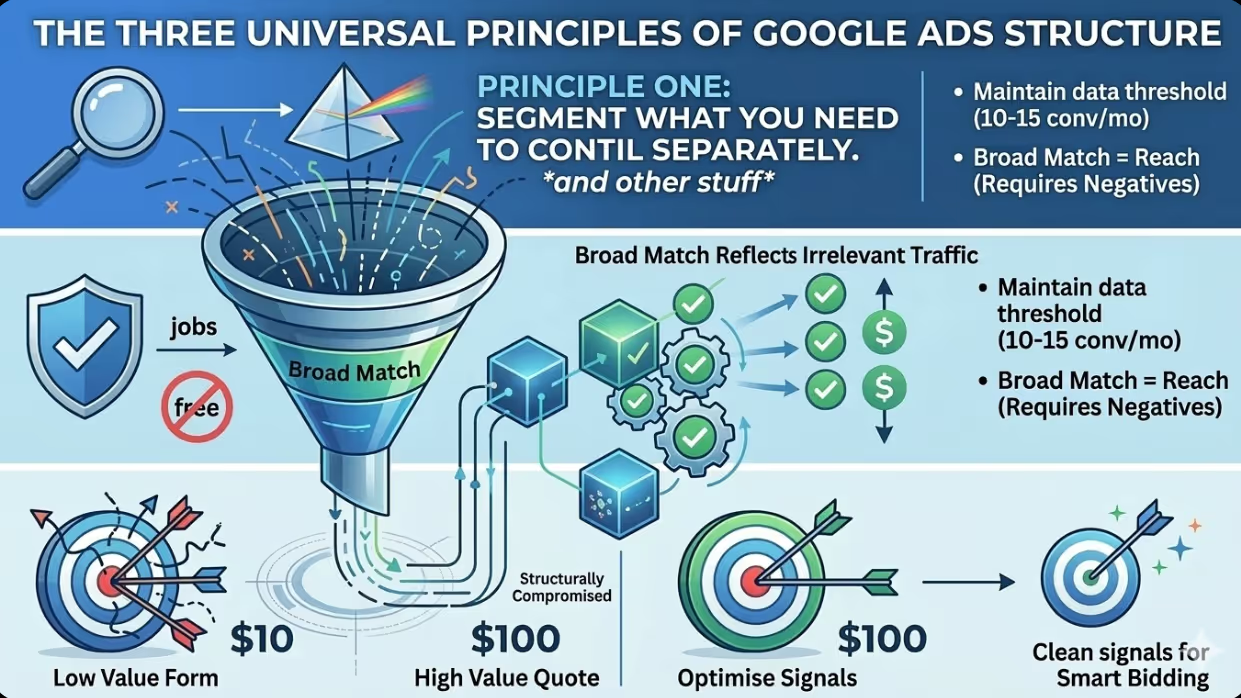
Principle One: Segment What You Need to Control Separately
The correct unit of segmentation in a Google Ads account is whatever the manager needs to control, measure, or bid on independently. If two campaign types require different budgets, different bidding strategies, or different performance targets, they must be in separate campaigns. If two products have different margins, different conversion rates, or different competitive intensities, they likely require different campaigns or at minimum different ad groups with independent bidding. If two audience types respond differently to the same keyword, they should be in separate campaigns or ad groups so the response difference is visible in the data and actionable through bid adjustments or budget reallocation.
The corollary is that segmentation should stop at the point where it creates campaigns or ad groups too small to gather sufficient conversion data for the bidding algorithm to function. A campaign generating fewer than ten to fifteen conversions per month cannot support a target CPA or target ROAS smart bidding strategy reliably, because the data volume is insufficient for the algorithm to distinguish signal from noise. Segmentation that fragments data below this threshold creates the appearance of control while reducing the actual quality of optimisation.
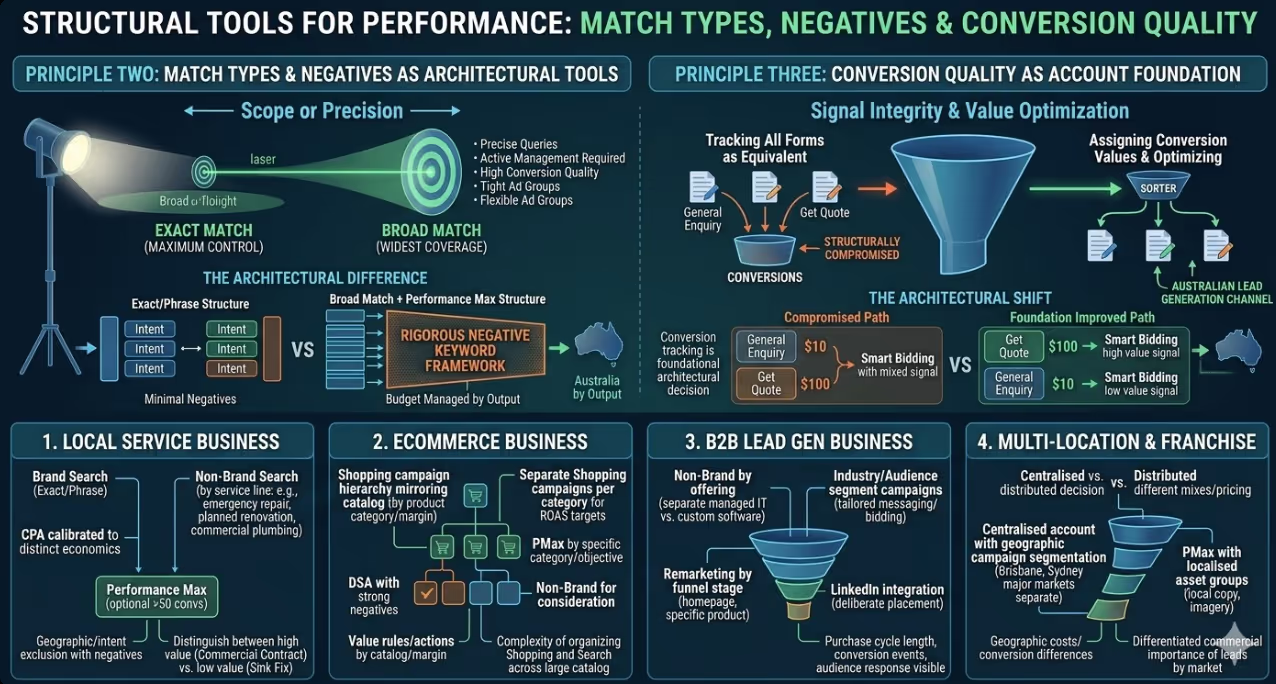
Principle Two: Match Types and Negatives Are Structural Tools
The match type configuration across an account is an architectural decision, not just a keyword management detail. An account that relies heavily on broad match requires a different negative keyword architecture, different ad group structure, and different budget management approach than one structured around phrase and exact match. As broad match and Performance Max have become increasingly dominant in Google's recommended account structures, the structural implications of each match type choice have become more consequential.
Exact match campaigns provide maximum control over which queries trigger ads but require the most active keyword management to maintain coverage. Broad match campaigns provide the widest coverage with the least keyword management overhead but generate the most irrelevant traffic without rigorous negative keyword frameworks in place. A structurally sound account defines deliberately which match type approach suits each campaign's objective and manages the negative keyword architecture accordingly.
Principle Three: Conversion Tracking Quality Is Part of Account Structure
An account optimising toward a conversion action that is poorly defined, incorrectly attributed, or capturing a mix of conversion events of different commercial value is structurally compromised regardless of how well its campaigns are organised. Conversion tracking configuration, including the specific actions tracked, the attribution model applied, and whether different conversion values are assigned to different conversion types, is a foundational architectural decision that shapes every performance metric the account produces.
For Australian businesses using Google Ads as a lead generation channel, the single most common conversion tracking problem is tracking all form submissions as equivalent conversions when some forms represent enquiries of high commercial value and others that represent lower value or irrelevant contact types. Assigning conversion values that reflect the relative commercial importance of each conversion type, or tracking them as separate conversion actions with different optimisation priorities, is a structural improvement that improves the quality of bidding signals without requiring any change to campaign organisation.
Architecture for Australian Local Service Businesses
A local service business operating in one or two geographic markets with a defined set of service offerings and a primary goal of generating qualified enquiries has a relatively concentrated account structure need. The complexity comes from ensuring the separation between Brand Search and Non-Brand Search campaigns, the segmentation of services of different commercial value, and the exclusion of irrelevant geographic and intent traffic.
Brand Search campaign. A single campaign targeting the brand name and its common variations, with exact and phrase match keywords and a target CPA bid strategy calibrated to the high conversion rate typical of brand searches. This campaign should have its own protected budget that is not adjusted based on the performance of Non-Brand Search campaigns.
Non-Brand Search campaign by service category. One campaign per primary service line where the service lines are sufficiently distinct to warrant separate budget and bid management. A plumbing business with emergency repair, planned renovation, and commercial plumbing service lines has different competitive intensities, different margins, and different urgency signals in the search queries for each. Separating them allows budget and bid strategy to be calibrated to the different economics of each service line rather than blended across all three.
Remarketing campaign. A separate Display or Search remarketing campaign targeting previous website visitors, with a distinct bid strategy and messaging appropriate for that audience. The conversion rate from remarketing traffic is typically higher than from cold search traffic, and a separate campaign allows the budget and bidding to reflect this difference.
Performance Max campaign (optional). A supplementary channel for local service businesses with sufficient monthly conversion volume (a minimum of 50 conversions per month is a practical threshold before Performance Max adds meaningful value for a local business). Below this threshold, the standard Search campaign structure will typically outperform Performance Max for a local service business.
Architecture for Australian Ecommerce Businesses
Ecommerce account structure is substantially more complex than service business structure because the product catalogue introduces a dimension of segmentation that service businesses do not have. The core structural question for an ecommerce account is how to organise the Shopping and Search campaigns to maximise efficiency across a catalogue that may range from dozens to hundreds of thousands of products.
Brand Search campaign. Identical in purpose to the local service business brand campaign: a protected, separately budgeted campaign capturing brand name queries with a bid strategy appropriate for the high conversion intent of branded traffic.
Shopping campaign structure. For ecommerce businesses with fewer than 500 products in a single category, a single Shopping campaign with ad groups segmented by product category is a practical starting structure. For businesses with multiple product categories that differ significantly in margin, competitive intensity, or conversion rate, separate Shopping campaigns per category allow budget and ROAS targets to reflect the different economics of each. A campaign structure that allocates equal budget to a category with higher margins and one with lower margins is not optimised. Separate campaigns with different ROAS targets allow the bidding algorithm to push harder in the category with higher margins and pull back in the one with lower margins.
Performance Max campaign. For ecommerce businesses, Performance Max typically performs at its best when it is structured around a specific product category or objective rather than run as a single campaign across the entire catalogue. An ecommerce business with distinct product lines should consider separate Performance Max campaigns per product category, each with its own asset group and conversion value rules, rather than a single Performance Max campaign that spans the whole account that blends all categories.
Non-Brand Search coverage. Covering the commercially most valuable category and intent queries where Shopping does not capture all relevant traffic. For categories where searchers use descriptive queries before evaluating specific products, Search captures the traffic representing the consideration stage that Shopping may miss.
Dynamic Search Ads campaign. For ecommerce businesses with large catalogues where manual keyword coverage would be impractical, a Dynamic Search Ads campaign provides a structured way to capture traffic from narrower, longer queries using the product catalogue as the targeting source, with strong negative keyword controls to prevent it from cannibalising the structured Shopping and Search campaigns.
Architecture for Australian B2B Lead Generation Businesses
B2B lead generation accounts have a different structural challenge from both local service businesses and ecommerce businesses. The purchase cycle is longer, the conversion events are further from the final sale, and the audience segmentation is more important because different audience types, different industries, and different stages of the decision process require different messaging and bidding logic.
Brand Search campaign. As with all account types, a protected brand campaign is the foundational starting point.
Service or solution campaigns, segmented by offering. B2B businesses with multiple service lines or solution categories should structure their Non-Brand Search campaigns around these segments rather than running a single campaign that covers everything. A technology firm offering both managed IT services and custom software development will see different CPCs, different query patterns, and different conversion rates for each, and a single blended campaign cannot be managed to the optimal budget and bid strategy for both simultaneously.
Industry or audience segment campaigns. For B2B businesses whose services are relevant across multiple industries or audience types, separating campaigns by industry vertical allows messaging, landing page destination, and bid strategy to be tailored to each audience's specific needs and conversion behaviour. A compliance software company targeting both financial services firms and healthcare providers will find that the search vocabulary, the objections, and the conversion path differ significantly between these audiences, and a unified campaign prevents the messaging and bidding from being optimised for either.
Remarketing campaigns with audience stage segmentation. B2B remarketing should be structured to distinguish between different stages of the consideration cycle: visitors who have viewed a specific product or service page are warmer than visitors who have only seen the homepage, and visitors who have started a contact form without completing it are warmer still. Separate remarketing campaigns or ad groups for each audience stage allow the bid and message to match the audience's position in the decision process.
LinkedIn integration strategy. For B2B accounts where the target audience is most efficiently reached through LinkedIn rather than Google, the account structure should include a deliberate decision about which queries are best served by Google Search and which audience types are better served by LinkedIn Ads, with the Google account structured around the queries where search intent exists and LinkedIn used for the prospecting based on audience targeting that search cannot deliver.
Architecture for Australian Franchise and Multi-Location Businesses
Businesses operating across multiple locations present a structural challenge unique to their model: how to balance the efficiency of centralised account management with the geographic specificity needed to serve different markets effectively.
Centralised versus distributed account management. The decision between running a single Google Ads account with geographic targeting applied at the campaign or ad group level, versus running separate accounts for each location or region, depends primarily on the degree to which the locations share the same products, services, pricing, and messaging. Businesses where locations are substantially similar should typically use a centralised account with campaign segmentation by location. Businesses where locations have different product mixes, different competitive landscapes, or different pricing structures often benefit from separate accounts per region.
Geographic campaign segmentation. For centralised accounts covering multiple locations, each major geographic market should have its own campaign or campaign set, allowing budget and bidding to reflect the different competitive costs and conversion rates in each location. A Brisbane location and a Sydney location for the same business will have different CPCs, different conversion rates, and different competitive intensities, and a single campaign blending both markets will produce a budget split and bid strategy that is wrong for each.
Localised asset groups within Performance Max. For businesses with multiple locations using Performance Max, separate asset groups for each location, with imagery specific to each location, copy, and landing page destinations, allow the campaign to serve locally relevant creative to audiences in each market rather than defaulting to generic national assets.
FAQs
How many ad groups should each Google Ads campaign contain for optimal performance in 2026?
The optimal number of ad groups per campaign has shifted significantly with the increasing adoption of broad match and Performance Max. In accounts built primarily on phrase and exact match keywords, a tightly themed ad group per intent cluster remains the recommended structure: typically three to eight ad groups per campaign, each containing five to twenty tightly related keywords and two to three responsive search ads tailored to the specific intent of that group. In accounts using broad match extensively, the ad group is a less important structural unit because broad match keywords with strong negative keyword controls can cover a wide intent range within a single ad group without the search term fragmentation that required tight ad group theming in the phrase and exact match era. The practical guidance in 2026 is to start with fewer, broader ad groups when using broad match, and to add ad group segmentation only when performance data demonstrates that different intent clusters within the same campaign are producing materially different conversion rates that require separate bidding or messaging.
When should an Australian business consider restructuring an existing Google Ads account rather than working within the current structure?
Account restructuring is justified when the current structure is preventing the business from achieving a specific commercial objective, not simply because the structure looks different from a theoretical ideal. The most common restructuring triggers are: brand and Non-Brand keywords mixed in the same campaign making it impossible to manage brand CPCs independently; a Shopping campaign that lacks the category segmentation needed to apply different ROAS targets to different margin products; Performance Max campaigns that are cannibalising spend from stronger structured campaigns due to insufficient exclusion management; and conversion tracking that is blending conversion types of different commercial value in a way that is directing smart bidding toward the wrong optimisation target. Restructuring an active account requires careful staging to prevent gaps in conversion data that would destabilise smart bidding strategies, and it should be approached as a planned migration rather than an immediate rebuild.
How does the introduction of Performance Max change the optimal structure of a Google Ads account that previously relied on standard Search and Shopping campaigns?
Performance Max does not replace Search and Shopping campaigns for most Australian advertisers. It extends the reach of the account into inventory that Search and Shopping do not cover: YouTube, Display, Discover, Gmail, and Maps. The optimal account structure in 2026 for most Australian businesses is a hybrid in which standard Search and Shopping campaigns continue to handle the core demand capture based on search intent with full transparency and direct control, while Performance Max is allocated supplementary budget to extend coverage beyond what structured campaigns can reach. The structural challenge is ensuring that Performance Max is configured with asset groups, conversion value rules, and exclusions at the campaign level that prevent it from simply reattributing conversions from the structured campaigns rather than generating genuinely incremental results. This requires careful monitoring of search term overlap and conversion attribution rather than assuming that Performance Max is adding value just because its reported conversion metrics look strong.
Structure Determines What the Data Can Tell You
A Google Ads account that is well structured does not just generate better results in the short term. It generates better data, and better data compounds into better decisions, better optimisation, and progressively stronger performance as the account matures and the algorithm accumulates conversion signals within a structure designed to make those signals as clean and actionable as possible. For Australian businesses managing PPC investment at any meaningful scale, account structure is not an administrative detail. It is a strategic foundation.
Maven Marketing Co builds and audits Google Ads account structures for Australian businesses across all major business model types, from initial account setup through to full restructuring engagements.
Talk to the team at Maven Marketing Co →

Table of contents
read more blogs
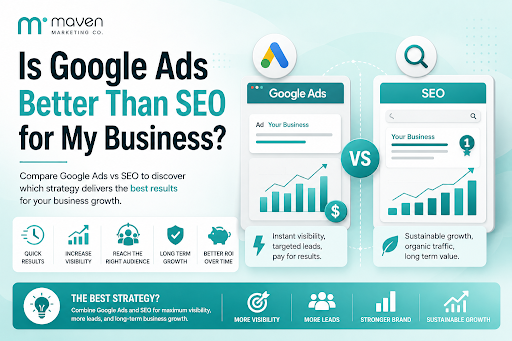
Is Google Ads Better Than SEO for My Business
One of the biggest questions business owners ask when they are planning online growth is whether they should invest in Google Ads or SEO. Both are strong marketing plays that help your company show up in Google search results, but they do things in separate lanes. Google Ads gives quicker visibility and can bring in leads fast, whereas SEO more or less focuses on slow, steady organic traffic that tends to grow the longer you keep building it. Picking the right direction depends on what you want to achieve, how much money you can spend, how crowded the market is, and how quickly you need results, like sooner rather than later. The good news is you don’t always have to choose one or the other; it’s not exactly a black-and-white situation. If you take time to understand the strongest points of both, you can put together a more sensible digital marketing plan that supports consistent expansion. In this guide, we’ll compare Google Ads vs SEO, explain the main differences, and help you figure out what option makes the most sense for your business.

When Should I Hire a Digital Marketing Agency
Growing a business today takes more than just having a website or throwing a post on social media; customers usually search around online, compare providers, skim reviews, and basically expect the brand to show up with a solid digital presence before they even think about buying. Many businesses try to run their marketing themselves, but there comes a point when “doing it all in-house” becomes clunky and hard to manage, all at once. Knowing when to hire a digital marketing agency can end up making a big, real difference for your growth. If you’re not getting enough leads, or your online visibility feels stuck, or sales are just not moving, the right agency can bring the know-how, plus a clear plan, to help you get noticeably better outcomes. In this guide, we’ll dig into what a digital marketing agency actually does, the usual signs it’s time to bring one on, and how picking the right marketing partner can help your business move forward at a faster pace.
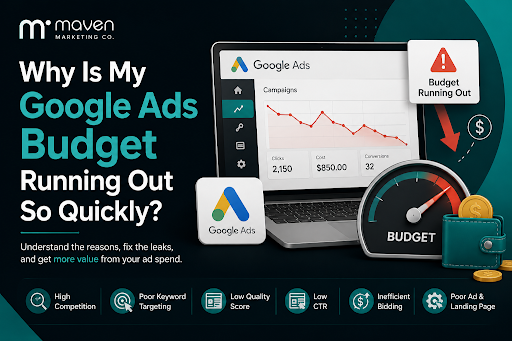
Why Is My Google Ads Budget Running Out So Quickly
Running a successful Google Ads budget isn’t only about throwing more money at it. It’s more like making every dollar, doing a bit extra. A lot of businesses start a Google Ads campaign with big hopes, then find out their daily budget is gone within a few hours, and that feels weird, right? After that, your ads stop showing effectively, new leads slip away, and your return on investment dips. So if your Google Ads budget is running out too fast, don’t stress. It’s a fairly common issue, and in most situations, it can be repaired with the right approach. There are multiple little things that can drain your advertising money quicker than you expected, from costly keywords to audience targeting that just doesn’t quite fit. In this guide, we’ll walk through why your budget disappears so quickly, how to cut wasteful spend, and the most reliable ways to boost your Google Ads ROI, even if your budget stays the same.