.svg)


%201.svg)

Key Takeaways
- Customer journey mapping documents every touchpoint customers experience from initial awareness through purchase, onboarding, ongoing relationship, and advocacy—revealing experience gaps, friction points, and emotional low points that strategic improvements address
- Effective journey maps are research-driven rather than assumption-based, incorporating actual customer interviews, behavioural analytics, session recordings, and survey data that reveal genuine customer experience rather than internal assumptions about what customers encounter
- Journey maps serve multiple strategic functions including experience improvement prioritisation, cross-functional alignment around customer needs, new employee onboarding, and investment justification for experience enhancement initiatives
- Different journey map types serve distinct purposes—current state maps document existing experience, future state maps envision ideal experience, and day-in-the-life maps contextualise customer behaviour within broader life context beyond brand interactions
- Regular journey map updates maintain accuracy as customer behaviour evolves, new touchpoints emerge, and experience improvements implemented through mapping insights change the journey customers actually encounter
A Melbourne telecommunications provider conducted internal workshops where department heads collaboratively mapped the customer journey for new residential subscribers. Marketing mapped the acquisition journey. Sales mapped the sign-up process. Customer service mapped support interactions. Technical teams mapped installation. The resulting map was comprehensive, detailed, and represented what each team believed customers experienced.
Customer interviews revealed a completely different reality. Customers discovered the provider through comparison sites the marketing team hadn't prioritised. The online sign-up process marketing described as "streamlined" actually confused customers who frequently called support mid-signup—interactions the sales team never witnessed. Installation appointments consistently ran late, creating anxiety that the technical team was unaware of because customers didn't complain about it directly. The first billing statement confused most customers—but customer service only heard from the minority motivated enough to call.
The gap between assumed and actual customer journey was enormous. The internal map reflected how the organisation believed it operated. The research-validated map revealed how customers actually experienced every touchpoint. Only the research-validated map enabled meaningful improvement.
According to research from McKinsey & Company, organisations that map and systematically improve customer journeys achieve revenue increases of 5-10% and cost reductions of 15-20% through reduced churn, improved conversion, and more efficient customer service operations.
Understanding Customer Journey Mapping Strategic Value

Journey mapping delivers strategic value extending far beyond creating visually appealing diagrams—understanding this value enables appropriate investment and application.
Experience reality revelation distinguishes journey mapping from internal process documentation. Internal teams consistently overestimate experience quality because they see their own intentions rather than customer reality—they know what they're trying to deliver, which colours perception of what customers actually receive. Research-validated journey maps reveal actual customer experience including emotional responses, confusion points, unmet expectations, and pleasant surprises that internal perspectives never capture. The telecommunications example above illustrates this gap dramatically—every internal team believed their component of the journey was well-designed whilst customers encountered systematic friction throughout.
Cross-functional alignment addresses a fundamental organisational challenge where different departments optimise their individual touchpoints without coordinating the overall experience customers perceive as seamless or fragmented. Marketing optimises acquisition. Sales optimises sign-up. Operations optimises delivery. Customer service optimises support. Each department's success metrics incentivise local optimisation that sometimes creates poor overall customer experience—handoffs between departments are particularly vulnerable to creating confusion, repetition, and dropped context that frustrates customers. Journey maps create shared visualisation enabling cross-functional teams to see the complete experience customers receive rather than only their department's contribution.
Prioritisation framework guides experience investment decisions toward highest-impact improvements. Journey maps displaying customer emotion levels across touchpoints reveal which stages create most satisfaction and most frustration—emotional low points within high-traffic journey stages represent highest-priority improvement opportunities combining significant customer impact with broad audience reach. Without journey mapping, experience improvement investments often reflect internal political dynamics or executive intuition rather than systematic prioritisation based on actual customer experience data.
Empathy development for customer experience among staff who never interact directly with customers. Finance teams approving billing system upgrades may not understand how confusing current statements are for customers. Technology teams building internal systems may not appreciate customer-facing implications. Marketing teams crafting acquisition messages may not understand post-purchase experience gaps that undermine the promise their advertising creates. Journey maps translate customer experience into shared organisational understanding enabling empathy across functions that rarely encounter customers directly.
Churn prevention through identifying and addressing experience failures that drive customer departure. Most churning customers don't complain before leaving—they silently experience frustration, form negative perceptions, and eventually switch to alternatives without ever explaining why. Journey mapping identifies the touchpoints where churn-driving frustration most commonly occurs, enabling proactive intervention before silent frustration becomes irreversible departure. Australian businesses with subscription models, repeat purchase expectations, or long-term client relationships gain particular value from understanding churn-driving journey failures.
Advocacy development systematically creates conditions where satisfied customers become active referral sources. Advocacy doesn't emerge randomly from satisfied customers—it's cultivated through deliberate journey design that creates shareable moments, provides natural conversation hooks, removes friction from referral actions, and reinforces positive customer emotions at peak experience moments. Journey mapping enables systematic advocacy design rather than hoping exceptional customers spontaneously recommend you to peers.
Journey Map Types and Applications
Different journey map formats serve distinct analytical and strategic purposes—selecting appropriate map type for specific objectives produces more useful outputs than applying single format regardless of purpose.
Current state journey maps document the actual experience customers currently encounter, serving as diagnostic tools revealing gaps between intended and delivered experience. Current state maps incorporate both internal process documentation and external customer research, with discrepancies between these sources highlighting where operational intentions don't translate into customer experience. These maps answer the diagnostic question: what do customers actually experience today? Current state mapping is the foundation for all other journey mapping work—accurate baseline documentation enables meaningful improvement target-setting and impact measurement.
Future state journey maps envision ideal customer experience after planned improvements are implemented, serving as strategic design tools and organisational aspiration documentation. Future state maps articulate what excellent customer experience looks like across every journey stage, providing design targets for experience improvement initiatives. These maps answer the strategic question: what should customers experience? Future state mapping enables cross-functional alignment around shared experience vision rather than each department independently defining its improvement objectives without coordinating the overall customer experience.
Day-in-the-life maps contextualise customer behaviour within broader life contexts beyond brand interactions, revealing the situations, emotions, and competing priorities customers bring to touchpoints that affect how they experience them. A customer interacting with your checkout process on a Monday morning commute on their smartphone has completely different context than the same customer browsing from home on a Saturday afternoon. Day-in-the-life mapping is particularly valuable for Australian businesses where mobile commerce is significant—understanding the contexts in which mobile interactions occur informs mobile experience design beyond simply making desktop experiences responsive.
Service blueprints extend customer journey maps to include the organisational backstage—staff actions, supporting processes, and infrastructure that deliver visible customer touchpoints. Service blueprints connect customer-facing experience with operational processes enabling organisations to understand what internal changes are required to deliver improved customer experiences. These maps answer the operational question: what must we do internally to deliver the desired customer experience? Service blueprints are particularly valuable for complex service businesses where multiple operational processes contribute to single customer touchpoints.
Lifecycle maps document the complete customer relationship from initial brand exposure through eventual churn or long-term advocacy across extended timeframes covering years rather than single purchase journeys. Lifecycle maps are particularly relevant for Australian subscription businesses, professional services relationships, and B2B accounts where customer value accumulates over years of ongoing relationship. These maps identify how customer needs, emotions, and touchpoints evolve through relationship maturity stages enabling appropriate evolution of engagement approaches as customers progress from new to established to loyal advocates.
Persona-specific maps acknowledge that different customer types encounter meaningfully different journeys to the same destination. An Australian SME discovering your accounting software through Google search encounters a completely different journey than an enterprise prospect introduced through channel partner referral—different touchpoints, different decision-making timelines, different evaluation criteria, different onboarding requirements, and different ongoing success definitions. Mapping multiple customer personas separately reveals experience differences requiring distinct improvement strategies rather than averaging across diverse customer types into a single map that accurately represents nobody.
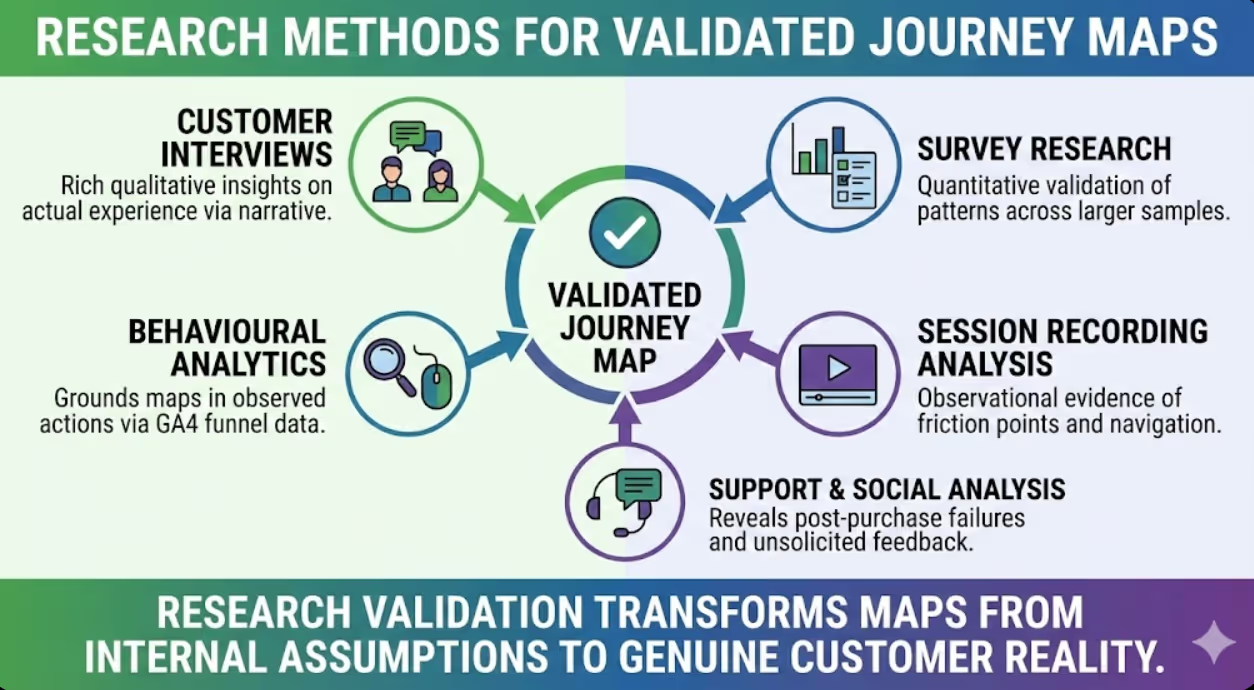
Research Methods for Validated Journey Maps
Research validation transforms journey maps from internal assumption documentation into genuine customer experience representation—the critical distinction between useful and misleading journey maps.
Customer interviews provide richest qualitative journey insights through structured one-on-one conversations exploring actual customer experience across journey stages. Interview questions should encourage narrative rather than evaluation—"Walk me through how you first heard about us and what happened next" produces richer journey insight than "How would you rate your onboarding experience?" Target diverse interview participants including recent acquirers (fresh journey memory), long-term customers (complete relationship perspective), recently churned customers (experience failure insight), and high-value advocates (journey success insight). Nielsen Norman Group research suggests five to eight interviews per customer segment typically reveals most significant journey patterns—diminishing returns appear as additional interviews confirm rather than expand discoveries.
Survey research enables quantitative validation of qualitatively identified journey patterns across larger customer samples. Post-interaction surveys measuring satisfaction at specific touchpoints (NPS after onboarding, CSAT after support interactions, CES after purchase) provide stage-specific emotional data at scale. Journey-specific surveys investigating particular stages in detail enable statistical analysis identifying which touchpoint characteristics most strongly predict overall satisfaction, advocacy likelihood, or churn risk. Survey research complements but doesn't replace interviews—surveys measure what customers think about identified experience elements whilst interviews reveal what experience elements matter and why.
Behavioural analytics integration connects GA4 quantitative data with qualitative research insights. Conversion funnel analysis reveals where prospects drop out during acquisition and consideration journeys. Content engagement patterns reveal which information customers seek most actively during evaluation. Support ticket analysis reveals which post-purchase questions and problems most commonly arise. Email engagement patterns reveal which communications customers open, click, and ignore. Behavioural data grounds journey maps in actual observed behaviour rather than self-reported recollections that sometimes differ from actual actions.
Session recording analysis provides qualitative behavioural evidence complementing interview self-reports. Watching actual customers navigate website touchpoints during research and evaluation reveals friction points that customers may not consciously notice or mention in interviews. Session recordings of onboarding processes reveal confusion patterns that customers either don't recall or didn't find significant enough to mention unprompted. The combination of explicit customer interviews and implicit behavioural observation through session recordings provides comprehensive evidence for journey documentation.
Support interaction analysis reveals post-purchase journey failures through systematic review of customer service contacts. Categorise support tickets, live chat transcripts, and call recordings by journey stage and issue type—high volumes of similar questions indicate journey failures where information needs aren't proactively met. Support analysis is particularly efficient for identifying post-purchase journey problems because customers who contact support have already experienced a failure significant enough to motivate action—each support contact represents the visible portion of a larger frustration iceberg affecting customers who don't contact support but quietly form negative perceptions.
Social listening and review analysis captures unsolicited customer experience feedback across review platforms, social media, and online communities. Australian customers sharing experiences on Google Reviews, Trustpilot, ProductReview.com.au, and industry-specific communities provide unfiltered journey feedback not subject to research participation bias. Sentiment analysis of review content identifies journey stages most frequently mentioned positively and negatively. Social listening reveals experience themes customers consider share-worthy—both strongly positive and strongly negative experiences—providing insight into journey moments with greatest advocacy or detraction potential.
Employee interviews and workshops capture frontline perspective on customer journey reality that management-level research might miss. Customer service representatives hear consistent customer questions, complaints, and emotional responses that pattern into journey insights. Sales teams observe prospect evaluation behaviour and objection patterns revealing consideration journey reality. Delivery and implementation staff witness onboarding experience challenges firsthand. Frontline employees often possess sophisticated understanding of customer journey failures that reporting structures fail to surface to leadership—journey mapping research processes that capture frontline knowledge frequently reveal operationally known problems that haven't reached strategic attention.

Journey Map Architecture and Components
Effective journey maps incorporate specific components enabling comprehensive experience documentation and clear communication to diverse organisational audiences.
Journey stages structure maps around major phases of customer relationship progression. Common stage frameworks include Awareness (first exposure to brand or category), Consideration (active evaluation of options), Decision (purchase commitment), Onboarding (initial product or service adoption), Experience (ongoing relationship and usage), and Advocacy (referral and recommendation behaviour). Stage definitions should reflect actual customer behaviour patterns rather than internal sales funnel stages—customers don't experience themselves as "prospects in consideration stage" but as "people researching options before making a significant purchasing decision."
Touchpoint documentation catalogues every significant interaction point within each journey stage. Touchpoints include both owned channels (website, email, social media, in-person locations) and third-party channels (review platforms, comparison sites, social media conversations, word-of-mouth) where customers encounter your brand, form impressions, and make decisions. Comprehensive touchpoint documentation frequently surprises internal teams—customers regularly encounter brand touchpoints (industry forums mentioning your brand, employee LinkedIn profiles, news articles) that marketing teams aren't actively managing but that significantly influence customer perceptions.
Customer thoughts and questions documentation captures the information needs, uncertainties, and mental conversations customers have at each touchpoint. What is the customer trying to accomplish? What questions are they asking? What information are they seeking? What concerns are they weighing? Documenting customer cognitive state at each touchpoint enables organisations to proactively address information needs rather than leaving customers with unresolved questions that create friction or drive them to competitor resources answering what your touchpoints leave unclear.
Customer emotions mapping tracks the emotional experience customers have at each touchpoint on scales from strongly negative through neutral to strongly positive. Emotion mapping reveals the overall emotional arc of the customer journey—whether it consistently improves, peaks during purchase and declines post-purchase, or fluctuates through highs and lows that collectively create either positive or negative overall impressions. The post-purchase emotional dip is particularly common—customers feel excitement during purchase that turns to anxiety and confusion during onboarding, requiring deliberate journey design to maintain positive emotional momentum through the vulnerable early experience period.
Pain points and friction identification documents specific obstacles, frustrations, and disappointments customers encounter at each touchpoint. Pain points range from minor inconveniences (slightly confusing navigation) through significant friction (multi-step verification processes for simple actions) to experience failures (technical errors preventing task completion, incorrect billing, failed delivery). Pain point documentation should include frequency (how many customers encounter this?) and severity (how strongly does it affect customer experience and satisfaction?) enabling prioritisation beyond simple identification.
Moments of truth highlight the highest-stakes touchpoints where customer impressions are most powerfully formed and customer decisions most significantly influenced. Moments of truth are the touchpoints where customers make or break their assessment of your brand—where positive experiences create lasting loyalty and negative experiences create irreversible churn decisions. Common moments of truth include first product use experience (does it deliver on purchase promise?), first problem encounter and resolution (how does the organisation respond when things go wrong?), and renewal decision point (is continued investment justified by delivered value?).
Opportunities documentation transforms pain point identification into improvement action guidance. For each identified pain point or emotional low point, document potential improvements addressing the underlying cause, estimate impact on customer experience and business outcomes, and assess implementation complexity and cost. Opportunities documentation converts journey maps from diagnostic tools into strategic planning inputs—without explicit opportunity identification, journey maps risk becoming impressive analytical artefacts that don't generate improvement actions.

Awareness Stage Journey Optimisation
The awareness stage determines whether potential Australian customers ever discover your brand during their initial category exploration—optimisation here maximises the qualified audience entering subsequent journey stages.
Discovery channel diversity acknowledges that Australian customers discover brands through multiple channels that vary significantly by demographic, industry, and purchase category. Search engine discovery through organic rankings and paid advertising, social media exposure through organic content and paid promotion, peer recommendations through professional networks and personal relationships, industry publication coverage through editorial and contributed content, and comparison site appearances through listing and review management all contribute to awareness generation. Journey research revealing which discovery channels are most common for your highest-value customers enables strategic investment in those channels rather than distributing resources equally across all possible awareness mechanisms.
Category education content serves customers in early awareness stages who are exploring solution categories rather than evaluating specific providers. Australian customers beginning research journeys frequently don't know what solution type they need—they understand the problem they're trying to solve but haven't yet concluded what category of solution addresses it. Content educating prospects about solution approaches, helping them understand their problem more precisely, and guiding their thinking toward categories your products or services occupy serves customers before they're ready to evaluate specific providers. This education content builds brand familiarity during research that influences subsequent evaluation when customers become ready to assess specific solutions.
Awareness-to-consideration transition is the critical journey moment where casual awareness becomes active evaluation interest. Customers in awareness stage encounter your brand amongst many others—the transition to consideration requires sufficient interest to motivate further investigation. Transition enablers include immediately comprehensible value proposition that resonates with customer's recognised problem, clear differentiation from alternatives making further investigation worthwhile, and social proof reducing perceived risk of investing evaluation time in an unknown brand. Journey maps should specifically document what motivates or prevents awareness-to-consideration transitions for different customer types.
Consideration and Decision Stage Optimisation
Consideration and decision stages determine whether interested prospects become customers—the stages where most conversion optimisation investment is concentrated but where journey mapping reveals often-overlooked friction.
Evaluation criteria alignment ensures your consideration stage content addresses the specific criteria customers use to evaluate options in your category. Journey research revealing actual customer evaluation criteria—which may differ significantly from what your marketing assumes—enables content and communication that directly addresses what customers are actually evaluating rather than what you believe should matter to them. Australian B2B buyers evaluating professional services weight implementation risk, reference case studies, and service model clarity heavily—marketing that emphasises credentials and capabilities without addressing implementation concerns misaligns with actual evaluation priorities.
Competitive comparison touchpoints acknowledge that Australian customers in consideration stage actively research alternatives before committing. Journey maps should document where and how customers encounter competitor information, what competitor claims customers find most compelling, and what comparative weaknesses in your offering most frequently influence evaluation decisions. Understanding the competitive consideration landscape enables strategic communication addressing comparative concerns rather than ignoring the competitive context customers are actively navigating.
Decision friction reduction addresses barriers that prevent motivated prospects from completing purchase or inquiry commitments. Common decision friction points include unclear next steps after evaluation (how do I actually purchase or engage?), excessive information requirements before initial commitment, inability to find pricing information requiring sales contact for basic budget qualification, and lack of low-risk trial or pilot options enabling commitment-averse prospects to begin relationships with reduced risk. Journey mapping frequently reveals that organisations create decision friction inadvertently—fixing it often requires cross-functional coordination across marketing, sales, and operations that journey mapping enables by creating shared visibility of the problem.
Post-Purchase Journey: Onboarding and Experience Stages
Post-purchase journey stages determine whether acquired customers become retained, satisfied advocates or churned, disappointed detractors—yet receive significantly less strategic attention than pre-purchase acquisition stages in most Australian organisations.
Onboarding experience design addresses the critical period immediately following purchase when customers form lasting impressions of whether their investment was justified. Effective onboarding acknowledges the emotional vulnerability of new customers—excited about their purchase but anxious about whether it will deliver expected value—and systematically reduces anxiety whilst building confidence through early wins. Onboarding journey design should minimise time-to-first-value (how quickly does the customer experience initial benefit?), proactively address common early questions before they create anxiety, and maintain positive emotional momentum through the transition from purchase excitement to product reality.
Ongoing relationship touchpoints maintain engagement and demonstrate value throughout customer lifecycle stages that extend far beyond initial onboarding. Regular value-demonstrating communications, proactive account review contacts, relevant educational content advancing customer capability and outcomes, and community connection opportunities all contribute to ongoing relationship experience quality. Ongoing relationship journey design is particularly important for subscription businesses and professional services relationships where customer value requires continuous demonstration rather than assuming initial purchase satisfaction persists indefinitely.
Problem and complaint handling represents the most high-stakes ongoing relationship touchpoint—how organisations respond when things go wrong reveals character more powerfully than how they behave when things go well. Service recovery journey design should enable rapid problem identification, clear escalation paths, empowered frontline staff capable of resolving common issues without bureaucratic escalation, and systematic follow-up confirming resolution satisfaction. Australian customers who experience effective problem resolution often become stronger advocates than customers who never encountered problems—the service recovery paradox creates advocacy opportunity from what initially appeared to be experience failure.
Advocacy Stage Development
Systematic advocacy development transforms satisfied customers into active referral sources rather than hoping advocacy emerges spontaneously from satisfaction alone.
Peak experience identification reveals the journey moments where customer satisfaction is highest and emotional engagement is strongest—the natural advocacy triggers where customers are most motivated to share their experience. Journey maps displaying emotional curves across touchpoints reveal these peak moments, enabling deliberate design that creates natural conversation opportunities, provides sharing mechanisms, and reinforces positive emotions through acknowledgement and celebration. Advocacy-enabling design at peak experience moments dramatically increases organic referral rates without requiring incentive programmes that sometimes create transactional rather than genuine advocacy.
Referral mechanism design removes friction from advocacy actions that willing advocates often fail to complete due to unclear processes. Simple referral programmes with clear benefit articulation, social sharing integrations enabling one-click experience sharing, testimonial and case study development processes that celebrate featured customers, and online review prompting strategies that guide satisfied customers to appropriate platforms all reduce advocacy friction. Many satisfied Australian customers would recommend their providers if asked clearly and given simple mechanisms—absence of advocacy programmes leaves substantial referral potential unrealised.
Community development creates belonging that sustains advocacy beyond individual transaction satisfaction. Customer communities built around shared interests, challenges, and experiences enable customers to derive value from each other rather than exclusively from your organisation. Community belonging is one of the most powerful drivers of sustained advocacy—customers who are part of communities associated with your brand advocate for the community as much as the product or service. Australian businesses across industries have successfully developed community dynamics that transform transactional customer relationships into identity-relevant affiliations generating sustained organic advocacy.
Frequently Asked Questions
How long does customer journey mapping take for Australian businesses, and what resources are required for a first mapping project?
Initial customer journey mapping projects typically require four to eight weeks from research commencement through completed validated map, depending on business complexity, customer diversity, and research depth. Resource requirements include dedicated project leadership (typically marketing or customer experience role, 30-50% time allocation during project), cross-functional workshop participation (two to four hours from representatives of each customer-facing department), customer research execution (conducting and analysing 8-15 customer interviews plus survey analysis), and visual map creation (design resource or customer experience platform subscription). Smaller Australian SMEs with simpler customer journeys and less customer diversity can complete initial mapping in two to three weeks with proportionally lighter research. The investment is justified by subsequent clarity enabling more targeted experience improvement than unfocused improvement initiatives—journey mapping projects typically identify two to three high-impact improvements that individually justify the entire mapping investment through conversion or retention improvements they enable.
How should Australian businesses prioritise journey improvement initiatives when mapping reveals numerous experience gaps simultaneously?
Improvement prioritisation requires assessing both customer impact and business impact rather than addressing all identified gaps simultaneously. Prioritisation framework considerations include frequency (how many customers encounter this touchpoint?), severity (how significantly does the experience gap affect satisfaction, conversion, or retention?), emotion (how strongly negative is the customer emotional response?), and moment-of-truth status (does this touchpoint significantly influence overall customer assessment?). High-frequency, high-severity gaps at emotional low points within moments-of-truth touchpoints represent top priorities for immediate action. Additionally assess business impact through estimated conversion improvement, churn reduction, or advocacy increase, and implementation feasibility through cost and complexity. Quick wins (high-impact, low-complexity improvements) should be implemented immediately whilst building organisational support for larger strategic improvements requiring more extensive investment.
What is the difference between customer journey mapping and customer experience mapping, and which approach is more appropriate for Australian SMEs?
Customer journey mapping and customer experience mapping are frequently used interchangeably but represent different emphasis levels. Customer journey mapping focuses on documenting the sequence of touchpoints and interactions customers move through over time—the narrative of what customers do and encounter throughout their relationship. Customer experience mapping emphasises the emotional and perceptual dimension—how customers feel and what they think throughout those touchpoints. In practice, comprehensive journey maps incorporate both touchpoint documentation and experience quality assessment, making the distinction largely semantic. Australian SMEs should focus on creating maps that document what customers actually encounter (touchpoints), what they're thinking and feeling (experience quality), and what gaps exist between experience delivered and experience expected (improvement opportunities)—regardless of which label is applied to the output.
How frequently should Australian businesses update their customer journey maps, and what triggers should prompt immediate revision?
Scheduled reviews should update customer journey maps annually as minimum practice, with more frequent reviews for rapidly evolving businesses or industries undergoing significant change. Annual updates incorporate accumulated customer research, experience improvement implementation outcomes, and emerging touchpoint changes into current documentation. Triggers warranting immediate map revision include significant product or service changes altering what customers experience, major digital transformation initiatives creating new touchpoints or eliminating existing ones, substantial customer feedback indicating journey changes not reflected in existing maps, entry into new customer segments with different journey patterns, and competitive landscape changes that alter how customers evaluate options during consideration stages. Many Australian businesses treat journey maps as one-time projects rather than living documents—maps that aren't maintained gradually diverge from actual customer experience until they misrepresent reality more than they illuminate it.
How should Australian businesses handle journey mapping when their customers include both B2B and B2C segments with fundamentally different journey patterns?
Businesses serving both B2B and B2C customers require separate journey maps for each segment rather than attempting to document both within single maps that accurately represent neither. B2B and B2C journeys differ across virtually every dimension—awareness channels (professional networks versus consumer media), consideration timeframes (weeks to months versus hours to days), decision-making structure (buying committees versus individual decisions), evaluation criteria (ROI and risk versus value and experience), onboarding complexity (implementation projects versus immediate self-service), and advocacy channels (industry referral networks versus social media sharing). Begin with the segment representing greatest revenue or strategic priority, develop thorough research-validated map for that segment, then extend to secondary segments. Cross-segment pattern analysis sometimes reveals interesting similarities informing shared improvement opportunities—but accurate mapping requires segment-specific research rather than assuming pattern similarity before research validates it.
Can small Australian businesses with limited customer research budgets create useful journey maps without expensive research programmes?
Valuable journey maps are achievable with modest research investment focused on quality over quantity. Five to eight customer interviews conducted by someone within the business (founder, sales director, customer success manager) using structured interview guides provide substantial journey insight without external research costs. Existing customer feedback sources—support tickets, online reviews, email responses, informal customer conversations—contain substantial journey insight that systematic analysis can surface without new research investment. Free survey tools (Google Forms, Typeform free tier) enable post-interaction satisfaction surveys generating ongoing touchpoint feedback at minimal cost. Session recordings from Microsoft Clarity (free) provide behavioural journey evidence supplementing self-reported interview data. These accessible research methods won't produce the depth of insight that comprehensive professional research programmes generate—but they produce significantly better journey maps than pure internal assumption documentation, which is the relevant comparison for resource-constrained Australian SMEs.
How do customer journey maps connect to specific marketing and operational improvements, and how do Australian businesses avoid maps becoming impressive documents that don't drive action?
Journey maps drive action through explicit connection between documented insights and improvement initiatives rather than assuming that documentation automatically produces change. Action-driving practices include assigning ownership for each identified improvement opportunity (named individual responsible for progress rather than generic team ownership), setting specific improvement timelines with accountability checkpoints, connecting journey improvements to measurable business metrics (conversion rate, retention rate, NPS) enabling ROI demonstration, presenting journey findings to executive leadership in business impact terms rather than customer experience terminology, and building journey improvement initiatives into annual planning cycles rather than treating them as separate projects. The most common reason journey maps don't drive action is that they're produced by customer experience teams without cross-functional authority to implement the operational, technological, or policy changes required—ensuring executive sponsorship and cross-functional participation from the beginning of mapping projects rather than presenting findings after completion dramatically improves subsequent action rates.
Customer Journey Mapping Creates Competitive Advantage
Customer journey mapping transforms Australian businesses from organisations delivering what they intend to provide into organisations that understand and systematically improve what customers actually experience—a fundamental shift that compounds into sustainable competitive advantage through superior conversion, retention, and advocacy.
The frameworks outlined in this guide—research-validated mapping, comprehensive touchpoint documentation, emotional arc analysis, and systematic improvement prioritisation—provide practical foundation for journey mapping programmes that drive genuine business outcomes rather than producing impressive analytical artefacts that generate no improvement action.
Australian businesses committing to ongoing journey mapping as strategic practice rather than one-time project consistently discover that understanding actual customer experience reveals improvement opportunities that internal perspectives permanently miss—and that addressing those opportunities produces commercial returns through improved conversion, reduced churn, and increased advocacy that justify sustained journey management investment.
Ready to map and improve your customer journey from awareness through advocacy? Maven Marketing Co. provides comprehensive customer journey mapping services including research design, customer interviews, cross-functional workshops, map development, and improvement prioritisation ensuring your journey mapping investment drives genuine experience improvement and measurable business outcomes. Let's discover what your customers actually experience and systematically improve the touchpoints that matter most.

Table of contents
read more blogs

Is Google Ads Better Than SEO for My Business
One of the biggest questions business owners ask when they are planning online growth is whether they should invest in Google Ads or SEO. Both are strong marketing plays that help your company show up in Google search results, but they do things in separate lanes. Google Ads gives quicker visibility and can bring in leads fast, whereas SEO more or less focuses on slow, steady organic traffic that tends to grow the longer you keep building it. Picking the right direction depends on what you want to achieve, how much money you can spend, how crowded the market is, and how quickly you need results, like sooner rather than later. The good news is you don’t always have to choose one or the other; it’s not exactly a black-and-white situation. If you take time to understand the strongest points of both, you can put together a more sensible digital marketing plan that supports consistent expansion. In this guide, we’ll compare Google Ads vs SEO, explain the main differences, and help you figure out what option makes the most sense for your business.

When Should I Hire a Digital Marketing Agency
Growing a business today takes more than just having a website or throwing a post on social media; customers usually search around online, compare providers, skim reviews, and basically expect the brand to show up with a solid digital presence before they even think about buying. Many businesses try to run their marketing themselves, but there comes a point when “doing it all in-house” becomes clunky and hard to manage, all at once. Knowing when to hire a digital marketing agency can end up making a big, real difference for your growth. If you’re not getting enough leads, or your online visibility feels stuck, or sales are just not moving, the right agency can bring the know-how, plus a clear plan, to help you get noticeably better outcomes. In this guide, we’ll dig into what a digital marketing agency actually does, the usual signs it’s time to bring one on, and how picking the right marketing partner can help your business move forward at a faster pace.
Why Is My Google Ads Budget Running Out So Quickly
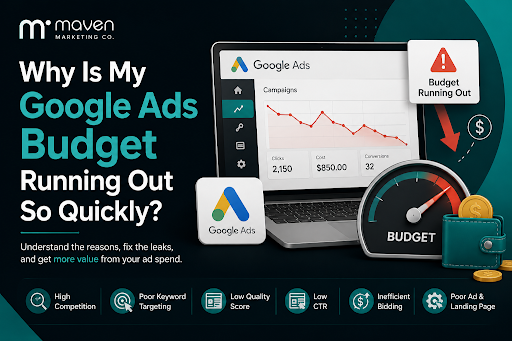
Running a successful Google Ads budget isn’t only about throwing more money at it. It’s more like making every dollar, doing a bit extra. A lot of businesses start a Google Ads campaign with big hopes, then find out their daily budget is gone within a few hours, and that feels weird, right? After that, your ads stop showing effectively, new leads slip away, and your return on investment dips. So if your Google Ads budget is running out too fast, don’t stress. It’s a fairly common issue, and in most situations, it can be repaired with the right approach. There are multiple little things that can drain your advertising money quicker than you expected, from costly keywords to audience targeting that just doesn’t quite fit. In this guide, we’ll walk through why your budget disappears so quickly, how to cut wasteful spend, and the most reliable ways to boost your Google Ads ROI, even if your budget stays the same.