.svg)


%201.svg)
.avif)
Key Takeaways
- Conversion tracking transforms campaign optimization from guessing based on clicks and CTR to data-driven decisions based on actual leads, sales, and revenue generated by specific keywords, ads, and audiences
- Enhanced conversions improve accuracy 15-30% by using hashed customer data matching clicks to conversions even when cookies fail, recovering attribution lost to browser restrictions and cross-device journeys
- Google Tag Manager simplifies implementation enabling marketers to deploy and modify conversion tracking without developer dependency, whilst providing testing and debugging tools ensuring accuracy before campaigns spend budget
- Offline conversion import captures phone leads and in-store sales connecting Google Ads clicks to conversions happening outside website, revealing true campaign value often 40-80% higher than online-only tracking suggests
- Value-based bidding optimizes toward revenue not just conversion volume, prioritizing high-value customers over low-value conversions through assigning transaction-specific values enabling profit-focused optimization
Your Google Ads dashboard shows impressive metrics: 3,400 monthly clicks, 6.8% CTR, $4.20 average CPC. Your account manager celebrates these "strong performance indicators" whilst recommending budget increases to scale success.
Yet your business revenue from Google Ads remains mystery. You know the platform costs $14,280 monthly but can't attribute specific sales to advertising investment. Some months feel profitable, others wasteful, but absent conversion tracking, you're optimizing toward engagement metrics whilst business outcomes remain invisible.
This scenario repeats across Australian businesses daily—celebrating proxy metrics whilst actual ROI remains unmeasured and unknowable.
Brisbane software company Xero implemented comprehensive conversion tracking discovering their "best performing" campaign (highest CTR, lowest CPC) generated only 12% of actual trial signups whilst overlooked campaign with mediocre engagement metrics delivered 47% of conversions at superior economics. This revelation drove complete budget reallocation improving trial volume 67% without increasing spend—purely through optimizing toward business outcomes rather than vanity metrics.
Research examining conversion tracking implementation shows that businesses measuring actual conversions achieve 2.3-3.8x higher Google Ads ROI than those optimizing toward engagement metrics, with improvement stemming from data-driven optimization focusing investment on genuinely profitable keywords, audiences, and campaigns rather than those merely generating clicks efficiently.
Understanding Conversion Types: What Should You Track?
.avif)
Conversion tracking begins with defining which user actions constitute valuable business outcomes warranting measurement and optimization.
Macro conversions represent primary business objectives directly generating revenue or qualified leads. E-commerce purchases completing checkout process. Lead form submissions providing contact information. Phone calls exceeding minimum duration threshold (typically 60-90 seconds indicating genuine inquiry). Chat conversations initiated through website. Appointment bookings scheduled through online calendar. Trial signups activating product access. Download completions for gated content capturing leads.
Sydney accounting firm identified macro conversions as "consultation booking" (primary), "phone call 90+ seconds" (secondary), and "contact form submission" (tertiary). This hierarchy enabled optimization prioritizing highest-value conversion types whilst maintaining visibility into alternative conversion paths.
Micro conversions indicate progress toward macro conversions without immediate business value. Add-to-cart actions demonstrating purchase consideration. Product page views showing interest. Video views engaging with content. Email signup building remarketing audience. Resource downloads indicating research phase. Each micro conversion represents step toward eventual macro conversion, providing early signals enabling optimization before sufficient macro conversions accumulate for statistical significance.
Melbourne e-commerce retailer tracked both purchases (macro) and add-to-cart (micro) discovering campaigns generating strong add-to-cart rates but weak purchase rates indicated pricing or checkout friction rather than poor targeting. This insight drove landing page optimization rather than campaign pause, preserving traffic quality whilst improving conversion environment.
Online conversions occur directly on website through user actions measurable via tracking code. These represent easiest conversion types to implement requiring only properly configured tracking tags. Most Australian businesses start with online conversion tracking before expanding to offline measurement.
Offline conversions happen outside website requiring manual import or integration. Phone calls converting to sales, in-store purchases following online research, sales team closing deals from web-generated leads. These conversions often represent majority of actual business value whilst remaining invisible without deliberate offline tracking implementation. Adelaide car dealership discovered that whilst website conversions (enquiry forms) totaled 140 monthly, subsequent offline conversions (actual vehicle sales) reached 67—revealing true conversion rate of 48% invisible in online-only tracking.
Conversion value assignment transforms binary conversion counting into economic measurement. Assign actual revenue for e-commerce transactions. Use average customer lifetime value for lead-generation conversions. Calculate typical deal size for B2B sales. This value-based tracking enables optimization toward revenue rather than conversion volume, prioritizing high-value customers over low-value conversions.
Google Ads Conversion Actions: Basic Setup
.avif)
Conversion actions in Google Ads define what constitutes convertible behavior, establishing tracking infrastructure capturing these events.
Creating conversion actions:
Navigate to Google Ads Tools & Settings → Measurement → Conversions. Click blue plus button selecting "Website" for online conversions. Choose conversion goal matching your business objective: "Submit lead form," "Purchase," "Phone calls," etc. Name conversion action descriptively: "Contact Form Submission—Home Page" or "Purchase—Checkout Complete." Set conversion value using actual transaction value for e-commerce or estimated value for leads (average deal size × close rate). Select conversion count: "Every" for e-commerce (each purchase counts), "One" for lead generation (prevent duplicate counting if users submit multiple forms).
Brisbane legal firm created three conversion actions: "Free Consultation Booking" (value: $450 = $4,500 average case × 10% retention), "Phone Call 120+ Seconds" (value: $270 = $4,500 × 6% retention from calls), and "Contact Form—Case Enquiry" (value: $180 = $4,500 × 4% retention from forms). This granular setup enabled comparing acquisition cost across conversion types informing budget allocation.
Conversion window settings determine attribution timeframe:
Click-through conversion window (default 30 days) credits conversions occurring within specified days after ad click. Extend to 60-90 days for longer consideration purchases like professional services or high-ticket items. View-through conversion window (default 1 day) credits conversions after ad view without click. Keep shorter (1-7 days) as view-through attribution weaker than click-through. Engagement window for video ads determines how long after video interaction to attribute conversions.
Attribution models distribute conversion credit across customer touchpoints:
Last click assigns 100% credit to final ad click—Google Ads default but systematically undervalues awareness and consideration touchpoints. Data-driven attribution uses machine learning analyzing actual conversion paths assigning proportional credit—recommended for accounts with 400+ conversions monthly. Position-based allocates 40% each to first and last interactions, 20% to middle—balancing awareness and conversion value.
Melbourne SaaS company switched from last-click to data-driven attribution discovering their awareness campaigns (previously showing poor ROI under last-click) contributed significantly to eventual conversions often completed through branded search. This insight prevented budget cuts to profitable awareness campaigns.
Google Tag Manager Implementation: Technical Foundation
Google Tag Manager provides centralized tag management enabling marketers to deploy tracking without developer dependency whilst maintaining testing and version control.
GTM container setup:
Create Google Tag Manager account at tagmanager.google.com. Install GTM container code on all website pages—place container snippet in <head> section and <body> section per GTM instructions. Remove existing Google Ads tracking code if present (GTM will manage it). Verify GTM installation using GTM Preview mode confirming container fires on all pages.
Creating conversion tracking tags:
Within GTM, click "Tags" → "New" → "Tag Configuration." Select "Google Ads Conversion Tracking" tag type. Enter Conversion ID and Conversion Label from Google Ads conversion action. Set trigger determining when tag fires—typically "Form Submission" or "Page View" depending on conversion type. For form submissions, create trigger firing when form submit button clicked or thank-you page loads. Save and submit container version making changes live.
Sydney e-commerce retailer implemented purchase tracking through GTM creating tag firing on "order confirmation" page with dynamic conversion value pulled from dataLayer variable containing actual transaction amount. This setup required one-time dataLayer implementation by developer but enabled marketers to modify tracking without ongoing technical dependency.
DataLayer implementation provides structured data exchange between website and GTM:
Developer adds dataLayer code to website pushing relevant information (transaction value, product details, user ID) into standardized format GTM accesses. For e-commerce, dataLayer includes order total, products purchased, transaction ID. For lead generation, includes lead source, form type, or other contextual data. GTM tags reference dataLayer variables accessing this information for conversion tracking and enhanced conversions.
javascript
<script>
dataLayer.push({
  'event': 'purchase',
  'transactionId': '12345',
  'transactionTotal': 299.99,
  'email': 'customer@example.com',
  'phone': '+61412345678'
});
</script>
Testing and debugging:
Use GTM Preview mode testing tags before publishing. Navigate through conversion process confirming tag fires correctly. Verify conversion appears in Google Ads (conversions may take 24-48 hours appearing). Check Google Ads conversion tracking status showing "Recording conversions" not "No recent conversions." Review GTM debug console identifying any firing issues or errors.
Brisbane agency discovered during testing that form submission trigger fired prematurely when users clicked submit button even if form validation failed, causing false conversion tracking. Adjusted trigger to fire only on thank-you page load ensuring legitimate conversions only.
Enhanced Conversions: Improving Tracking Accuracy
Enhanced conversions supplement standard tracking with hashed customer data improving attribution accuracy amidst browser restrictions and cross-device journeys.
How enhanced conversions work:
When user converts, website sends hashed customer data (email, phone, address) to Google alongside conversion. Google matches hashed data against signed-in Google account recovering attribution when cookies unavailable due to browser restrictions or cross-device behavior. This matching improves conversion tracking accuracy 15-30% by recovering lost conversions.
Enhanced conversion setup methods:
Google Tag Manager (recommended for most businesses): Enable enhanced conversions in Google Ads conversion action settings. In GTM, update Google Ads conversion tracking tag enabling "Include user-provided data from your website" option. Map dataLayer variables containing customer email, phone, and address to corresponding fields. Email address alone provides strongest matching signal.
Google tag (gtag.js) for websites not using GTM: Modify website code adding enhanced conversion parameters to gtag conversion event. Include email, phone, first name, last name, street address, city, region, postal code, and country when available. More data points improve matching accuracy.
Melbourne professional services firm implemented enhanced conversions through GTM discovering 23% more conversions attributed after implementation compared to previous cookie-only tracking. The improvement came primarily from mobile conversions where Safari ITP restrictions previously prevented attribution.
Data handling requirements:
Hash customer data before transmission (GTM handles this automatically). Implement only on conversion pages where customer information available (checkout, thank-you page, registration). Obtain proper consent for data usage per Privacy Act requirements. Update privacy policy describing data collection and usage. Don't collect unnecessary personal information—use only what's needed for matching.
Enhanced conversion limitations:
Requires customer providing identifying information (email or phone). Doesn't help for purely anonymous conversions. Requires users signed into Google account for matching (70-80% of users). Improves accuracy but doesn't achieve 100% attribution. Still subject to conversion windows and attribution model settings.
GA4 Integration: Unified Measurement Platform
Google Analytics 4 integration with Google Ads enables holistic view of customer journey combining advertising data with comprehensive website behavior analytics.
Linking GA4 and Google Ads:
In GA4, navigate to Admin → Property Settings → Google Ads Links. Click "Link" button selecting Google Ads account to connect. Enable auto-tagging ensuring URL parameters capture campaign data. Enable Google signals for remarketing and cross-device reporting. Import GA4 conversions to Google Ads making them available for campaign optimization.
GA4 conversion event creation:
In GA4, navigate to Configure → Events identifying events representing conversions. Mark events as conversions clicking toggle button. Common conversion events include "purchase" (e-commerce), "generate_lead" (form submission), "begin_checkout" (cart progression). Create custom events for business-specific conversions not automatically tracked.
Sydney education provider created GA4 events for "course_enquiry," "download_brochure," and "book_consultation" marking each as conversion. Importing these to Google Ads enabled optimizing campaigns toward specific conversion types based on student journey stage.
Benefits of GA4 integration:
Access GA4's machine learning including predictive audiences and purchase probability scoring. View complete user journey including organic, direct, and social sessions alongside paid advertising. Analyze landing page and on-site behavior for converting versus non-converting users. Create audiences based on behavior exporting to Google Ads for targeting. Unified reporting dashboard combining advertising and analytics data.
Cross-domain tracking maintains user identity across multiple domains (e.g., main website and checkout subdomain):
Configure GA4 cross-domain measurement listing all domains. Update GTM configuration including all domains in cross-domain tracking setting. Test user journey flows across domains confirming single session maintained. Brisbane e-commerce company with separate checkout domain (checkout.example.com) implemented cross-domain tracking preventing attribution breaks when customers moved from product pages to payment processor.
Offline Conversion Import: Capturing Full Value
.avif)
Offline conversion import connects online advertising to offline business outcomes including phone sales, in-store purchases, and sales team-closed deals.
When offline tracking matters:
Businesses where conversions occur primarily offline: car dealerships, real estate, professional services. Phone-heavy industries where calls represent primary conversion path. Multi-location retail with online research driving in-store purchases. B2B companies with sales team closing deals from marketing-generated leads. Without offline tracking, Google Ads appears to underperform dramatically despite driving substantial offline revenue.
Adelaide car dealership tracked only online enquiry forms (140 monthly) without connecting to actual vehicle sales (67 monthly from web leads). Implementing offline conversion import revealed true conversion rate and actual cost per sale, transforming perceived campaign performance from mediocre to highly profitable justifying 3x budget increase.
Click ID tracking setup:
Enable auto-tagging in Google Ads capturing GCLID (Google Click ID) in URL parameters. Store GCLID when lead submits form or calls, typically in CRM alongside contact record. When offline conversion occurs (sale closes, appointment completes), match to original GCLID for upload.
Offline conversion import methods:
Manual upload via Google Ads interface: Navigate to Tools → Conversions → Uploads. Download template spreadsheet entering GCLID, conversion time, conversion value, and currency. Upload completed spreadsheet monthly or as conversions occur. Suitable for low-volume businesses tracking manually.
API integration for automated systematic import: Connect CRM or sales system to Google Ads via API. Automatically import conversions when marked closed-won in CRM. Requires technical implementation but enables real-time attribution. Melbourne B2B software company integrated Salesforce with Google Ads automatically importing conversions when opportunities marked "Closed Won," complete with actual deal value for precise ROI measurement.
Google Ads conversion import from CRM platforms: Platforms like HubSpot, Salesforce, and Microsoft Dynamics offer native Google Ads integrations. Configure once, conversions import automatically. Simplest option for businesses using supported CRM systems.
Offline conversion best practices:
Import conversions within 90 days of original click (Google's conversion window). Include actual conversion value for value-based optimization. Use consistent naming avoiding duplicates. Verify imports processing successfully checking Google Ads conversion reports. Document GCLID capture process ensuring sales team consistently tracks.
Value-Based Bidding: Optimizing Toward Revenue
Value-based bidding shifts optimization from maximizing conversion volume to maximizing conversion value, prioritizing high-value customers over low-value conversions.
Conversion value assignment:
E-commerce uses actual transaction value automatically captured. Lead generation assigns estimated value based on: average deal size × close rate = lead value. B2B might use: typical contract value × lead-to-opportunity rate × opportunity-to-customer rate. Professional services calculate: average project value × consultation-to-client conversion rate.
Perth consulting firm selling services ranging $5,000-$50,000 assigned lead values by service type: "SEO Consultation" = $8,000 (average project), "PPC Management Consultation" = $12,000, "Full Digital Strategy" = $28,000. This granular valuation enabled campaigns to prioritize high-value service leads.
Target ROAS bidding optimizes toward return on ad spend target:
Set target ROAS (e.g., 400% = $4 revenue per $1 spend). Google's algorithm adjusts bids prioritizing high-value conversions within ROAS target. Requires minimum 30 conversions with value in past 30 days for learning. Start conservatively with achievable ROAS (current performance level), gradually increase as performance improves.
Brisbane e-commerce retailer selling products $50-$800 implemented Target ROAS at 300% (current performance), gradually increasing to 450% over six months. Algorithm learned to bid more aggressively for high-value product searches whilst moderating bids for low-margin categories, improving profit margins 34% without reducing revenue.
Maximize conversion value bidding pursues highest possible total conversion value within budget constraints. Requires no ROAS target, simply maximizes revenue. Suitable when all revenue profitable regardless of acquisition cost. Adelaide retailer with consistent margins across product range used maximize conversion value enabling Google to pursue all profitable opportunities without artificial ROAS constraint.
Value-based bidding requirements:
Accurate conversion value tracking reflecting actual economics. Sufficient conversion volume (30+ monthly minimum). Realistic value assignments avoiding inflation. 2-4 week learning period before performance stabilizes. Ongoing monitoring ensuring algorithm performance meets expectations.
Troubleshooting Common Tracking Issues
.avif)
Even properly configured conversion tracking encounters issues requiring systematic diagnosis and correction.
No conversions recording:
Verify tag fires using Google Tag Assistant or GTM Preview mode. Check conversion tracking status in Google Ads showing "Recording conversions" not "Unverified." Confirm tag fires on correct page (thank-you page, not form page). Review form submission trigger in GTM ensuring it captures actual submissions. Test complete conversion process yourself verifying conversion appears in Google Ads. Allow 24-48 hours for conversions to appear in reporting.
Duplicate conversions:
Check conversion count setting using "One" for lead generation preventing multiple counting. Review trigger configuration ensuring tag doesn't fire multiple times per conversion. Examine GTM debug console identifying duplicate tag firings. Consider using "Transaction ID" preventing duplicate imports.
Conversion value discrepancies:
Verify dataLayer correctly passes transaction value to GTM. Check currency setting matching actual business currency (AUD). Review conversion value assignment for consistency. Compare Google Ads conversion value to actual revenue identifying systematic over/under-reporting.
Melbourne retailer discovered 15% conversion value discrepancy investigating root cause: dataLayer included tax in transaction total whilst Google Ads reporting excluded tax, creating apparent tracking error that was actually reporting methodology difference.
Attribution timing differences:
Conversions appear in Google Ads based on click date, GA4 based on conversion date. This creates timing differences in reporting particularly for longer conversion windows. Document which platform uses which attribution timing avoiding confusion during month-end reporting.
Frequently Asked Questions
What's the minimum conversion volume needed for Google Ads optimization?
Google recommends minimum 30 conversions per campaign monthly for automated bidding strategies to work effectively, with 50+ conversions preferred for stable performance. Below these thresholds, machine learning lacks sufficient data for confident optimization decisions. However, you should implement conversion tracking regardless of volume—even 5-10 monthly conversions provide valuable insight into which keywords and campaigns generate business outcomes versus just traffic. If conversion volume is insufficient for automated bidding, use manual CPC bidding whilst tracking conversions informing manual optimization decisions. Consider consolidating campaigns to increase conversions per campaign or using micro-conversions (add-to-cart, engagement) as proxy until macro-conversion volume increases. Brisbane professional services firm with only 12 monthly conversions tracked them diligently using manual bidding until reaching 40+ monthly conversions enabling Target CPA automation.
Should I track phone calls as conversions?
Absolutely, particularly for businesses where phone calls represent primary conversion path. Google Ads call tracking (formerly Google call forwarding) assigns unique phone numbers to campaigns measuring calls directly from ads. Call conversions require minimum duration threshold (typically 60-90 seconds) filtering out wrong numbers and spam. Implementation requires Google forwarding number or integration with third-party call tracking platforms like CallRail or WhatConverts. Adelaide plumber discovered phone calls represented 73% of total conversions but only tracked form submissions initially, dramatically understating campaign performance and nearly pausing profitable campaigns. After implementing call tracking, discovered actual cost per lead was $34 not apparent $87, justifying budget increases. For businesses receiving substantial phone inquiries, call tracking is non-negotiable for accurate ROI measurement.
How do I handle conversions happening across multiple devices?
Cross-device conversions (user clicks ad on mobile, converts on desktop) challenge accurate attribution. Google Ads addresses this through requiring users sign into Google account enabling cross-device tracking for signed-in users (60-70% of traffic). Enhanced conversions improve cross-device matching using hashed customer data. GA4 cross-device reporting uses Google signals tracking signed-in users across devices. However, perfect cross-device attribution remains impossible—some conversions will go unattributed when users aren't signed in. Accept 10-20% attribution loss as tracking reality rather than trying to achieve impossible 100% accuracy. Focus on directional correctness and trends rather than obsessing over perfect attribution. Sydney retailer implemented enhanced conversions and Google signals reducing unattributed conversions from 34% to 18%—improvement but not elimination.
Measure What Matters: True ROI Not Vanity Metrics
Conversion tracking transforms Google Ads from expensive traffic source into accountable revenue generator, enabling optimization toward actual business outcomes rather than proxy metrics that feel good but don't correlate with profit. Australian businesses implementing comprehensive conversion tracking—from basic online conversions through enhanced conversions, offline import, and value-based bidding—achieve 2-4x better advertising ROI than those flying blind optimizing toward clicks and CTR.
Yet most Australian SMEs either skip conversion tracking entirely or implement basic setup missing critical components like offline conversions, enhanced tracking, or value-based optimization. This measurement gap costs thousands monthly through misguided optimization decisions and inability to prove marketing ROI.
Maven Marketing Co specializes in conversion tracking implementation for Australian businesses, providing comprehensive setup including Google Ads conversion actions and GTM implementation, enhanced conversions improving attribution accuracy, GA4 integration enabling unified measurement, offline conversion import capturing phone and in-store sales, value-based bidding optimization toward revenue not just volume, and troubleshooting and validation ensuring tracking accuracy.
From initial tracking strategy through complete technical implementation and ongoing accuracy monitoring, we ensure your Google Ads optimization targets business outcomes not meaningless vanity metrics.
Schedule your conversion tracking audit with Maven Marketing Co today and discover what tracking gaps prevent accurate ROI measurement, how much revenue current attribution misses, and what setup improvements will enable true performance-based optimization.
Stop celebrating clicks. Start measuring conversions and revenue that actually matter.

Table of contents
read more blogs
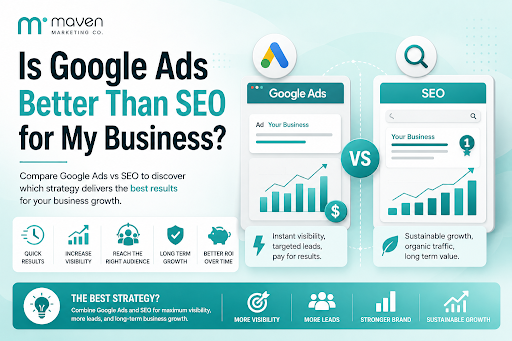
Is Google Ads Better Than SEO for My Business
One of the biggest questions business owners ask when they are planning online growth is whether they should invest in Google Ads or SEO. Both are strong marketing plays that help your company show up in Google search results, but they do things in separate lanes. Google Ads gives quicker visibility and can bring in leads fast, whereas SEO more or less focuses on slow, steady organic traffic that tends to grow the longer you keep building it. Picking the right direction depends on what you want to achieve, how much money you can spend, how crowded the market is, and how quickly you need results, like sooner rather than later. The good news is you don’t always have to choose one or the other; it’s not exactly a black-and-white situation. If you take time to understand the strongest points of both, you can put together a more sensible digital marketing plan that supports consistent expansion. In this guide, we’ll compare Google Ads vs SEO, explain the main differences, and help you figure out what option makes the most sense for your business.

When Should I Hire a Digital Marketing Agency
Growing a business today takes more than just having a website or throwing a post on social media; customers usually search around online, compare providers, skim reviews, and basically expect the brand to show up with a solid digital presence before they even think about buying. Many businesses try to run their marketing themselves, but there comes a point when “doing it all in-house” becomes clunky and hard to manage, all at once. Knowing when to hire a digital marketing agency can end up making a big, real difference for your growth. If you’re not getting enough leads, or your online visibility feels stuck, or sales are just not moving, the right agency can bring the know-how, plus a clear plan, to help you get noticeably better outcomes. In this guide, we’ll dig into what a digital marketing agency actually does, the usual signs it’s time to bring one on, and how picking the right marketing partner can help your business move forward at a faster pace.
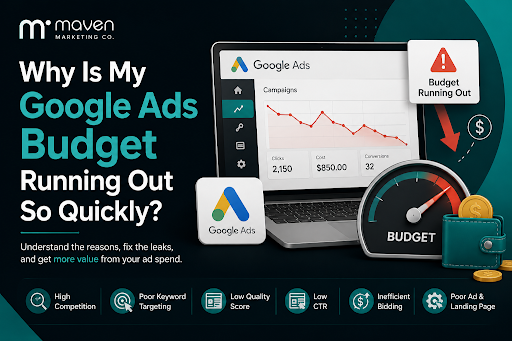
Why Is My Google Ads Budget Running Out So Quickly
Running a successful Google Ads budget isn’t only about throwing more money at it. It’s more like making every dollar, doing a bit extra. A lot of businesses start a Google Ads campaign with big hopes, then find out their daily budget is gone within a few hours, and that feels weird, right? After that, your ads stop showing effectively, new leads slip away, and your return on investment dips. So if your Google Ads budget is running out too fast, don’t stress. It’s a fairly common issue, and in most situations, it can be repaired with the right approach. There are multiple little things that can drain your advertising money quicker than you expected, from costly keywords to audience targeting that just doesn’t quite fit. In this guide, we’ll walk through why your budget disappears so quickly, how to cut wasteful spend, and the most reliable ways to boost your Google Ads ROI, even if your budget stays the same.