.svg)


%201.svg)

Key Takeaways
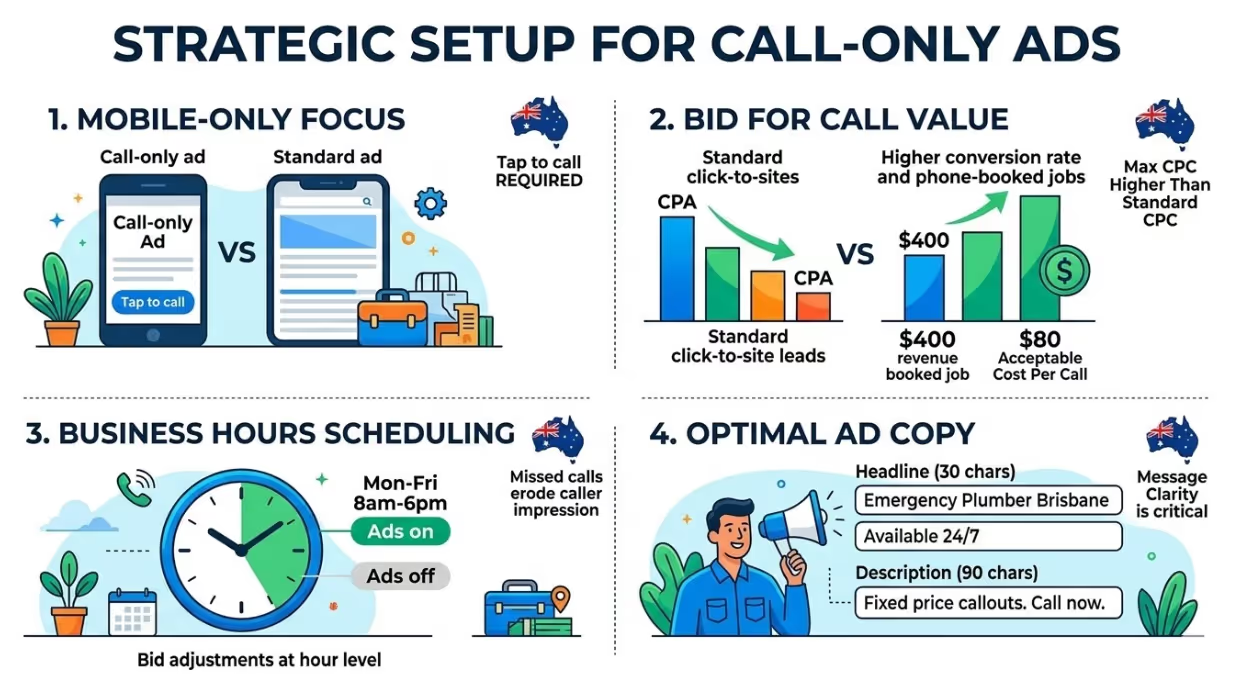
- Call-only ads appear exclusively on mobile devices because they require the searcher to tap to call. They should not be confused with call extensions on standard search ads, which add a phone number to a regular text ad but do not make calling the only available action.
- The headline and description lines in a call-only ad must make the case for calling in the available characters. There is no landing page to complete the persuasion, so the ad copy must achieve message clarity, credibility, and a call to action within the constraints of the ad format.
- Bid strategy for call-only campaigns should be based on the commercial value of a phone call to the business, not on the same target CPA used for form-based campaigns. Phone calls typically convert to booked jobs at a higher rate than website leads, which justifies a higher maximum CPC than would be appropriate for a click that lands on a website.
- Business hours targeting is particularly important for call-only campaigns because a call-only ad that generates a call outside business hours produces a missed call rather than a lead. Scheduling the campaign to serve only during hours when calls can be answered prevents the waste of ad spend on calls that nobody picks up.
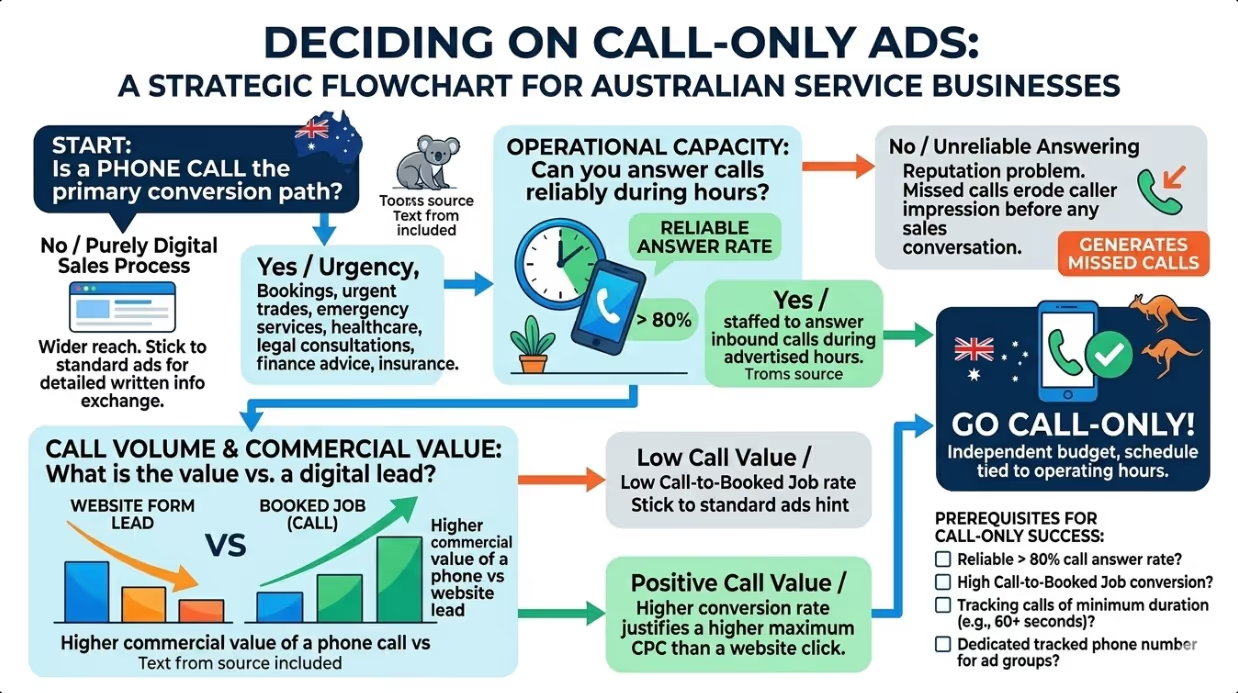
- Call duration filtering in conversion tracking allows the campaign to count only calls of a minimum length as conversions, filtering out accidental calls, wrong numbers, and very brief contacts that do not represent genuine enquiries.
- A dedicated tracked phone number for each call-only campaign or ad group allows performance to be assessed at the campaign level rather than relying on Google's reported call impressions and click data alone.
- Call-only campaigns and standard text campaigns can run simultaneously on the same keywords, with the call-only campaign targeting mobile devices and the standard campaign targeting desktop and tablet, allowing the account to serve the most appropriate ad format to each device type.
When Call-Only Campaigns Are the Right Choice
Call-only campaigns are not appropriate for every service business. The decision to invest in call-only campaigns is driven by the business's sales process, operational capacity to handle inbound calls, and the commercial value of a phone lead relative to a digital lead.
Call-only campaigns are the strongest fit for businesses where the conversion path genuinely requires a phone call: emergency services, healthcare bookings, legal consultations, real estate enquiries, trade services with urgent demand, financial advice, insurance, and any service where the prospect has a question that cannot be resolved through a website but that a phone conversation of two minutes addresses directly.
They are a weaker fit for businesses with a purely digital sales process, those whose service requires extensive written information exchange before a conversation is appropriate, or those without the staffing to answer inbound calls reliably during business hours. A call-only ad that generates calls nobody answers is not a lead generation campaign. It is a reputation problem.
The operational prerequisite for a call-only campaign is a reliable answer rate during the hours the campaign runs. If the business answers fewer than 80 percent of calls during its advertised hours, the call-only campaign will generate missed calls that erode the caller's impression of the business before any sales conversation has occurred.
Setting Up Call-Only Campaigns
Campaign Structure
Call-only campaigns should be structured as separate campaigns from standard text campaigns for the same keywords, rather than mixing call-only and standard ads within the same campaign. Separate campaigns provide independent budget control, independent bid strategies, and independent scheduling, which is essential because call-only campaigns require scheduling tied to operating hours that standard campaigns may not need.
The campaign type should be set to Search, with the "Phone calls" objective selected during setup. This ensures that Google's ad serving system treats the campaign's goal as call generation rather than website traffic.
Ad groups within the call-only campaign should follow the same thematic organisation as the corresponding standard search campaigns: grouping keywords by intent and service category, with ad copy specific to each group's theme. A plumbing business might have separate ad groups for emergency plumbing, blocked drains, hot water systems, and general plumbing in each geographic area, with call-only ad copy in each group that speaks to the specific service intent.
Keyword Strategy
The keyword strategy for call-only campaigns should focus on queries showing strong intent and readiness to act where the searcher's immediate next step is genuinely to call a business. These include queries with explicit urgency signals ("emergency plumber near me," "broken pipe plumber now"), queries with explicit intent to book ("book a plumber today," "plumber available this week"), and queries from searchers who are clearly past the research phase and ready to engage a provider.
Generic informational queries ("how much does a plumber cost," "what causes blocked drains") are less appropriate for call-only campaigns because the searcher behind them is likely in research mode rather than ready to call. These queries may be better served by standard text ads that direct traffic to an informative landing page.
Exact match and phrase match keywords are the most appropriate match types for call-only campaigns because the higher intent required to justify a call warrants tighter query control. Broad match in call-only campaigns can generate calls from queries that do not match the searcher's intent tightly enough to produce quality calls.
Ad Copy
Call-only ad copy has two headline fields of 30 characters each and two description fields of 90 characters each, plus the phone number field and the business name. Every character must work toward convincing a mobile searcher to tap and call right now rather than tapping back to examine other results.
The first headline should identify the service and the location or geographic coverage clearly: "Emergency Plumber Brisbane" or "Sydney Conveyancing Solicitors." The second headline should provide the strongest available credibility or availability signal: "Available 24/7" or "Same-Day Appointments" or "30 Years Experience."
The description lines should address the two most common objections or hesitations a caller in this category might have, and deliver them in plain, direct language. For an emergency plumber: "Fixed price callouts, no surprises. Our plumbers are available now across Brisbane's northside and southside." For a legal firm: "Free 20 minute initial consultation. We respond to all enquiries within two hours."
The call to action is implicit in the ad format itself (the searcher taps to call), but including a specific prompt in the description such as "Call now for a free quote" reinforces the intended action and sets the expectation for what the call will involve.
Bidding Strategy for Call-Only Campaigns
The bid strategy decision for call-only campaigns is more consequential than for standard search campaigns because the call intent signal is stronger. A searcher who taps a call-only ad is further along the decision process than a searcher who clicks a text ad to visit a website. The conversion rate from tap to call to booked job is typically higher than from click to website to submitted form.
For call-only campaigns with sufficient call volume (a minimum of 20 to 30 calls per month as a rough threshold), Target CPA bidding with the target set to the acceptable cost per call is an appropriate strategy. The CPA target should reflect the commercial value of a phone call rather than the CPA target used for website form submissions if they are different. If a booked job from a phone call is worth $400 to $500 in revenue and the business accepts a 20 percent cost of sale, the acceptable cost per call is $80 to $100, which may be substantially higher than the acceptable cost per web form submission.
For new campaigns without sufficient call history, Maximise Conversions is the appropriate starting strategy, set with a budget constraint that prevents overspend during the data collection period. Once 20 to 30 calls have been tracked, the strategy can transition to Target CPA with a target based on the actual average CPA from the data collection period.
Manual bidding with Enhanced CPC is an alternative for campaigns where the account manager wants to maintain direct control over maximum CPCs, particularly in geographic areas or service categories where call intent and call value differ significantly across query types within the same campaign.
Scheduling and Geographic Targeting
Business Hours Scheduling
The most important targeting decision for call-only campaigns is the schedule. Call-only ads should serve only during hours when phones are answered and calls can be responded to with the promptness the format implies. For most Australian service businesses, this means the campaign should be paused outside of business hours, with the specific schedule reflecting the actual answering hours for the business.
For businesses offering genuine out-of-hours availability, such as emergency services or 24-hour providers, call-only campaigns can run continuously, and the ad copy should explicitly communicate this availability to justify the out-of-hours ad spend.
For businesses that are closed on weekends or public holidays, the campaign schedule should reflect these closures. Running a call-only campaign on a public holiday when nobody is available to answer the phone generates missed calls, negative caller impressions, and wasted budget simultaneously.
In Google Ads, bid adjustments can be applied at the hour and day level to increase bids during peak demand periods and reduce bids during quieter periods, without fully pausing the campaign. For a business open Monday to Friday from 8am to 6pm, applying higher bids during the periods of highest search demand, typically mornings and afternoons, extracts more value from the most commercially productive parts of the day.
Geographic Targeting
Call-only campaigns for local service businesses should be targeted tightly to the actual service area rather than broadly to the city or state. A plumber based in Paddington who services the inner Brisbane area should target the specific suburbs in their service area rather than all of Brisbane, because a call from a suburb an hour outside the service area produces a call the business cannot convert rather than one it can.
For businesses with multiple service areas or multiple locations, separate campaigns or ad groups with copy specific to each location and service area targeting prevent the account from mixing geographic signals and producing calls from outside the serviceable areas.
Call Tracking and Conversion Measurement
Google Ads Call Reporting
Google Ads provides call reporting for call-only campaigns that shows the number of calls generated, the call duration, whether the call was connected, and the start time of the call. This data is available at the campaign, ad group, keyword, and ad level, providing the granular attribution needed to assess which queries, ad groups, and times of day are generating the most valuable calls.
Call duration is the most important indicator of call quality available within Google Ads reporting. Calls under 30 seconds almost always represent wrong numbers, accidental taps, or calls that were not answered. Calls over two minutes typically represent genuine conversations with prospective customers. Filtering the conversion event to count only calls above a minimum duration threshold produces a conversion signal that reflects genuine lead quality rather than raw call volume.
Conversion Tracking Setup
Call-only conversion tracking in Google Ads requires configuring a conversion action of type "Phone calls from ads." The minimum call duration for the conversion to be counted should be set based on the typical length of a qualifying conversation for the business. For a trade service booking call, 60 seconds is a reasonable minimum. For a legal consultation enquiry, 90 to 120 seconds may be more appropriate.
The call conversion action should be imported into the Smart Bidding strategy if Target CPA or Target ROAS bidding is used, so the bidding algorithm uses call conversions rather than or alongside other conversion types to set bids.
Third-Party Call Tracking
For businesses that want call tracking data beyond what Google Ads provides, integrating a call tracking platform from a third party such as CallRail, Delacon, or Nimbata with the Google Ads call-only campaign provides additional capabilities: call recording for quality assessment and training, caller ID and geographic origin data, integration with CRM systems, and the ability to assess the outcome of calls (booked, not booked, wrong area, a follow-up call required) rather than just the call duration.
Call tracking from a third party requires the use of a tracked number in the ad rather than the business's direct number. This number forwards to the business line while recording the call data. The tracked number should be consistent with the business's actual phone number format to maintain caller confidence.
FAQs
How do call-only campaigns differ from adding call extensions to standard text ads?
Call extensions on standard text ads add a phone number below the text ad, giving the searcher the option to call or to click through to the website. The phone number in a call extension is an additional option alongside the primary website link. A call-only ad replaces the website link entirely with a button that triggers a tap to call, so calling is the only action available to the searcher. The practical implication is that call-only ads produce only calls, no website clicks, while standard ads with call extensions produce a mix of calls and website visits. For businesses where calls are significantly more valuable than website visits, running a dedicated call-only campaign extracts more call volume from the available budget than relying on call extensions on standard ads, because the entire ad impression is devoted to generating a call rather than splitting the user's choice between two conversion paths.
What call volume is required before call-only campaigns can use smart bidding effectively in Australia?
The minimum call volume for smart bidding to function reliably in call-only campaigns is approximately 20 to 30 conversions per month within the campaign. In the Australian market, where CPC levels are generally lower than in the US or UK for most service categories, achieving this volume may require a daily budget of $30 to $80 depending on the service category and geographic area. Categories with high average CPCs, such as legal, financial, and insurance, may require higher budgets to generate sufficient call volume for smart bidding within a reasonable timeframe. For campaigns that cannot reach 20 to 30 calls per month due to budget or market size constraints, Maximise Conversions without a CPA target is the appropriate bidding approach, and smart bidding with a CPA target should be deferred until the volume threshold is met.
Can call-only campaigns run simultaneously with standard text campaigns on the same keywords without one cannibalising the other?
Call-only and standard text campaigns can run on the same keywords, and with correct device targeting they serve complementary rather than competing roles. Call-only ads serve only on mobile devices and drive calls. Standard text ads can be targeted to desktop and tablet, driving website traffic on those devices. On mobile devices, both ad types may enter the same auction, but the different conversion actions they optimise toward mean they typically serve different segments of mobile searchers rather than directly competing. The recommended approach is to run standard text ads across all devices and a separate call-only campaign targeted to mobile-only, with a device bid adjustment applied to the standard campaign that reduces mobile bids to minimise overlap. This structure gives the call-only campaign priority for mobile traffic while preserving standard ad coverage on desktop and tablet.
Calls Are the Shortest Path Between Intent and Revenue
For Australian service businesses where a phone call is the beginning of the sales process rather than a step within it, call-only campaigns are among the most commercially direct PPC formats available. They meet the searcher at the moment of highest intent, remove the friction of a landing page and a form, and connect the business to a prospective customer who has already committed to making contact. Managed with the right scheduling, targeting, bidding, and tracking, a call-only campaign that is well structured converts budget into booked jobs with an efficiency that standard text campaigns, for these business types, consistently struggle to match.
Maven Marketing Co sets up and manages call-only campaigns for Australian service businesses, including call tracking integration, smart bidding configuration, and performance analysis.
Talk to the team at Maven Marketing Co →

Table of contents
read more blogs
Is Google Ads Better Than SEO for My Business
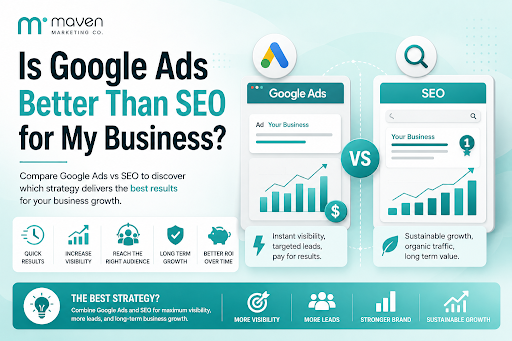
One of the biggest questions business owners ask when they are planning online growth is whether they should invest in Google Ads or SEO. Both are strong marketing plays that help your company show up in Google search results, but they do things in separate lanes. Google Ads gives quicker visibility and can bring in leads fast, whereas SEO more or less focuses on slow, steady organic traffic that tends to grow the longer you keep building it. Picking the right direction depends on what you want to achieve, how much money you can spend, how crowded the market is, and how quickly you need results, like sooner rather than later. The good news is you don’t always have to choose one or the other; it’s not exactly a black-and-white situation. If you take time to understand the strongest points of both, you can put together a more sensible digital marketing plan that supports consistent expansion. In this guide, we’ll compare Google Ads vs SEO, explain the main differences, and help you figure out what option makes the most sense for your business.

When Should I Hire a Digital Marketing Agency
Growing a business today takes more than just having a website or throwing a post on social media; customers usually search around online, compare providers, skim reviews, and basically expect the brand to show up with a solid digital presence before they even think about buying. Many businesses try to run their marketing themselves, but there comes a point when “doing it all in-house” becomes clunky and hard to manage, all at once. Knowing when to hire a digital marketing agency can end up making a big, real difference for your growth. If you’re not getting enough leads, or your online visibility feels stuck, or sales are just not moving, the right agency can bring the know-how, plus a clear plan, to help you get noticeably better outcomes. In this guide, we’ll dig into what a digital marketing agency actually does, the usual signs it’s time to bring one on, and how picking the right marketing partner can help your business move forward at a faster pace.
Why Is My Google Ads Budget Running Out So Quickly
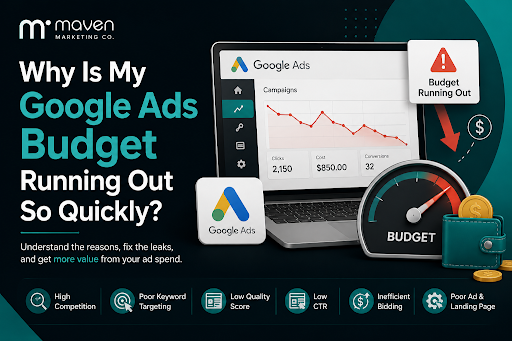
Running a successful Google Ads budget isn’t only about throwing more money at it. It’s more like making every dollar, doing a bit extra. A lot of businesses start a Google Ads campaign with big hopes, then find out their daily budget is gone within a few hours, and that feels weird, right? After that, your ads stop showing effectively, new leads slip away, and your return on investment dips. So if your Google Ads budget is running out too fast, don’t stress. It’s a fairly common issue, and in most situations, it can be repaired with the right approach. There are multiple little things that can drain your advertising money quicker than you expected, from costly keywords to audience targeting that just doesn’t quite fit. In this guide, we’ll walk through why your budget disappears so quickly, how to cut wasteful spend, and the most reliable ways to boost your Google Ads ROI, even if your budget stays the same.