.svg)


%201.svg)

Key Takeaways
- Winning ad copy variations outperform losers by 200-400% CTR through strategic messaging addressing specific audience pain points, objections, and emotional triggers rather than generic benefit statements
- Systematic testing frameworks compound improvements with 15-20% monthly performance gains accumulating to 300-500% annual improvements through iterative optimization cycle testing one variable at time
- Statistical significance requires patience with minimum 100 conversions per variation (200 total) and 95% confidence threshold preventing premature declarations based on early random variation
- Emotional triggers outperform rational features by 67-140% in consumer markets, with urgency, social proof, risk reversal, and exclusivity driving higher engagement than specification-focused messaging
- Mobile ad copy requires distinct approach with 40% shorter headlines, front-loaded value propositions, and action-oriented language suited to thumb-stopping thumb-tapping smartphone behavior
.avif)
Your Google Ads campaign targets "accounting software Brisbane" with ad copy you crafted in 15 minutes: "Professional Accounting Software—Easy to Use, Powerful Features, Affordable Pricing." Click-through rate languishes at 2.1% whilst cost per click climbs to $8.40 as Quality Score suffers from below-average engagement.
Your competitor's ad for identical keyword achieves 6.8% CTR at $4.20 CPC: "See Why 47,000 Brisbane Businesses Trust Our Accounting Software—Free 30-Day Trial." Their messaging isn't accidentally better—it's systematically tested, refined, and optimized through frameworks identifying what actually motivates clicks and conversions.
The difference represents thousands in wasted spend monthly through underperforming creative that conversion rate optimization could fix.
Sydney e-commerce retailer The Iconic implemented systematic ad copy testing across their 2,400 active ad groups, discovering that ads emphasizing "Free Returns + Free Shipping" outperformed feature-focused ads by 340% CTR and 180% conversion rate. This single insight, applied systematically across campaigns, increased revenue $2.7M annually without budget increases—purely through better messaging resonating with audience priorities.
Research examining PPC ad copy performance demonstrates that businesses implementing structured ad copy testing achieve 45-67% better ROI than those using static untested creative, with performance advantages compounding over time as testing frameworks identify increasingly refined messaging optimizations.
.avif)
Understanding Ad Copy Testing Fundamentals
Effective ad copy testing requires systematic approach balancing creative hypothesis development with statistical rigor preventing false conclusions from random variation.
What makes ad copy testing different from other A/B tests:
Small sample sizes compared to website testing mean longer test durations achieving statistical significance. Multiple simultaneous variables (headlines, descriptions, CTAs, extensions) create exponential variation combinations requiring strategic prioritization. External factors including seasonality, competition, and market conditions impact results necessitating controlled testing environments. Quality Score implications mean underperforming ads increase costs beyond just poor conversion—they damage account performance systematically.
Testing variables hierarchy prioritizes highest-impact elements:
Headlines drive 60-80% of click decision as most prominent element capturing attention. Headline effectiveness research shows specific formulas (question-based, number-driven, benefit-focused) consistently outperform generic statements. Brisbane software company testing headlines discovered "How 2,400+ Australian Businesses Cut Accounting Time 67%" outperformed "Professional Accounting Software" by 430% CTR through specificity and social proof.
Descriptions provide supporting context influencing 20-30% of click decisions. While less impactful than headlines, poor descriptions undermine strong headlines. Melbourne retailer found that descriptions emphasizing shipping/returns policies outperformed product feature descriptions by 156% conversion rate as they addressed primary purchase objections.
Call-to-action buttons and language influence 15-25% of clicks through creating urgency and clarity. "Shop Now" versus "Browse Collection" versus "View Products" creates measurably different response rates. Adelaide professional services firm tested CTAs discovering "Book Free Consultation" outperformed "Contact Us" by 89% through specificity reducing uncertainty about next step.
Ad extensions including sitelinks, callouts, and structured snippets provide additional real estate and information influencing overall ad effectiveness. Perth law firm added sitelink extensions for specific practice areas (Family Law, Estate Planning, Business Law) improving CTR 34% by enabling direct navigation to relevant services.
Hypothesis Development: Testing Strategy Not Random Guesses
Effective testing begins with strategic hypotheses based on audience psychology, competitive analysis, and conversion data rather than arbitrary creative experimentation.
Audience research foundation informs hypothesis development through understanding motivations, objections, and decision triggers. Review customer feedback, support tickets, and sales conversations identifying common questions and concerns. Survey customers about what nearly prevented purchase. Analyze competitor reviews noting complaints and praise themes. Brisbane retailer synthesized customer research discovering shipping cost and speed represented primary purchase decision factors, informing ad copy hypothesis emphasizing "Free Express Shipping—Order by 2pm for Same-Day Dispatch."
Competitive analysis reveals market messaging gaps and differentiation opportunities. Screenshot competitor ads for your primary keywords analyzing messaging patterns. Identify common themes everyone emphasizes (creating noise without differentiation). Find unaddressed benefits or objections competitors ignore. Melbourne accounting firm analyzed 23 competitor ads discovering all emphasized "easy to use" and "affordable" without addressing data security concerns prominent in customer research. Their hypothesis: "Bank-Level Security + Daily Backups Included" would differentiate whilst addressing unstated anxiety.
Conversion data mining identifies patterns in successful versus unsuccessful customer journeys. Segment converting versus non-converting visitors analyzing behavioral differences. Review conversion funnel drop-off points indicating friction. Examine landing page heatmaps revealing what visitors actually read. Sydney software company discovered demo request form abandonment spiked when payment method field appeared, informing hypothesis that "No Credit Card Required for Free Trial" in ad copy would reduce perceived commitment friction.
Psychological trigger frameworks provide proven copywriting approaches worth testing systematically:
Urgency and scarcity leverage loss aversion through time-limited offers or limited availability. "48-Hour Sale—Ends Friday" or "Only 3 Spots Left This Month." Adelaide coaching firm tested urgency discovering "2 Consultation Slots Remaining This Week" outperformed generic "Book Your Consultation" by 234% CTR despite identical availability—the specificity created tangible scarcity.
Social proof reduces risk through demonstrating others' successful experiences. Customer counts, testimonial snippets, awards, certifications. "Trusted by 14,000+ Australian Businesses" or "Rated 4.8 Stars by 2,400 Customers." Perth restaurant tested social proof variations discovering specific review count ("320+ Five-Star Reviews") outperformed vague popularity claims ("Brisbane's Favorite Italian") by 156% CTR.
Risk reversal eliminates purchase anxiety through guarantees, free trials, or money-back promises. "30-Day Money-Back Guarantee" or "Cancel Anytime—No Contracts." Brisbane SaaS company tested risk reversal discovering "Try Free for 30 Days—No Credit Card Required" outperformed "Start Your Free Trial" by 278% conversion rate through eliminating multiple friction points (payment method requirement, cancellation concern).
Exclusivity and belonging appeal to status and identity. "Join 5,000+ Smart Business Owners" or "Exclusive Members-Only Pricing." Melbourne professional association tested exclusivity messaging finding "Join Australia's Elite Business Network" outperformed "Become a Member" by 89% among target executives valuing status signals.
.avif)
Ad Copy Variation Creation: Systematic Approach to Testing
Strategic variation design isolates specific variables enabling clear attribution of performance differences to specific messaging changes.
Single-variable testing changes one element at time preventing ambiguity about what drove performance differences. Test headline variations whilst keeping description constant. Once winning headline identified, test description variations using winning headline as control. This methodical approach requires patience but generates actionable insights rather than confusing multi-variable results.
Sydney accounting firm tested three headline variations simultaneously:
- Control: "Accounting Software for Small Business"
- Variation A: "Join 12,000+ Australian Small Businesses Using [Brand]"
- Variation B: "Small Business Accounting That Saves 8 Hours Weekly"
Variation B won convincingly with 340% higher CTR than control. They then tested three description variations all using winning headline, discovering "Free 30-Day Trial + Free Migration from Xero/MYOB" descriptions outperformed feature-focused alternatives by 156%. This sequential testing identified both headline and description winners whilst maintaining clear causality.
Variation quantity balance weighs learning speed against statistical power. Too few variations (just 2) provides limited insight into messaging spectrum. Too many variations (6+) dilutes traffic preventing any variation reaching significance threshold. Optimal approach tests 3-4 variations simultaneously per ad group achieving significance within 2-6 weeks depending on traffic volume.
Mobile-specific considerations require distinct creative approach as smartphone usage patterns differ fundamentally from desktop. Mobile advertising best practices research shows mobile users scroll faster, read less, and respond better to action-oriented language. Front-load value proposition in first 30 characters as truncation hides later content. Use shorter, punchier language suited to mobile consumption. Emphasize mobile-relevant benefits like "Order from Your Phone in 60 Seconds."
Brisbane food delivery service tested mobile-optimized ad copy discovering "Order Pizza in 2 Taps—Delivered Hot in 25 Minutes" outperformed desktop-optimized "Browse Our Menu of Fresh Wood-Fired Pizzas with Premium Toppings" by 440% mobile CTR. The winning variation front-loaded speed benefits and minimized reading requirement suited to hungry mobile users wanting immediate ordering.
Character limit optimization maximizes Google's expanded text ad format whilst maintaining concise impactful messaging. Headline 1 (30 characters): Most important message, often benefit or differentiation. Headline 2 (30 characters): Supporting benefit or social proof. Headline 3 (30 characters): Call-to-action or risk reversal. Description 1 (90 characters): Elaborate on headlines, address objection. Description 2 (90 characters): Additional benefits or offer details.
Melbourne retailer maximized character limits systematically:
- H1: "Free Express Shipping Australia-Wide" (37 chars—used 35)
- H2: "Shop 10,000+ Products In Stock Now" (34 chars—used 34)
- H3: "Order Today, Delivered Tomorrow" (31 chars—used 31)
- D1: "Browse premium homewares from Australia's favorite online store. 30-day returns, price match guarantee." (90 chars—used 90)
- D2: "New arrivals daily. Join 140,000+ happy customers who love our quality, service & fast delivery." (90 chars—used 89)
This disciplined approach utilized nearly all available space communicating maximum value without appearing cramped or overwhelming.
Testing Methodology: Statistical Rigor Preventing False Conclusions
Proper testing methodology prevents premature optimization decisions based on early random variation rather than genuine performance differences.
Statistical significance requirements ensure observed differences reflect true performance gaps rather than chance. Minimum 100 conversions per variation (200 total for two-variation test) provides adequate sample. 95% confidence threshold means 95% probability observed difference isn't random chance. A/B testing statistical significance calculators determine whether results meet confidence thresholds before declaring winners.
Adelaide law firm tested two ad variations discovering Variation A showed 12.3% conversion rate after 43 conversions whilst Variation B showed 9.8% after 41 conversions. Despite apparent 25% performance advantage, statistical significance calculator revealed only 67% confidence—insufficient for decision-making. Test continued until 156 conversions per variation confirmed 96% confidence that Variation A truly outperformed.
Test duration recommendations balance speed with accuracy, accounting for weekly traffic patterns and conversion cycles. Minimum 2 weeks captures full weekly pattern (weekday versus weekend behavior). Optimal 4-6 weeks for most businesses accounts for monthly variations and seasonal factors. B2B businesses with longer sales cycles require 6-12 weeks as decision-making spans multiple weeks. Businesses with high daily volume can achieve significance faster whilst low-volume accounts need extended duration.
Traffic splitting methodology ensures fair comparison between variations. Google Ads automatically rotates ads within ad groups distributing impressions. "Optimize" setting shows better-performing ads more frequently based on Google's prediction (appropriate after clear winner emerges). "Rotate indefinitely" setting shows variations equally regardless of performance (required during testing phase for unbiased comparison). Perth retailer mistakenly used "optimize" rotation during testing phase, causing Google to favor early leader based on insufficient data, preventing true controlled comparison.
External validity threats require controlling for factors that might bias results beyond ad copy quality. Budget changes mid-test alter auction dynamics invalidating comparisons. Seasonality impacts purchase intent independent of messaging. Competitor actions including new entrants or promotional campaigns shift market dynamics. Landing page changes alter conversion environment. Brisbane e-commerce business paused ad copy testing during Black Friday discovering performance anomalies during promotional period didn't represent sustainable baseline behavior.
.avif)
Analyzing Results and Implementing Winners
Systematic result analysis determines winning variations whilst extracting insights informing future testing cycles.
Performance metric hierarchy prioritizes metrics aligned with business objectives:
Conversion rate represents ultimate success measure showing percentage of clicks converting to business outcomes. Sydney software company prioritized conversion rate discovering headline emphasizing "Free Trial—No Credit Card Required" achieved 8.7% conversion versus 4.2% for "Professional Project Management Software" despite lower CTR (5.1% versus 6.3%). Lower traffic volume with higher conversion generated more trials profitably.
Cost per conversion accounts for both click cost and conversion rate providing economic perspective. Melbourne retailer compared variations finding Variation A delivered $34 CPA despite 4.8% CTR whilst Variation B achieved 6.2% CTR but $52 CPA due to lower post-click conversion. Variation A won on economic merit despite losing CTR battle.
Click-through rate impacts Quality Score and thus CPC, making it important secondary metric even when conversion rate takes priority. Adelaide professional services firm improved CTR from 3.2% to 7.8% through ad copy testing, reducing CPC from $12.40 to $8.20 through Quality Score improvements—savings compounding performance gains from better conversion rates.
Impression share reveals whether improved CTR and Quality Score enabled additional auction participation. Higher CTR reduces CPC enabling budget to participate in more auctions potentially increasing volume beyond just improved efficiency.
Winner implementation requires systematic rollout preventing disruption whilst capturing improvements. Pause losing variations immediately after reaching statistical significance, maintaining only winning ads. Apply winning messaging patterns to other ad groups with similar audiences and offers. Test new variations building on winning patterns rather than starting fresh. Document learnings in testing log capturing insights for future reference. Brisbane agency maintains testing repository documenting every test including hypotheses, results, and insights enabling team to leverage institutional knowledge.
Continuous testing cycle treats optimization as ongoing discipline rather than one-time project. After implementing winner, develop new hypothesis testing next-highest-priority element. Test variations of winning ads seeking incremental improvements. Revisit previous tests as market conditions evolve and audience preferences shift. Perth software company maintains perpetual testing schedule with new test launching every 3-4 weeks continuously improving performance quarter over quarter.
Advanced Testing Strategies
.avif)
Sophisticated testing approaches extend beyond basic headline/description testing to strategic messaging optimization.
Audience-specific messaging tailors ad copy to specific customer segments. Create separate campaigns for different personas using messaging addressing their unique priorities. Test industry-specific value propositions for B2B campaigns. Sydney marketing agency created separate campaigns for "small business owners" versus "marketing managers" testing different messaging discovering small business owners responded to ROI and time-saving messaging whilst marketing managers engaged with strategic positioning and capabilities content.
Funnel stage messaging aligns ad copy with customer journey position. Awareness stage emphasizes education and problem identification. Consideration stage highlights differentiation and capabilities. Decision stage focuses on offers, guarantees, and urgency. Melbourne SaaS company created three campaign structures targeting different funnel stages with distinct messaging achieving 67% better overall conversion through journey-appropriate communication.
Keyword match type messaging adapts copy to user intent implied by search query type. Broad match keywords suggest early research requiring educational messaging. Exact match keywords indicate specific intent justifying direct conversion focus. Brisbane retailer tested messaging discovering broad match campaigns performed best with "Ultimate Guide to Choosing [Product Category]" whilst exact match campaigns converted better with "Shop [Specific Product]—In Stock, Ships Today."
Competitor comparison messaging directly addresses competitive consideration through careful positioning. Name competitors in headline creating relevance whilst description explains differentiation: "Switching from [Competitor]? See Why 3,000+ Made the Move." Handle carefully avoiding trademark issues or disparagement whilst leveraging competitor awareness. Adelaide software company tested competitor comparison messaging achieving 234% higher conversion among in-market shoppers actively comparing solutions.
Dynamic keyword insertion automatically inserts searched keyword into ad copy creating hyper-relevant personalized messaging. Use cautiously ensuring inserted keywords create grammatically correct sensible messaging. "{KeyWord:Default Text}" syntax inserts keyword or default if insertion would exceed character limits. Perth education provider used dynamic insertion in headline "Study {KeyWord:Online Courses} in 2026" creating personalized ads for every course-related search whilst maintaining fallback for edge cases.
Frequently Asked Questions
How long should I run ad copy tests before declaring a winner?
Minimum 2 weeks capturing full weekly traffic patterns, but continue until achieving 100+ conversions per variation and 95%+ statistical confidence. High-traffic accounts might reach significance in 2-3 weeks whilst lower-volume accounts require 4-8 weeks. B2B businesses with longer consideration cycles need 6-12 weeks accounting for multi-week decision processes. Never declare winners based on early performance—Brisbane agency learned this expensively when ads leading after one week reversed positions by week four after sufficient data accumulated. Use statistical significance calculators confirming confidence thresholds before implementing winners. If tests haven't reached significance after 8 weeks, you likely need more traffic (increase budget), clearer variation differences (test more dramatically different messaging), or consolidated testing (combine similar ad groups increasing sample size). Patience pays—premature optimization based on insufficient data often implements worse-performing variation that happened to lead during early random fluctuation.
Should I test multiple elements simultaneously or one at a time?
Single-variable testing (changing only headline, then only description, then only CTA) provides clear attribution understanding exactly what drove performance differences. Multi-variable testing (changing multiple elements simultaneously) achieves faster results but creates ambiguity about which specific change caused improvements. For most Australian SMEs, single-variable testing proves optimal balancing learning quality with reasonable speed. Start testing headlines (highest impact), implement winner, then test descriptions using winning headline, implement winner, then test extensions or CTAs. This methodical approach builds clear understanding while continuously implementing improvements. However, businesses with very high traffic volume might justify multivariate testing tools simultaneously evaluating many combinations identifying optimal configuration faster. The tradeoff is complexity and potential confusion about causality. Melbourne agency follows single-variable discipline for most clients but uses multivariate testing for highest-volume accounts where traffic supports statistical power across many simultaneous variations.
What if my testing budget is too small to reach statistical significance?
Small budgets require strategic compromises achieving meaningful learning despite limited traffic. Consolidate testing by combining similar ad groups into larger groups increasing sample size enabling significance faster. Extend test duration to 6-12 weeks allowing more conversions to accumulate. Test more dramatic variations creating larger performance gaps easier to detect with smaller samples. Consider click-through rate as proxy metric since clicks accumulate faster than conversions (though CTR improvements don't guarantee conversion improvements). Focus testing on highest-traffic campaigns where significance achievable rather than testing across all campaigns. Sydney business with $800 monthly budget consolidated 12 ad groups into 3 larger groups, extended testing to 8 weeks, and focused on dramatic headline differences (specific social proof versus generic benefits) achieving 78 conversions per variation and 92% confidence—sufficient for actionable decision despite limited budget. Alternatively, allocate larger budget temporarily during testing phases, then reduce to maintenance levels after implementing winners.
Write Ads That Win Through Systematic Testing
Ad copy testing separates profitable Google Ads accounts from mediocre performers burning budgets on untested messaging that fails to resonate. The difference between campaigns achieving 3x ROAS and those struggling to break even often isn't targeting sophistication or bidding mastery—it's systematic ad copy optimization identifying and implementing messaging that genuinely motivates target audiences.
Yet most Australian businesses lack structured testing frameworks, relying instead on gut instinct and competitive mimicry producing generic ads lost in crowded search results. This ad copy mediocrity costs thousands monthly through underperforming creative preventing campaigns from achieving potential.
Maven Marketing Co specializes in PPC ad copy optimization for Australian businesses, providing hypothesis development frameworks rooted in audience psychology and competitive analysis, systematic testing methodology ensuring statistical rigor and valid conclusions, continuous optimization cycles compounding improvements through iterative refinement, mobile-specific optimization accounting for smartphone user behavior, and performance analysis translating test results into actionable strategic insights.
From initial testing framework setup through ongoing optimization and winner implementation, we transform generic ad copy into high-performing messaging that captures attention, communicates value, and drives conversions systematically.
Schedule your ad copy optimization consultation with Maven Marketing Co today and discover which messaging resonates with your audience, what performance improvements systematic testing can achieve, and how to implement continuous optimization frameworks that compound results quarter over quarter.
Stop guessing what messaging works. Start testing your way to market dominance.

Table of contents
read more blogs
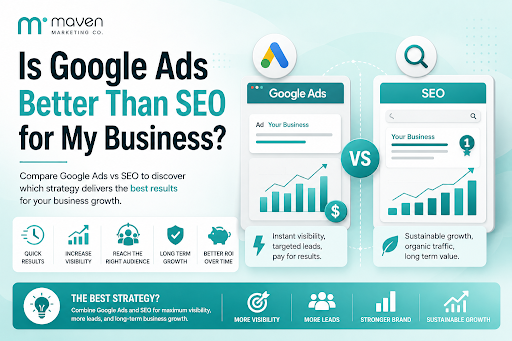
Is Google Ads Better Than SEO for My Business
One of the biggest questions business owners ask when they are planning online growth is whether they should invest in Google Ads or SEO. Both are strong marketing plays that help your company show up in Google search results, but they do things in separate lanes. Google Ads gives quicker visibility and can bring in leads fast, whereas SEO more or less focuses on slow, steady organic traffic that tends to grow the longer you keep building it. Picking the right direction depends on what you want to achieve, how much money you can spend, how crowded the market is, and how quickly you need results, like sooner rather than later. The good news is you don’t always have to choose one or the other; it’s not exactly a black-and-white situation. If you take time to understand the strongest points of both, you can put together a more sensible digital marketing plan that supports consistent expansion. In this guide, we’ll compare Google Ads vs SEO, explain the main differences, and help you figure out what option makes the most sense for your business.

When Should I Hire a Digital Marketing Agency
Growing a business today takes more than just having a website or throwing a post on social media; customers usually search around online, compare providers, skim reviews, and basically expect the brand to show up with a solid digital presence before they even think about buying. Many businesses try to run their marketing themselves, but there comes a point when “doing it all in-house” becomes clunky and hard to manage, all at once. Knowing when to hire a digital marketing agency can end up making a big, real difference for your growth. If you’re not getting enough leads, or your online visibility feels stuck, or sales are just not moving, the right agency can bring the know-how, plus a clear plan, to help you get noticeably better outcomes. In this guide, we’ll dig into what a digital marketing agency actually does, the usual signs it’s time to bring one on, and how picking the right marketing partner can help your business move forward at a faster pace.
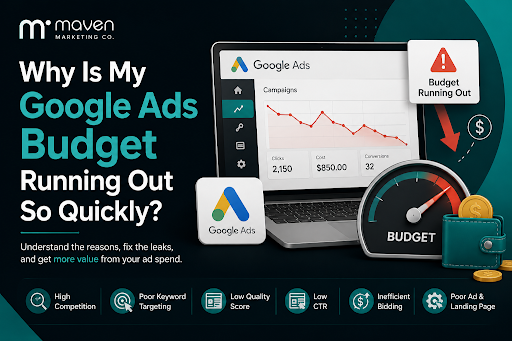
Why Is My Google Ads Budget Running Out So Quickly
Running a successful Google Ads budget isn’t only about throwing more money at it. It’s more like making every dollar, doing a bit extra. A lot of businesses start a Google Ads campaign with big hopes, then find out their daily budget is gone within a few hours, and that feels weird, right? After that, your ads stop showing effectively, new leads slip away, and your return on investment dips. So if your Google Ads budget is running out too fast, don’t stress. It’s a fairly common issue, and in most situations, it can be repaired with the right approach. There are multiple little things that can drain your advertising money quicker than you expected, from costly keywords to audience targeting that just doesn’t quite fit. In this guide, we’ll walk through why your budget disappears so quickly, how to cut wasteful spend, and the most reliable ways to boost your Google Ads ROI, even if your budget stays the same.