.svg)


%201.svg)

Key Takeaways
- YouTube TrueView for Action campaigns are optimised for conversions, not just views or reach, making them a genuine direct response channel.
- The first five seconds of any skippable ad determine whether your audience stays or leaves. Creative strategy must reflect this.
- Smart bidding strategies like Target CPA and Target ROAS require sufficient conversion history before they can optimise effectively.
- Audience targeting on YouTube draws from Google's full data ecosystem, making it one of the richest targeting environments available to Australian marketers.
- Video action campaigns that run across YouTube and Google video partners extend reach significantly without proportional increases in spend.
- Remarketing to users who have already engaged with your YouTube channel or watched your ads is one of the highest performing tactics available within the platform.
- Conversion tracking must be connected directly to Google Ads before launching any action campaign.
Why Video Is No Longer Just a Brand Play
For a long time, the conversation around video advertising followed a predictable script. You ran video to build awareness. You ran search to drive conversions. The two channels lived in separate budget lines, answered to different KPIs, and rarely spoke to each other in any meaningful strategic sense.
That separation made sense when the tools did not exist to close the loop between a video view and a downstream conversion. It makes very little sense now.
YouTube TrueView for Action, which Google has progressively folded into the broader Video Action Campaign framework, is built entirely around measurable response. The format allows advertisers to attach prominent calls to action, headline text, and sitelink extensions directly to their video ads, driving viewers to a landing page, a lead form, or an app download in a single click. The campaign then optimises delivery toward the viewers most likely to convert, drawing on Google's full suite of intent and behavioural signals.
For Australian businesses, this matters because YouTube reaches an enormous proportion of the population. According to Google's own advertising reach data, YouTube reaches more than 17 million Australians every month. That is a substantial addressable audience, and with TrueView for Action, you can move beyond simply reaching them toward actually converting them.
How TrueView for Action Works
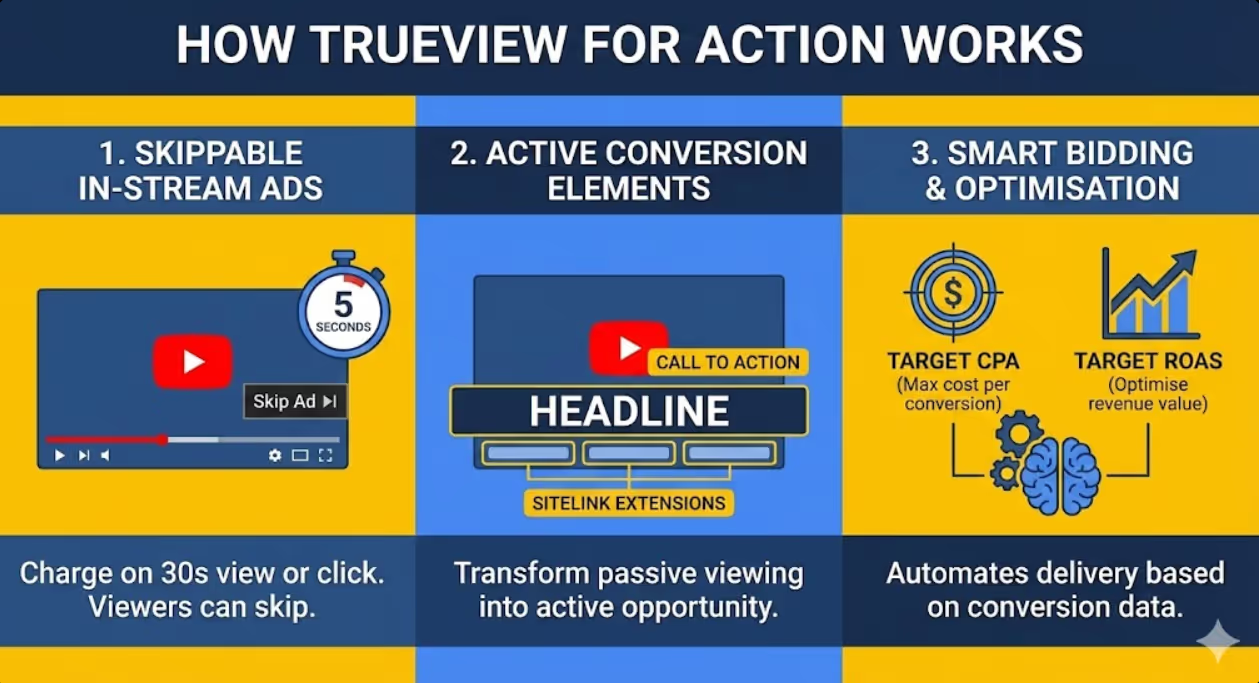
At its core, a TrueView for Action campaign uses skippable instream video ads as the primary creative format. These are the ads that play before or during YouTube content and can be skipped after five seconds. Advertisers are only charged when a viewer watches at least 30 seconds or to the end of the video, or when they click through to the destination URL, whichever comes first.
What distinguishes an Action campaign from a standard video campaign is what surrounds the video itself. A prominent call to action overlay appears on the video throughout playback. A headline sits beneath the video player. Sitelink extensions can direct viewers to multiple relevant pages. These elements transform what would otherwise be a passive viewing experience into an active conversion opportunity.
The campaign uses Smart Bidding to automate where and to whom your ads are served. Target CPA bidding tells the system the maximum you are willing to pay for a conversion, and the algorithm allocates impressions accordingly. Target ROAS bidding goes a step further, optimising not just for conversion volume but for revenue value relative to spend. Both strategies require meaningful conversion data to function well, a point worth returning to in detail.
Google's guidance on Video Action Campaigns confirms that these campaigns can run across YouTube and across Google video partner sites, which are third party apps and websites where Google has the rights to serve video inventory. Enabling video partners alongside YouTube typically extends reach and reduces average CPV (cost per view) without a corresponding drop in conversion performance, making it a worthwhile option for most campaigns.
Setting Up for Conversion: The Technical Foundations
Before the creative discussion begins, the technical foundations need to be solid. A TrueView for Action campaign that is not properly connected to conversion tracking is not an action campaign in any meaningful sense. It is an awareness campaign with delusions of grandeur.
Conversion tracking for YouTube campaigns flows through Google Ads and should be configured to capture the specific actions that represent genuine value to your business. For most advertisers, this means connecting Google Ads to either Google Analytics 4 via a linked property, or directly via a Google Ads tag on the relevant conversion pages. For lead generation campaigns using Google's native lead forms, the form submissions are tracked automatically once the form is connected.
The conversion window matters more than most advertisers realise. Someone who watches a YouTube ad does not always convert immediately. They might watch on their phone during a commute and complete the purchase on their laptop that evening. Setting an appropriate conversion window for views, typically between seven and 30 days depending on your product's decision cycle, ensures those conversions are captured and fed back into the campaign's optimisation engine.
Connected Store visits and offline conversion imports are also worth considering for Australian businesses with physical locations. When a user watches your YouTube ad and subsequently visits your store, that visit can be reported back to your campaign as a conversion. This closes a tracking gap that has historically made it difficult to justify video spend for businesses whose primary conversions happen offline.
Audiences That Convert: Targeting on YouTube
One of the genuine competitive advantages of YouTube advertising over many other video platforms is the depth of audience targeting available. Because YouTube sits within the Google ecosystem, advertisers can layer search intent signals, browsing behaviour, app usage, location data, and demographic information to reach audiences with a specificity that is simply not possible on most alternatives.
For TrueView for Action campaigns, the most valuable audience types for Australian marketers include the following.
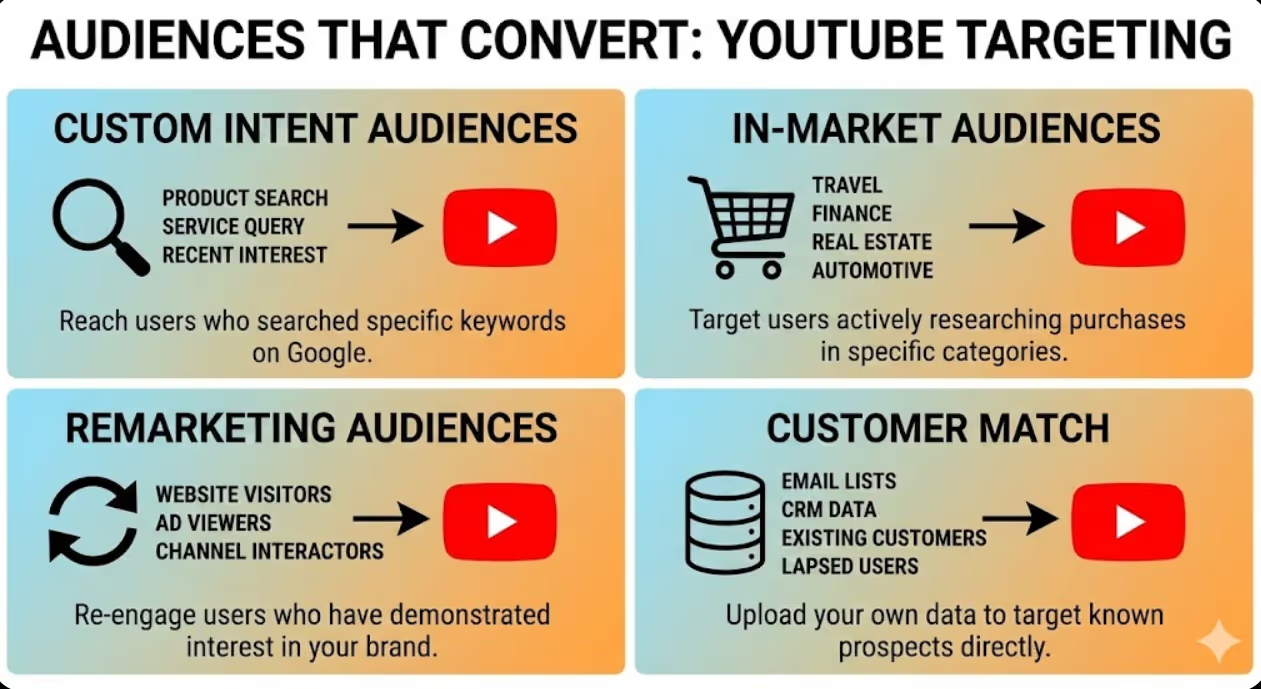
Custom intent audiences built from search terms allow you to reach YouTube users who have recently searched for specific keywords on Google. If someone has been searching for terms related to your product or service in the past week, you can serve them a video ad on YouTube. This is as close to capturing demonstrated purchase intent as video advertising gets.
In market audiences target users whom Google's algorithm has identified as actively researching a purchase in a specific category. The quality of these audiences varies by vertical, but for categories where Google has rich purchase signal data such as travel, finance, real estate, and automotive, they can be remarkably effective.
Remarketing audiences are often where the strongest conversion rates come from. Users who have already visited your website, watched your previous YouTube ads, or interacted with your YouTube channel have already demonstrated an interest in your brand. Serving them a direct response video ad with a compelling offer and a clear call to action consistently outperforms cold audience targeting in cost per conversion terms.
Customer match allows you to upload your own email lists and target existing customers or known prospects directly on YouTube. For Australian businesses with a well maintained CRM, this is a powerful tool for cross sell and upsell campaigns, as well as for bringing lapsed customers back.
Creative That Drives Action: The Five Second Rule and Beyond
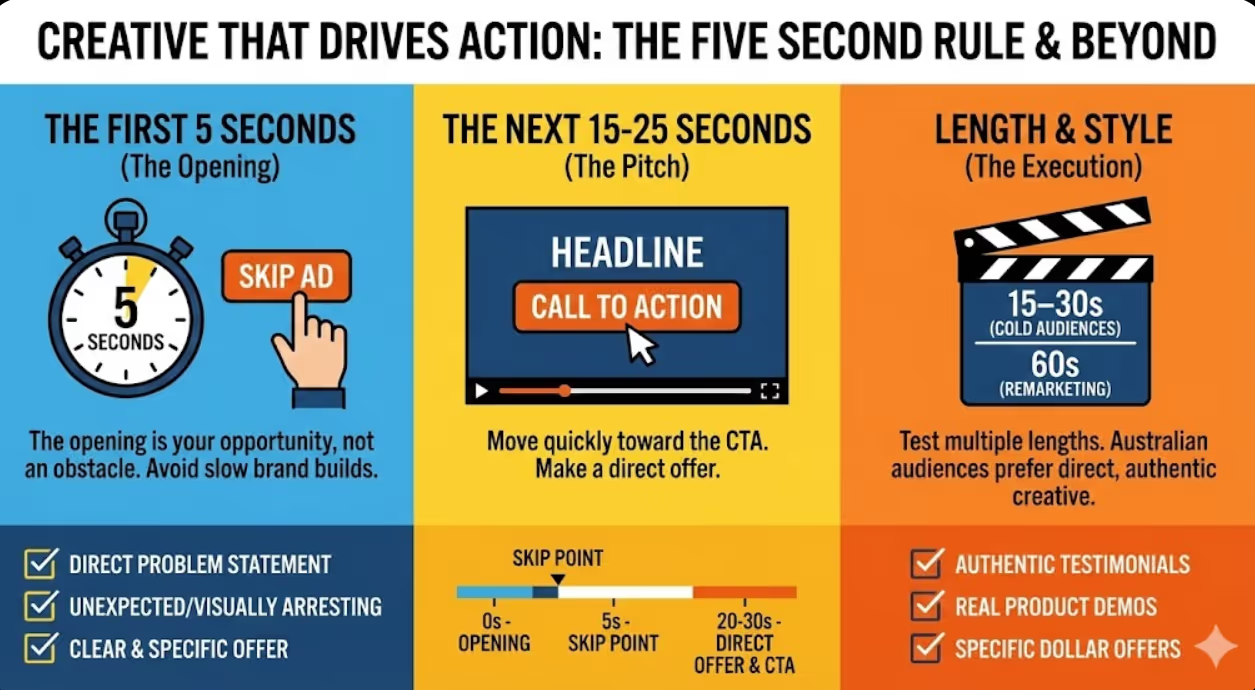
Here is the uncomfortable truth about TrueView for Action creative. The vast majority of viewers will skip your ad the moment they are allowed to. At the five second mark, the skip button appears and most people use it. Your entire direct response strategy has to account for this behavioural reality, not work against it.
The five second window before the skip button appears is not an obstacle. It is your opening. In those five seconds, you need to do enough to earn the next five, and then the five after that. The most effective approaches open with a direct statement of the problem your product solves, an unexpected or visually arresting moment, or a clear and specific offer. What does not work is a slow brand build, a logo hold, or a gentle musical intro. Those formats were designed for broadcast television and they do not translate to an environment where the audience controls the off switch.
For viewers who stay past the skip point, the creative should move quickly toward the call to action. Unlike brand awareness video where you might build narrative across 60 or 90 seconds, a TrueView for Action ad should be making a direct offer and directing the viewer to act within the first 20 to 30 seconds. The call to action overlay and headline text running alongside the video reinforce this, but the video itself carries the primary persuasion load.
Length recommendations for TrueView for Action ads generally sit between 15 and 30 seconds for cold audiences and can extend to 60 seconds for remarketing campaigns where the viewer already has context. Testing multiple lengths within the same campaign is strongly recommended, as performance can vary significantly by audience type and offer.
Australian audiences respond well to direct, plain spoken creative. Advertising that is overly produced or feels too polished can actually underperform against straightforward, problem and solution formats. Authentic testimonials, real product demonstrations, and offers framed in specific dollar terms consistently outperform lifestyle and aspirational formats in direct response video contexts.
Bidding Strategy: Starting Smart and Scaling Sensibly
The bidding conversation for TrueView for Action follows a similar logic to App Campaigns for Action. Smart bidding strategies are where the performance ceiling is highest, but they require data before they function effectively.
For a new campaign with no prior YouTube conversion history, launching with Maximise Conversions bidding rather than Target CPA gives the algorithm freedom to gather the conversion data it needs without the constraint of a CPA target it cannot yet meet. Once the campaign has accumulated at least 30 to 50 conversions, shifting to Target CPA with an initial target set at or slightly above your observed CPA gives the algorithm a realistic target to optimise toward.
Bidding too aggressively from the start is the single most common cause of underperformance in TrueView for Action campaigns. A Target CPA set well below observed performance causes the campaign to underspend, restrict delivery, and generate too few conversions to exit the learning phase. Patience in the early weeks of a campaign almost always pays off in the medium term.
Budget also matters more than many advertisers appreciate. A campaign with a daily budget of $20 running on Target CPA bidding will struggle to accumulate the conversion data it needs. A general rule is that your daily budget should be at least three to five times your target CPA, giving the algorithm enough runway to test and learn within each day's cycle.
Measuring Performance Beyond Views and VTR
View count and view through rate are natural reporting anchors for video campaigns, but for TrueView for Action they are secondary metrics at best. The primary performance indicators that should be driving optimisation decisions are conversion rate from views, cost per conversion, and the downstream revenue or value of those conversions.
Earned actions are worth monitoring closely. These are the additional interactions such as channel subscriptions, likes, and additional video views that result from a single paid ad engagement. High earned action rates indicate that your creative is resonating beyond the paid interaction, which has value both for organic channel growth and as a signal that your audience targeting is well aligned.
Attribution is a genuine complexity for YouTube campaigns. The platform works across the full purchase funnel, and viewers who watch a YouTube ad may convert through a different channel entirely. Data driven attribution models in Google Ads and GA4 give YouTube its appropriate credit in multi touch journeys, whereas last click attribution will systematically undervalue video's contribution. Australian marketers running multi channel campaigns should ensure their attribution model reflects how customers actually move through the funnel rather than defaulting to whatever the platform reports by default.
FAQs
What is the minimum budget needed to run a TrueView for Action campaign effectively in Australia?There is no hard minimum, but campaigns running on Smart Bidding strategies need sufficient budget to accumulate conversion data quickly. A daily budget of at least three to five times your target CPA is a practical starting point. Below this threshold, campaigns often struggle to exit the learning phase and the algorithm cannot optimise effectively. For most Australian advertisers, a realistic starting budget sits somewhere between $50 and $150 per day depending on the target CPA and the competitiveness of the audience.
Can TrueView for Action campaigns work for lead generation as well as ecommerce?Absolutely. Lead generation is one of the strongest use cases for TrueView for Action in Australia, particularly in industries with longer consideration cycles such as financial services, education, home services, and B2B. Google's native lead forms can be attached directly to video ads, allowing viewers to submit their details without leaving YouTube. These forms tend to convert at higher rates than outbound landing pages because they remove the friction of loading an external page.
How is TrueView for Action different from a standard YouTube awareness campaign?A standard awareness campaign such as TrueView for Reach or Bumper Ads is optimised for reach and frequency, serving your ad to as many relevant users as possible at the lowest CPM. TrueView for Action is optimised entirely for downstream conversion events, serving ads to users most likely to take a specific action after viewing. The creative requirements, bidding strategies, measurement frameworks, and audience targeting approaches are fundamentally different between the two objectives.
Ready to Make Your Video Budget Work Harder?
Brand awareness has its place, but if your video advertising is not generating measurable leads, sales, or conversions, you are leaving significant performance on the table. TrueView for Action campaigns give Australian businesses a direct line between video content and commercial outcomes, with the targeting depth and optimisation intelligence to make that line as efficient as possible.
Maven Marketing Co builds and manages performance video campaigns for Australian businesses ready to treat YouTube as the direct response channel it genuinely is.
Talk to the team at Maven Marketing Co →

Table of contents
read more blogs

6 Ways Digital Marketing Can Boost B2B Lead Generation
B2B lead generation is not about filling a CRM with as many names as possible. The real objective is to attract businesses that fit your offer, give the right people a reason to engage and create enough confidence for a genuine sales conversation to start.That distinction matters because B2B buying is usually more targeted than consumer marketing and often involves several people influencing the decision. Current LinkedIn lead-generation guidance makes the same point: more leads do not automatically mean better results if only a small proportion are genuinely relevant or likely to progress.Digital marketing helps by creating multiple paths into the business. Search can capture active demand. Paid media can put an offer in front of a tightly defined audience. Content can build authority before a buyer is ready to talk. Social media can keep the brand visible across a long decision cycle. Your website turns interest into action, while email helps nurture that interest over time.The strongest B2B digital marketing strategies do not treat these as six separate activities. They use them as one connected system designed to generate quality B2B leads, support sales and build a more dependable pipeline
How to Build a Brand Positioning Strategy That Sets Your Business Apart
Most businesses can explain what they sell. Far fewer can explain, in a sentence or two, why the right customer should choose them instead of another credible option. That gap is where brand positioning matters.A strong brand positioning strategy gives your business a clear place in the market and a clear place in the customer's mind. It helps your team decide who you are speaking to, what you want to be known for, which benefits deserve the most attention and how your marketing should sound and look across every channel.It is not a slogan exercise and it is not something reserved for large consumer brands. For an Australian service business, e-commerce brand, professional firm, or growing B2B company, positioning can make everyday decisions easier, from website copy and campaign messaging to pricing, sales conversations, and brand identity. The goal is not to look different for the sake of it. The goal is to be meaningfully different in a way the right customers understand and value.

The Role of Digital PR in Long Term SEO Growth
Building a solid online presence is basically more than just posting content now and then or sprinkling keywords across your website. Search engines such as Google tend to point users toward businesses that feel trustworthy, useful, and backed up by others online, even if it’s not always obvious at first. When a company puts together a well-thought-out digital PR strategy, it can bring in solid media mentions, earning high-quality backlinks and stronger brand awareness, all of which feed long-term SEO progress. Rather than obsessing solely over rankings, digital PR helps you build credibility plus authority, so your site looks more appealing to search engines and also to real people who might become customers. In this guide, we’ll walk through how digital PR supports SEO, what makes it such a key part of modern marketing, and the most effective approaches for sustainable growth in search results.