.svg)


%201.svg)

Key Takeaways
- Platform selection should be driven by the business's operational requirements, not by the agency's or developer's expertise. The strongest recommendation is the one that fits the business, not the one the recommender happens to build in.
- WordPress is the strongest choice for websites with heavy content requirements, service businesses without complex ecommerce requirements, and organisations that need a flexible content management system that can be extended without significant development investment.
- Shopify is the strongest choice for ecommerce businesses whose revenue model is fundamentally product sales, whose inventory and checkout requirements are standard or well within the Shopify ecosystem, and whose team needs to manage the store without ongoing developer dependency.
- Custom development is justified when the business has requirements that neither WordPress nor Shopify can meet without workarounds that compromise performance, maintainability, or the user experience, and when the budget and ongoing technical resources to support a custom codebase are genuinely available.
- The total cost of ownership across a three to five year horizon is the correct frame for comparing platform options, not the initial build cost. A cheaper build on the wrong platform produces higher ongoing costs in plugin conflicts, developer workarounds, and eventual migration than a more expensive build on the right one.
- Migration between platforms is expensive, disruptive, and frequently underestimated. The platform decision made at launch is likely to be in place for three to seven years, making it worth the investment of a systematic assessment before committing.
- Most Australian businesses underestimate their content requirements and overestimate their ecommerce complexity. Honest assessment of both is the foundation of a good platform recommendation.
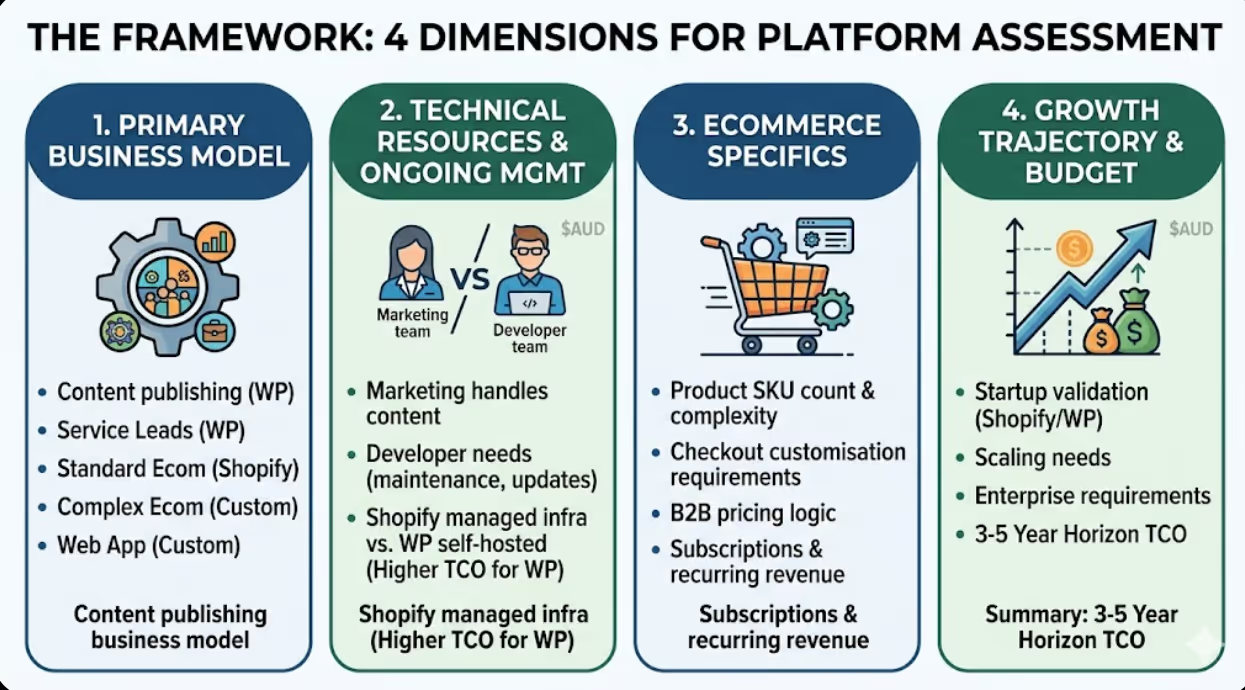
The Framework: Four Assessment Dimensions
The platform recommendation framework assesses the business across four dimensions before any platform is discussed. The answers to the questions in each dimension produce a profile that makes the optimal platform choice clear in most cases, and identifies the genuine genuine trade offs in the cases where it does not.
Dimension 1: Primary Business Model
The primary business model determines which platform family is the appropriate starting point.
Content and information publishing. Businesses whose primary website function is publishing and managing content, including blogs, news, editorial content, knowledge bases, documentation, and information resources, are best served by a content management system built for editorial workflows. WordPress was built specifically for this use case and remains the strongest platform in this category for most Australian businesses.
Service business with enquiry generation. Service businesses whose website is primarily a lead generation and tool for building credibility, with no or minimal ecommerce function, need a platform that excels at presenting service content, managing enquiry forms, integrating with CRM systems, and being updated by a marketing team without technical skills. WordPress with a page builder that is well chosen handles this requirement effectively and without the overhead of an ecommerce platform.
Ecommerce: standard product catalogue. Businesses selling physical or digital products with a reasonably standard checkout process, no custom pricing logic, no complex fulfilment integration, and a catalogue that is manageable within the Shopify ecosystem are well served by Shopify. The platform's merchant ecosystem, its payment processing infrastructure, its inventory management tools, and its theme marketplace make it the most operationally efficient ecommerce platform for standard retail requirements.
Ecommerce: complex requirements. Businesses with complex ecommerce requirements that fall outside Shopify's standard capabilities, including subscription billing with complex tier logic, B2B pricing with pricing specific to each customer, operations across multiple currencies and markets operations beyond Shopify's international commerce features, highly customised checkout flows, or deep integration requirements with bespoke ERP or inventory systems, may require either WooCommerce (WordPress's ecommerce layer) for moderate complexity or a custom build for the most demanding requirements.
Application or platform. Businesses building a product that is fundamentally a web application rather than a marketing website or an ecommerce store, including SaaS products, member portals, booking systems, marketplaces, and other products that function as applications, require custom development. No CMS or ecommerce platform available off the shelf is the correct foundation for an application.
Dimension 2: Technical Resources and Ongoing Management
A platform that the team cannot confidently manage independently creates an ongoing dependency on external development that adds cost and operational friction to every content update, product addition, and marketing campaign.
Technical resources assessment for WordPress. WordPress is manageable by a marketing team without technical skills for standard content operations, including publishing pages and posts, updating images, and managing basic site content. Plugin updates, performance optimisation, security maintenance, and template customisation require either a dedicated developer on staff or a retainer relationship with a WordPress agency. The maintenance overhead of a WordPress site is genuinely higher than Shopify's, and this difference in ongoing operational cost should be factored into the platform comparison.
Technical resources assessment for Shopify. Shopify's managed infrastructure handles server maintenance, security updates, and performance optimisation automatically. A competent marketing team member can manage product catalogue updates, collection management, basic theme customisation, and marketing integrations without developer support. Developer involvement is typically needed for theme customisation beyond the Shopify design editor, for custom functionality not available through the Shopify app store, and for complex integration work. The day-to-day operational independence from developers is one of Shopify's most commercially significant advantages for small to medium Australian businesses.
Technical resources assessment for custom development. A website or application built from scratch requires an ongoing relationship with the development team that built it, either in house or external. Every feature addition, every integration change, and every infrastructure update requires developer involvement. The operational cost of custom development is the highest of any platform option, and this cost is often significantly underestimated by businesses considering a custom build. Australian businesses choosing custom development should have a clear, technical partnership that is long term in place with the development team before the project begins.
Dimension 3: Ecommerce Requirements Specifics
For businesses with any ecommerce function, the specific requirements of the ecommerce operation are the most technically consequential dimension of the platform assessment.
Product catalogue size and complexity. Shopify handles catalogues of up to several thousand SKUs effectively for most standard retail configurations. Very large catalogues, those with tens of thousands of SKUs, complex variant structures, or extensive custom attribute requirements, may perform better on WooCommerce with appropriate hosting, or on a custom platform with dedicated database optimisation. The product catalogue size is not the primary determinant: catalogue complexity and the management workflow for maintaining it are equally important.
Checkout customisation requirements. Shopify's checkout is deliberately constrained. The standard checkout flow is highly optimised for conversion and cannot be meaningfully restructured without Shopify Plus (the enterprise tier). Australian businesses that need custom checkout logic, qualification forms with multiple steps before checkout, complex upsell sequences embedded in the checkout flow, or integrations with payment providers outside the standard options may find Shopify's checkout limitations restrictive. WooCommerce offers significantly more checkout customisation but requires developer implementation for every element not included in the standard configuration.
Pricing and customer segmentation. Standard retail pricing, where all customers see the same prices, is well handled by both Shopify and WooCommerce. B2B pricing with price lists specific to each customer, volume discounts with complex tier logic, member pricing, or pricing that varies by location or order history requires custom development in Shopify or WooCommerce extensions in WordPress. For businesses whose pricing logic is a genuine competitive differentiator that cannot be compromised, custom development of the pricing engine may be warranted even if the rest of the site could be handled by an platform available off the shelf.
Subscription and recurring revenue. Both Shopify and WooCommerce support subscription products through extensions from third parties. For businesses where subscription management is central to the revenue model, the limitations of subscription management built on extensions, including limited dunning logic, constrained cancellation and pause flows, and restricted reporting depth, may justify a custom subscription management layer built on a dedicated billing platform such as Recurly, Stripe Billing, or Chargebee.
Dimension 4: Growth Trajectory and Budget
The platform that is right for the business today may not be right for the business in three years, and the correct choice accounts for where the business is going rather than only where it is.
Startup and Australian businesses at an early stage. For businesses at an early stage with limited budget, unvalidated revenue models, and uncertain growth trajectories, Shopify for ecommerce or WordPress for service and content businesses is the correct choice in almost all cases. The speed of getting to market, the lower development cost, the reduced operational maintenance overhead, and the ability to validate the business model before investing in custom infrastructure are all compelling arguments for the managed platform approach at this stage.
Established Australian businesses scaling. For businesses with validated revenue, predictable growth, and specific requirements that the managed platforms do not serve efficiently, the conversation about custom elements or platform migration becomes relevant. This is typically the stage at which a WooCommerce implementation outgrows its hosting or plugin architecture, or a Shopify store encounters checkout or pricing constraints that are genuinely limiting revenue, rather than being managed with acceptable workarounds.
Enterprise Australian businesses. For large Australian businesses with complex technical requirements, significant internal technical teams, and the operational capacity to manage a custom technical infrastructure, the case for custom development is strongest. At enterprise scale, the limitations of managed platforms compound across the volume of transactions, the complexity of the integrations, and the number of technical dependencies, in ways that a platform built from scratch addresses more efficiently than a managed platform patched with workarounds.
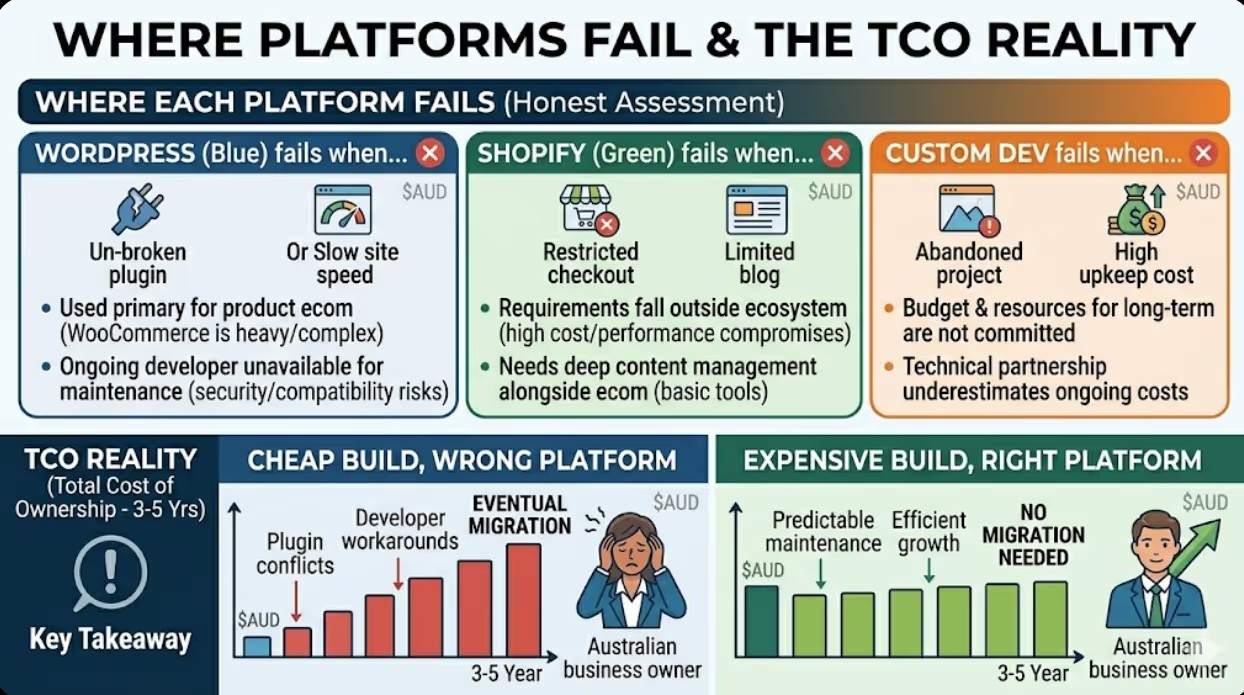
The Honest Assessment: Where Each Platform Fails
A platform recommendation that does not acknowledge the genuine limitations of each option is a sales pitch rather than an assessment.
WordPress fails when: it is used as an ecommerce platform for businesses whose primary revenue is product sales. WooCommerce on WordPress can handle ecommerce, but it is a plugin on a CMS rather than a native ecommerce platform, and the performance, scalability, and operational management of a large WooCommerce store require significantly more technical expertise and infrastructure investment than a comparable Shopify store. WordPress also struggles when the development team is unavailable for ongoing maintenance, because the security and compatibility requirements of a WordPress installation hosted on its own infrastructure with multiple plugins create genuine vulnerability and compatibility risks that are not present in a managed platform.
Shopify fails when: the business has ecommerce requirements that fall consistently outside the platform's native capabilities and the Shopify app ecosystem cannot address them without introducing prohibitive costs or unacceptable performance compromises. Shopify also fails when a business needs deep content management capabilities alongside its ecommerce function: the blog and content management tools in Shopify are adequate for basic editorial needs but are not in the same category as WordPress's content management capabilities. For businesses that generate significant revenue through both SEO through content and product sales, the tension between Shopify's ecommerce strengths and its content management limitations is a genuine platform challenge.
Custom development fails when: the budget and technical resources to support it over the long term are not genuinely committed. Sites and applications built from scratch that are handed to clients without a clear ongoing technical support arrangement invariably become maintenance liabilities within 18 to 36 months, as the original build becomes outdated, plugin equivalents accumulate as workarounds, and the team responsible for the original build is no longer available. Custom development is only the right choice when the technical partnership is as committed as the build itself.
FAQs
Can an Australian business migrate from WordPress to Shopify, or vice versa, without significant SEO damage?Platform migration always carries SEO risk, but the risk can be substantially mitigated with careful planning. The most important SEO preservation tasks in any platform migration are maintaining all existing URL structures where possible (or implementing precise 301 redirects from every old URL to the correct new URL where restructuring is unavoidable), preserving all existing meta titles and descriptions, migrating all structured data and schema markup to the new platform's format, and transferring the sitemap to reflect the new URL structure before informing Google of the change through Search Console. A migration conducted without a redirect map covering every indexed page will produce 404 errors that cause ranking losses that can take months to fully recover. Australian businesses planning a platform migration should treat URL mapping and redirect implementation as the technical task with the highest priority in the migration process.
Is it possible to start with WordPress or Shopify and migrate to a custom platform later, without rebuilding from scratch?Partial migration is possible in some cases and complete migration is always possible, but neither is inexpensive. The elements that can typically be migrated with reasonable effort include the product catalogue data, customer records, and order history, which can be exported and imported in standard formats. The elements that typically require rebuilding are the design and visual front end, the custom functionality, and the integrations, because these are implemented differently on each platform and do not have a portable format. The practical reality for most Australian businesses is that migrating from a managed platform to a custom build means retaining only the data and rebuilding the implementation. This is a significant project even for a site that was not complex in its managed platform form, and it is another reason why getting the platform decision right initially is more commercially efficient than planning to migrate later.
How should Australian businesses evaluate Shopify pricing, including apps, against the true total cost of a WordPress build?The Shopify subscription fee is the visible cost, but the full cost of a Shopify store includes the app subscriptions for any functionality not included in the core platform, the cost of any custom theme development, and the transaction fees on the subscription plan if not using Shopify Payments. A Shopify store with a moderate app stack of six to eight apps commonly costs $200 to $400 per month in platform and app fees alone, plus any custom development costs. The full cost of a WordPress site includes hosting (typically $50 to $200 per month for a managed WordPress hosting that is well configured environment), plugin licences for premium plugins, and the ongoing developer cost for maintenance and updates. Both options have genuine ongoing costs, and the comparison between them should be conducted over a three to five year horizon that includes realistic estimates of the ongoing maintenance and development costs for each, not only the initial build and subscription costs.
The Right Platform Is the One the Business Can Actually Operate
Platform capability on paper means nothing if the platform cannot be operated confidently by the team that will manage it, or if its ongoing costs undermine the commercial rationale of the project. The framework in this article produces the correct platform recommendation for most Australian businesses because it starts with the business requirements rather than with the platform features, and it forces an honest assessment of the ongoing operational and cost implications of each option alongside the initial capability comparison.
Maven Marketing Co recommends, designs, and builds on all three platform types for Australian clients, including WordPress, Shopify, and bespoke custom development, and makes platform recommendations based on the framework in this article rather than on a preferred specialisation.
Talk to the team at Maven Marketing Co →

Table of contents
read more blogs
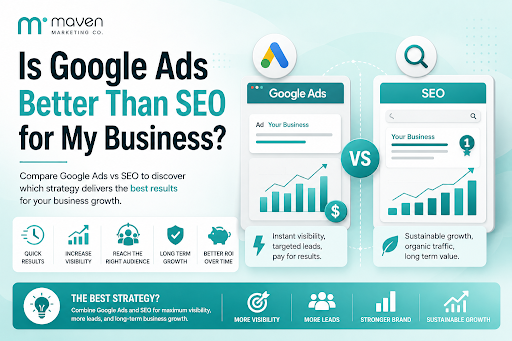
Is Google Ads Better Than SEO for My Business
One of the biggest questions business owners ask when they are planning online growth is whether they should invest in Google Ads or SEO. Both are strong marketing plays that help your company show up in Google search results, but they do things in separate lanes. Google Ads gives quicker visibility and can bring in leads fast, whereas SEO more or less focuses on slow, steady organic traffic that tends to grow the longer you keep building it. Picking the right direction depends on what you want to achieve, how much money you can spend, how crowded the market is, and how quickly you need results, like sooner rather than later. The good news is you don’t always have to choose one or the other; it’s not exactly a black-and-white situation. If you take time to understand the strongest points of both, you can put together a more sensible digital marketing plan that supports consistent expansion. In this guide, we’ll compare Google Ads vs SEO, explain the main differences, and help you figure out what option makes the most sense for your business.

When Should I Hire a Digital Marketing Agency
Growing a business today takes more than just having a website or throwing a post on social media; customers usually search around online, compare providers, skim reviews, and basically expect the brand to show up with a solid digital presence before they even think about buying. Many businesses try to run their marketing themselves, but there comes a point when “doing it all in-house” becomes clunky and hard to manage, all at once. Knowing when to hire a digital marketing agency can end up making a big, real difference for your growth. If you’re not getting enough leads, or your online visibility feels stuck, or sales are just not moving, the right agency can bring the know-how, plus a clear plan, to help you get noticeably better outcomes. In this guide, we’ll dig into what a digital marketing agency actually does, the usual signs it’s time to bring one on, and how picking the right marketing partner can help your business move forward at a faster pace.
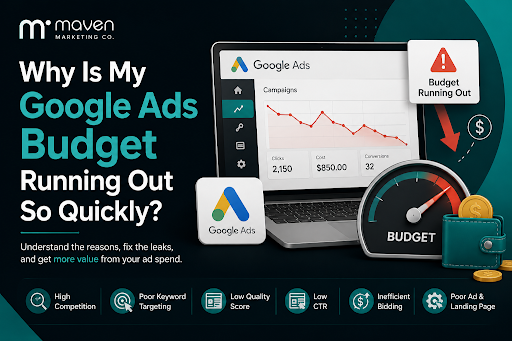
Why Is My Google Ads Budget Running Out So Quickly
Running a successful Google Ads budget isn’t only about throwing more money at it. It’s more like making every dollar, doing a bit extra. A lot of businesses start a Google Ads campaign with big hopes, then find out their daily budget is gone within a few hours, and that feels weird, right? After that, your ads stop showing effectively, new leads slip away, and your return on investment dips. So if your Google Ads budget is running out too fast, don’t stress. It’s a fairly common issue, and in most situations, it can be repaired with the right approach. There are multiple little things that can drain your advertising money quicker than you expected, from costly keywords to audience targeting that just doesn’t quite fit. In this guide, we’ll walk through why your budget disappears so quickly, how to cut wasteful spend, and the most reliable ways to boost your Google Ads ROI, even if your budget stays the same.