.svg)


%201.svg)

What is artificial intelligence and how does it actually work?
Artificial intelligence is technology that enables computers to perform tasks requiring human-like intelligence:
Core definition: AI refers to computer systems capable of learning, reasoning, problem solving, and making decisions without being explicitly programmed for every scenario. Rather than following rigid rules, AI systems learn from experience and improve over time.
How it learns: AI systems analyze vast amounts of data to identify patterns and relationships. Think of it as teaching a computer by showing millions of examples instead of writing millions of rules. The system recognizes what makes a cat a cat by examining thousands of cat images rather than being programmed with specific cat characteristics.
Machine learning foundation: Most modern AI relies on machine learning, where algorithms train on labeled data sets to classify information or predict outcomes. The system learns the mapping between inputs and outputs, then applies that learning to new, unseen data.
Neural networks: The most powerful AI systems use neural networks modeled after the human brain's structure. Interconnected layers of nodes process complex data, with each layer extracting increasingly sophisticated patterns. This enables AI to handle tasks like language understanding and image recognition that previously only humans could do.
Types of AI: Current AI is "narrow" or "weak," excelling at specific tasks but lacking general intelligence. Siri recognizes speech, Netflix recommends shows, and Tesla cars navigate autonomously, but each system performs only its designated function. Artificial general intelligence matching human versatility across all domains remains theoretical.
Continuous improvement: AI systems get better through exposure to more data and feedback loops. When you correct Alexa's misunderstanding or Netflix tracks what you actually watch versus what they recommended, that data improves future performance.
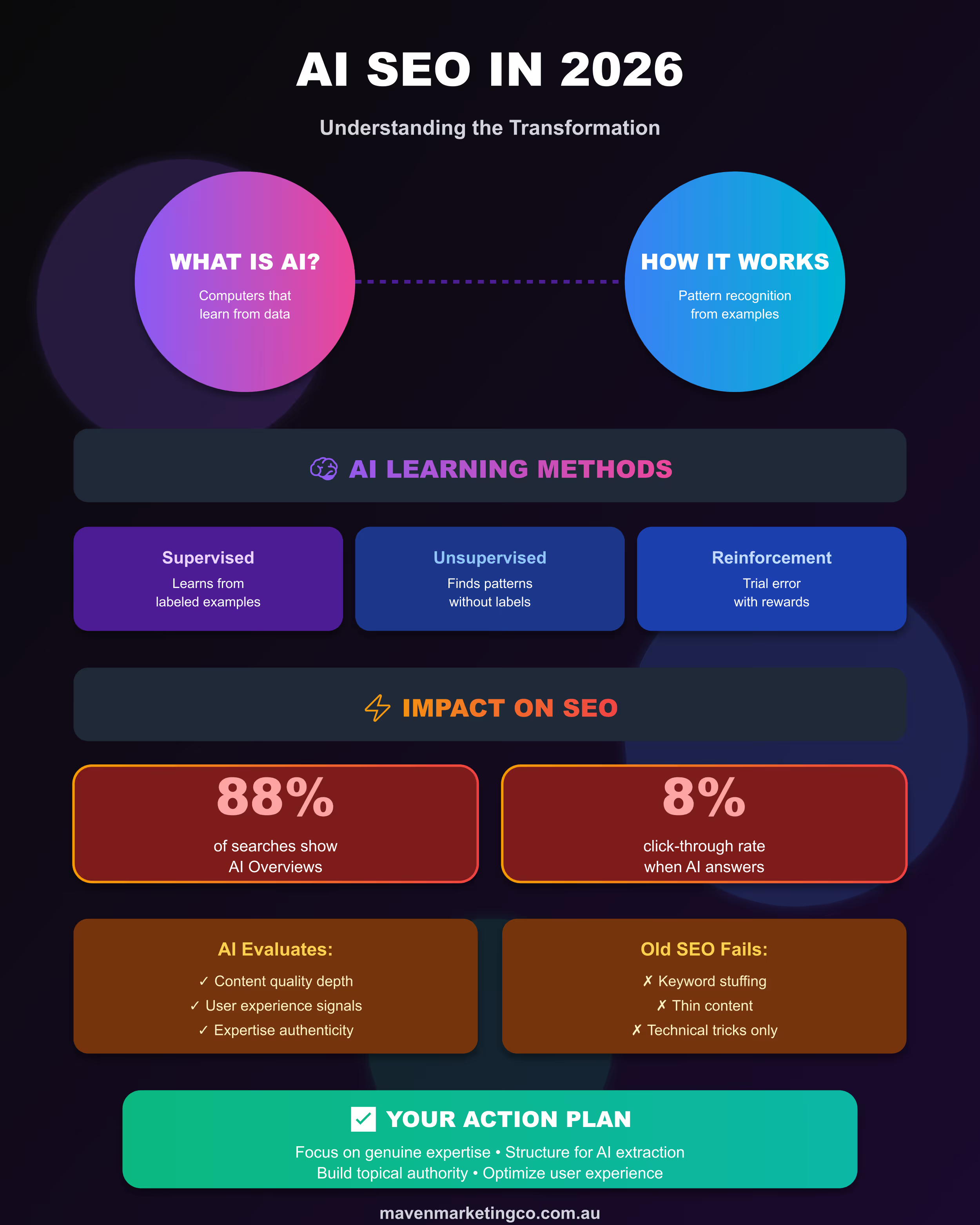
How is AI transforming SEO and what should businesses do differently?
AI changes SEO across multiple dimensions requiring strategic adaptation:
Search understanding evolution: Google's AI can now grasp search intent, context, and meaning far beyond keyword matching. The algorithm understands synonyms, related concepts, and what users actually want even when queries are vague or conversational. This means keyword stuffing fails while comprehensive topic coverage succeeds.
AI Overviews dominance: AI generated answer boxes now appear in 88 percent of informational queries, providing synthesized responses above traditional organic results. Only 8 percent of users click through when AI Overviews appear, fundamentally changing traffic dynamics. Content must be structured for citation within AI answers, not just ranking in blue links.
Content quality signals: AI better detects thin content, keyword manipulation, and low quality material that previously might rank through technical optimization alone. Google's helpful content update specifically targets AI generated spam, rewarding content demonstrating Experience, Expertise, Authoritativeness, and Trustworthiness through original insights and first hand knowledge.
User experience metrics: AI analyzes engagement patterns including time on page, bounce rates, and navigation paths to evaluate content quality. Sites delivering poor user experiences get deprioritized regardless of keyword optimization because AI recognizes when users aren't finding what they need.
Semantic search supremacy: Modern SEO requires optimizing for topics and concepts rather than individual keywords. AI understands content context, so comprehensively covering related subtopics and answering associated questions signals expertise that isolated keyword targeting cannot match.
Practical adaptations: Focus on creating genuinely helpful content for humans rather than gaming algorithms, structure information in Q&A formats that AI can easily extract and cite, demonstrate expertise through original data and first hand experience, prioritize exceptional user experience across all devices, and build topical authority through comprehensive coverage rather than scattered keyword targeting.

If you've felt confused by all the AI terminology flying around lately, you're not alone. Artificial intelligence, machine learning, neural networks, deep learning. The terms blur together, making it hard to understand what's actually happening beneath the hood and why it matters for your business.
Here's the reality: AI isn't some distant future technology anymore. It's fundamentally reshaping how people find information online right now, which means it's directly affecting your organic visibility whether you understand it or not.
Let's break down what AI actually is, how these systems work in plain language, and most importantly, what this means for your SEO strategy.
Understanding AI: The Basics
Artificial intelligence is technology that enables computers to simulate human learning, comprehension, problem solving, and decision making. Rather than following explicitly programmed instructions for every possible scenario, AI systems learn from experience and improve their performance over time.
Think about how humans learn. You don't memorize rules for every situation. Instead, you see examples, recognize patterns, and develop intuition about how things work. AI attempts to replicate this process digitally.
The simplest way to understand AI is through a practical example. Traditional programming says "if the email contains words X, Y, and Z, mark it as spam." This rigid rule misses spam that uses different words and flags legitimate emails that happen to contain those terms.
AI approaches the problem differently. Show the system ten thousand examples of spam and ten thousand examples of legitimate email. The AI analyzes what patterns distinguish spam from ham, learning features that humans might not even consciously notice. Word combinations, sender patterns, timing, formatting quirks. The system builds a model of what spam looks like, then applies that model to new emails it hasn't seen before.
This is machine learning, the foundation underlying most AI applications today. The computer isn't programmed with spam rules. It's trained with examples, then makes predictions about new cases based on what it learned.
How Machine Learning Actually Works
Machine learning sounds complex, but the core concept is straightforward. You start with a large dataset of examples where you know the correct answer. This is called labeled data. For image recognition, that might be thousands of photos labeled as "cat" or "dog." For sentiment analysis, it's thousands of product reviews labeled as positive or negative.
The machine learning algorithm examines these examples, looking for patterns that correlate with the labels. What features distinguish cats from dogs? What language patterns indicate positive versus negative sentiment? The algorithm adjusts its internal parameters through a process called training, getting progressively better at matching inputs to correct outputs.
Once trained, you test the model on new data it hasn't seen before. If it correctly identifies cats in new photos or accurately judges sentiment in new reviews, the model has successfully learned. If performance is poor, you might need more training data, different features, or a more sophisticated algorithm.
This is supervised learning, where humans provide the labels telling the system what's correct. There's also unsupervised learning, where algorithms find patterns in unlabeled data without being told what to look for. And reinforcement learning, where systems learn through trial and error, receiving rewards for good actions and penalties for bad ones.
Neural Networks: The Power Behind Modern AI

The most powerful machine learning systems use neural networks, named for their loose resemblance to how neurons work in the human brain. While the biological inspiration is real, modern neural networks are mathematical constructs rather than faithful brain replicas.
A neural network consists of layers of interconnected nodes. The input layer receives raw data like pixel values from an image. Hidden layers in between extract increasingly sophisticated features. The output layer produces predictions or classifications based on what the network learned.
Here's where it gets interesting. When you show a neural network pictures of cats, the early layers might learn to detect edges and shapes. Middle layers combine those into features like ears, whiskers, and eyes. Deeper layers recognize "catness" as a combination of those features arranged in particular ways.
This hierarchical learning is why neural networks excel at complex pattern recognition. They don't just look for simple rules but build sophisticated internal representations of what they're trying to recognize or predict.
Deep learning refers to neural networks with many hidden layers, sometimes dozens or hundreds. These deep architectures can learn extraordinarily complex patterns, which is why they've enabled breakthroughs in image recognition, natural language processing, and game playing that seemed impossible just years ago.
AI in Search Engines
So what does all this mean for search? Google uses AI extensively throughout its search process, from understanding queries to evaluating content quality to ranking results.
When you type a search query, AI interprets what you actually want even if your phrasing is ambiguous. Traditional search matched keywords. AI search understands meaning, context, and intent. Search for "what should I plant in my shady garden in Melbourne?" and Google's AI recognizes you want plant recommendations specific to shade conditions in Melbourne's climate, even though you didn't include keywords like "recommendations" or "climate appropriate."
The ranking algorithm uses AI to evaluate content quality in ways that would be impossible through manual programming. How comprehensively does this page cover the topic? Does it demonstrate genuine expertise or just surface-level knowledge? Will users find this helpful or quickly bounce back to search results? AI models trained on vast amounts of data and user behavior patterns make these judgments at scale.
Google's helpful content update specifically uses AI to identify content created primarily to rank in search rather than serve users. The system recognizes patterns in how that type of content is structured, how users interact with it, and how it differs from genuinely useful resources.
The AI Overviews Revolution
Perhaps the most visible AI impact on search is AI Overviews, Google's feature providing AI generated summaries and answers directly in search results. When you ask a question, the AI synthesizes information from multiple sources into a coherent response, sometimes with citations to original sources.
From a user perspective, this is incredibly convenient. Immediate answers without clicking through multiple sites. From a business perspective, it's disruptive. If Google answers the question in the search results page, users have less reason to click through to your site. Traffic decreases even when your content was used as a source.
The data bears this out. When AI Overviews appear in search results, only 8 percent of users click through to traditional organic listings, compared to 20 to 30 percent for standard results. That's a dramatic erosion of organic traffic potential for informational queries.
This changes what success means in SEO. Getting cited inside an AI Overview becomes more valuable than ranking position five in organic results. Content needs to be structured so AI can easily extract and reference it, which requires different formatting than what optimized for traditional search.
Content Quality Through AI Eyes
AI fundamentally changes how search engines evaluate content quality. Traditional algorithms looked at signals like keyword usage, backlinks, and technical optimization. AI can make far more sophisticated quality judgments.
Does this content demonstrate first hand experience with the topic, or is it generic information anyone could write? AI looks for specific details, personal anecdotes, and original insights that signal genuine expertise versus surface research.
Does the content comprehensively address the topic, or does it skim the surface? AI evaluates depth by looking at related concepts covered, questions answered, and whether the content goes beyond what's already widely available elsewhere.
Is the content updated and accurate? AI can detect when information is outdated or contradicts more recent authoritative sources. This makes maintaining content more important than ever.
Does the content serve users or search engines? AI recognizes patterns in how content is written and structured. Keyword stuffed content optimized purely for rankings looks different from content genuinely trying to help readers. AI rewards the latter while penalizing the former.
The practical implication is that technical SEO tricks provide diminishing returns. You cannot game your way to rankings with mediocre content anymore. The AI can see through it. Quality at a human level is what matters.
User Experience as Ranking Signal
AI enables search engines to use engagement metrics as quality signals in ways that weren't possible before. When users search, click a result, quickly hit back, and try a different result, that signals the first page didn't satisfy the query. When users land on a page and spend substantial time reading, that suggests valuable content.
Traditional analytics could track these patterns but struggled to use them at scale without false positives. AI handles the complexity better, recognizing genuine quality signals amid noise.
This makes user experience a direct ranking factor. Page speed matters not just for technical SEO but because slow pages create poor experiences that AI detects through bounce rates and engagement patterns. Mobile usability matters because a substantial portion of searches happen on phones, and terrible mobile experiences show up in how users interact with your content.
Content structure affects both human and AI evaluation. Walls of dense text without headings or breaks are harder for humans to scan and for AI to parse. Well structured content with clear headings, logical flow, and scannable formatting serves both audiences better.

What This Means for Australian Businesses
For Australian businesses, these AI changes create both challenges and opportunities. The challenge is that easier answers in AI Overviews reduce informational search traffic, particularly for simple queries with straightforward answers. If your content monetizes through display ads or affiliate links on informational content, the model is under pressure.
The opportunity is that businesses demonstrating genuine local expertise through detailed, authoritative content can earn citations in AI Overviews, building credibility and brand awareness even without the click. When someone in Sydney searches for small business tax advice and Google's AI cites your content as a source, that's valuable visibility.
The smaller Australian market means somewhat less competition for citations and rankings compared to global markets. This creates space for businesses that adapt quickly to establish authority before competitors catch up.
Australian specific content becomes more valuable because AI recognizes local relevance. Content addressing Australian regulations, market conditions, and examples resonates better with Australian queries than generic international content. This gives local businesses advantage in serving local markets.
Adapting Your SEO Strategy
So what should you actually do differently? Several strategic shifts matter in the AI era.
First, obsess over content quality in human terms. Write for people, not algorithms. If your content wouldn't interest readers who landed on it directly, it won't work for AI search either. The AI evaluates content similarly to how engaged humans would.
Second, demonstrate genuine expertise through original insights, data, and experience. Don't just synthesize information available elsewhere. Add value through your unique perspective, first hand knowledge, and specialized understanding.
Third, structure content for AI extraction. Use clear question headings that match how people actually search. Provide direct answers early, then expand with detail. This format works for both AI citations and human readers.
Fourth, build topical authority through comprehensive coverage. Rather than scattered blog posts on random topics, become known for deep expertise in specific areas. Publish multiple related pieces that together demonstrate mastery of the topic cluster.
Fifth, optimize for user experience religiously. Fast load times, mobile optimization, clear navigation, scannable formatting. These affect both human satisfaction and AI evaluation of your content quality.
Sixth, stop chasing quick SEO wins through technical tricks. The AI is getting too sophisticated. Sustainable organic visibility comes from genuinely serving users better than competitors.
Looking Forward
AI will continue evolving rapidly, making predictions difficult beyond broad directional trends. Search will likely become more conversational, with users asking complete questions instead of typing keywords. Content that naturally addresses questions will perform better.
AI personalization will increase, with search results tailored to individual users based on their history, location, and context. This makes optimizing for a single "best" result less meaningful. You need to be relevant for multiple user contexts.
AI generated content will become more common, but quality standards will rise simultaneously. Search engines will get better at identifying AI spam while users will demand higher quality than what automation easily produces. The sweet spot may be AI assisted content with substantial human oversight and expertise.
The fundamental SEO principle remains unchanged: create genuinely valuable content that serves your audience better than alternatives. AI changes how search engines evaluate that value and how content gets discovered, but the core principle endures.
Ready to Adapt Your SEO for the AI Era?
At Maven Marketing Co, we help Australian businesses develop SEO strategies that work in AI powered search environments. Our team understands how AI systems evaluate content quality, what makes content citation worthy in AI Overviews, and how to balance traditional SEO with new AI realities.
Whether you need help auditing your current content through an AI lens, restructuring for better AI extraction, or building topical authority that withstands algorithmic evolution, we're here to navigate this transition with you.
Let's future-proof your SEO strategy

Table of contents
read more blogs
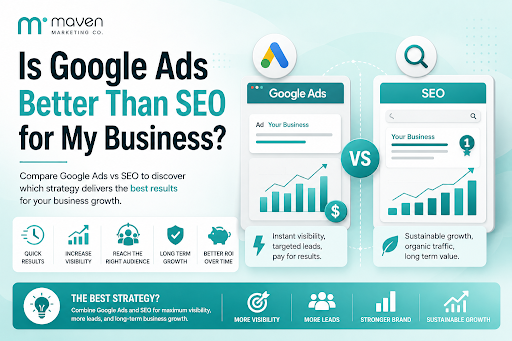
Is Google Ads Better Than SEO for My Business
One of the biggest questions business owners ask when they are planning online growth is whether they should invest in Google Ads or SEO. Both are strong marketing plays that help your company show up in Google search results, but they do things in separate lanes. Google Ads gives quicker visibility and can bring in leads fast, whereas SEO more or less focuses on slow, steady organic traffic that tends to grow the longer you keep building it. Picking the right direction depends on what you want to achieve, how much money you can spend, how crowded the market is, and how quickly you need results, like sooner rather than later. The good news is you don’t always have to choose one or the other; it’s not exactly a black-and-white situation. If you take time to understand the strongest points of both, you can put together a more sensible digital marketing plan that supports consistent expansion. In this guide, we’ll compare Google Ads vs SEO, explain the main differences, and help you figure out what option makes the most sense for your business.

When Should I Hire a Digital Marketing Agency
Growing a business today takes more than just having a website or throwing a post on social media; customers usually search around online, compare providers, skim reviews, and basically expect the brand to show up with a solid digital presence before they even think about buying. Many businesses try to run their marketing themselves, but there comes a point when “doing it all in-house” becomes clunky and hard to manage, all at once. Knowing when to hire a digital marketing agency can end up making a big, real difference for your growth. If you’re not getting enough leads, or your online visibility feels stuck, or sales are just not moving, the right agency can bring the know-how, plus a clear plan, to help you get noticeably better outcomes. In this guide, we’ll dig into what a digital marketing agency actually does, the usual signs it’s time to bring one on, and how picking the right marketing partner can help your business move forward at a faster pace.
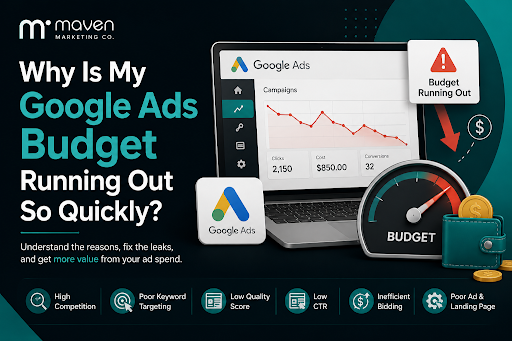
Why Is My Google Ads Budget Running Out So Quickly
Running a successful Google Ads budget isn’t only about throwing more money at it. It’s more like making every dollar, doing a bit extra. A lot of businesses start a Google Ads campaign with big hopes, then find out their daily budget is gone within a few hours, and that feels weird, right? After that, your ads stop showing effectively, new leads slip away, and your return on investment dips. So if your Google Ads budget is running out too fast, don’t stress. It’s a fairly common issue, and in most situations, it can be repaired with the right approach. There are multiple little things that can drain your advertising money quicker than you expected, from costly keywords to audience targeting that just doesn’t quite fit. In this guide, we’ll walk through why your budget disappears so quickly, how to cut wasteful spend, and the most reliable ways to boost your Google Ads ROI, even if your budget stays the same.